
I have a verse for Mr. Pat Robertson…

Wise words from Romans 14:22
“So whatever you believe about these things
keep between yourself and God.”
Why don’t we ever hear more sermons on such a great idea? Why don’t I preach on it more? There’s a truth loose in the world and it goes something like this… “You don’t need to hear my views on everything, or vice versa.” Please, Mr. Robertson, enough.
Paul has struggled through a very sticky situation in his Roman letter. It’s a moral, ethical and spiritual question with huge impact on the civil, secular, communal and daily lives of believers. Should a believer eat food that is consecrated to another god? And if so, or if not, to what lengths do they go to discover if it has been consecrated or not? The whole thing has very little meaning to many Christians today, but we do have our own big questions, moral questions, ethical questions, questions that impact our daily lives. And we spend a lot of time expressing opinions, many of which are hurtful and uncharitable.
Paul’s solution? In part, silence. Respectful. Silence. Quiet time with God.
I don’t question Mr. Robertson’s right to hold views on the causality of earthquakes or the relationship between what we call natural disasters and the impact of spiritual powers in the world. I just wish he’d keep most them to himself. Instead, he heaps blame and shame on an already suffering, impoverished and destitute population. Not what I define as a “Charitable Act.”
I could go on, but that’s pretty much it.
Lord God, in your mercy,
hear our prayers and pour out your peace,
hope and blessing on the people of Haiti.
Amen.
Some thoughts on Emergent Church…

I’m planning to come back to some more thoughts on preaching, but since my brain tends to bump and jive between multiple threads (not necessarily a good thing), I’m going to share some thoughts on the whole “emergent” church stuff first, or “emerging,” or “emergence,” whatever.
Honestly, too, I’ve lately not only had some questions put to me about it, but I’ve also read a few things that I only marginally thought had merit. Also, I’m surrounded by a church family, many of whom are new to the vocabulary of emergent and find themselves where most of us find ourselves, when painfully honest… that’s an exercise of defining emergent for myself, because we each have had a varied introduction to, experience of, and history with emergent church friendship/conversation/aspiration.
Here’s a couple of things you should know about me, in case you’ve never heard me say them out loud: 1) I self-identify as a pastor of an emergent church, 2) most of the folks in my church family are versed or becoming versed with things “emergent,” and 3) I in no way consider “emergent” to be a denomination, affiliation or even much of a genuine modifier past my own set of thoughts and definitions.
I was at a little conference hosted by our Disciples of Christ sisters and brothers in DC back in 2007 and heard Tony Jones try to share a metaphor with folks about why emergent is not a denomination, or even a reformation movement, but simply a survival move that has resonated with a lot of people. He said that he and his friends who kick started what we now call “emergent church” simply jumped ship from their Christian traditions into spiritual life-rafts in an effort to save their own faith. But amazingly, as they paddled away in their life-rafts they heard the splashing and calls of all the folks jumping ship after them and hoping to also salvage their own faiths.
That resonates with me. I was at a place where my own faith had become sullen, caged and dry. Because my church tradition was wrong? No. Because my church tradition was stupid or bad? Nope. My faith was in jeopardy because my church tradition simply didn’t have the built in receptors for a person like me. (I mean “receptors” like when certain proteins or viruses are made to connect and join together.) There were no places of safety for me to ask my questions. There was no value placed on diversity of thought or expression. So, as an individual human and as a follower of Christ, as I began trying to unpack certain parts of my life and faith, I found mostly only confusion and hostility.
Was it because I’m a “post-modern?” I suppose partly. Was it because I’m a “rebel?” At one point, yes. Today? Not so much. Could I have stayed in my tradition and made a place for folks on a spiritual journey like mine? I could not have stayed. Some of my friends who are kindred spirits have stayed, and I respect that. For me, survival meant moving on.
So, back in about 2003 I read a little book by Eddie Gibbs called ChurchNext about why we needed missionaries in America again, folks who are tooled to re-deliver the gospel in new terms and models. As a trained cross-cultural missionary, this woke me up and put words to many of the thoughts and questions with which I had previously wrestled. It also laid the ground work for me to pick up my first Brian McLaren book, More Ready Than You Realize. Brian started filling in some the terms and frameworks that I needed to find my new way of faithing. That help ultimately culminated in his Generous Orthodoxy.
More authors followed: Darrell Guder, Doug Pagitt, GK Chesterton, Richard Pascale and more. Ultimately, I found ways to express my yearnings and fill in some of the blanks… and that is the foundation for our church family in Bethesda right now… and so we are arriving at a few of my thoughts on what emergent church means to me…
Emergent gives faith a fighting chance against certainty.
That’s right, I don’t think faith is simply holding a certain set of theological definitions or affirming certain doctrinal statements. Faith is something other than certainty. I can’t believe that with all the scriptural witness to what faith is, we have so often made it an answer instead of a question. Faith is hope. Faith is yearning. Faith is trust. Faith is appetite. Faith needs to move and live and breathe. We try to make faith into the acceptance of a method and form like the four spiritual laws (easily distilled to a tract, pamphlet or sermon). We try to make the scriptures answer all our questions so that we can construct a base of certainty. We try to make a hermeneutic that can help us navigate and subdue the Holy Scriptures of our “faith” and leave no questions in doubt. Can we have faith without doubt? Really? With certainty in place, we’ve no need of faith.
Well, I found my certainty system to be severely lacking. I’ve probably investigated and found yours to be lacking, too. What I love to read about these days is your faith. I want to know how you hear God and touch the divine. Without the certainty crutch you can become frighteningly mystical, and that is necessarily a good thing. I want to hear your doubts, and how you grapple with a God who is wrapped in the deepest mystery and yet also is claimed to have walked in human flesh. That’s a God worth my time. That’s a God who defies my pamphlets and snorts when I talk about my awesome theologies. That’s a God who calls all people, for that’s a God able to wrap around all kinds of people, I hope, I trust, I faith.
Emergent gives diversity a fighting chance against conformity.
So, did I run into trouble in church because I’m a “postmodern?” Yes, I have to admit that I did. My value system just can’t support a communal structure that enforces conformity. I also can’t abide in myself an inauthentic acquiescence that screams hypocrisy from the depths of my soul. Sweet grief, I can’t even abide the idea that you’d agree with everything I’m writing and be thinking just like me! What kind of screwed up world would we have if we all thought alike? Diversity is the core of imagination. Diversity is the foundation of innovation. Diversity is flavor and color. Diversity is needed for mental, intellectual, emotional and spiritual health. When a faith system or church tradition loses diversity or moves to quell diversity, it becomes inert, that is without internal and vital motion. The same is true, I believe, for a single human soul.
Members of our church family in Bethesda claim many church traditions and often still self-identify with those traditions. And that’s awesome! We’re not post-denominational, we’re pan-denominational, or I usually say “multi-denominational.” So, my messages on Sunday mornings often have more to do with what someone might go make of my sermon ideas than what they’re supposed to agree with me about. Ergo… sermonizing as “Here’s an idea/image in scripture that I think we need to fashion a response to; Now what might that response be in your life, or our life as a worshipping community?” Diversity is fertile soil for growth.
Emergent gives a relational, gracious community a fighting chance against earned acceptance.
Let’s face the facts. If I am to be me, I’m not really welcome in very many congregations. One of the hardest things for me in my earlier years of ministry was the recurring fights and arguments with church leadership. Often, I would have taken so much time to tailor my words and finesse my communication to be non-threatening, but still end up with horrible things being said to me. I would think I had come up with the most innocuous way to say something, and then BOOM, I’d blow someone’s world apart and off we’d go down the rabbit’s hole. It took a few years, but I finally figured out that it was me, ME, who I was and how I thought was the problem. And I couldn’t just stop being me. I have tried that, by the way, and seen others choose that path, and it leads to spiritual death.
We have to relearn how to practice a very authentic and whole-hearted welcome. We have to relearn how to love each other whether we agree on some things or not. People, including ourselves, must be able to walk into the life of a faith community with a full, intact and immediate worth and dignity. If we withhold that on any basis of merit, we have sinned, and sinned mightily.
We’ve spent to much time deciding and communicating who wasn’t welcome. We’ve spent too much time “protecting” the church to let it be porous enough to admit some of the most needful folks in our society and some of the folks we’ve most needed among us. In our rush to certainty we’ve forgotten to trust God. In our unreasonable fear of God and of messing up that solid base of certainty, we’ve not allowed ourselves to love as God loves or risk ourselves as God so amazingly risked personhood in the life and death of Jesus who was the Christ. Walled-in communities and souls risk a death of stale inertness.
I never thought I would say this and really mean it, but I would so attend worship with my church family, even if I weren’t their pastor! I love those folks! Man, some of them are screwed up, almost as bad as I am! Some hold political opinions or theological ideas that scare me, really. Some can’t sing on key and some truly share nothing in common with me. I love them all! They love each other. It sounds stupid and fake, but we have to love each other. You don’t come to us to have your belief/certainty system validated! Truth is, it’s our love for one another and for God that allows transformation among us. It’s the tension of our diversity that fires the kinetic joy, peace and imagination among us. We practice an authentic welcome because we each depend on it and need it so much.
Wow. This is a long post. And it only has three thoughts in it so far. But I have to lay just one more out here, before I chicken out totally…
Emergent gives dynamic, “becoming” faith a chance against a completed, static system.
I was once asked if I didn’t think the scriptures provided a complete “Christian Worldview.” My answer then, as it is now, was no. What I felt I was really being asked was if I couldn’t see that the Bible gives us a single answer to every moral and ethical, methodological and theological question which confronts humanity in each epoch, place, generation and situation. My answer reflected my belief that we are not ultimately called to parrot doctrinal and moralized statements generation after generation, but called to be thinking, processing, growing agents of eternal life. If calling faith “appetite” didn’t make you grimace then the implications for church of that last little ditty should have. My humble opinion is that our loss of becoming, our loss of identity as contemporary agents of eternal life, is why so many church buildings stand empty today and why so many congregations devour books on how to keep a dying congregation alive. We’ve traded off an amazing invitation to become something for the consolation prize of belonging to something.
If we aren’t allowed to “become” church just like the lucky folks living in 70A.D. or 325A.D. or 1500A.D., then we become the simplest minded, however clever, copy-cats the cosmos has ever created, and most of the unbelieving world’s criticisms of us become well-earned. For some of you, I just stopped being a “Bible Believing Christian” because I thoroughly undermined the authority of scripture. All I can say is this: I love, cherish and cling to our scriptures. They guide me, admonish me and uphold me. I love our scriptures and the community of souls whose story they share and invite us to be a part of… but I don’t worship the scriptures or follow them in place of a living God. Fact is, it’s in the scriptures that I see the call to become.
Now, if we are allowed to become, then it’s an imperative that we hold to faith and love, without which we fracture in our diversity and lose touch with one another in a hurry. BEWARE: What I become may not be what you need to become! The scariest things for me to hear is someone saying, “We’re the only true emergent blah, blah…” or something like that. Go catch the wind and put it in your pocket, my friend. “Emergent” is not what we are becoming. “Emergent” is not just a new way of conforming and belonging. What I am becoming, what you are becoming, that’s all God’s business. And the day that “emergent” stops facilitating that becoming, I’m moving on, I promise.
Emergent stuff is a dangerous game we play, as dangerous and threatening as any relationship we’ve ever pursued with another person, but the rewards! The joy of the kind of community and running with God that this emergent conversation, friendship, and aspiration has afforded me! It’s been well worth every momoment.
Some Thoughts on Preaching, Part One
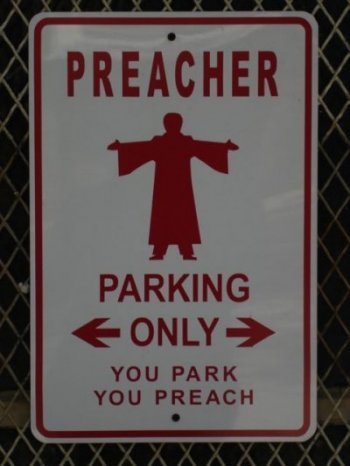
Several conversations this past year have had me thinking about writing something about the practice of preaching. I’ve sat with several folks from my church family and responded to questions about my preaching style and habits, and I suppose that what I want to do here is share some of that with you. This is part one of that effort.
Why share thus stuff?
Am I tooting my own horn or flexing my pretentious muscles? I really hope not. But, I think it’s important to talk about things from individual perspectives and experiences. When we do that we find out that we’re not nearly as unique or alone as we tend to think. So, I guess I’m trolling for kindred spirits as I do this, friends trying to make a similar path. I wasn’t trained to preach as I do, so it’s been an odd journey for me to do different things and attempt new methods. Sometimes it has soared with eagles and other times hidden in the mud with worms, but I find that experience far more authentic and life-like than the many idealized preachers of my youth who became more and more distanced from us and God because of a rigid preaching practice until they fell into the worst sins against which they weekly railed. As is probably the case for most church leaders, I am deeply concerned with the lives and souls of the people who look to me for leadership, but I’m also hoping to live the life eternal now and always for myself.
Here are a few things I don’t tend to do…
I don’t ever read a prepared sermon.
If you are trained to do this, and you enjoy it, and you minister with a church family that appreciates it, don’t change a thing! I found that I could not engage my listeners when I engaged the paper. My experience has been that younger generations, unless trained otherwise by seminary or church experience, tend not to respond positively to the sermons being read to them. I think it has to do with the way the younger gens interpret and recognize a couple of crucial things: authenticity and relationship.
Did I just say that written sermons aren’t sincere and authentic? Nope. I said that I’ve found the younger gens, and many from the older ones, are finding a prepared and read sermon to feel less engaging, and therefore not seeming authentic to the life of the speaker. That’s my experience when trying to encode messages for my listeners… and it resonates with me as well.
The idea of relationship is probably even more important and really impacts the idea of a speaker’s authenticity. Younger gens are way more relational these days, and they often hear you or don’t hear you based on their relationship or perceived relationship to you. I believe that to be a fairly true generalization. Many younger folks just aren’t looking for the “power” image in preachers, but instead want someone who can relate to and connect with them at empathetic levels.
Of course the kingdom still has plenty of room it seems for the styled hair, capped teeth and prosperity models who build some of our mega-churches. Cool. That’s no skin of my bald head, not so pristine teeth and jeans. I don’t go into Sunday mornings looking like a slob, nor a poster child, but just me. I’ve found the effort worth the dividends of trust and grace that my church family folks are willing to extend to me.
I don’t like to draw a closed circuit of conclusions.
I don’t think that what I have to say should ever be the final word on something, or that my conclusions are the necessary conclusions for each of my listeners. What? But aren’t preachers paid to think for us, study for us and tell us what the coolest theological trends might be for the day? Aren’t we actually saved by our rightness regardless of our lip service to grace and faith?
I don’t try to complete some of the ideas I’m preaching because I intend for them to be germinal in my listeners. My applications tend to be exploratory. I genuinely invite folks to chew on what I’m saying and give me alternative conclusions or ideas. I’ve been broadened many times by my church folks coming to me with alternatives and additions to what I’m talking about, and I often include those points or reference their thoughts on a following Sunday. The classical form of a sermon that has an introduction, three points and a conclusion is more of “take it or leave it” situation than one in which a person in invited to grow and take their time. Simply put, I don’t expect my listeners to accept everything I say in a message at face value or in the moment of hearing my words… I’ve had a while to play with my ideas and conclusions, digest them and throw them through some tests before any given Sunday morning. It would be un-neighborly not to allow my listeners some time to digest and incorporate the ideas, and improve on them in the effort.
Humility seems to call for a bit of openness and invitation to many of a preacher’s conclusions. After all, I am one person, and God’s Spirit lives in the many persons surrounding me. If I have faith that God’s Spirit is a present, convicting agent in peoples’ lives, then I carry no less of a burden as preacher, but a little different of a burden, one shared with my church folks, not imposed on them.
At the risk of making any comparison between myself and Jesus, which would be a huge mistake for me, I’d ask you to consider how many times Jesus threw some teaching out and then walked off leaving people scratching their heads, frustrated or confused, but also processing and deeply involved in what he had said, though maybe not what he concluded.
I try not to move in a linear fashion through points A to D, 1 to 5, etc.
Mostly, linear communication leads to two great evils: 1) alliteration, and 2) lazy listening. I’m doing my part to kill both practices in the world. Seriously, I can remember in one of my earliest preaching class experiences when the teacher was trying to help us grasp the finer points of outlining our messages and ended up with sub-points A) thru Q) on the board under his second main point. No kidding. It forever altered my perception of the job of a preacher.
Of course, I don’t think that everyone who practices alliteration is evil or dumb, I’m just wore out on the five P’s of this and sixteen J’s of that. Alliteration takes valuable energies that could be much better spent in service to the church and the world. I involuntarily tune out the moment I see sermon notes that have five blank lines all beginning with a capital “U:” because we’re getting the five great U’s of uber discipleship. OK, I don’t just tune out, my mind changes channels and rips off the tuner knob. And, though maybe not all preachers are crass enough to say it out loud, I simply preach the way I want to listen. That’s why not every preacher is right for every listener. I usually say it another way… if I’m not comfortable and enjoying myself, then I bet my listeners aren’t either.
And I think linear messages can lead directly to lazy listening. You know what lazy listening is right? That’s like when someone listens through a whole sermon, shakes hands afterward and compliments the preacher, and immediately moves on with life with nothing better than hopefully a subconscious plant to later haunt them. Lazy listening engenders no questioning of what the speaker just said, it engenders no curiosity or creativity, and it certainly never leads to interrupting the speaker during the message.
I think that classical American preaching set out to do two things, to inform and to convict. So my grandparents were trained to sit and receive information during a sermon and maybe be convicted to do something. These two movements were the meat and bread of persuasion. My grandparents’ generation really believed that they should listen to a sermon because it was good for them to do so, sort of like eating broccoli was supposed to be a good thing.
Later, some preacher with too much time on his/her hands decided to plant a joke in their sermon, and the modern preacher was born… now we’re going to inform, convict and make them like us, too! How liberating and exciting for a tired preacher! Critics of this new paradigm shift invariably call this the “entertainment” model of sermonizing. The more jealous they are of a preacher’s ability to be liked is directly related to their time spent calling it entertainment, even though that preacher is usually still playing the same old game of informing and trying to convict his/her audience. So, my parents were trained to sit and listen, but they really lived for the next humorous story or tear-jerking anicdote. They were willing eat their broccoli, but now demanded some melted cheese on top, because really!
Listen, I’ve done all that! I’ve laid out my points, I’ve brought the Reader’s Digest to bear on important topics, and I’ve tried to bring folks down front during fifteen verses of Just As I Am with tearful pleas between each verse. But these days I’m more interested in getting people engaged than persuaded. I would be just as happy if one of my sermons made someone go be a student of the Bible in an attempt to prove me wrong then because I was so eloquent. I’d love to think that our circular weave through paintings, scripture and life one Sunday morning caused an artist to think about writing a new song or putting brush to canvas. I would often rather one of my sermons leave you with a big question than a big answer. Why? Because I don’t fear God blasting you for something you don’t know more than I hope for you to seek God in a new way, a new question or a renewed period of reflection.
Then again, someone might do what I usually do when listening to a sermon… often I hear a word or phrase early on and disconnect because it’s sent me off on a grand chase down some rabbit hole of scripture or reflection. I’m always grateful to the preacher for kicking off that journey for me, though I probably didn’t hear their message’s conclusion, much less was I persuaded by it. But I did engage. Folks are welcome to do the same during my sermons.
Really… look again at Jeremiah 31:33-34, especially the second part: “This is the covenant I will make with the house of Israel after that time,” declares the LORD. “I will put my law in their minds and write it on their hearts. I will be their God, and they will be my people. No longer will they teach their neighbors, or say to one another, ‘Know the LORD,’ because they will all know me, from the least of them to the greatest,” declares the LORD. “For I will forgive their wickedness and will remember their sins no more.” Sounds like the end of preaching as a profession, huh? Maybe it is, or maybe it is a reminder that God wants a lot more engendered in the hearts of all the people than in the pulpits and sermons of the churches. Maybe this new covenant hope has been stalled because we keep wanting folks more focussed on what we’re saying than what we’re releasing them to experience.
I’ll stop here. I’m almost ranting, and that’s not always constructive. Peace!
Prayer Stations in Our Worship Experience

It dawned on me after writing yesterday’s post that most folks don’t have “prayer stations” in their worship experience and might not really have a ready mental image or knowledge of what I’m talking about.
Firstly, cool. You don’t have to have prayers stations. No one has to have them. We do, because we find it helps us 1) to move around in the worship time, 2) to have some tangibles surrounding us when we deal with big life issues, and 3) to add a dynamic of experience to something that is too often just observed and/or heard. All three ideas are interrelated.
We believe it’s good to move in worship.
That’s not to say I didn’t grow up moving in worship services, but it was usually just things like, sitting, standing for songs, passing trays during communion, etc. Some of you added clapping and even a little dancing to that list. Others of you grew up with the word “Spirit” being a verb and you don’t need any convincing of movement’s worth. On a weekly basis at CiB we try to move. We have the old-school church building with pews, but we don’t let them corral or contain us. I enjoy the practice of walking forward to receive communion. We usually practice intinction as our communion method. (Intinction: tearing away a piece of bread, dipping it in the up and eating.) I also love the sharing nature of one person serving another the communion elements. Each Sunday we are practicing active service. I love to say or to hear words like, “This is the Cup of Salvation.” Most Sundays we simply call for volunteers to come up and serve… and they come, younger, older, male, female.
So communion is truly a journey for us. We move forward to receive the bread and cup, and then we begin to move through experiencing and exploring the “stations” that inhabit the Sanctuary. There are almost always candles to be lit in prayer. We have kneelers in a quiet corner where we practice different postures of prayer. Then we have a variety of stations that invite action, writing, contemplation, service, or some other mode of addressing God’s presence in our lives. For a couple of months in 2009 we had a “vineyard” with soil, flower bulbs, painting, grapes to eat, and much more. Get moving, get the blood flowing… it helps the heart and the mind!
We believe that people need tangibles.
Let’s face it, one of the hardest things we do is often bringing our hopes, faith, desires and passions into real life. We struggle to translate our ideas and ethereal faith concepts into action. So, when it is difficult to pray, light a candle and let your soul dance for God with that flame. Scripture assures us that God’s Spirit dances and prays with/for us. If we talk about the “soil” of our hearts, why not feel the dirt in your hands and see the stones that must be removed before planting a garden? Why not eat some grapes or taste some more bread when talking about “fruits” and the “Bread of Life.” Take the time, while you’re in worship and gathered with your church family, to do some small action of service or ministry for someone else. “Taste and see…”
If we are wrestling with concepts that we want to have an impact on our daily lives, then it can only help to add a dynamic of the material life into which God has made/placed us. I’ve watched many churches move in some new directions in the last couple of decades, adding new elements like dramatic skits, videos or more lively songs, and many pastors have discovered the power of visual aids. (Visual aids have tended to be items in hand, on stage, or most of what is projected at some churches during the sermon time.) And truly, visuals are powerful. I’m excited that so many churches are doing this, because I feel it is part of a recognition that people need more connective buy-in and sensory engagement in worship. The only caveat I have with all those innovations is that they tend toward just being more observation. Those things are often tangible, but still at some distance. What a great segue paragraph (I said these are all interrelated)…
We believe that participation is more than consenting observation, but should include a more complete sensory experience.
God gave us many senses, but honestly, we’ve tended to prioritize them in worship services and ignore some. God worked to provide us with a great collection of experiences… circumcision, baptism, communion, voicing song and scripture, “holy kisses,” etc. We’re given hands and feet and eyes and ears and nerve endings, olfactory senses and taste buds. We’re asked to do things like follow, “walk humbly,” offer cups of water and “build houses on rock.” Let’s revel in that! The scriptural idea of fearing God is not a fear of accidentally over-worshipping or being too present and experiential of a God just waiting to slap us down. I believe it’s a deep, abiding, humble, reverencing, driving, seeking-while-fleeing, burn in a soul that knows what it is to be loved. The love of our significant others is often frightening, and God’s love is big enough to be downright fearful. Reverence doesn’t necessarily exclude dirty finger-nails, wet paint on canvases, or rubbing shoulders at a prayer station of service. We’ve long been asked to consent to belief, and now we’re discovering that there’s also value to an active experience.
One of my greatest joys is when people come to me to share a good experience (feeling, insight, thought, conclusion, vision) that they had from visiting a prayer station that was not part of the experience I, as it’s designer, intended them to have. Be ready for God to use these stations and teach you a thing or two!
Any there some tips or practical advice for the whole prayer station exercise? Sure there are! Here’s a few:
- Don’t do this to be cool. Do this to better engage the things of God.
- Do this prayerfully. Bathe this stuff in prayer before, while experiencing, and after the experience.
- Don’t mandate this on your people. A lot of folks get scared and angry when surprised or confronted with the unexpected. Use a lot of grace with this stuff. Lead into it yourself. Talk about it before throwing people into it. Tell people some of what they might expect to find or experience in it. Share why you’re doing it. Even still, some folks won’t ever go to your prayer stations, and that’s ok. If they aren’t ready or willing, that’s fine. Don’t forget that they don’t have to do this.
- We always play music while in the communion time and time of experiencing the stations. That music is usually canned, sometimes performed live, and always helps fill the space and time.
- We do this during our communion celebration because we’re already up. If you try this as a stand-alone part of worship, then expect some time to be needed (or even resistance) for people to get up and get moving.
- Be meaningful. Let this inform your people.
- Don’t overdue one idea. Ask for input and invite others to help you develop creative ideas and implementation.
- Do this because you love your church family.
- Expect that this, as with any new practice or experience, will have to grow and gain momentum. It takes time for a community to fully embrace and grow into new methods.
- Don’t be overly discouraged by a “failed” station. Not all your ideas are good. Not all my ideas are good.
What would you add to all this?
Oh, here’s a document of notes I made a while back about “Experiential Worship.” I can’t remember what all I wrote (it was for a presentation to some colleagues), but there might be something in it of value. Surely there are some good thoughts and ideas I haven’t had or shared? One of the things I’m working on for 2010 is a good, internet-based way to broadly share things like prayer station ideas and inspirations… shared creativity is awesome!
Practicing Ministry During Worship Services…

I have meant to write something about practicing acts of ministry during worship for a while now. At CiB we like to often use our time together in worship services to bless others… usually we choose the children and families at The Children’s Inn located at the National Institutes for Health. We incorporate two things: 1) our use of prayer stations, and 2) their practice of “thoughtful treasures.”
We always have prayer stations set up during our communion (eucharist) celebration and our folks move around through them after receiving the bread and the cup. These stations are meant to facilitate prayer and action, often helping make the things we are talking about a little more tangible and present.
The Inn has a program called “Thoughtful Treasures” wherein each child gets to open a personal mailbox each morning and starts that day with a special treat before all the routine and often painful medical appointments and regimens of the day get going. Many folks and organizations in our area help supply those treasures.
So this last week we prayerfully put notes of encouragement on candy canes, about 90 in all, at a prayer station. Next week we’ll be assembling jingle bell necklaces while we pray for the kids and their families. The candy canes were simply decorated with a mailing label wrapping around the stem which read, “We’re praying for your holiday!” and included our church family’s logo. Often our efforts are “small,” but intentional and uplifting for the recipient.
Other ministry activities we’ve practiced have included letters to encourage orphans in Sudan and letters and cards to our sick members or friends. We’ve also written notes of appreciation to one another, or maybe a coworker or a family member. Ideas for what we do flow from the pastoral staff as well as others in the congregation. The practice fits with our desire to begin enacting the grace of God in tangible ways at all times. And I’ll tell you from experience… this is not a put-off for visitors! Typically, they join in and love it!
I’m sharing all this because I’d love to know what you folks are doing out there… let’s share ideas and inspirations. I’m only positive of three things: 1) we’re not the first folks to do this, 2) we’re not the only folks doing this, and 3) we won’t be the last folks to do this. Share some ideas and practices you are loving to be a part of!
When We Find Ourselves Lost

Maybe you’ve had the joy to be following the current stink going on between the NewSpring Church in Anderson , SC, Perry Noble (PN) it’s Pastor, and a local college prof named James Duncan (JD)… if not, here’s a couple of links that will (slowly, it’s quite a read) catch you up to speed: James Duncan’s Story: Holy Rage At The Spring and the Church’s recent Announcement. I appreciate the friends who were posting last week and put me onto the story.
I’ve read the story from JD’s side and I read the church’s announcement. I have gone through some of JD’s older posts to pick up some of his blog style and thought process. I watched some video clips and I’ve read some things that PN has produced.
I’ve gone thru this multi-day process of incredulity and shame, disbelief that Christians are out acting this way… PN and NewSpring seem to have failed their responsibility to lead with the Spirit of Christ from the top down, in some ways, and it opened the door to horrible things being done to JD and his family. (If only half of the things actually happened as JD sees them happening, it’s truly deplorable.) Also, having read thru JD’s blogs, he has exhibited a true proficiency (he is a communications prof) to nit-pick, spin and negatively portray PN and NewSpring no matter what they’re saying, and also forgets the Spirit of Christ in his blogging content.
NewSpring is a huge church that seems to have been relatively quickly built (10 years) on a tightly controlled, highly charismatic-personality-centered, high-budget, attractional model. OK. It seems to also have been built on things like enthusiasm, faith, service (local and global), evangelism, creativity, technology and high energy.
JD seems to be a concerned, learned and invested observer. I actually found myself shaking my head at most of his criticisms because they seemed far less founded than JD thought they were. OK, straight up… I don’t agree with hardly anything JD writes. But then, I don’t do church completely like PN and NewSpring either.
Where are things today, by my distant view from sifting the internet? PN doesn’t seem to have paid attention to aspects of his staff and staff behavior, and probably let his gifted hyperbole and sense of humor set the stage for some major misunderstandings among his staff at NewSpring. So, a few staffers and volunteers under PN were not prepared psychologically or spiritually for a challenge like JD and they responded way off the chart of appropriateness. The level of personal responsibility that PN carries for these circumstances is a “your guess as good as mine” thing until a jury is asked. But, I would bet you money that it hurts his soul right now. I see his actions and words as full of denial, hurt, fear and frustration… none of this fits his view of what he wants to be spending his time or the church’s time talking about. And I’m sorry, the church announcement was a hit job on JD’s credibility, well crafted and cleverly written. Didn’t look at all graceful.
JD is off and running, and seems to be enjoying himself, blogging, doing interviews, etc. I hesitate to call this “self-fulfilling prophecy,” but he sort of started the whole internet stalking game here, running down every usable quote from NewSpring staff to spin and blog and denigrate. But of course, he’s just a blogger, so his intentions are always pure and honest and calm, non-violent and selfless. Sorry, I was being a little facetious there. He just doesn’t seem to get it that his claim of PN and NewSpring’s responsibility to address his concerns is more than a little spurious. They are not obligated to answer every critic, nor to address every one of his complaints. Get used to it. So he offers to co-write a book with PN to adress his own concerns, and then is surprised when PN say no thanks? Prideful.
I’m just frustrated that both sides have failed to regulate themselves any better than this. And I’m sorry JD asked for loads of dough. Since they were at the point of lawyers and blah, blah… he could have presented a case for damages and pursued the point of restoration. Were there damages? Absolutely! Horrible things seem to have been done to JD. But then he also gave them a $3million “silent” option? What? Looks bad. Looks as “mafia” as the things done to him. Purchased silence, hm? How do all the claimed higher ethics and morals mesh with putting a price tag for silence on the truth?
Here’s the metaphor I am thinking about for this today… it’s like when a four-year-old continues to heckle an eight-year old sibling until the older sibling strikes out physically and then the younger gets to play the “He (she) hit me!” card, assuming the bigger, stronger siblings inherent culpability. So, JD gets to stalk and riddle PN and NewSpring with accusations and blog entries (which I think is not necessarily good), and then gets to play the “NewSpring hurt me!” card when the response from the NewSpring staffer and volunteers is absolutely bad and wrong? Truth of the story… both siblings need a spanking.
This is a story of today’s church in America. This is a story of Christians in today’s age and culture. This is a story of facing the lostness within our churches, our souls, our words and our energies. Not the kind of lostness that means we’re not Christians, but the kind that shows we often still struggle to know it means to be found. So far, the only moral I can see to the story is that when I’m being naughty I need to be sure to insulate myself with 1) a blogger’s inherent rights of free speech, criticism and verbal stalking, or 2) a rigid church structure and loads of lawyers thru which I can establish some plausible deniability. I’m still trying to make up my mind which I’ll choose.
Ink, the movie… see it!

There’s a new movie by Jamin Winans on instant viewing (if you’re a Netflix subscriber) that I’d like to recommend. It’s called Ink.
Here’s the deal… the maker of Ink is going for a high level of art and visual magic in his film, and in many ways he does succeed. But it is also fairly slow and enigmatic plot-wise at times, so let the visuals carry you when the story moves a little slower. Special effects range in intensity, but he nailed the “dream eyes.” If you’ve ever had a nightmare in which you just couldn’t get your eyes to focus, then you’ll know what I mean.
My bottom line with Ink is this: If you can hold on for an hour and a half of “OK” movie, then the last fifteen minutes will make it all worth while. I was not stunned by most of this movie, but the last fifteen minutes ate my lunch (in a good way). So, if the definition of a great movie includes taking you somewhere and making you want to stay there, then this might just be a great movie. I’ve already bounced to iTunes and purchased the soundtrack… great electronica!
Check it out! You’ll be glad that you did!
No, I’m sorry… God Loves.
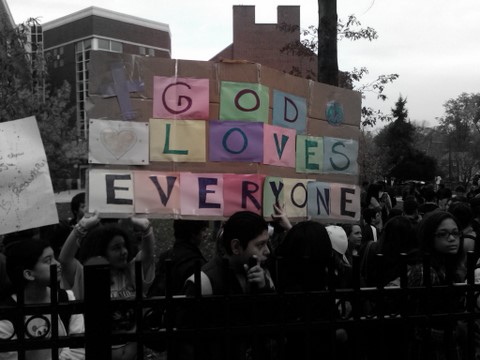
So, the sad folks of Westboro Baptist Church came to Bethesda today with a message of hate and condemnation; they’re the “God hates fags” folks. They stood outside my son’s high school with graphically disgusting signs, taunts of hatred and shameful messages of violence. I did not want to validate their illness by taking pictures of them. Instead I took a picture of the students’ response, one of love. That sign says it all.
I’m filled with parental pride that my son asked if he could go in early and stand with the other students of the school in quiet response to these people of hate. My son gets it. My son knows that the haters are wrong. My son is not growing up to be a hater. I was proud to stand with other parents and keep our cool while these people were protected in their right to speak their sick minds. I’m not sure how, but we kept our cool.
There’s nothing new about their illness. If you read their website it becomes obvious that they are completely messed up. And I’m no where near the first to say that they are wrong, but I’ll say it anyway. It’s important that we say they are wrong. It’s important that we stand against that kind of hate. They are wrong.
I’m back in my office now, myself somewhat sick in heart. I’ve got some Rich Mullins playing, trying to chase away the demons.
“Savior God, pour out your Spirit on these students in Bethesda. Bless them for their commitment to love, for love belongs to and flows from you… and deliver us from evil.”
Resolving Deadly Viper…
I just perused a very welcome update on the Viper interplay between the authors and the voices of protest. I’m glad to see the prayers of many answered in this obviously relational move to resolve the hurt and to move the whole kingdom forward. Amen!
Let’s be honest… like never before our predominantly Anglo majority in our country is having to come to grips with our heterogeneous society on levels and in arenas unimagined. We have to face the shallowness of the much lauded, historic “welcome” that we presented to other peoples who came to our country to share our space and raise their families with us. We also face this within the kingdom of God. The “Viper” parable can be an anchor as we move forward. White folks don’t just write and speak for white folks, and Asian folks don’t just speak and write for Asian folks, and so on… we share the movements of God in this world, and that means we share a heavy responsibility of love, grace and adaptation.
I think that this coming Sunday we will all lift the cup and bless the bread a little more one, and a little more in sync. That’s a good thing.
The Deadly Viper Controversy… *sigh*
My thoughts on the Deadly Viper controversy…
 Honestly, I first thought, “I wish this wasn’t a controversy.” But that’s my first thought every time there’s a controversy… I don’t really like conflict. I’ve kept reading and I’ve come quite a ways from that first impression. I’m glad that we’re having this conversation, I’m glad that brothers and sisters of Asian descent have clued the rest of us in on their hearts and this great mistake in communication and publishing.
And a mistake it is. I have not read the content of the book, but then I don’t see this as a content mistake; by all accounts the content gets good reviews. I don’t personally know the authors, but I’m comfortable saying that was not a mistake of intent; they did not set out to be offensive and plenty folks say what good people they are. But surely, this was a mistake of wisdom, what our great tribe of believers across the world and generations has called discernment.
I recognize that kind of a mistake because it hits home with me. I really don’t usually whiff it on the knowledge base. I rarely intend to do wrong. But I’ve been known to blow it on the wisdom of things; I have been too often guilty of a mistake in discernment not to recognize the signs.
I have taken a couple of days to put myself in the shoes of my Asian descended sisters and brothers, and I empathize with the sting of the images and misuse of elements within their cultures and heritages. This wasn’t a conversation between friends; it was a publishing house putting offensive stereotypes and hurtful allusions into the hands of many people who were expected to laugh at those cultural images and illustrations. That’s painful. It was probably not what the authors expected from their meetings in preparing the book. But the book left the safe confines of meetings and drawing boards and entered the public arena. They did not do good discernment. They were not wise. And I have too many friends of Asian descent and am a pastor to many good people of Asian descent not to make an attempt to understand how painful this may be for them. As their friend and pastor I am doing my own soul-searching to see what changes I may not have realized I need to make in my own life and discernments.
Back to mistakes of wisdom… I’ve had great ideas that went on to blow up and land me in worlds of hurtful, unintended consequences. My knowledge was usually pretty tight, and my intentions were stellar… my wisdom was not up to par. When those kinds of mistakes happen, it’s called “Learning Humility.” Humility hurts. Humility is not a quaint Bible study. It’s when reality is introduced to us, shakes our hands and kicks our butts. Humility lessons suck old egg.
But wait, Humility doesn’t stop at sucking egg, it’s also horribly necessary. We need those humility lessons to grow. They remind us to wrap our gifts and abilities in the Spirit of God, over and over again. Those kinds of mistakes can be admitted, owned, and repented of, thereby opening new avenues for God to work through us and do greater things than we have seen and done.
So, I believe the authors need to embrace the humility that demands they repent of their mistake. Let this be a growth moment. It’s not the end of their publishing careers, it’s a potential point of great change for the better. Imagine what two writers of greater wisdom and discernment might accomplish with their obvious gifts and abilities! And they owe it to their spiritual family! We aren’t just all consumers and marketers here, with apologies to the good folks at Zondervan! This is an opportunity to forge the kinds of friendships-out-of-pain that make us a better community of faith around the globe. Embrace the Humility! Humility is a good thing.
In case you haven’t read up on it, here are some helpful links:
Deadly Viper’s Website
Deadly Viper’s Blog
An Open Letter to the Authors (Prof. Rah)
Just Another White WordPresser Like Me I Found by Googling the Controversy (But he says good stuff)

