
Mingling the Human & Divine
A few months ago I was walking our little dog Tito in the neighborhood, fairly mentally zoned out, when a big silver pickup truck rounds a corner and pulls directly over to stop at the curb near me. Yes, it was a little unnerving, but I stopped and the passenger side window went down. Inside is a big burly guy behind the wheel with tears flowing and he asks me if I could stop and talk a bit.
I could and I did.
The concentrated cigarette punch from the truck was enough make my eyes water, but I leaned against the door and asked what was going on. He described through his tears how he was just done, how he had damaged and maybe ruined his most important relationships, and how he wasn’t sure if there was any reason to keep going.
I think I might have reached in to touch his shoulder, and I began the litany. You probably know the words, “Brother, I hear you. I hear how bad it is and I hear how much it hurts. Going on is the way you heal. Going on is the way you repair what can be fixed, and how you atone for what cannot. God’s got you. God’s not done with you. God will go on with you.”
I know more was said and more tears fell, but I honestly don’t remember it all. High emotion has a way of making that deep recall difficult. I do know that after a few minutes, some more tears and some deep breaths he drove off. I walked Tito home and went on with my day, hopeful that I’d done anything to help.
Now we jump to this morning and Tito and I are headed out for our morning patrol. We get about half the way up my block and I see a guy in a driveway who had been prepping for some lawn work, but was now just standing there watching me approach. I got closer and he says, “Man, I’ve been watching and waiting to see you. You probably don’t remember me.”
That’s when I noticed his big silver truck and looked back at him and nodded, “Brother, I do.” He goes on to tell me that since we talked that morning he had put himself into rehab and he’s made it to 90 days sober. He told me about his new morning prayer routine and how God has helped him pick up the pieces. He said his wife recently told him, “I’m so glad to have my husband back.”
He asked if he could give me a hug and I said, “I need one!”

Over the years I’ve often prayed things like, “God, just use me. Put me in places of need.” As God has answered that prayer I’ve noticed that it’s not always a very comfortable experience. It’s almost never happened as I imagined it would or as I would choose. But God has answered the prayer, and I think I’ve been put in situations which I needed as much as I might be needed.
Some prominent voices in our public discourse have recently offered the idea that empathy is a weakness and even a damaging sentiment. Empathy is different from pity or sympathy in that it’s the ability to connect with the feelings of another, to connect with and share their humanity. I personally tend to define empathy with the words of our faith, “Love your neighbor as yourself.” Does that mean I should love my neighbor as I love myself, or maybe on a deeper level I love my neighbor because they are me, and I am them?
I believe empathy is a muscle that when strengthened allows us to hold onto one another past any fears or barriers that arise. It’s the strength to make a connection and to love. Empathy is the power of presence, to truly be with someone beyond simple proximity.
The late and great Howard Thurman once wrote that “…hatred often begins in a situation in which there is contact without fellowship, contact that is devoid of any of the primary overtures of warmth and fellow-feeling and genuineness.” (Jesus and the Disinherited, 1949.) Digest that for a moment: contact without fellowship. How much hatred and accompanying fear festers in our society because we allow proximity without the effort of empathy and compassion? How often do we avoid contact, much less fellowship?
The next time any voice asks you to hate someone, to fear someone or to hold someone at a distance, the best response would be to take a deep breath, draw nearer and to flex that muscle of empathy. See the other person’s humanity, their value and beauty, even if those come in forms and expressions that are new for you.
I’m going to keep praying for God to put me in the places of need, without specifying that it be another’s need or my own. Though it’s not always easy, I’m going to keep stretching myself to lean in and empathize with others. I believe that in such empathy and presence we again mingle the human and the divine, incarnating the healing wholeness modeled by our Christ. I know I felt Christ’s presence in that hug.
AMDG, Todd
Praying With a Crucifix
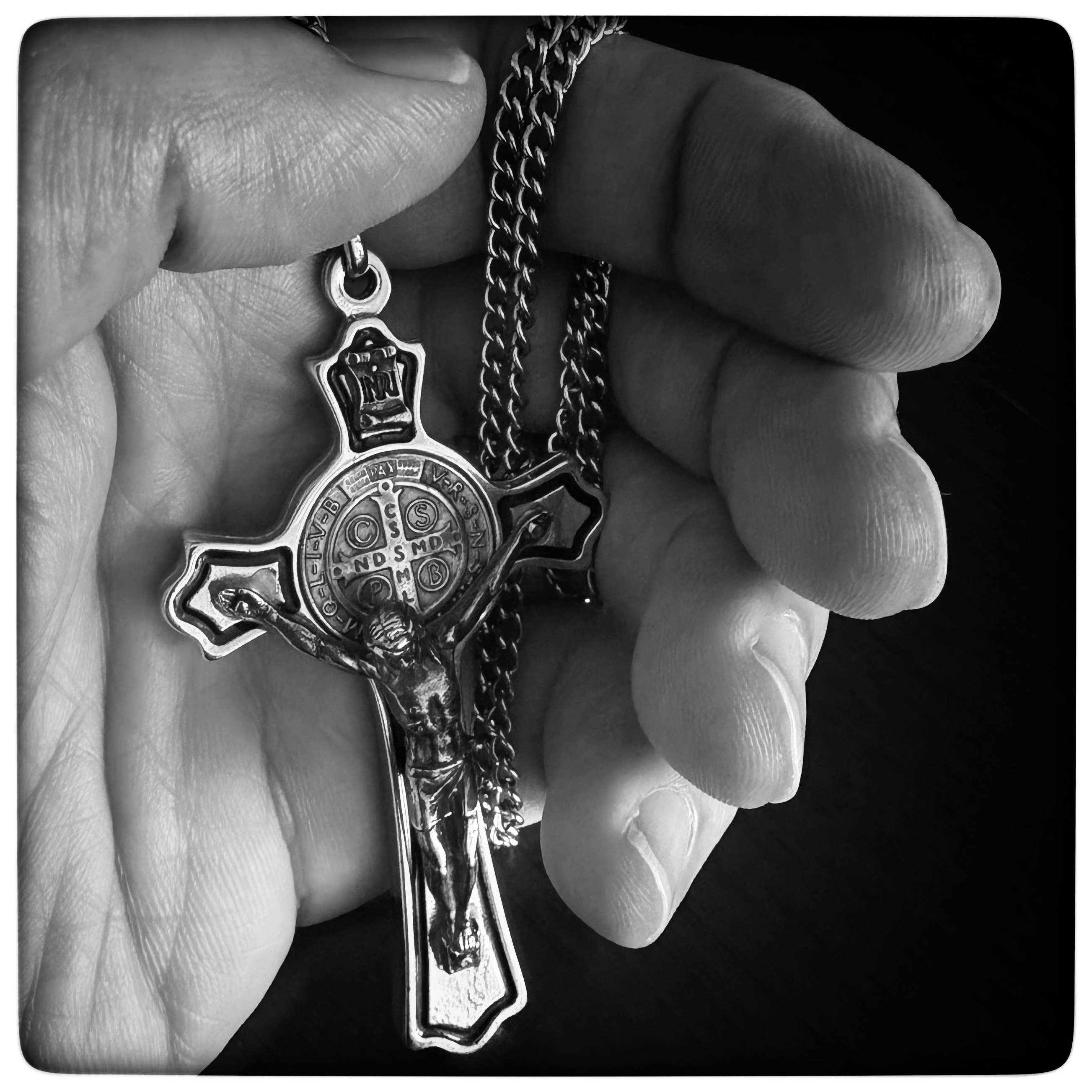
Jesus went with his disciples to a place called Gethsemane. When they got there, he told them, “Sit here while I go over there and pray.” Jesus took along Peter and the two brothers, James and John. He was very sad and troubled, and he said to them, “I am so sad that I feel as if I am dying. Stay here and keep awake with me.”Jesus walked on a little way. Then he knelt with his face to the ground and prayed, “My Father, if it is possible, don’t make me suffer by drinking from this cup. But do what you want, and not what I want.”
Matthew 26:36-39, Contemporary English Version
I did not grow up with crucifixes. Of all the crosses that might be around in the churches of my youth the most common was just a plain Latin cross, unadorned and uninhabited. As the church of my youth so often reminded me, “Jesus isn’t on the cross anymore!” And honestly, as someone believing the Risen Christ I wasn’t sure what to do with the image of a forever-crucified Christ.
I do have a few crucifixes these days, and today I found myself holding one of them during my morning prayers, a crucifix given to me by a dear brother from Jamaica when we shared a few days together in San Juan, Puerto Rico. Somehow this image of a suffering Christ sparked extra hope and resilience in my soul. It stirred up some sacred imagination within me.
Writers of our Christian scriptures will often make connections between the suffering of Christ and our suffering, and I’ll admit it’s been too easy for me to intellectualize that or simply hold it in a conceptual realm. Sitting with a visual reminder of what Jesus experienced in his human suffering, from the daily aches and frustrations to the apex of his pain on the cross, caused me to feel seen and known. It was visceral, not just conceptual.
Though I may not have a crucifix around for daily wear or constant reference, it does have an important place in our little human pilgrimages as we hurtle through space on this island planet of ours. In the midst of our stellar insignificance we are neither isolated nor alone. Indeed, our faith reminds us that our very smallness is known and cherished by God, the God who cannot be fully contained in this ever-expanding universe and yet deigned to stand among us in the form of a single vulnerable human being. No pain is felt alone. No frustration is not seen and shared.
That crucifix and its image of a murdered victim helped me to sit in my own humanness, take a deep breath, exhale and prepare to journey onward. Our stories are so very human, with all the banality and insignificance that implies, and yet we’re also infused with the sacred, the eternal and the divine. I’m so grateful today for this little cross and its suffering inhabitant. I’m glad for the reminder that we are so valued, comforted and celebrated in our own humanity.
AMDG, Todd+
Praying With the Executive Functions
The executive functions are the mental and emotional tools with which we face a day’s work; it’s common to find lists of six, eight or twelve functions. I’ve been prayerfully considering a list of eight and how I might pray for my use of and growth in these areas of life. In no particular order, here are the eight executive functions I’m using for this exercise: Self-Monitoring, Flexible Thinking, Emotional Control, Impulse Control, Organization, Working Memory, Planning & Prioritizing, Task Initiation.
What I’ve written is my first attempt to lay out a day of prayer for each with a prayer for the morning, for use throughout the day, and in the evening. There’s also a brief scriptural meditation for each. The plan is not to sit and pray through all eight executive functions at once. I’ve seen in my own life that seasons of need come and go, and daily tasks and requirements come and go. The plan is to recognize what is demanded by the time, and to pray for one or two needful functions.
These are my thoughts and prayerful responses to the eight executive functions listed above. As a Priest and a Spiritual Director I have a bit of experience with prayer. Since I’m not a cognitive or neuroscience specialist I have limited understanding and academic experience with the executive functions. Please take this work as an effort to faithfully pray and honor God in the work and flow of daily life, not as neuroscience in any form. That’s not a dodge, but an invitation! Help me out with this project of prayer. What nuances could you bring to my understanding of the executive functions, as well as prayer or scripture? I’m always open to hear and learn from others as I swim in these deep waters.
May God be honored in all of this, and God’s beloved world served by it. And please, Lord, help us all to be more joyful, peaceful, effective and productive in the daily intentions we bring to you in prayer! Amen.
With peace & prayers,
Rev. Todd Thomas
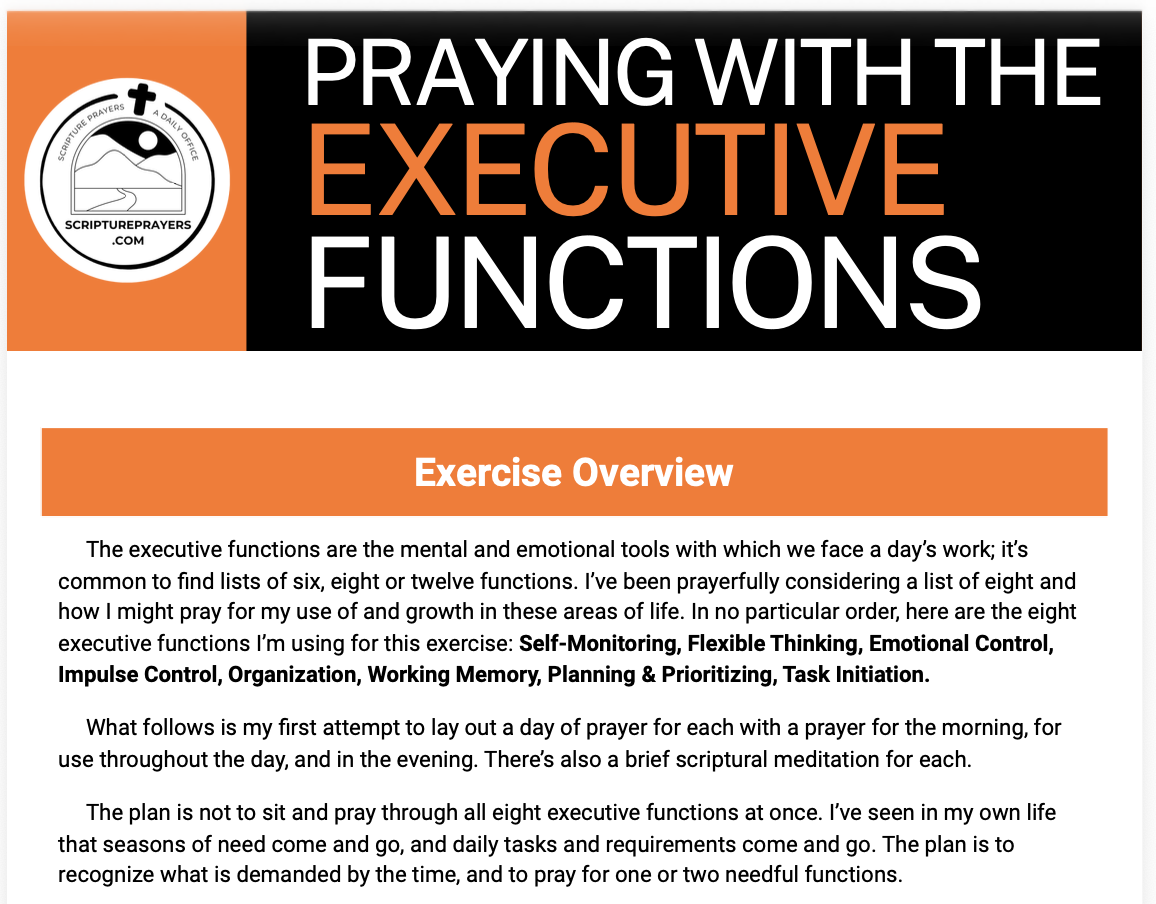
Click on the image above for the document!
You Must Stand Against Racism, Even Trump’s
I don’t play the “priest card” very much on social media, but today’s an exception.
There are ridiculing and insulting memes and images posted on social media every single day. Many of those in recent years have focused on Donald Trump, and it’s a sad commentary on our shared lack of decorum and inability to imagine reconciliation. I don’t post those kinds of images and memes, though I’m very clear on my moral and ethical objections to Donald Trump’s words and actions. I’m unequivocally opposed to his policies and politics. I take his moral and ethical failures as an elected leader far too seriously to play insult games, and as a priest of God I’m held to a higher standard of behavior. I’m not perfect by any stretch, but I am given high expectations and aspirational values with which to guide my words and actions.
It’s indefensible for Donald Trump to post such a racist trope of Barak and Michelle Obama. It is irrefutable proof of Donald Trump’s unfitness to lead anything, much less our nation. As a priest, I condemn that posting and I condemn that racism. We have a word in church circles for that kind of racism and moral failure: sin. And sin calls for repentance and atonement.
If you’re a Christian, claiming to follow Christ, then I ask you to consider the timing; in the middle of Black History Month and just a matter of days before the penitential Season of Lent begins, our elected president makes a mockery of both with this public display of racism. This isn’t just someone on the street being a racist, but the person in the highest office of our nation. This man’s time and energy is spent pulling our nation down and trapping us in his moral and ethical failures. We must all repudiate those words and actions immediately, and begin holding him accountable. He’s not been held accountable so far, and it’s destroying us. It’s also doing terrible damage to the credibility of our Christian faith as so many refuse to hold him accountable and to repudiate his moral and ethical failures. To date, as of the time I’m writing, he refuses to apologize for or to repent of that racist post in any way, just as he has dodged the moral and ethical implications of his other questionable social media posts, his continued lying about voter fraud, his felony convictions, his notable appearances in the Epstein files and his words which will forever haunt his legacy and our entire nation, “You can do anything. Grab ’em by the pussy. You can do anything.”
No, you cannot. You cannot do anything. You cannot continue to perpetuate racism from our highest office. You cannot drag our country into this kind of constant moral and ethical failure, even if too many citizens fear to call you out and hold you responsible. For the dignity of and value of all our neighbors of color, for the sake and safety of all women, especially the young and vulnerable, and for the defense of what is right and good, we call for you to be held accountable for your words and actions.
Our faith has earned a bad reputation for talking too much about sin, mostly because we fail to talk as seriously about the other great words we have like repentance, atonement and transformation. The story of our faith doesn’t begin and end with sin, but it is filled with invitations and opportunities to be transformed, with wisdom about making up for and fixing the injuries we have caused, and the strength to grow into the good human beings we are intended to be. That transformed life begins with a recognition of failure and a choice to change, a choice to be better.
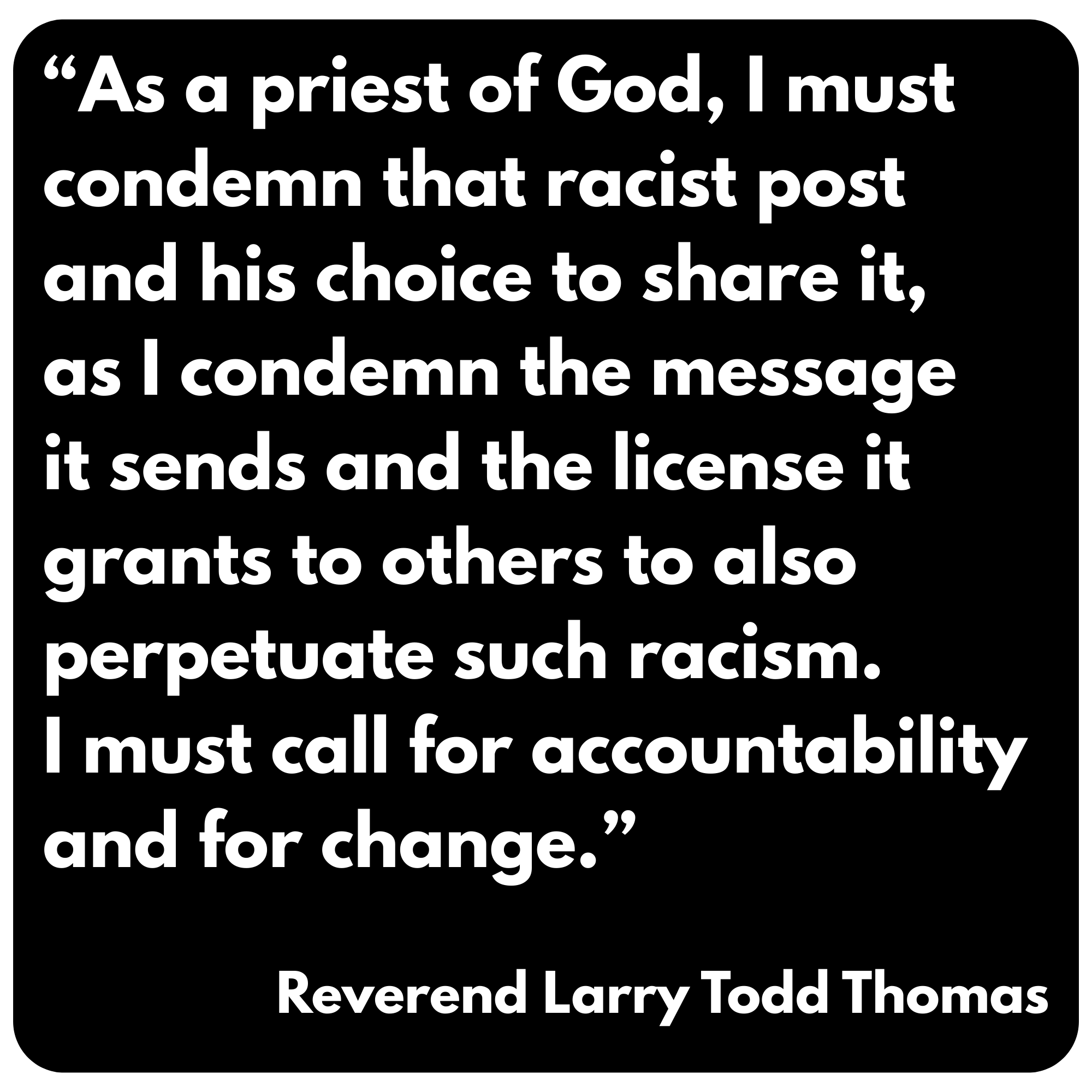
As a priest of God, I must condemn that racist post and his choice to share it, as I condemn the message it sends and the license it grants to others to also perpetuate such racism. I must call for accountability and for change. The highest office of our land must not be the purveyor of such moral and ethical decay. Donald Trump needs to change and we need to change our national dialogue. Donald Trump needs to be held accountable and he needs to resign.
Humbly, Reverend Larry Todd Thomas
Praying for ICE Aggressors
Praying for those who are the aggressors in the current immigration focused violence across our nation.
To start our discussion about praying for ICE aggressors I want to recognize how triggering this might be for some, especially if you are closer to the brutality we’ve see on our streets. Praying for an aggressor should never be an exercise of excusing what they have done or ignoring the pain of the victim. If the very thought of praying for them only brings pain and confusion for you, please take a step away and breathe deep. This conversation will be here when you’re able to continue with it.
I’m writing from the perspective of a follower of Jesus Christ, and that brings an emphasis on what he himself taught about challenging things like forgiveness, reconciliation and mercy. I’ve been praying and advocating in my own small ways for the victims of ICE aggression spreading across our country, for the families and individuals of color unjustly targeted, for all detained and held without due process, and especially for those who have lost their lives in detention centers and on our streets. It has been growing in my heart and mind that I should also pray for ICE.
We pray, then we peaceably protest. We pray, then we speak truth to power. We pray, then we oppose the aggressors. We pray, then we stand in solidarity with our most vulnerable neighbors.
“Blessed are the peacemakers, for they will be called children of God.” Jesus in Matthew 5:9
That this federal administration can so easily find and hire all these agents, these willing aggressors, points to a moral, ethical and spiritual illness within our society. The violence is especially painful because the aggressors are also our neighbors and represent themselves as law enforcement. We’re sickened by their decision to hate and to do such violence, and we unequivocally oppose and condemn their actions. We also stand in a faith tradition that has always taught us that we do not return hate with hate or violence with violence. We chase after a better way. We chase after peace.
The highest example for living that better way is Jesus Christ.
In the midst of his own unjust and painful execution he could still look down upon an angry crowd who put him on a cross and pray, “Father forgive them.” (Luke 23:32-34) We want to also have the kind of eyes that can look upon an aggressor and see their humanity, even while deploring their actions and injustices. We also want the kind of heart that remains unstained by their anger and stronger than their hate. Jesus could see within that violent crowd people who themselves needed a better way.
Jesus asks us to make prayer our response to persecution and love our gift to those who would be our enemies.(Matthew 5:43-48)
That’s not a posture of weakness or a capitulation to violence, instead it’s a starting place from which we break the cycle of violence and hatred multiplying through our interactions. In that Matthew 5 passage Jesus lifts love and prayer out of the usual system of transactional reciprocity, just giving some to get some. He realigns love and prayer to be transformative and reconciling, able to bring about something new and unexpected.
The Apostles Peter and Paul (1 Peter 3:9-12 & Romans 12:13-21) both continue this teaching from Christ in letters to the church by reminding us to resist the all too easy reflex of repaying evil with evil. The Rev. Dr. Martin Luther King Jr. brings this wisdom home for us in our own time, in his amazing work, Strength to Love (1963).
“Returning hate for hate multiplies hate, adding deeper darkness to a night already devoid of stars. Darkness cannot drive out darkness; only light can do that. Hate cannot drive out hate; only love can do that. Hate multiplies hate, violence multiplies violence, and toughness multiplies toughness in a descending spiral of destruction.”
To pray for ICE agents we begin by praying for ourselves.
We begin by asking for the Spirit of God to soften our hearts and to open our minds. It will take some imagination and effort to see past the masks, guns, grenades and tactical gear of war. Somewhere in all that mess is a fellow human being. We pray for the grace to see that valuable person, as broken and sick as their aggression might be. We ask for help because this is not an easy task.
“O God, help us to see the value and humanity in all our neighbors; even for the aggressor we would have a capacity to love and give mercy. Give us eyes to see them as more than their aggression. Help us to find within our hearts a sincere love for them, as undeserved, as unasked for and as unexpected as it might be.”
We pray for their healing.
A friend of mine used to always remind me of the axiom that hurting people hurt people. What kind of brokenness has moved these human souls to such aggression and violence? What kind of hurt causes a one to be so blind to the pain of others? Their willingness to put on all that gear and invade people’s homes and places of work points to some deep brokenness.
“O God, forgive them for their blindness to the evil they do. Give them healing from their fears and insecurities, and give them insight into the pain and fear they cause. Bring people of healing and wholeness into their lives, people who can show them the strength of love.”
We pray for their conviction and courage.
It’s so clear when we watch the videos that these aggressors are deeply insecure and afraid. The posturing, the escalation of violence and their willingness to follow bad-faith orders show how badly they crave acceptance and validation. The extremes of their bigotry and violence show a complete lack of self-reflection. Their moral and ethical compasses have been lost.
“O God, we ask you to open their eyes, ears and hearts to the pain caused to others by their actions. Weigh down their every waking moment with deep doubts about their choice to harass, divide and persecute. Awaken them to the shame of their chosen path.”
We pray for them to experience a conversion.
The word conversion carries a lot of baggage for some people, but it’s a good word for what we want for these souls. They need to be converted, changed, moved to a whole new way of being a human. We pray for a true interior reorientation. We’re wanting a Damascus Road kind of experience for them, like the one that stopped a murderously aggressive Saul in his tracks and turned him 180 degrees in life. (Acts 9:1-22) We pray for these souls to be shook.
“O God, draw them to yourself to be made new and transformed. May they be shaken from the fortress of ignorance and bigotry which blinds their hearts and fuels their violence. Humble them and bring their aggression to a standstill. Uproot them from the fear that binds and the hatred that drives.”
We’re believing in and calling for the best humanity in the aggressors and in ourselves.
Fighting them with reciprocal hatred and violence will not solve our shared societal illnesses. Again, from Strength to Love, Dr. King so powerfully defines the call, the work and the hope of being a peacemaker.
“At times we are able to humiliate our worst enemy. Inevitably, his weak moments come and we are able to thrust in his side the spear of defeat. But this we must not do. Every word and deed must contribute to an understanding with the enemy and release those vast reservoirs of goodwill which have been blocked by impenetrable walls of hate.”
We pray, then we peaceably protest. We pray, then we speak truth to power. We pray, then we oppose the aggressors. We pray, then we stand in solidarity with our most vulnerable neighbors.
“O God, we’re all broken, but we would be made whole. May our reservoirs of goodwill be found and opened wide. Bring us all together in greater humility do kindness and mercy. May we always be peace-makers, peace-seekers, peace-doers and peace-speakers. Amen.”
Isaiah 59 Feeling Days

For sometime I’ve had the blessing of being part of a poetry writing group hosted by Q Christian Fellowship. We meet weekly to check in with each other and to write poetry together. I don’t always manage to write something myself, but when I do the group gives me wonderful feedback and support, and I am so often amazed at what my friends in that group compose.
Of course, right now we’re processing together the results of the 2024 general election, and sharing with one another our feelings of anxiety, fear, disbelief, and confusion that so many in this country could elect a convicted felon who bragged of sexually assaulting women. We share an unease and anxiety at being asked to follow the lead of and to respect the office now held by a predator. Last night our poetry expressed where we were in our hearts and minds, and I have to say that my friends did such a better job than me.
Two times last night someone shared poetry which cast me into scripture, recalling to mind important words of faith and aspiration.
The first instance was in a poem written about gentleness, that was in fact a prayer for gentleness. That’s an amazing aspiration and it threw me into the words of St. Paul to the Philippians, “Let your gentleness be known to everyone.” (Philippians 4:5) That verse has always resonated with me, especially living in a time in Western Christianity which more often values the opposite, which values winning fights, winning arguments, and just shouting louder if that’s all we got.
One of the hallmark teachings of Jesus is about breaking cycles of violence, I believe in both speech and action. He said to love one’s enemies, and he taught us an extremely difficult way of giving forgiveness again and again while turning from personal vengefulness. (Matthew 5:38-48 & 18:21-35) I’m not sure about you, but I know that my heart too quickly and too easily reacts to anger with anger and to hatred with hatred. Those statements are not meant to embolden or excuse an abuser, but to keep the abused and injured from joining in the violence. When the time comes for our strength and conviction to be acted upon, gentleness allows us to be just and to know and to share healing.
The second instance of being thrown back on scripture was when another poem’s lament landed me mentally in Isaiah 59. You may be familiar with that chapter, but let me give a quick synopsis. In that chapter we hear first that God can save, “Surely the arm of the Lord is not too short to save nor his ear to dull to hear.” But there’s a problem, and that problem is the mess that we make. Humanity’s messiness can be huge and egregious, staining our hands with blood and destroying justice among us. In fact, the chapter laments that justice cannot be found, it can no longer be heard and is now far from those most needing it. The lament is that we look for justice, but cannot find it, because we killed it. We look for light but only find shadows. By verse 14 we hear the haunting words, “So justice is driven back, and righteousness stands at a distance; truth has stumbled in the streets, honesty cannot enter. Truth is nowhere to be found, and whoever shines evil becomes a prey.” Wow, that really sums up the gut-punch of this past week’s election.
Having had a week to process the general election, and to think about this felon, this abusive predator, again sitting in our highest office, and the damage he will do through those with whom he will surround himself and a Congress which will not oppose him, these truly feel like Isaiah 59 kind of days.
I have no hope that this incoming felon will value truth, uphold justice or shine any light by which we might find a good path. But I do have hope. In the next movement of Isaiah 59 God looks upon the earth and sees the mess people have made, and God is not happy. It says that God looked and saw that there was no justice and no one working for justice, and so God goes on the move. God puts on some familiar sounding armor to those of us who read the Christian scriptures (Ephesians 6:10-18)… God puts on the armor of righteousness, salvation, zeal, and the intention to bring justice against those who have oppressed the people, and moves coast to coast to clean things up!
By the beginning of the next chapter, the people are called to “Arise, shine, for your light has come!” (Isaiah 60) The light of God has broken through the shadows and that light will shine on the people and will reflect from the people to every part of the world. A promise is given that “I will appoint Peace as your overseer and Righteousness as your taskmaster. Violence shall no more be heard in your land, devastation or destruction within your borders; you shall call your walls Salvation and your gates Praise.” (Isaiah 60:17-18) I want to be there in an Isaiah 60 world, but we have to go through these Isaiah 59 days first.
Another blessing for me in these days has been the rhythm of Celtic Daily Prayer, sacred words for the morning, midday and for the evening. Each evening includes an expression of faith, words spoken from Isaiah 59 days in trust of the coming Isaiah 60 morning…
Lord, You have always given
bread for the coming day;
and though I am poor,
today I believe.Lord, You have always given
strength for the coming day;
and though I am weak,
today I believe.Lord, You have always given
peace for the coming day;
and though of anxious heart,
today I believe.Lord, You have always kept
me safe in trials;
and now, tried as I am,
today I believe.Lord, You have always marked
the road for the coming day;
and though it may be hidden,
today I believe.Lord, You have always lightened
this darkness of mine;
and though the night is here,
today I believe.Lord, You have always spoken
when time was ripe;
and though you be silent now,
today I believe.
Walking through a difficult and hurtful chapter can make the next chapter seem less real and too far off. It especially pains us that this terrible chapter has just begun and has years yet to be written. But it will end, and a new chapter will begin.
I will watch out for you, and I know you’ll be watching out for me. Though I wait for so much which I can only hope to see tomorrow, today I believe.
AMDG, Todd

Reacting to the Election in 2024
I’ve tried to capture my thoughts and emotions on a devastating morning after. The transcript will be posted below the video. I would also offer this 1995 album, Lament, from Resurrection Band… it’s the music of my day.
Beloved, take care of yourselves today, please… AMDG, Todd
2024 Election Reaction, transcript
Like many, I’m having a visceral reaction to the election, a reaction of shame, embarrassment and dismay. I don’t understand the heart and mind of my neighbors who voted for the convicted felon, the one who bragged of sexually assaulting women, a financial huckster with his trading cards, sneakers, Bibles and wristwatches. I don’t understand how my neighbors can reward a politician and a whole political party for January 6th, 2021, or all the election denials and for his speaking so casually of using the Department of Justice and US military against those who disagree with him.
The part of me that is a US citizen feels lost, without a home and without a people. I didn’t think I could see again such a travesty of justice in my lifetime, such a mockery of our nation’s promise. I feel undone, and I feel as though our nation is coming undone, lost in a fresh miscarriage of truth and hope.
I’m ashamed and I am grieved by those who voted for this dark new chapter of our shared life in the name of God and of Christ. I am afraid for the lasting harm done to our witness and for the tighter hold of ignorance, hatred and idolatry which already strangle our faith. In some ways, the deepest part of me, the largest part and the longest-striving part of me, which is a follower of Christ, feels the deepest disconnect of my life with the broader church in our nation.
All that is part of my truth, but it’s not all the truth I have to hold or to share.
Even if good loses the vote, I will stand for it. Even when goodness loses an election, I will still choose it. When the love of power overshadows the promise of justice, I will align myself with those who the powerful despise. I will name the shame I feel at this election, but I will not allow it to rule me. And when my nation knocks me down, I will get back up. Even when so many followers of Christ make me want to hide away and be silent, I will speak and move, with God’s help.
Even when so many of our neighbors choose the path of shame and make us walk it with them, I cannot hate them. Even when they elect the felon, the abuser, and look to have stacked Congress on his side, I cannot hate them. But I also cannot ignore it. I will name it. I will call out that darkness, loudly and relentlessly. I will not abide this shameful chapter of our life silently. I will shine what little light I have on that darkness and attack every shadow with the strength God gives me.
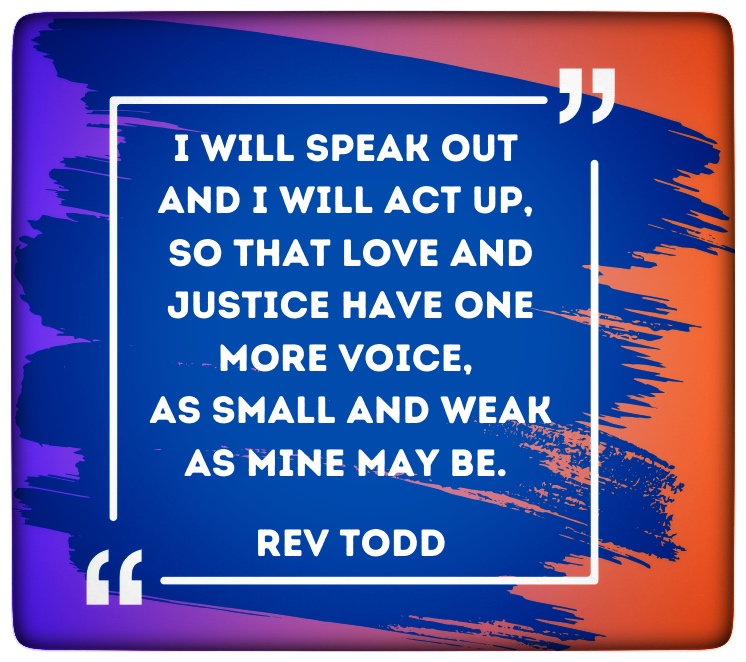
For every American who now will fear for their ability to express their own sexually and gender, who fear for their marriage and family, who fear for their privacy and reproductive rights, who fear for their place at the table of civil life and participation, I will not be silent. I will pray and I will keep faith, so that shame becomes motivation. I will speak out and I will act up, so that love and justice have one more voice, as small and weak as mine may be.
We lost an election, not our light. We hoped for some respite, but again are called to the struggle.
Faith & Depression: A Few Thoughts

This post began life as a reflection on mental health for the Lenten Season I was asked to make for a church project back in 2019. Now, five years down the road, I’ve returned to it to see if my thoughts have changed. It’s a good moment for me to do this, because I’ve had an acute episode with depression in recent months. Here are my reflections from five years ago with a few updates, things I believe about dealing with life-long depression and mental health struggles, particularly in the arena of faith.
Having Faith is No Free Pass
Some would believe and even say that being a person of faith can insulate you from mental health struggles like depression. I’ve found in my life that neither having faith nor being in ministry automatically keeps one from suffering the very human travails of depression. Depending on which studies you prefer to accept clergy will suffer depression at least as often or more often than the general public. Don’t get me wrong. When I’m experiencing depression I’m so glad for my faith and the positive and hopeful truths of my beliefs. My faith assures me of God’s love and my worth, and those are powerful countering messages to the inner voices of my depression and existential anxieties. But they aren’t an instant cure.
My spiritual director recently asked me how my prayer life changes when I’m depressed. That’s a great question. I don’t stop praying, but I definitely have seen a shift from a more relational expression of prayer, just talking with God, to a more intercessory style of prayer, talking about what others around me need. That’s not necessary a bad shift, but I do miss the quietly affirming conversations with my God. Those times will come back around, and it helps me to read back in my journals and reflect on that deeper experience of prayer in other times of my life.

Depression Doesn’t Make You Bad
Being depressed does not make me or you a person bad. I’m not weak, stupid, broken or any of the other things we sometimes call ourselves and others when suffering comes around. Depression can and does happen to anyone. Do you remember the scene of that night Jesus spent in the garden wrestling with fear and anxiety? It’s Lent, so if you go to church much you’ll probably hear the story read sometime soon. He spent a sleepless night in a garden feeling sad enough to die. He suffered anxiety and a deep fear and existential pain, but not because he had done anything wrong. Suffering through that dark night of sadness (and yes, dark night is a common metaphor for seasons of depression and suffering) did not mean he was bad, weak or deficient in his faith. It mostly meant his claims of being human were all too true.
It’s not easy to release the shame and guilt that accompany depression, but they are not weights which have to be borne, and certainly not borne alone.
There’s No Need to Ask Why
We don’t need to ask why someone is depressed. Certainly there are ways to live our lives which are healthy or not, and things which affect us like seasonal affective disorder, and we sometime abuse substances. I believe though that asking why someone is depressed, at least as a first question, can get in the way of acceptance, love, support and comfort. Too often a search for why is just an extension of a blame game, or just a bad, a fix-it game. Next time someone says to you ‘I’m depressed” and you feel the “Really? Why?” start to form in your mind, say instead, “I’m sorry, that’s no fun. I love you.” Let’s not assume guilt when someone suffers. All Jesus asked for from his closest companions while he was suffering that night in the garden was for them to sit with him awake a while. Let’s be friends willing to sit with someone through their dark night. You don’t need to analyze or fix them, but just be willing to be there and let your presence be a strength and help. If we can do that, then we may find the opportunity and relationship needed to ask, “How can I help?”
Beloved ones, times of depression come and go for everyone, more often for some. Instead of viewing these seasonal changes of life as a weakness or deficiency, may we ever see them as opportunities to affirm our love and support for one another.
AMDG, Todd+
A Prayer for George Santos
I find myself wanting to pray for George Santos, and to pray for the nation. It would be dishonest for me to say that I’m unhappy with today’s vote in the House of Representatives that he be expelled. We’ve been missing these kinds of consequences in the face of a lot of egregious behavior.
George Santos is not the only politician under scrutiny right now for words and behaviors, and we have no lack of examples of how not to speak or conduct oneself in the public arena. But the story of George Santos has been captivating because his indiscretions have been so visible and easily seen, and any shred of personal responsibility so lacking.
I’m not happy with his expulsion because he’s a Republican. I’m not happy because he’s been publicly embarrassed or punished. I’m happy that our political representatives in the House, regardless of party affiliation, can still sometimes do a right thing.
So, I’m sincerely praying for George and for our nation. I’m offering a couple of prayers from our Book of Common Prayer, and one of my own…
For the Human Family, pg. 815
O God, you made us in your own image and redeemed us
through Jesus your Son: Look with compassion on the whole
human family; take away the arrogance and hatred which
infect our hearts; break down the walls that separate us;
unite us in bonds of love; and work through our struggle and
confusion to accomplish your purposes on earth; that, in
your good time, all nations and races may serve you in
harmony around your heavenly throne; through Jesus Christ
our Lord. Amen.For Those Who Influence Public Opinion, pg. 827
Almighty God, you proclaim your truth in every age by many
voices: Direct, in our time, we pray, those who speak where
many listen and write what many read; that they may do their
part in making the heart of this people wise, its mind sound, and
its will righteous; to the honor of Jesus Christ our Lord. Amen.
And in my own words…
God of Grace and God of Glory,
I ask you to pour out your Spirit of Truth and presence on us all.
For every human person, so beloved by you, even those like me,
and like George, I ask for your healing presence and strength.
Help us every single one to be more completely tuned to all that
you have tried to teach us: that kindness matters, that honesty is
a strength, and that we are one another’s keepers. Help us all to
believe wholeheartedly in and to work for the common good, the
blessing and wholeness of all your people, all our neighbors upon
this island home you have given us among the stars.
I ask in faith, in anticipation and in the name of the Christ. Amen.
AMDG, Todd+
Life Profession

This week I’m in Seattle WA for the annual Chapter meeting of the Anglican Dominicans, my chosen religious order. This is a special Chapter for me because I am making my Life Profession, vowing to live the rest of my life by the values and promises of this particular community.
The Anglican Dominicans are folks mostly from the Episcopal Church, who have chosen to study and embrace the charism of St. Dominic de Guzman and the Roman Catholic Dominican Order which he founded early in the 13th Century. Our Father Dominic envisioned and launched an Order of friar preachers committed to the proclamation of the Gospel for the blessing of the world.
As Anglican Dominicans we profess vows which reflect both religious history and our contemporary lives today as some of us are ordained and others not, some married and others not, but all immersed in active daily lives of work, school and church. The historic vows of the religious life are chastity, poverty and obedience. Our vows today are to live purely, in simplicity and with obedience. That is to say that we strive to to make holy and healthful relationships with those around us, we strive to move out of our usual consumeristic focus and selfish economics, and we follow the lead of those in the Anglican Dominican Order who have taken responsibility for our personal formation and ministry.
Why?
I most often hear the question, “Why?” Why do this? Why does this matter? The assumption is often that I must have felt I wasn’t enough as simply a Christian, a believer. Let me say that I believe we are all enough in our faith, totally and completely beloved of God in whatever place we find ourselves in life. Joining a Religious Order is not about attaining God’s love, we have that, or about competing with and out-distancing others, we have no need of that. But some people are called by the Spirit to pursue their religious vocation and spiritual formation in these communities of shared vows and values.
I’ve been blessed to have my Dominican siblings pray with and for me, guide me in study and to share visions of what a faithful life entails for us. My formation journey has been a four year journey to bring me to this week: I became an Inquirer in the Fall of 2019, was accepted as a Postulant in the Fall of 2020, was made a Novice in the Fall of 2021, and now by God’s grace after two years of my Novitiate studies and after the vote of the members I have made my life profession, taking vows to give myself fully to this community.
Do I need to be an Anglican Dominican to be a Christian? Of course not, and neither do you. Does being a Dominican make me a better Christian than someone else? Of course not, we aren’t intended to be in any form of competition in our faith. Does being a Dominican make me a better me? I believe it has and I believe it will. I’ve often explained to others that no one joins a religious order because they are so holy, but probably because they need the extra help in what holiness they want to attain. It’s like getting an academic tutor, not because of what you can do, but because of what you hope to do.
Recently on a Sunday morning I used the Gospel reading to draw a connection between a couple of parables told by Jesus and why I am a Dominican. In Matthew 13:44-46 Jesus tells two stories about pursuing, finding and gaining two treasures, an unexpected treasure and a long sought after treasure. In each story Jesus expresses the idea of doing whatever it takes to get the treasure (the kingdom of heaven), selling all one has and expending every energy to attain and keep what has been found. That’s been my experience with the Dominicans! I went looking for treasure and found it in the Dominican Order, and ever since I’ve done whatever I could to have and to hold onto that treasure.
The Charism
The charism of the Dominican Order is based in preaching, the proclaiming of the Gospel, and there are several ways it is has been expressed by Dominicans through the centuries. St. Dominic himself expressed it by encouraging his religious siblings to “Speak only of God or with God.” Dominicans use the the catchword “Veritas” to express our devotion to truth in all its forms. We have the tagline “To Praise, To Bless, To Preach” to remind ourselves of our connectedness with and responsibility to all people. St. Thomas Aquinas coined the phrase “To contemplate and to share the fruits of contemplation” to express the core of Dominican life and vocation: to listen for God and to share what we hear. Do you have to be a Dominican to do any of this? Of course not. Does living a Dominican life mean that I’m striving for these things? Yes, it does.
The four pillars of Dominican life are prayer, study, preaching and community. We pray daily and lean into the Daily Office for that practice. We study daily, leaning into scripture to encounter God, truth and our foundation for life. We preach and proclaim the Gospel in every way we can through words spoken and written, acts of service, the sacraments and in any opportunity which God opens for us. And we are in community, making every effort to serve, to remain in and to build our lives together.
What’s Next?
You know, life rolls on. I’m still just Todd, a husband, father, son and brother, a priest, a preacher and a nerd who plays too many hours of video games each week. I’ll now be able to wear the full habit of the Anglican Dominicans, and I’ll be supporting the Order as I am able with what meager gifts I have by God’s grace.
My life is further circumscribed by the vows taken in the presence of God and my siblings of faith; my baptismal promises and vows as a Priest are simply further supported by my vows as an Anglican Dominican. My hope and faith remain rooted in what God is doing and what the Divine will do in me, believing it to be far beyond what I myself may accomplish or conceive.
What’s next? Next is my life with the past and present Dominican siblings who surround me. From our Spiritual Father Dominic to our Brother Thomas, our Sister Catherine, Brother Martin and all those who have blessed us and are blessing us today, I ask: What may I learn? What may I imitate? How may I serve? What might I share? Whatever may come I am strengthened by the witness and love of my Anglican Dominican siblings and the faith and wisdom of all Dominicans who have come before me.
Here is the full Life Profession Mass from August 2, 2023, in Seattle, WA. My vows are at the 44:35 minute mark.

