
Christians Being Rude…
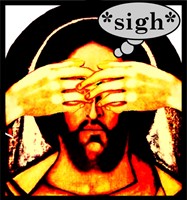 I recently threw out a tweet that also went to my facebook expressing my shame at the actions of some Christians a few weeks back who felt it was somehow in the Spirit of Christ to go disturb their Muslim neighbors who had gathered at the National Mall for a day of prayer. While the people tried to pray, some stood to the side with bullhorns and tried to “evangelize” them, and then got in arguments with the DC police. Sheesh.
Really, that’s who we are supposed to be? The persecutors? We somehow have been granted the licence to rudeness? Really?
So, I went to my Sunni next-door neighbor and apologized, even though he wasn’t there that day. He was so great. He said something like, “We know all Christians aren’t like that.” He then looked over my shoulder to the view of my church building down the street, and he looked at the Presbyterian church across the street, and turned back and said something to the tune of, “My wife and I are so happy to have the churches here so close, we feel it is a sign of peace for us.” Sorry, it wasn’t a news interview so I have to do some paraphrasing.
I also spent some time trying to find an email for the fella who planned the whole prayer event at the Mall. I finally found one and sent him an apology, as a local Christian Pastor who was embarrassed by the angry, rude Christians. I wanted to share the reply I received yesterday, because I thought it was very gracious…
“Dear Reverend Thomas,
Thank you very much for your kind words and prayers. We did receive opposition from Christians but it didn’t prevent us from having a most wonderful prayer service on Capitol Hill. We prayed for the good of America, for all people of all races, religions, etc. Many of us who participated were born in America. We deeply care for and love America.
Take good care and may the peace of God (the one creator) be with you always.
Peace and blessings,
Sayydah”
There’s no doubt that there are Muslims in the world who don’t love America. Heck, there are Christians in the world who don’t love America. And I’m not going to jump onto a bandwagon of condemnation for the Christians with bullhorns… as I recently heard the late, great Rich Mullins say in video, “I’m not saying they’re bad, they’re just wrong.” Scripture directs us to be the righteous ones, so that observers have no true basis to make derisive remakes about our behavior. Scripture also says that our anger does not accomplish the will of God. And common sense says that interrupting someone else’s prayer does nothing to help my prayer.
So, I’ll just close with sincere apologies to the artist of the icon with which I took certain liberties when trying to do something visually clever for this post. Sorry, my friend.
Showing the Fuel Cell to the Students!
So, been having a blast showing the fuel cell to students at my youngest son’s elementary school, and my middle son’s middle school… still trying to get a foot in the door at my oldest’s high school! You should see the eyes light up when they hear that when they have their license, this baby will be on the road!

it’s the incarnation, baby…
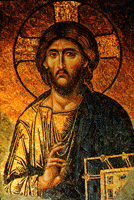 For several years I’ve made statements like, “My theological gravity well is in Eastern Orthodoxy…” and I did mean it, but I’m really only now discovering what that really means to me.
I have loved the Orthodox emphasis on the incarnation and the deep incarnational theology for a while now, though I would hazard to say that I’m just beginning to identify an internal shift within me to feel the significance of the incarnation and what it means to see it as what I will call the “hinge” or pivotal moment of the scriptural narrative.
As the vast majority of Western Christians have, I have always operated my faith and life in relation to the crucifixion being that pivotal moment of the biblical narrative. The Orthodox however choose the incarnation as that point, and it’s finally gotten down into me.
You see, it changes things when you make these kinds of shifts. I am not saying that the crucifixion is not a hugely meaningful and important event in the narrative. I believe it happened, happened as scripture tells us, and it had deep significance for our faith and life. I’m not even trying to convince you to think as I do… the last thing I want is some kind of fight over who’s got the best hinge passage or story.
But different things take on different hues and natures as we shift from one focus to another. For instance… God’s love, care and concern for all of creation become so much clearer and real when the event of God’s arrival is loosed to be the clarion call of our salvation, a salvation we share with all things created, not just human souls. Stop and recall that we read “For God so loved the world (kosmos)…” There’s more than a small problem with our crucifixion-heavy view of narrative which allows us to unthinkingly interpret that to an exclusively human experience of “For God so loved us…”
And it feels right to fully rejoice with the scriptural writers that “Word became flesh…” and “Now God has spoken to us through his Son…” and that “He humbled himself, taking the form of a slave…” The good news of Immanuel is self-evident and really doesn’t need too much explaining, “God is with us.”
A few weeks ago at CiB we made an attempt to capture gospel or “good news” in a way that we could live it and share it with our neighbors… we tired to gain a hold on the essence of the good news. What we landed with were three big ideas that we’d like folks to experience: 1) God is real, 2) God is near, and 3) God is love. That is the story of incarnation, the story of our salvation, in three terribly simple sentences. It’s a reflection of a titanic shift (hinge) in the biggest story of all, the time when God drew near.
Humanity and the Environment…
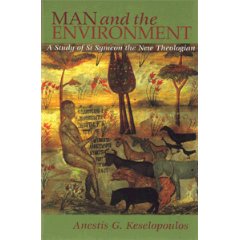 Well, I’ve been working thru “Man and the Environment: A Study of St. Symeon the New Theologian” by Anestis G. Keselopoulos for a few years now. I will look in and read a little, then forget it, then find it again and try wading through some more… but today I decided to take a far less linear approach and start moving back and forth thru the book trying to grab some of the big ideas and only dig into successive paragraphs when needing more detail or illumination… and I feel like Anestis and I are getting something done… finally.
Here’s a quick rundown of what I’m taking away from St Symeon’s work, seen through Keselopoulos:
1) We have a real problem in the western dualistic mind as it leads us to be wrongly antagonistic toward matter. We’ve tended to view humanity as spiritual beings trapped in matter instead of whole beings intended, in fact created by God, to be beings of unified spirit and matter. This dualism and it’s subsequent antagonism leads us to subordinate the inferior matter to the superior spirit, thereby devaluing matter and all created things, even functionally separating matter (ultimate nothing) from God (ultimate everything).
2) Now, out of this functional separation of creation from it’s Creator (except as an object lesson every now and again for beauty), we have a free hand to develop any and all technologies or uses of matter regardless of their negative impact on creation. I think this is where some of us will actively be abusive of creation (both our own bodies and the created world around us), or we’ll be fairly apathetic of the abuse happening around us. We then are free to exercise a “domination” over creation that has no understanding of our shared essence or responsibility toward creation.
3) Christ came at a time when many had abandoned a true understanding of nature as a reflection of the Creator, and they had turned to worship the created out of that disconnect. We have not gone that way today, but instead I think many of us have such a morbid fear of somehow worshiping creation that in our separation of the created from the Creator we “ultimately denigrate” it instead of “ultimately deifying” it. So, anyone today who speaks of the connection between God and matter/creation, or of our responsibility to creation and matter as the people of God, intended to live a unity of spirit and matter, runs the risk of being called an idolater of the world who has forsaken the highest spiritual matters before us.
These things are running through my mind right now, or maybe I should say, running roughshod over my mind. I am very appreciative though of our Christian tribe having a deep and long non-dualistic tradition that becomes present and timeless as we continue to struggle through a epoch in which so many Christians have lived a life built on shaky premises such as “This life is just a dress rehearsal for eternity” or “It’s all gonna burn one day anyway.” We exist in a “now” that engages us in an exciting, dynamic and God-intended present existence, not only a hopeful future one.
A Week and Few Days with a Fuel Cell!
[This was my second entry at the GM Drivers Blog…]
I am about a week and a half in with my Equinox, and it really is second nature now, as far as operation and driving. It is a fun truck to drive and I’m loving the conversations it can generate. So, at this point I’m willing to point out a couple of things I really dig about the system and a couple that I don’t…
 I love the electric propulsion… very “twist-and-go” like the Yamaha scooter which serves as my daily driver. The quickness and response is pure joy and it always startles my friends who drive it. I guess they think it will accelerate like the electric golf carts they’ve driven. But, having lauded life without a transmission, this baby can roll away! I mean, a good 8 to maybe 10 inches at times when I’ve parked and put it in “Park.” I’ve had a scare several times that I might hit another parked vehicle across from me on a slight incline. It will also roll away at some red lights and stop signs when I remove my foot from the brake pedal.
This is also a really nimble system. I don’t know the contrast in curb weights bewteen our Fuel Cell trucks and a combustion engine Equinox, but I assume we’re a lot lighter, at least it drives as if it were. That’s a great thing, except my wheels can pop and spin on a little bit of moisture. Mostly, I just have to curb my enthusiasm!
My average fuel economy is always hovering around 44 m/kg and that gets people thrilled and excited. I’m usually asked about an eventual price tag in 2015, and I’ve had a lot of success getting $1,000 deposits on future trucks from people… just kidding! Folks really are ready to buy this truck!
Peace, Swirlyfoot
I am test driving a fuel cell truck for GM!
 So, a couple of years ago I signed up GM.com to be a test driver for their fuel cell vehicle, and that dream has finally come true! The following is a blog entry I made yesterday on their driver’s site… I’m sharing it here with you, too…
Weeeee! I picked up my Equinox a few days ago!
Listen, I love this truck. I am going to wait until I have a whole week “under my belt” before I actually offer any critiques or specific ideas on the handling and performance, but for now, I’ll just mention how much people love to get thrilled about this truck and to find problems with it. It’s almost like the grief response steps as far as being able to be mapped: 1) curiosity, 2) apprehension, 3) excitement, 4) challenge, and finally 5) envy. It seems everyone starts off really curious, “Does it run water?” But soon after learning a little about Hydrogen they get a little nervous about standing so close. After learning more about Hydrogen they get pumped and want to drive it. Then, they feel a strange need to “debunk” it by expressing concern about it making too much H2O and messing up our naural balance with too much water, or something like that. Finally, they just get good and envious that I have it and they don’t, and they want it bad.
The funnest scene so far for me was my chiropractor emptying the whole clinic, staff and patients, for an impromptu inspection and Q&A time, yesterday. I’ve promised him that he’ll get a test dive on Friday! Peace, y’all! Todd
Welcome at the Table
 Sunday was a fantastic day. In the morning we had the joy of a new experience for me, a couple from our church family exchanged wedding vows during our worship gathering. That was really cool. And on top of that, their exchange of vows brought in a whole bunch of visitors to the service, their friends and family, who added an amazing element of diversity, discovery and participation.
I knew before the service that many of the visiting family were Jewish. And though we didn’t leave Jesus out of our vocabulary or singing, or any part, we were able to welcome this group of people to a level of comfort and participation that I hoped for, but wasn’t sure we might achieve. I spoke of marriage in a brief homily, mostly from the New Testament and I shared the story of Jesus at the wedding in Cana. Then in the ceremony I referenced the love of God seen in scriptural metaphors from the garden in Genesis through the Psalms and up to Paul’s writings. And our guy Gary, who was leading communion, did the best possible job I could imagine of welcoming our guests to celebrate what was originally their Sader, now our commemoration of Christ. He spoke of communities of faith working to enlarge our circles of fellowship and love, versus shrinking those circles… he was great.
Most of our visitors joined our communion celebration and then shared some prayers during our “open mic” time of Prayers of the People after communion.
All that to say that when we had moved onto a time of fellowship, many visitors stayed to share their joy and appreciation of the worship gathering. One visitor said to me, “I’m Jewish, and I’ve taken communion for the first time!” and I’m thinking, and I believe I replied, “That is awesome!” I thought of Ephesians 2, when Paul says that Jews and Gentiles can be made into one person to have access to God… I saw that in real life!
Another visitor asked if they could return to worship with us again, even though they are gay. That gave me a chance to express how our people would probably represent a vast multitude of ideas, opinions and experiences having to do with the issue of sexual orientation, but our commonality would be found in our commitment to welcome, love and safeguard the dignity every human being. So yeah, you come on back and share yourself with us, all of yourself. Please. We need you. We welcome you.
So there we were, for a short time on Sunday morning, gathered around the table… Jew, Gentile, black, white, American, Nigerian, heterosexuals and homosexuals, Republicans and Democrats, male, female, young and old, and more… reaching out to the God who made us, craves our attention and has laid a table of welcome for all of us.
I know it’s not the church, the typical Sunday morning, of my youth. I know that it doesn’t really fit all the tidy boxes into which many of our churches tend to safely cradle our worship experiences. Still, I also know that God showed up. And I will be always grateful for that morning, even if not one of those visitors ever returns. O, Lord, I pray they do… but that one morning was a real gift, and I want to let it stand on it’s own and not neglect a single syllable of thanks that I owe for it.
I guess this is when I need to quote someone smarter than me, to you know, cement the moment…
“The day will come when, after harnessing the ether,
the winds, the tides and the gravitation,
we shall harness for God the energies of love.
And on that day, for the second time in the history of the world,
man will have discovered fire.”
~ Pierre Teilhard de Chardin, S.J.
Third Sunday, “Passing the Peace to Barack Obama”
Passing the Peace to Barack Obama
Third Sunday, January 18
“I urge, then, first of all, that petitions, prayers, intercession and thanksgiving be made for everyone— for kings and all those in authority, that we may live peaceful and quiet lives in all godliness and holiness. This is good, and pleases God our Savior, who wants all people to be saved and to come to a knowledge of the truth.”
1 Timothy 2:1-4
“My dear brothers and sisters, take note of this: Everyone should be quick to listen, slow to speak and slow to become angry, because our anger does not produce the righteousness that God desires.”
James 1:19-20
Well, we are into week three of talking about the way we might build a culture of peace, but not just any peace. Last week we spent some time with Saint Francis’ famous prayer that begins with the line, “Lord, make me an instrument of your peace…” That is “your” peace, the peace of God. St. Francis is seeking an expression of faith, a reflection of God in that bringing of peace. And we seek the same.
Towards that end we are doing something different this coming Sunday. We run the danger of being misunderstood, but it seems a worthy gamble to me. We are going to take the opportunity to “pass the peace” to President-Elect Barack Obama.
We always have prayer stations around the Sanctuary for personal devotion and community activity, and for the next couple of weeks we’ll have a place to extend the peace of Christ to our incoming President. Some of you saw the temporary wall that appeared at the National Mall after the election last year which congratulated Barack Obama on his victory and pledged to give him support for tackling the many issues he raised as priorities during his campaigning: issues like poverty, peace and unity. We are mimicking that wall with one of our own which will be a place for folks to sign their names, draw and paint.
Here’s how I was thinking the pledge on our wall might read: “President Obama, we extend to you and your family the peace of Christ as you enter into this new office of service to our nation. We pray for you all the needed wisdom and strength from God to hold such a position of responsibility and power with integrity, patience and perseverance. We at Church in Bethesda pledge our prayers on your behalf. We also pledge that we will speak and act as agents of peace and unity during your administration’s years in office. We renounce the destructive language of political abuse, humiliation and degradation that has become the norm in our times. We will speak to edify and encourage. Our faith calls us to respectful submission to those in authority and faithful service to our neighbors. These ideas will guide us as we follow your lead in the coming years. May the God of grace and wisdom enrich your years of service.”
That pledge, and the wall where we can prayerfully commit to it, will stand in our Sanctuary for the next couple of Sundays. Now, I don’t personally want anyone too confused by the wall… we are not trying to either politicize our religion or “religiousize” our politics. This is an expression of faithfulness. We would have found a way to pass this peace to John McCain as our next President at this time had he won the last election.
It will be hard for some Christians to sincerely pass the peace to Barack Obama, just as it would have been difficult for some to pass it to John McCain, but it’s who we are. We are the people who have chosen a King who sends us in peace. So we do it, when it is easy and when it is not. We don’t plan to have this “wall of peace” in our Sanctuary to choose a party side and exclude someone of varying political sensibilities. It’s not about the politics of the nation, but about the faith of the kingdom. Watch for photos of the wall. I’ll surely post some.
Now, may God bless our country and give us the peace that we need. May God bring peace to the battlefields and killing fields around the world. May the Spirit of God consume the warring souls of those leaders and all in authority who cannot find such peace within themselves.
May Christ be better known and clearer shown in all corners of the world in this new year. May God be glorified, the divine peace increased, and all people shown the beauty of life, life immersed in the eternal. Amen.
Part 2 of “Notes on Passing the Peace” Jan 09 Messages
Notes for Passing the Peace
Second Sunday, 01-11-09
“Then we will no longer be infants, tossed back and forth by the waves, and blown here and there by every wind of teaching and by the cunning and craftiness of people in their deceitful scheming. Instead, speaking the truth in love, we will in all things grow up into him who is the head, that is, Christ. From him the whole body, joined and held together by every supporting ligament, grows and builds itself up in love, as each part does its work.”
Ephesians 4:14-16
“So from now on we regard no one from a worldly point of view. Though we once regarded Christ in this way, we do so no longer. Therefore, if anyone is in Christ, the new creation has come: The old has gone, the new is here! All this is from God, who reconciled us to himself through Christ and gave us the ministry of reconciliation: that God was reconciling the world to himself in Christ, not counting people’s sins against them. And he has committed to us the message of reconciliation. We are therefore Christ’s ambassadors, as though God were making his appeal through us. We implore you on Christ’s behalf: Be reconciled to God. God made him who had no sin to be sin for us, so that in him we might become the righteousness of God.”
2 Corinthians 5:16-21
We have started talking about passing the peace in the sense of building a culture of peace within our faith community that is then expressive to the world around us of the peace of God. We started by stating expressly that we desire a posture of peace versus a combative posture with others, specifically moving from trying to influence people from a position of power to an influence that is in line with the scriptural metaphors of salt and yeast.
We’re following that up by talking about a shift from a “persecution complex” being sold in our country today to a realization of our status as ambassadors, with either majority or minority status.
It would be funny to think of Christians as persecuted in our country today, if religious persecution wasn’t such a deadly reality in so many places around the world. Leave it to some American Christians, numbered among the 5% of global consumers who consume an estimated 24% of the world’s resources, to somehow figure themselves victims.
Victims fight for rights, for revenge, for justice for themselves. Ambassadors work create connection, reconciliation, peace… they work for the rights and others. Maybe in many ways the nouns victim and ambassador don’t make complete sense when set up as opposites, but I believe they do a fairly good job of representing the choice we have as Christ followers in our current culture and context in the West. When we choose to be victims we become self-centered, self-interested and self-absorbed. We begin to carry massive chips on our shoulders and to interpret slights against our faith or faithful habits as attacks, a loss of “rights” and a new battle ground on which to make our stand. When we embrace the role of ambassador, as did Christ, as did Saint Paul, and so many others of our historical faith community, we find a new chance to respond to our minority status or at least to the growing cultural dissonance with our public expressions of faith with a new tact, a new level of peace. Victims are humiliated. Ambassadors are humbled.
Saint Paul actually used the word “ambassadors” in our second letter to Corinthians as I believe he immediately spoke about his own work, but also of the work of the Christian community as a whole. I think this flow begins back in the third chapter, at least. In the third chapter he draws a contrast between the will of God written on stone tablets and then written on the living hearts of followers, a contrast between death and lasting righteousness. Theologically he will hang the idea on two points in the fifth chapter: 1) the fact that this life is not the only life or not the paramount expression of life, and also 2) the driving love of Christ. He calls that love “compelling.”
Here’s how I think this all begins to work out… in this world we belong to a kingdom, but we’re not building one. Christ did not come to extend through his followers a new political power base of movers and shakers to dominate the world scene through force of will or arms. Here we are reminded of last week’s scriptural metaphors of salt and yeast. In fact, the kingdom, and it’s influence, would be vastly different, and therefore far more meaningful and lasting than a particular political or civic establishment. We bring life to the dying, that is part of the message of Christ. We bring peace to the hopeless, freedom to the enslaved. These are hallmarks of Christ’s purpose. But we are not called to bring Christian rule. There’s a necessary difference between the reign of Christ and the rule of Christians. Didn’t Jesus renounce the kind of “fighting kingdom” about which Pilate seemed interested? Hmm…
We are also confronted with the imperative to be led by and formed by the compelling love of Christ. In other words, when a Christian confronts anyone and/or responds to any situation out of disgust, hatred, envy, apathy, racism, vengeance, superiority, lust, self-interest or pride they are on the wrong track. This compelling love of Christ is not a pithy Hallmark card slogan, but it is a real and difficult challenge for a “nation of ambassadors” to carry out in the arenas and times of both domestic and international conflict and even relative tranquility.
A people without an understanding of and a commitment to the kingdom priorities of reconciliation and love will quite naturally have a hard time with “speaking the truth in love.” In fact, I think we have often had a hard time doing this thing. Popular alternatives that I’ve seen have tended to look like “speaking the truth with tough love,” or when we are feeling particularly righteous, “speaking the truth and loving it.”
We have to embrace our ambassadorial status to go and make the connections in the world that lead us to being a people of reconciliation. I’m praying for the day that followers of Christ are not known in our hemisphere for who they hate. I pray for the day that fringe groups of our faith, no matter how small or marginal, have stopped making “God hates Fags” signs. I pray for the day that my own understanding of that compelling love has moved me deeper into relationships of reconciliation with my neighbors, maybe the ones I’ve thought would be the least interested in Christ’s message of peace. There can be a kingdom in this world that while being faithful to God is extending and sharing the divine peace with all the fellow travelers along our roads. Bet on it.
Part 1 of “Notes on Passing the Peace” Jan 09 Messages
These are some notes I’ve made in preparation for leading a discussion at CiB in January on building a culture of peace, an imperative for Christ followers…
As Israel invades Gaza in a continuation of it’s recent offensive, I’m just not interested in the same old arguments about who started what when. I am reminded of the old African proverb, “When the elephants quarrel, it’s the grass which suffers.” My prayers are with the folks in both Israel and Gaza who are dodging rockets and gunfire. My prayers are with the respective leaderships who cannot find enough love of peace in the jumble of all their many desires.
Tomorrow, I am starting a discussion at Church in Bethesda about creating a culture of peace, in our own lives, in the life of a faith community and in our world. We’ve come a long way from a serving, suffering Christ to find his followers organized into political caucuses, both left and right, fighting for dominance and rights and civil power.
Maybe that big question of who really ultimately fired first in the whole Israel/Gaza mess has a less deadly, but still crass and hurtful analogy in the “Great American Bumper-Fish War.” You know what I mean; on some cars a Jesus fish gobbles the Darwin fish, while on others a Darwin fish consumes the Jesus fish. I don’t know whose fish ate whose first, but I think that in such a contest that no one is winning any hearts or minds. I also don’t believe that faith and intellect are antithetical. Why do we draw lines and go spoiling for a fight?
Mostly, I don’t believe that Jesus calls us to a “one upping” of cultural or personal slights. How far from “Blessed are the peacemakers” do we wander when we assume a combative, either offensive or defensive, posture with the world? Did Jesus die for my civil rights? Did Jesus die for my cultural dominance? Did Jesus ask me to take up my cross and shove into people’s faces? Jesus took a small fish and blessed it and fed the hungry. Why would we use a small fish to divide and insult?
So, tomorrow we start talking about what scripture might be doing when it calls us to be “salt” and likens the kingdom reign of God in this world to “yeast.” I don’t wonder why we can’t “all just get along.” I wonder when we as Christ followers will claim our rightful place as servants, when we will not be found to be the ones standing up for ourselves, but standing to the side, quietly leavening a world that doesn’t need us to win, but to love.
Seriously, there’s only a “culture war,” as the pundits call it, if we show up to fight. When we choose peace, well then there’s just a chance to do some good. I’ve really already stared this conversation with several friends sitting in offices, coffee shops and living rooms. Seemed like something some of you might want to join in on.
With peace, Todd

