
October 15, 2012 Redux in 2016
Oct. 15 ~ Civility won’t always be the funnest or funniest response. It can be hard being an adult. #civility
Yeah, I know. Incivility can be funny, and fun. But we have to have our sights set on higher goals. Have we mentioned that civility has a price tag? Indeed, it does. And the person choosing civility most often pays it.
We like to get a laugh. We like to “score a point” for our side. It often takes a mature measure of self-control and wisdom to choose to be civil, to choose to be civil instead of funny or vindictive.
October 14, 2012 Redux in 2016
Oct. 14 ~ Civility accepts an apology. #civility
Do we need to elaborate? Civility is always asking more of us than the easiest response in situations of disagreement or simple divergence on issues and topics of life. This is no different.
Civility will allow the other to apologize, and will do so with grace and courtesy. Accepting an apology is tough stuff, but that’s all the more reason to knuckle down and get it done! The tough choices are often the most needful.
At the end of the day, it’s a civil response to accept the other’s apology because the day will come soon enough when you need your own accepted!
October 13, 2012 Redux in 2016
Oct. 13 ~ Civility asks good questions. #civility
If we believe that civility is built on things like fairness and honesty then we will be asking good questions. No one likes leading questions or the good ole “gotcha” questions. Those kinds of tactics don’t advance conversations or ever convince anyone of anything.
Good questions seek to understand and to help the other person fully verbalize their thoughts. This kind of participatory listening and asking good questions can help everyone get a better grip on where a conversation has been, where it is, and where it can and needs to go!
Try it! Instead of “How stupid can you be?” ask the person “Who has influenced you most in your opinion on this topic?” Then listen! Instead of asking “How many more people must die at the hands of your ignorance?” ask them “So, what if we did things this way over here… what do you think would change?” And then listen!
Good questions lead to good conversations!
October 12, 2012 Redux in 2016
Oct. 12 ~ An opportunity of civility: opposing ideas working together can result in creative new options. #civility
Only when we recognize that both sides of an issue or argument will have some merit, some usable contribution, some wisdom and some worth, can we bring together all our variety of thoughts and experiences to create imaginative, new options.
The polarization of incivility simply divides us into camps devoted to the destruction and dominance of the other side, often in ways that block our own ability to be reflective or to adapt when needed. But if we can ever set aside some of the barriers that we build to “win” we just might be able to replace them with bridges that bring us together in amazing new ways.
Here’s some great work written on the creativity that holds opposing ideas in a constructive tension… The Opposable Mind by Roger Martin. It’s a great book that I highly recommend!
October 11, 2012 Redux in 2016

Oct. 11 ~ Allow the other to self-identify: Muslim, Christian, Atheist, Democrat, Republican, etc… #civility
It is basic courtesy and also civil to allow the other person to self-identify. It’s very common these days to hear things like, “She’s not really a liberal” or “He’s secretly a socialist.” From politics to religion, re-identifying people is a tool to isolate and motivate.
Isolate? Oh yes, this is a way that candidates or people are “cut from the herd.” If you don’t like what someone says, then remove them from the “group” so that their voice is minimized. It’s really a step beyond winning an argument as you assume the role of arbitrating who is even allowed to participate in the discussion. In a religious context you strip someone of the self-identifers of Christian, Muslim, Evangelical, Catholic… and in a political discourse the person becomes less than or simply not a Conservative, a Liberal, a Republican, a Democrat or even an American.
Motivate? Oh, yes this motivates! Few things can motivate the masses to rally to your cause than exposing the “wolf among the sheep,” the one who comes in under another guise and is set to attack and devour. Re-identifying the other person can motivate the mob and rally the troops. It can also incite the mob when we use loaded labels for the other person! We all know what it means in certain contexts to call someone a “Socialist” in our country, or a maybe a “Muslim” a “Liberal” or “Un-American.”
Civility allows the other person to self-identify. This is not the same as ignoring the substance of their arguments or abdicating your own convictions. The civil person may still challenge the substance of a statement or an argument. The civil person may still ask questions about and respond to the content of the other person’s words and actions. But the civil person will not take the other person’s ability and right to self-identify. In a real way this is living out the “golden rule” of “doing to others as you would have do to you.” What a great rule for guiding our discourse!
October 10, 2012 Redux in 2016
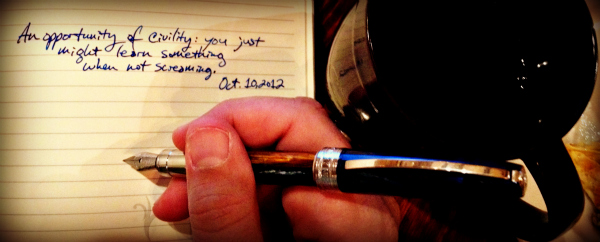
Oct. 10 ~ An opportunity of civility: you just might learn something when not screaming. #civility
Admittedly, this one is a little lighter today and I hope someone gets a chuckles from it. But at the same time, it’s a good one to remember.
In fact, it’s a good one to remember when speaking in political discourse, religious discourse, or just trying to figure out whose day it is to make coffee at the office. This one will hold true when we talk to our kids and when we walk up on the Meter Attendant slipping the parking ticket under our wiper blade.
Today’s post is about “posture” as much as volume. Am I postured for civil discourse? Does my body language, my reflex and habit, my volume, communicate that I’m ready to learn?
October 9, 2012 Redux in 2016
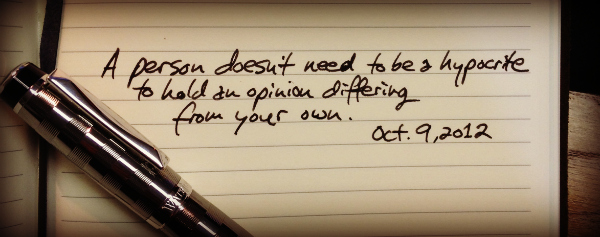
Oct. 9 ~ A person doesn’t need to be a hypocrite to hold an opinion differing from your own. #civility
Too often we hear a person maligned as a “hypocrite,” or we malign a person as a hypocrite, when expressing their opinion on an issue. And truthfully, we may be hearing them as very hypocritical. But have we listened well enough and asked good enough questions to understand how they arrived at the position they are espousing, and therefore level such an accusation?
We’re personally involved in the discourse. For me myself, it’s very true that I might be hypocritical indeed should I ever espouse their position. That gut knowledge that things wouldn’t be right for myself in their shoes can mislead me to believing that things aren’t right for them. It becomes too easy to assign the speaker malicious or nefarious motives.
We also often arrive at the conclusion that a person is a hypocrite by selective and easy posturing of ideas and positions into parity or equality. So, we begin by saying that if A = B and B = C, then A = C. This works in mathematics, but might cause a problem in other areas. We go on to say that if Opinion A = Opinion B, and Opinion B equals Opinion C, then Opinion A = Opinion C. It makes sense on the surface.
But in the human mind and heart we have a variety of values and beliefs, and many different experiences. A person may be speaking to Opinions A and B from a certain value and belief, but then speak to Opinion C after adding a second value into the equation. Or, a person’s experience leads them to develop Opinions A, B and C on the same value set, but Opinion B is nuanced out of parity with the others by personal trauma, frustration, pain or relationships.
You can’t know any of this about a person once you label them hypocrite and then have to bend all of your effort and influence to prove your claim. At the end of the day the person just might be a naughty hypocrite, but it’s not civil to assume that or begin with that presupposition. Civility will draw you into a discourse in which you can know the other and be known, in deeper, meaningful ways.
October 8, 2012 Redux in 2016
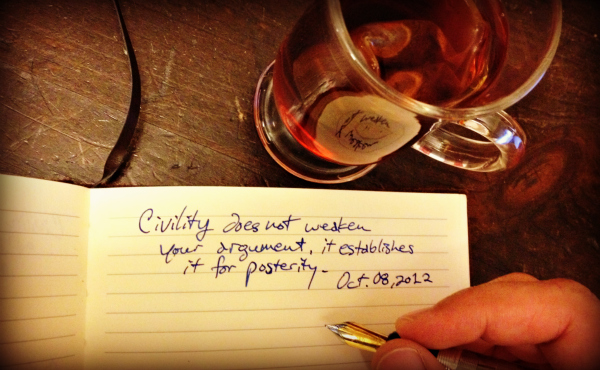
Oct. 8 ~ Civility does not weaken your argument, it establishes it for posterity. #civility
Too many times we believe that things like shrillness, dominance, volume and agression mark the good debater, the solid argument and the one who can shape social opinion. The other part of that misconception is that civility represets a kind of weakness. It is supposed that the argument made civilly is a missed opportunity.
Civility is not a weakness, but a strength for the longer term. When you or I are able to express and share our thoughts in a civil manner we establish those thoughts on a foundation that can last. We all want to be heard, but not at the expense of being heard well.
Incivility is a short cut that doesn’t pay off. Incivility can and often does bully itself onto the stage of public discourse and seems to have an audience, but it doesn’t last, it has no solid foundation.
We should let civility shape our discourse so that posterity will be able to continue to hear, to use and to righty judge the substance of our thought.
October 7, 2012 Redux in 2016
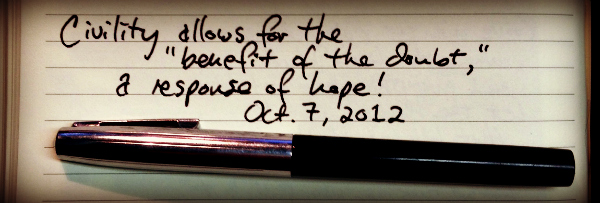
Oct. 7 ~ Civility allows for the “benefit of the doubt,” a response of hope. #civility
*I know it’s getting hard to be hopeful, but we can do it!
Civility has everything to do with hope, and giving the benefit of the doubt is often the first seed of hope that is sown in disagreement. When you give the benefit of the doubt you assume that the other person is not evil or irredeemable, even as they speak a position or opinion that is antithetical to your own.
When you do this you allow for many things to happen… you allow for them to nuance the things they have said. You allow them to keep speaking so that you might better understand them. You allow them to be a “work in progress.” And if we are serious about communication, then we recognize the progress needed by all of us.
Giving the benefit of the doubt also keeps the judgmental expressions off our faces. It keeps us from simply walking away. It keeps us from shutting down and giving up hope, and hope can be contagious. If we keep our hope alive, it just might spread and grow.
October 6, 2012 Redux in 2016
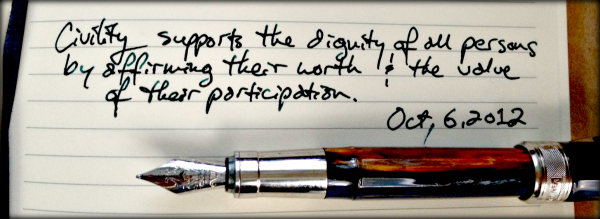
Oct. 6 ~ Civility supports the dignity of all persons by affirming their worth and the value of their participation. #civility
*This is something to think about, today. We’ve hit a point when not only are candidates ridiculed and smeared, but their supporters are called names as well. We hear “I’m going to cancel your vote” and taunts like that. The cynicism has reached new heights.
I’m hearing more and more voices in my lifetime that would limit who should be able to vote, and lamenting the many kinds of people who do. And they aren’t talking about race or gender, they’re talking about assumed intellectual and cognitive abilities.
It is simply uncivil to begin to pick and choose who has worth in our system of deliberation and choice. Just yesterday I watched SNL’s “Undecided Voter” gag. And I’ll admit I chuckled a few times. It was a funny, satirical poke at how many of us look at the other voters around us, especially those who disagree with us.
Still, civility demands of us a commitment to the value and worth of the other people participating in our discourse. I tweeted the last couple of days about the gift of allowing the other to speak and be heard. We won’t do that unless we understand our need for the other, their value and the importance of their participation.
 toddthomas.net