
Social Justice
Making Amends, Changing the Future
 272 Slaves Were Sold to Save Georgetown. What Does It Owe Their Descendants?
“In 1838, the Jesuit priests who ran the country’s top Catholic university needed money to keep it alive. Now comes the task of making amends.”
16, 2016
This is an important story for the Catholic Church, for Georgetown University and for our whole nation. Our deep historical sin of human trafficking, and the need to make amends for that sin, are not simply political or financial issues, they are the stories of fellow human beings with names and families that need to be told and owned by everyone in America, today. Even if you are not descended from human beings sold and exchanged as property, it is not so difficult to empathize and imagine the generational pain and impact of these kinds of wrongs in our history.
Today and tomorrow we need to be so much more aware of every person’s dignity, and also for yesterday, we need to be aware of a debt owed to those who carried more than their share of the cost at arriving where we are today as a nation. If first responders and soldiers are heroes for serving our country, and I believe that they are, then so also are the named and unnamed, remembered and forgotten slaves who toiled and served the economic engines at the birth of our nation. They may have not chosen their fate, but we can still honor their existence, repent the sins which enslaved them, and give them and their descendants their due. Honor them. Never forget them. Making amends is not about changing history, because that is something we cannot do. Making amends to them and to their families is about changing our now, and changing our future. That is something we can and must do.
This is an important story.
AMDG, Todd
Transgender Day of Awareness
 It’s November 20th and the 16th annual Transgender Day of Remembrance. If it’s a new idea to you, to mark this day, then I invite you to take a long painful look at the violence and rejection faced by our transgender family and friends, neighbors across our nation and world, every single day.
Especially today we’re remembering that our words feed into a larger mass of intolerance, fear and ignorance that will metastasize into physical violence, injury and death.
I’ll emphasize two important things from my last statement:
1) I believe we all carry some responsibility for the violence and deaths when we speak rejection, speak hatred and speak intolerant judgment toward transgender people. Our words can either support and build or diffuse and remove the hatred and fear toward our transgender neighbors, and…
2) Violence will happen toward our transgender neighbors; this is not an if but a when situation. This means it is crucial that we work toward a safer world for these precious, valuable fellow humans.
I invite you to make a conscious change when you speak of people, especially our transgender neighbors around the country and our world. I humbly offer these suggestions, believing them to be moral and needed responses:
1) No more jokes about transgender. It’s often a terrifying and painful situation for someone to contemplate or begin transitioning. It’s also often a time of joy and relief. They are seeing counselors and doctors and undertaking major change in their lives… they don’t need any more stress or trouble from us.
2) Let’s educate ourselves on the violence. Let’s dare to look at the numbers and the problem of violence toward our transgender neighbors and ask why it is happening and how we can help put it to an end.
3) Don’t spread rumors and false assumptions about transgender people. I can’t help but think of groups who spread fear and false ideas about transgender people, like the negative ads most recently in Houston which portrayed transgender people as opportunistic sexual predators. This is disgusting and not needed in our society.
4) Simply speak to and about people with dignity, all people. This isn’t as they say rocket science. When speaking of a transgender person, give them the courtesy and dignity of kindness. When speaking to a transgender person, give them the courtesy and dignity of kindness. Your grandmother will be proud.
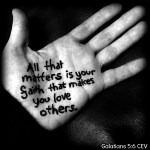 We don’t have a Transgender Day of Remembrance to set our transgender neighbors apart, but to highlight the need to work together toward safer and more dignified inclusion. As human beings, as fellow citizens and as people of faith, it is our responsibility to participate in making this world a safe place for all our neighbors.We share this world; let’s share it responsibly and joyfully.
AMDG, Todd
Also…
~ My post on November 20th 2014 Transgender Day of Remembrance with some amazing video footage.
~ My post on the problem of sexuality and violence.
~ My post earlier this year hoping for more unity in our humanity.
The Hashtag Matters
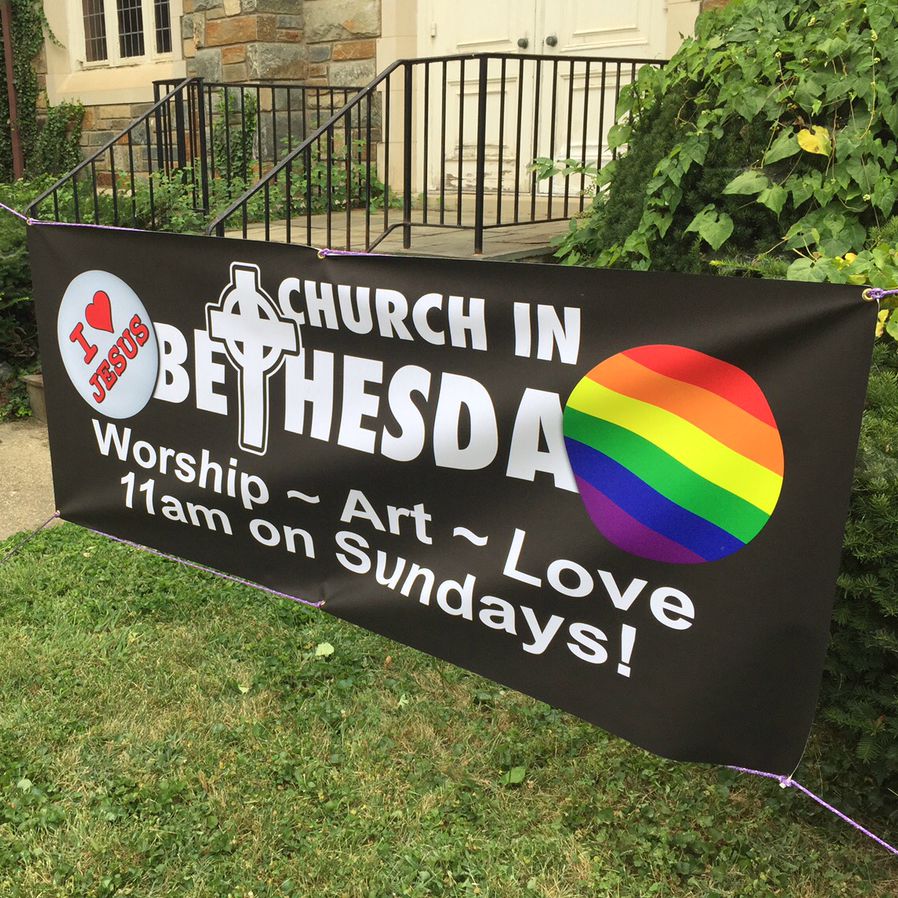
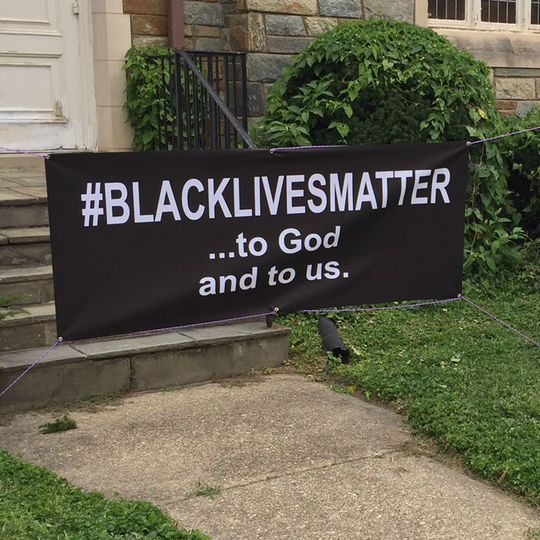 Black lives matter. I find it hard to understand why we have to elaborate so much on what this statement actually means. It means that our black neighbors matter. Our black friends matter. Our black family members matter. Following the suggestion of a congregant and leader here at CiB I made a #BlackLivesMatter banner for the lawn out front, to express our solidarity with all our black neighbors and to express our solidarity with a local church that had its own #BlackLivesMatter banner defaced multiple times.
When I got an email asking what I thought of this idea, making a banner for our church lawn, I thought immediately of another local church banner that was defaced. Back in the last couple of years a sister church up on Old Georgetown Rd, St. Luke’s Episcopal Church, had a banner asking for us to stand against gun violence defaced by the removal of gun. Really people, words matter.
The hashtag #BlackLivesMatter was born of a very real and present fear among our black neighbors that their lives don’t matter or don’t matter as much as other lives. That fear is born of many actual and verifiable things like:
- the history of racism and racial violence (as recent as a shooting this year in a black church in South Carolina, so don’t be fooled by the word history… that legacy of racism is still active and impactful in our society, today),
- prison incarceration rates for black citizens in the U.S.
- policing procedures in some cities that target black youth,
- harsher penalties for black offenders than people of other races for the same offenses,
- disproportionate arrest rates and episodes of police brutality and lethal force against unarmed black citizens.
- disproportionate death rates when interacting with police, even when unarmed.
 And if that weren’t enough, too many of their white neighbors just shrug and blame the victim for these inequalities and offer crass advice about too often playing the race card. And of course, we can always find an exception to a rule. There are black Americans who have not faced as much racism or negative attention from neighbors and law enforcement. But even as we are glad that some may not face such trouble, we are not granted a license to ignore the experience of so many who do. Finding a black neighbor without this fear does not erase the fear in the lives of others, just as one police officer behaving badly does not mean all police officers are bad. The hashtag is not just spin. The hashtag is asking if we care about our neighbor’s fear and pain. The hashtag invites us to come together around a truth that cannot be denied: black lives do matter. The hashtag doesn’t divide; it asks us to come together to put meaningful action behind our beliefs of equality and justice.
It seems we do have to say it: #BlackLivesMatter does not mean that white lives don’t, or brown lives don’t, or blue lives don’t (murder of police officers is tragically spiking this year), or that any other lives don’t matter. It simply means that black lives do matter, for real. It doesn’t mean they matter more, but does for sure address the fear that some believe that they matter less. The hashtag was born for a reason, with cause. It didn’t come from nowhere. It came from fear, doubt and experience.
It would be amazing if we didn’t need the #BlackLivesMatter hashtag! It would be an answer to prayers! It would be a great if our neighbors no longer lived in the fear and doubt that they would be aggressively policed and killed without cause. It would be wonderful if they that justice was also for them and theirs. It would be fabulous if their fears and concerns were heard and acted upon. The hashtag dreams of that world! Let it do its work. Let it remind us that listening to one another and taking one another seriously is important. Let it remind us that there are people behind hashtags, people that matter.
People of faith of any color should not be afraid of #BlackLivesMatter, but should embrace it’s truth: black lives do indeed matter. To become part of the solution we have to listen to the voices expressing the fear and doubt, and the pain and anger. Denying the voices of our neighbors who are hurting simply denies us and them the opportunity to begin the healing.
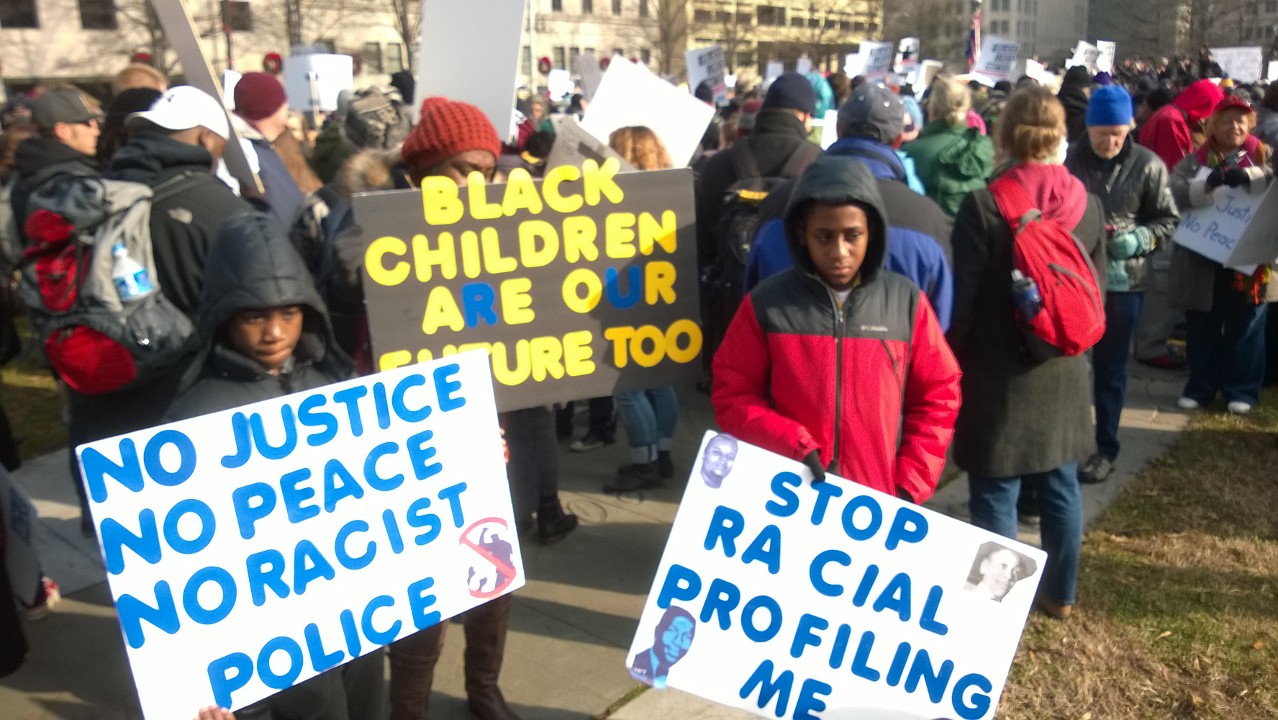
Escalate peace. The hashtag is not a call to violence or to more fighting. The hashtag is a call to step back and view one another with dignity and respect, black and white and blue and every shade around. We have to stop escalating the violence and fear and begin to build bridges and relationships between communities that will foster cooperation and growth. We can do this. We must do this. And the people of the book who claim the One who said “my peace I leave you” must work to establish this vision in the soil of very continent, nation and community of our beautiful shared planet.
AMDG, Todd
Reframing Our Expectations for One Another
Did you see the prank video floating through our Facebook streams recently about who helps a nicely dressed business man who falls and who helps an apparently homeless man who falls? The video opens many questions for us and itself seems to focus mainly on the appearances of the two men… I immediately wanted to go deeper with the video. If you haven’t seen it, here it is…
Perhaps like me, you live in and among a homeless population. We have many homeless folks in downtown Bethesda and more and more you can’t catch a red light on many main streets without a homeless or needful person asking for help while you wait. Homeless neighbors sit by us at Starbucks, greet us at the Metro and some will come and sit in our church building during the day as a quiet respite from the street. For the most part I believe we have created a different set of rules for interacting with our homeless neighbors, and that is a large part of what is happening in the video.
I dug around to see if my thoughts were online anywhere, and I at least found this bit on social interactions that better defined the thing I think we’re talking about in this case of this video… (the bolded emphasis in mine)
In sociology, social interaction is a dynamic sequence of social actions between individuals (or groups) who modify their actions and reactions due to actions by their interaction partner(s). Social interactions can be differentiated into accidental, repeated, regular and regulated.
A social interaction is a social exchange between two or more individuals. These interactions form the basis for social structure and therefore are a key object of basic social inquiry and analysis. Social interaction can be studied between groups of two (dyads), three (triads) or larger social groups.
Social structures and cultures are founded upon social interactions. By interacting with one another, people design rules, institutions and systems within which they seek to live. Symbols are used to communicate the expectations of a given society to those new to it, either children or outsiders. Through this broad schema of social development, one sees how social interaction lies at its core.
Source: Boundless. “Understanding Social Interaction.” Boundless Sociology. Boundless, 03 Jul. 2014. Retrieved 06 Feb. 2015 from https://www.boundless.com/sociology/textbooks/boundless-sociology-textbook/social-interaction-5/understanding-social-interaction-50/understanding-social-interaction-314-5912/
I believe the business man in the video represents someone living by our social rules, within acceptable systems and institutions. So when he falls, there is an immediate need among others to restore him. He better represents what we have invested ourselves in, an acceptable life by normative social standards. The homeless man? He is presumed to be living outside those systems and institutions, and therefore his fall has less impact on the passersby. They are not invested in him already, and so his immediate predicament is less impactful for them. In fact, he represents a threat for many people, either an immediate threat to their safety or a more cosmic threat to our presumed rules for living.
Am I trying to explain away the video and lessen it’s moral message and impact? No way! I want to take it’s message and come up with a deeper message than just, “Yo, help a brother off the curb!” As a human, I need to intentionally invest in my neighbors, even when they are living and doing life outside of my normative bounds, rules and institutions. Otherwise, I risk developing the kinds of blinders that allow me to walk past a fallen person without helping.
As a human who tries to operate out of a specific faith orientation, I am further challenged by following a religious leader who personally rejected and moved outside of many normative societal rules and regulations of his time. Yes, Jesus.
I’ve grown up hearing sermon after sermon about Jesus touching the untouchable, but has sermon after sermon changed any of us? Have we been equipped with eyes and understanding that allow us to risk stepping into the lives of those outside the social norm? The answer is a qualified and limited yes… I know and have known many amazing human beings, inside and outside of faith communities, who routinely step over those social lines and engage neighbors living outside the bounds of social norms. The answer is also a qualified and limited no… because many of us still operate almost exclusively inside the norms, some even religion’izing the social norms to become matters of faith. Don’t know what that means? Try to find the verse in the Bible that says, “Cleanliness is next to godliness.” (Hint: It ain’t there.)
If I’m being a bit too esoteric for you here, think of it this way… when a clean-cut businessman falls, there is very little cost to helping him… his clothes are less likely to stink or to get me dirty, he probably won’t ask me for money, and after a nice verbal gesture of appreciation we’ll both go on about our day with very little time lost. However, operating on our usual assumptions about people who live outside our normative rules and systems, I wonder if helping a homeless man will get me dirty, if he’ll smell bad, if he’ll ask me for money, if he’ll have a mental illness and hurt me, if he’ll want to talk and take up a bunch of my time… the assumptions go on, and those assumptions increase my projected cost to any social engagement with that person. Seriously, it takes a while to say it, but I think we routinely make these mental and spiritual calculations in a nanosecond.
Let’s pay up. Let’s intentionally reframe some of our social rules so that we are prepared to pay the cost of stepping outside the easy social norms and engage people less like us. It makes us more human. It makes us more faithful.
Just the other day I tried to give a friendly greeting to a certain local homeless man I often see at my favorite Starbucks. It’s one of the things I do, with homeless or well-off-seeming locals… I say hi and introduce myself. We’re neighbors after all. This particular homeless man wanted nothing to do with me. He rudely rebuffed me, loudly proclaiming that he didn’t want to talk to me, see me or shake my extended hand. And, it was a little embarrassing for me.
Now, at that moment of rebuff, I have a choice: 1) I can narrow my social rules and interactions, letting that experience confirm assumptions and stereotypes about “certain people,” and I can be very less inclined to try again to greet someone who is doing life outside my norms, or 2) I can pay the cost of that interaction, a blush and a rebuff, and offering a prayer for the pain and hurt this man is obviously carrying, I can prepare myself for loving the next neighbor to come along in my little sphere of life.
You see, Jesus did not touch the untouchable. Please, hear that… Jesus did not touch the untouchable. For Jesus all people were touchable, worthy of touch, deserving of touch and imminently desirable to touch. He wanted to engage them and was willing to pay the price, which could sometimes be high. He was whispered about, condemned and made fun of for engaging some folks, and in one memorable event he helps ten people, with only a single person taking the time to thank him.
Now, if you don’t live in a place with a present homeless population, I bet there still people not like you… I bet there are people who seem to live outside your rules and norms. Can you pay the cost of loving them? Can you move outside the norms of what you are most comfortable with and find them touchable? Can I? Or as our more grammatical gifted friends would correct me, “Will I?”
AMDG, Todd
Why We Must Prosecute Abusive Police Officers
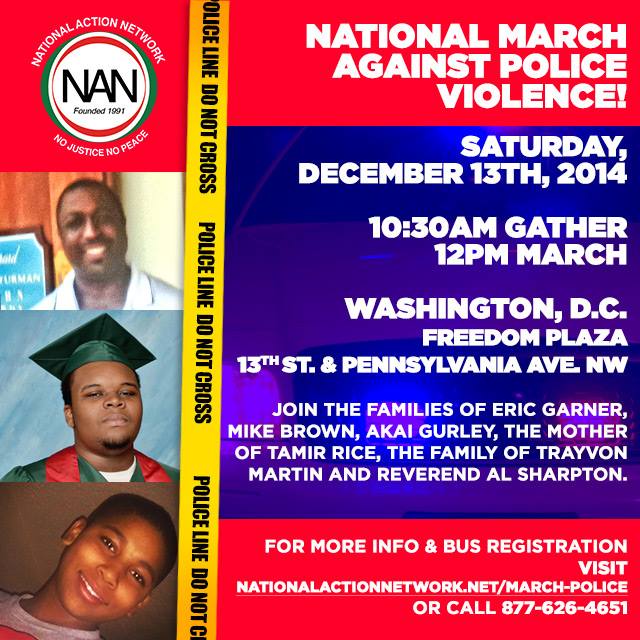 Why would we want to prosecute abusive police officers? Because we aren’t talking about whether all police officers are good or bad. They come in both varieties and we must prosecute the bad ones to respect and help the good ones. We need to recognize the difference so we can better appreciate the good and put an end to the bad.
I recently shared a post from Father James Martin S.J. on Facebook in which he points out that holding a bad officer responsible for abusive behavior is not to be against all officers in general, but against abuse. I’ll go a step further and say that’s it’s a necessity to hold bad officers accountable so that we further differentiate between the two. It is disrespectful in the extreme to every good upstanding police officer to let any overzealous, abusive or criminal officer get away with violence, much less with murder.
There are often stories of police officers who are amazing! I revel in those stories and I enjoy seeing and sharing them on my social media streams. I appreciate so much every officer who takes the job of policing our communities seriously and serves us with their best. Thank God for good police officers! Here are a couple of recent inspiring stories, officers who go the extra mile for people: With Food & Mercy and With Simple Courtesy.
I respect police officers so much. But I’m also going to downtown DC on Saturday to march with everyone else who gathers to protest police brutality. I don’t march because all police officers are bad. I march with families who have lost loved ones to bad policing. I march in memory of Michael Brown and Eric Garner, whose lives matter, and whose lives should not have been taken, and whose deaths are real and terrible.
~ I will march because of the lack of indictments for the officers who killed Mr. Brown and Mr. Garner (and so many others). Those missing indictments should scare every single person in this country, black, white, brown, yellow, male, female, etc etc. Can we be so dismissive of gun violence and the brutality of being choked to death that we just go on with our lives? Can two unarmed U.S. citizens be killed on our streets and our justice system simply choose not to address their deaths? Changes are needed.
~ I will march because so many of my friends here in their own country feel disrespected, disenfranchised, targeted and unsafe. Good good people are hurting because we haven’t learned to live together better than this. They carry a burden every day and every time they enter the public arena. I march on Saturday to show my solidarity with them. I march because I love them.
~ I will march because peace and a better tomorrow cannot come from simply ignoring the problems of today. We cannot dismiss this conversation away or ignore the pain and pleas of our neighbors just because it’s more sensational (or self-justifying) to focus on the rioters and looters.
~ And finally, I will march out of hope and a dream of peace, not out of anger or seeking violence. I’m not looking for a fight, but for an honest recognition that we have some real work ahead of us to bring justice to all our people. I will head downtown Saturday with a prayer on my heart and lips that God keeps the violent at bay and holds us all in check, so that voices might be easier heard than dismissed.
You don’t have to march on Saturday, but I sure wish you would. I sure wish you’d raise your voice with all the hurting people who cry for justice, for explanations, for hope for their children. I wish we’d all choose to work harder to speak for one another, seeing ourselves as our brother’s keeper and our sister’s keeper and the whole human family as our kin and beloved ones. We do not have separate futures in this country, but one shared and connected journey. Our children and grandchildren need us to secure the freedom, equality, safety and justice of that future in every way we can. We’ll only fully realize that hope when we work together.
AMDG, Todd
Sexuality and Violence
 I took a bit of time off from blogging to get thru Thanksgiving, and it was a great time! I hope your holiday was blessed, happy and safe. I have the same prayer for your Advent Season and celebration of Hanukkah: safety, joy and good times with friends & family!
Sexuality and Violence
I was captivated by the story this morning of two sisters in India who courageously fought back against some young men harassing them on a public bus. But, it stands in stark contrast to the tragic story of Tugce Albayrak who was murdered in Germany for standing up for two other women who were being harassed. Sexuality and it’s tragic link to violence is a conversation that we must all engage, in our homes, within our local communities, across our nation and around our world.
Women’s Sexuality and Violence
Women are whole sexual beings of value and beauty, not sexual commodities to be handled, traded, devalued or owned. I’m glad that in an increasingly post-patriarchal world we can see women’s value on the rise, but we still have a journey ahead of us. I encourage you to support campaigns like It’s On Us and Hollaback! I just started looking through the website of Stop Street Harassment, a group working to equip male allies in the struggle to end this type of sexual violence. Honestly, I’ve been a bit discouraged by the number of men I see on Facebook justifying or laughing about the problem of street harassment. We can do better.
Something that I believe men often miss is the physical and emotional stress caused by verbal violence and actions (proximity and following) which engender fear for women in public places. We’ve probably all seen the recent video highlight the problem of street harassment in NYC, but many men are missing the point. Take for instance this interview with a man who clearly has no clue what kind of violence lurks behind street harassment and defends it as something women secretly desire. Then there’s a video of a muscular man walking in NYC and receiving some similar catcalls and harassment. The creators of that video believe there’s a dynamic equivalent between the experience of the woman and the man in a similar situation. The sad truth is that women are sometimes beaten and killed for rejecting those street harassments whereas the muscular guy has a bit less of a chance of the verbal assault becoming physically violent. Let’s get real.
Here’s a quick look at the global problem of violence against women, courtesy of the World Health Organization.
LGBTQ Sexuality and Violence
One of the saddest parts of engaging the current conversations about our valuable LGBTQ sisters, brothers and neighbors is the prevalence of violence linked with their sexual identity. LGBTQ youth have a high rate of homelessness which leads to vulnerability to crime, exploitation and drug abuse. They are often rejected at home and either driven out by the stresses of nonacceptance or simply told to leave. This is sexual violence. One of the saddest parts of this picture is that religion is often cited as a basis for both the nonacceptance and for kicking these teens out of their homes.
Sadly, we’re all familiar with stories like this one from Philadelphia just a couple months ago when two gay men were harassed and beaten. These stories are all too familiar and they highlight the problem of sexuality and violence. I recently shared the video of Laverne Cox speaking on street harassment and the ugly verbal violence she has faced and the physical violence which sometimes faces transgendered women on the street.
And who can forget the preachers who have used their pulpits to incite violence, both verbal and physical, against our neighbors based on their sexuality? Some of us may want to forget them, but we should face the truth that this is our issue in the church and we still have work to do to address it and move forward.
Here’s a downloadable report on hate crimes and violence against our LGBTQ friends, neighbors and family, courtesy of the Human Rights Campaign.
Speaking Up on Sexuality and Violence
What I ask is that we learn to speak up on behalf of anyone and everyone who faces verbal and/or physical violence because of their sexuality. We’re talking about gender and sexual orientation. We need to develop reflexes as a culture and a species which react to this violence with justice and mercy. We need to be heard from our homes, phones, Facebook streams, blogs and pulpits clearly saying that this kind of violence predicated on issues of sexuality is unacceptable, not funny and unwelcome on our big blue spinning globe.
I’m mediating this week with the beginning of Advent on John’s introduction to who Jesus is as he arrives in the world, from John 1:1-4…
1 In the beginning was the Word, and the Word was with God, and the Word was God. 2 He was with God in the beginning. 3 Through him all things were made; without him nothing was made that has been made. 4 In him was life, and that life was the light of all people. 5 The light shines in the darkness, and the darkness has not overcome it.
Word. Powerful Word. Creative Word. We know this truth: that our words have meaning and power. As the Word was a shaping and creative force in God’s founding of creation, we have similar words to shape and make this a world of justice, peace and hope. We know the words of Jesus, who is himself the light and life, claiming that we similarly are “the light of the world.”
Are we ready to speak up? Are we ready to stand up and use our words to shape the world with God’s peace and grace? The world, every woman and man, every LGBTQ neighbor, awaits our decision. Let the light shine.
Let the light shine.
AMDG, Todd
Yesterday I Prayed
 Most of us rolled out of bed yesterday morning and reached for the nearest device that would link us to Tuesday’s election results. We saw the list of winners and losers. We felt like winners and losers.
And I prayed. I was both a winner and loser yesterday, my vote at times landed on a candidate who prevailed and at other times upon a candidate who will not lead us in the coming years. I would imagine that we all faced some wins and some losses as the ballots were tallied. We each will have issues and interests at stake in who leads us forward. We’ll all have hopes and we’ll all have fears.
Today, I’m still praying. Tomorrow, I’ll pray some more. Prayer is not a consolation prize or an escape from the realities of life. Prayer is the ever-present expression of what is timeless, what is transcendent, what is hopeful. Beyond the arguments, the political parties and caucuses, and all the maneuvering of the powers that be, there must exist a truth and a reality undiminished by our collective failure to express God’s love, justice, grace and charity to one another. It must.
When I pray I beg for wisdom and for graciousness to inhabit the winners and losers of Tuesday’s contests. I beg for wisdom to overwhelm them all. I pray for the Spirit of the Divine to overlay them, even if they do not recognize the source of their growing empathy, mercy, grace and courage.
We keep moving, praying and hoping. I know what issues and values I have at stake in these many new leaders, and in the old leaders who will continue in their positions of power and influence. I know what many of you, a diverse group of people I dearly love, have at stake in these leaders. But we cannot let our fear ever extinguish our hope. We cannot allow our disappointments or even our victories to erode our commitment to justice, mercy and equity for all people.
I hope we’re surprised and not surprised. I hope that in the coming months and years we realize more justice, more equality, more joy, more freedom, and more of the rich life that we have to share. I hope that we see less poverty, less disease, less violence and less hatred, beginning in the halls, offices and rooms of our own Capitol. I pray that the good stuff God brings us is surprisingly beyond what we can today articulate or hope. And I hope we’re faithful enough in our anticipation to not be too surprised.
Ad Majorem Dei Gloriam. To the greater glory of God. This is my daily prayer, inscribed upon my flesh with ink, that God’s glory grows and abounds in this world. This is my prayer because I am convinced that God’s glory is found in our love, grace, mercy and service to one another. Now and always, world without end. Amen.
AMDG, Todd
Why Campaigns Matter
 I have to admit that I have not always been a big campaigner.
I guess I’m missing the activist gene, because it just doesn’t come naturally to me. My genetic code seems heavier with apathy and procrastination. But, you know what? When I stop and pay attention I have to say, campaigns do matter.
We talk a lot about civility here at this blog, and I’m not at all apathetic about our need for civil discourse. As a person of faith I am convinced that our kindness, our gentleness and our support of all people’s value and dignity are at the core of being who God has made us to be, in both our words and our actions. Campaigns often help bring important things into focus and remind us of how we are to do life, how we are to do life well.
Someone just today on my Facebook feed shared something from the campaign to get us to stop using the word “retarded” as a humiliating insult or degradation of someone or something. I agree and I shared it along. I hate the word. It sounds and feels like a hit from a baseball bat. We need to do the same with the word “gay,” just like we need to stop using “hit like a girl” and various male and female genitalia as descriptions of negative and inadequate human attributes or behaviors.
Why does it matter? Isn’t this just all “political correctness” gone too far? I’m really done with the idea that we can use speech to offend, hurt and degrade, and then cry “political correctness” when we are held accountable for the destructive qualities of our verbal choices. I’ll tell you why the words we use matter:
1) Words have meaning, history and power. We cannot simply use a hurtful word and claim innocence by the fact that we have decided what it means for ourselves regardless of the word’s meaning and influence in the lives of other people. Retarded is a great example. The word has been used to degrade, hurt and humiliate people for years. It has, as many words do, both denotation and connotation. We do not have the right to ignore it’s negative impact on people around us.
2) We cannot use a word as an insult without insulting that to which the word refers. “That’s so gay” is an insult to gay people. “Hit like a girl” is an insult to girls, not a scientific measurement or expression of applied force. Using phrases like “He’s a real douche” or “Don’t be a dick” attaches negative meaning to things which are not in themselves negative. Feminine hygiene and male genitalia are not bad things. Our thoughtless words and actions can lead us to unintended consequences of meaning and perpetuation of hurtful meanings.
3) We have an obligation to listen and care. When our neighbors are injured by our words and/or actions, we have an obligation to care. There is no healthy philosophical, religious or spiritual system which separates one person’s well being from the well being of the world and people around her/him. We are connected. We should care.
Also…
- Joining a campaign doesn’t fix the problem. We don’t signal our participation with an anti-bullying campaign believing that to be the solution to bullying. What we hope is that within the sphere our friends and family we might increase the conversation and awareness of a problem, and thus we would hope to participate in concrete steps toward a solution.
- Joining a campaign does mean you’re thinking about something. Thinking is a good thing.
- Joining a campaign does mean you’re listening. Listening is polite.
- Joining a campaign does encourage campaign creators. That’s just neighborly.
Here are a few campaigns I’ve valued over the years and in recent months. I was excited to have had a chance to run in a local ONE Campaign 5k earlier this year and I just got my “It’s On Us” t-shirt a few weeks back. I believe that these kinds of campaigns are hopeful and reflect a lot of positive thinking and action in our world. I just might be becoming an activist…
Spread the Word to End the Word (retarded)
It’s On Us (combatting sexual violence)
He For She (solidarity for gender equality)
Hollaback! (you know, stopping street harassment)
I Choose (anti-bullying)
Human Rights Campaign (civil rights and equality)
The ONE Campaign (ending poverty)
Let’s keep it real. Endorse and support the campaigns you believe in, and let’s make the world a better, shinier, happier place for having supported us through the years of our lives.
AMDG, Todd
Ferguson: The Need to Listen
Before Ferguson becomes old news in the wake of a more recent death or similar narrative to the sad loss of Michael Brown’s life, I want to ask just one thing of my beloved friends and neighbors who are not African American: Please, start listening and validating your African American neighbors’ stories, fears and feelings.
It’s time for us to fully hear and validate the narratives from our African American sisters and brothers across this country. We have to listen, to hear the fear and to hear the pain, and we must accept it. It can be such a blessing to be heard, and such a hurt to be ignored.
When something like the death of Michael Brown occurs, the fatal police shooting of an unarmed young African American male, we begin to hear the multitude of voices saying that this is status quo for their neighborhood. They say that this just part of being black in America, that it’s their fear for their own children, and that it’s just another white man killing a black man. We need to listen to these voices.
I resist listening because to do so is painful. Another armed white man has killed an another unarmed black man, and won’t face any charges, because that’s just the way it is in America. As a white man I cringe and want to look away, to “listen away” if only I could. I want it to not be true. I want it to be wrong. I want to deny the voices. But to deny the words, to ignore the words or to argue against the reality of my neighbor’s fear, pain and frustration, is to add insult to their injury. In fact, it’s worse than insult. It’s further injury.
It’s painful to validate the pain of my neighbor because I must then help carry it. I will sometimes do this for people I know and love, say the people in my family or my closest friends… but to carry the pain of a stranger? To carry the pain of a stranger, a pain that is also an indictment of me and the so near and present history that has been a huge part of me being who I am, and where I am, and what I have? That’s hard for me, a white man.
And yet, listening is exactly what I need to do. I have to listen and believe in the person speaking. I have to validate their story. I must value and give dignity to the experience of my hurting neighbor. If I cannot hear and value my neighbor, then I cannot speak to and journey with my neighbor. I will have already taken from them the value of their presence.
We all need to be heard and validated. When our African American neighbors speak, they must be heard. When their stories are told, we must welcome them to share. And when we are shamed by their words and begin to feel the hurt they are sharing, we must carry it with them. This is the only road to the future.
When our African American neighbors speak of their fear of raising children and the specter of death from police shooting, we must listen. When they speak of fearing the police, we must listen. When they speak of being misunderstood and harassed by white law enforcement, we must listen. When their story is painful to us, we must pay the price of listening.
There’s no way forward other than giving the dignity of thoughtful listening, and the validating worth of being heard. We cannot simply choose a side and hunker down with our arguments in our better neighborhoods and hope for compelling distractions to ease our disquiet… at least until the next shooting.
There are many narratives, and they must be equally heard. The Ferguson narrative is not the only African American narrative of contemporary America, but it is an authentic and valuable narrative that needs to stand alongside the other stories of being an American today.
There are also streams of experience that cut across the many narratives. We won’t begin to find a way forward between communities and their police forces as long as we ignore the real fear, the real pain and the real distrust engendered by histories of abuse, injustice and neglect.
A new narrative comes from our collective pain over the past and present, our redressing of wrongs and our belief in one another. When white Americans quote “black-on-black” crime statistics and point to the background looting that so often accompanies the peaceful voices begging to be heard, we do a deep injustice to the future, theirs and our own.
We cannot just say that we want to move forward. We have to be fully present now. We must trustworthy listeners. Although there is a goodness in attempting to be “color blind,” I’m afraid the weakness of that idea exists in it’s refusal to validate the divergent stories and experiences of different colors.
 So, I’m trying harder than ever to listen, and I ask you to as well. Seek out the stories. Let the voices have their say and be heard. I ask you to want to better understand. Toward that goal, I’m reading Black Like Me at the moment. What the heck, I grew up in Texas and didn’t read this in school!? I grew up a few miles from the author’s home town and never heard of John Howard Griffin!!! Come on, Texas! I only know of him now because my dear friend David Gerard, who is African American, mentioned him in a poem I’m going to share in this post. David is also a musician, a poet and a gracious soul.
 Years ago I was affected by reading Nathan McCall‘s Makes Me Wanna Holler, a book of pain that forced me to hear someone’s story that was so very different from my own. It was hard to read and I wanted to argue at times, but his story needs to be heard and understood.
Maybe you have heard of “the talk,” the talk given to young black men by their parents who fear for them? This is a real part of growing up in America for many families, and we should all own that shame and want a better future.
I ask you, to hear my friend David’s poem, and to love him as I do. I’m going to reproduce the poem here and try to get his arrangement as visually true to his pdf he sent me as possible…
THE RACE CARD
when I try to tell my friends
what it’s like to be a black man in America
they evoke a patronizing empathywhen I try to tell my friends
that there is one standard for me
and a double standard between us
they seek refuge in their denialwhen I try to tell my friends
how every black man ever stopped by the Police
wonders if he’ll be shot to death
they say I’m just being melodramaticwhen I tell them that i’m nothing
in the eyes of authority
and that my life is easily expendable
they try to change the subjectwhen I tell my friends
that every black teen from Trayvon Martin to Michael Brown
is six feet under due to prejudice and brutality
they ask me to look at “the other side” of thingswhen I tell my friends
to go undercover, as John Howard Griffin did
and notice the difference in how they are treated
they accuse me of “playing the race card”when I was twenty-two,
I was talking with a friend
in the lobby of a moviehouse
when a bunch of cops came inin search of a suspect
they pinned me to the wall and frisked me
because they were looking for a black man
when the victim saw me
and said to them, “That’s not him”
they took their hands off me and left
without apologywhen I try to tell my friends
the humiliation and shame I felt
and their casual disregard
they say, “they were just doing their job”when I try to tell my friends
they will never know what it is
to walk a mile in a black man’s shoes
they just don’t get itmy friends accuse me of playing “the race card”
but that hand was already dealt to me
the day I was born.18 August, 2014
I thank David for telling his story. I pray that we listen better, and that together we all can make a way forward, a way that tells and values our stories, and writes a better one for tomorrow.
AMDG, Todd
Will We Live Up To Their Faith in Us?
 I’ve been thinking about the children on our Southern border and the need for us to move in a gracious, welcoming, valuing way to address their needs. But it’s not just about their needs. I believe an essential part of who we are as a nation and a people is on the line.
The child immigration crisis in the South is a test of our nation’s values, beliefs and future, and we run the risk of disappointing ourselves as much as neglecting these children. The more I try to hold all the facets of this problem in balance the more I am convinced that we face a unique moment of challenge and opportunity as a nation. Ten and twenty years from now, will we have a generation in our nation that includes these children, I’ll call them Hopers, among us at universities, schools, workplaces and communities across our country? Or will we have a shameful memory of not responding to the hurt and pain of our most vulnerable neighbors?
What is it that causes those parents to hope for so much from us? I’m stumped trying to imagine what the parents of these children must experience in their daily lives at home and what they must imagine we will do as surrogates for their children. Why do they believe in us so deeply and so optimistically? I don’t know, but I do believe this: We have not set a trajectory of hope or healing in our response to these children. We have been afraid and sometimes angry. It’s time to change the conversation and set a new trajectory that will lead us all, all of us, to a blessed and shared future.
Can we live up to what their parents have believed of us? Are we as good as we have believed? More and more I’m beginning to be a Hoper, myself. I want to hope in us and believe in us, too! I want to see us face such a challenge and opportunity with an amazing grace and the poise of a nation that knows all too well about displacement and the painful legacy it leaves behind. We have this amazing opportunity to change the way we act as a species, a nation, a culture and as neighbors. It truly is one of the greatest tests of sharing that I think we have ever faced. And we can be amazing if we choose to be. I hope we shine.
I know the arguments about lawful entry to our country. I understand the fear of validating the practice of just shipping children wholesale across the desert to our border. I get the worries, I understand the indignation, and I share some of the trepidation. We still have to hope. We need hope as much as these children need hope. We still have to act. We still must regard the sanctity of human life and our connection with all people as a central priority to safeguarding our own future, our shared future.
Let’s not fear anymore. Enough with the indignant outrage. Let’s put aside our worry. Let’s embrace these children and face tomorrow with them. They are here now. They are ours. They are us. Let’s share the hope and belief in us of those parents.
I don’t have all the answers to the problem at the border, but we must respond with dignity, hope, love and concern for these children. We must respond, sooner than later. Let’s shoulder the cost of welcoming. Pray. Sign petitions. Donate to relief work. Speak peace. Love these children.
Let’s all be Hopers.
AMDG, Todd
*Here’s a timely warning about neglect and an example of creative thinking to find longer term solutions to problems like this, from David Gergan and Daniel Katz. I thought it was a good read, worth consideration.
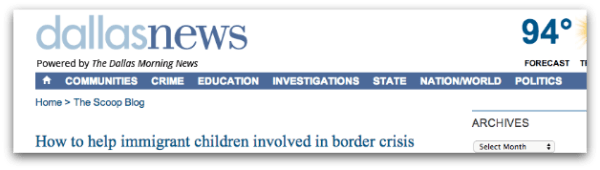
*No need to go into detail about how I’m getting involved, but here is an article from the Dallas Morning News with links to Texas area relief groups and opportunities to join their work…
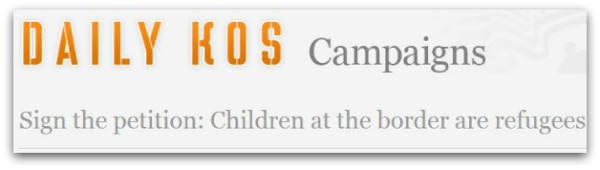
*Here are some petitions and perspectives…



- ← Previous
- 1
- 2
- 3
- 4
- Next →
 toddthomas.net