
Devotional Thoughts
A Sacred Companion
 With 2015 just around the corner I want to throw out as much encouragement as I can for you to make and attain some goals in the new year and to grow with God. I want to be a sacred companion for your new year.
This was a title we heard Fr. Richard Rohr use in his email I quoted in my last blog post… a sacred companion is a spiritual friend and/or a director who walks along with you. We walk with God, and a sacred companion is one who recognizes this and lives into that shared journey with you.
I personally come at this from two angles: 1) as a pastor and spiritual director, and 2) as a life coach. Let’s talk about the way each of these two roles can function for us in 2015.
Spiritual Direction.
As a spiritual friend directing you in prayer and spiritual growth I will be supplying you with a reading list of passages and questions for reflection. I’ll be supplying you with beginning places (intentions) and methods (different exercises) for prayer. You’ll journal and record the things you experience and discover in the practice of prayer and we’ll be in conversation about those experiences.
What does this spiritual relationship entail and require from you? You need to commit to several things: 1) At least a two month period of direction, 2) at least 30 minutes a day in prayer and reading, and 3) at least 30 minutes a week in conversation with me.
What does this spiritual relationship entail and require from me? I will be committing to several things as well: 1) praying for you daily, 2) reading the same passages you are reading, 3) at least 30 minutes a week in conversation with you, and 4) keeping in contact between our conversations.
A couple of past postings on prayer & spiritual growth:
Prayer Intention: Finding Rhythm, and
Ignatius of Loyola, My Spiritual Friend
Life Coaching.
Life coaching is a bit different from spiritual direction. In the life coaching relationship I still a companion, but I’m not directing the journey. I’m not providing you with readings and answers, but instead I’m asking questions and digging deep with you into the questions and goals you have about about your life. Life coaching is about managing change, setting goals, and achieving goals.
What does life coaching entail and require from you? Like a spiritual direction relationship, coaching will take some time and commitment… but the payoff can be more than worth it! You will be asked to: 1) be completely honest with me and yourself, 2) set some clear and measurable goals, 3) commit to yourself to pursue the changes and goals you identify as needed in your life, 4) meet with me for 45 minutes once a week, and 5) commit to at least four months of a coaching relationship.
What does life coaching entail and require from me? I also have a lot to do and accomplish with you coaching journey. I will be committed to: 1) being prepared for each meeting each week, 2) spending at least 45 minutes with you each week, 3) holding all our conversations in complete confidence, 4) being completely honest with you at all times, and 5) keeping in contact between our conversations.
A couple of my past posts on life coaching:
One Reason I Love Life Coaching: Healthy Dependence, and
I Will Listen
 These are two ways I offer myself to you, in a committed journey of life. Have questions? Let’s chat. Have concerns? Let’s chat. Both spiritual direction and life coaching can happen, and happen well, either face to face, video chatting or over the phone. I actually do prefer Skype. Of course, I’m always happy to have some good conversations with you, but these kind of committed journeys achieve the most for both of us.
Can we mix them up and do both? I think I’ve learned that we cannot in fact mix them up. We can do both over the same period of months, but our times together in conversation need to be kept strictly within the realm of spiritual direction or life coaching. We can do both over the same period of time, or one after the other, but not in a hybrid form of both at once.
Sound like something you could use? Let’s do this! 2015 waits!
AMDG, Todd
Dreaming Into 2015
 It just feels natural to look at the coming new calendar year and begin to dream. It’s a new year, but also the same old me. What will I dream for the coming combo of old me and new days? Am I ready to grow and seek, find and fail? Am I ready to move with a sense of purpose and love? Am I dreaming wide awake?
I was richly blessed by the daily email today from Fr. Richard Rohr. If you don’t get his emails I’ll link that email entitled In Our End Is Our Beginning as well as quoting a bit from it. He’s always laying some beauty and wisdom on us, a deep quiet for our busy and hectic days.
He lays out some important ideas for moving into the new year, new and old practices that help us engage life and growth. Here is how he labels and describes them:
Contemplative practice: Contemplation is a “laboratory” in which you learn to die and to be reborn. The rest of your life becomes the field in which you live out this way of surrender and participation in Love. Commit to a daily practice of some kind–silent meditation, yoga, chanting, or maybe one of the “Rest” practices introduced in the Saturday meditations.
Sabbath: Set aside regular, longer periods of quiet or retreat, simply to rest in awareness of God’s presence. Find a rhythm of rest and work that allows for renewal so that you enter your active life from contemplative grounding.
Service: Allow the natural welling-up of love to flow outward in acts of justice, healing, and compassion. Life is not about you; you are about life!
Shadow work: The task of searching out and embracing shadow–the parts of yourself that you hide or ignore–is ongoing, the work of a lifetime. Let the people and circumstances that “push your buttons” be your teachers. Look for yourself with a loving gaze in the mirror of both your enemies and those who enthrall you.
Spiritual direction: If you do not have someone to guide you, to hold onto you during the times of not knowing, you will normally stay at your present level of growth. Seek out a sacred companion you can trust to be honest and present to your journey, who can reflect back to you God’s presence in your life and the world.
These are beautiful movements of life and growth. How do we make them a reality in our daily hustle and bustle? What of these might you engage in 2015? What other dreams and goals will you set for these coming new days? You can call them goals, dreams or new year’s resolutions, but let’s talk about making some plans for 2015…
Simplicity Rules.
First, keep your dreams simple and attainable. Want to engage that contemplative practice? Then be realistic. You won’t begin by chanting an hour every day at 4am. Neither will I. Think about your schedule and where and when you might take a regular break. Is it the commute to work? Mornings are great times to center on God and God’s grace. Is it at lunch when you need to re-energize for the rest of the day? Keep your goals fairly simple and within reach: not too easy, but attainable. Then you can really celebrate the victory of that dream and move on with bigger ones! But doesn’t faith mean that I must dream bigger than I can imagine or attain? Nope. God does bigger than we can imagine, and we are not called to usurp God’s role in moving past our own abilities and imaginations (Ephesians 3:14-21). You can keep it simple and faithful. God will always surprise us.
Sharing is Nice.
Second, share your goals and dreams and have them visible. Let some others know what you are dreaming. They might become partners with that dream! You might inspire them to dreams of their own! But most of all, you are speaking that dream aloud and giving it even greater life. Write down your dreams and plans and keep them visible, prominent in a journal or on a wall at home. This helps you to be reminded of your goals as well as tracking progress and measuring your journey toward a dream. Life, as well as dreams, are best when shared. We need each other.
Plan for Success & Failure.
Third, make some plans for the times when you will succeed and when you will fail. We don’t like to admit that we may not meet a goal or always live according to our dreams for doing life, but it’s a reality that we are frail, fickle and forgetful at times. Be ready to celebrate the successes and to forgive yourself for the failings. How will you celebrate a dream realized? How will you “lift up the cup of salvation and call upon the name of the Lord”? (Psalm 116) How will you forgive yourself, learn whatever should be learned from the failure, and faithfully move on? Both successes and failures will follow our best planning and dreaming. Plan on it.
And finally, I offer myself as a sacred companion. I like that description which Fr. Rohr uses for a spiritual friend who travels along with you. I will be that for you and will ask you to be the same for me. Whether your dreams are more spiritual in nature, seeking growth with God, or more daily life in nature, looking for a new job or car, I will walk that road with you. Let’s talk more about it.
“Let no one ever come to you
without leaving better and happier.
Be the living expression of God’s kindness:
kindness in your face, kindness in your eyes,
kindness in your smile.”
Mother Teresa of Calcutta
AMDG, Todd
Advent Week Four: Love and Favor
 So Christmas week got a bit busy and I didn’t get a fourth blog out for the introduction to Jesus from Mark’s Gospel. I hope you all had a beautiful holiday with friends and family and I’m praying that you have an amazing new year! Today, I’d like to combine that missed week with the text we used this past Sunday at Church in Bethesda, because they are linked in a special way.
Mark doesn’t give us the dramatic birth narrative or any youthful Jesus at all. He begins with the prophetic voice of Isaiah and then the contemporary voice of John the Baptizer telling the people to pay attention, “The One is coming.” And the One who is coming is all about Good News.
1 The beginning of the good news about Jesus the Messiah, 2 as it is written in Isaiah the prophet: “I will send my messenger ahead of you, who will prepare your way”– 3 “a voice of one calling in the wilderness, ‘Prepare the way for the Lord, make straight paths for him.’ ” 4 And so John the Baptist appeared in the wilderness, preaching a baptism of repentance for the forgiveness of sins. 5 The whole Judean countryside and all the people of Jerusalem went out to him. Confessing their sins, they were baptized by him in the Jordan River. 6 John wore clothing made of camel’s hair, with a leather belt around his waist, and he ate locusts and wild honey. 7 And this was his message: “After me comes the one more powerful than I, the thongs of whose sandals I am not worthy to stoop down and untie. 8 I baptize you with water, but he will baptize you with the Holy Spirit.” Mark 1:1-8
Jesus is the awaited good news. Jesus is the intersection of the vast narrative of God with humanity in a special way, the fullest way, and he comes to us with Spirit. It’s a brief yet exciting introduction in my humble opinion.
And then the One arrives to be baptized by John and we finally have a bit of good narrative drama… the sky is torn wide open and that previously mentioned Spirit falls on Jesus as a dove and the voice of God proclaims, “You are my Son, whom I love; with you I am well pleased.” Mark 1:9-13
And so we meet Jesus, the very image and presence of God’s love and favor. In Mark’s Gospel we find the beginning of the story with Jesus rooted in the prophetic story of God and fueled by love and favor. God is pleased and announcing love. It must have been an amazing time for Jesus. I believe it was also formative for Jesus as love and favor become the core of his ministry and message.
Yesterday we turned back to Luke’s Gospel for a passage that is often described as the inauguration of Jesus’ public ministry. We know from the Gospel accounts that he has already been traveling and preaching, but it’s a special time in Nazareth when he sits in the synagogue and again we hear the words of the prophet Isaiah, which Jesus claims as his own. He truly is inaugurating something special…
14 Jesus returned to Galilee in the power of the Spirit, and news about him spread through the whole countryside. 15 He was teaching in their synagogues, and everyone praised him. 16 He went to Nazareth, where he had been brought up, and on the Sabbath day he went into the synagogue, as was his custom. He stood up to read, 17 and the scroll of the prophet Isaiah was handed to him. Unrolling it, he found the place where it is written: 18 “The Spirit of the Lord is on me, because he has anointed me to proclaim good news to the poor. He has sent me to proclaim freedom for the prisoners and recovery of sight for the blind, to set the oppressed free, 19 to proclaim the year of the Lord’s favor.” 20 Then he rolled up the scroll, gave it back to the attendant and sat down. The eyes of everyone in the synagogue were fastened on him. 21 He began by saying to them, “Today this scripture is fulfilled in your hearing.” 22 All spoke well of him and were amazed at the gracious words that came from his lips. “Isn’t this Joseph’s son?” they asked. Luke 4:14-22
God’s love and favor expressed at his baptism seems to become the core of what Jesus sees as his ministry, and he announces just that very favor in the synagogue of Nazareth. Again, there is the Spirit upon Jesus that now speaks through him to announce good news: favor for the poor, liberty for prisoners, sight for the blind, freedom for the oppressed, and a time of God’s favor. He sets his ministry firmly in the soil of God’s raging favor, rich love and grace for the least expecting, least powerful, most disenfranchised and often the least deserving.
He doesn’t announce a new reign of greater power for the powerful. He doesn’t promise greater glories for those in authority. He doesn’t come with reward for the faithful, but instead he offers hope to the hopeless and favor to those without merit. The weak and without power, the blind and captured ones, find sight and liberty. The guilty ones, the prisoners who have been captured in their own culpability, find freedom.
Jesus brings favor to those most needing it, not to those most deserving it. This is a fundamentally important aspect of his ministry and purpose that we must not lose. We must hold to the Jesus who brings God’s favor to all the unsuspecting and unexpected. This truly qualifies as good news.
So, what will your 2015 be like? Have you made plans? Have you laid out goals for the year? Do you understand that you are not trying to attain God’s favor, but you already have it? Have you breathed deep the love and favor of God to fill your lungs with vital life and readiness? Can you stop for a moment and imagine the sky torn asunder and the Spirit wrapping you in a warm embrace while God whispers, “I love you. You are amazing and I’m so happy you are mine.”
Go into the new year daring to stand in that embrace. Go into 2015 believing in the favor and the love of God. If you need to see, if you need to be freed, this is the what the favor does. If you struggle against a poverty of body, mind or soul, this is what the favor comes to help you with. Jesus is the image of favor offered, not favor earned. Claim it, for it is yours.
“You don’t have to change
for God to love you.”
Anthony de Mello SJ
AMDG, Todd
Advent Week Three: BEHOLD!
 In looking at Matthew’s introduction to Jesus we focused on the story of Joseph, and it only makes sense to cover Mary’s story with Luke’s Gospel. Luke gives us the grand narrative of the birth of Jesus, beginning with the drama surrounding his aunt, uncle and cousin, and then his own parents traveling to Bethlehem in that iconic journey which comes to rest under the star. He has angels galore, shepherds and an all-booked-booked-up inn. We have women breaking out into song and a guy with temporary muteness. Luke really delivers.
But in Mary’s story a single word has captivated me this season: Behold. You almost have to go back and grab an old translation for this, and I chose to study and read from the King James Version this past Sunday, Luke 1:26-38…
26 And in the sixth month the angel Gabriel was sent from God unto a city of Galilee, named Nazareth, 27 To a virgin espoused to a man whose name was Joseph, of the house of David; and the virgin’s name was Mary. 28 And the angel came in unto her, and said, “Hail, thou that art highly favoured, the Lord is with thee: blessed art thou among women.” 29 And when she saw him, she was troubled at his saying, and cast in her mind what manner of salutation this should be . 30 And the angel said unto her, “Fear not, Mary: for thou hast found favour with God. 31 And, behold, thou shalt conceive in thy womb, and bring forth a son, and shalt call his name JESUS. 32 He shall be great, and shall be called the Son of the Highest: and the Lord God shall give unto him the throne of his father David: 33 And he shall reign over the house of Jacob for ever; and of his kingdom there shall be no end.”
34 Then said Mary unto the angel, “How shall this be, seeing I know not a man?” 35 And the angel answered and said unto her, “The Holy Ghost shall come upon thee, and the power of the Highest shall overshadow thee: therefore also that holy thing which shall be born of thee shall be called the Son of God. 36 And, behold, thy cousin Elisabeth, she hath also conceived a son in her old age: and this is the sixth month with her, who was called barren. 37 For with God nothing shall be impossible.” 38 And Mary said, “Behold the handmaid of the Lord; be it unto me according to thy word.” And the angel departed from her.
Mary said “BEHOLD!”
It was interesting to look into newer translations and see verse 38 expressed in different ways. Many simply had Mary say something like “I am the Lord’s servant” or a variant thereof, and some at least allow her to say, “Here I am…” In the Greek she says idou, which is “see me, perceive me.” She really does say behold!
I think that Mary was often presented to me as someone who acquiesced to God’s will… but this is not acquiescence, this is proclamation! She turns the table on the angel and says, “Ok Gabriel, now you pay attention and see that I am God’s gal!” She’s not giving in, she’s buying in.
Mary is sounding very prophetic here. This part of her story reminds me of Isaiah’s moment of identifying himself in God’s plans, “Also I heard the voice of the Lord, saying, Whom shall I send, and who will go for us? Then said I, Here am I; send me.” Isaiah 6:8, KJV.
This Is A Powerful Woman.
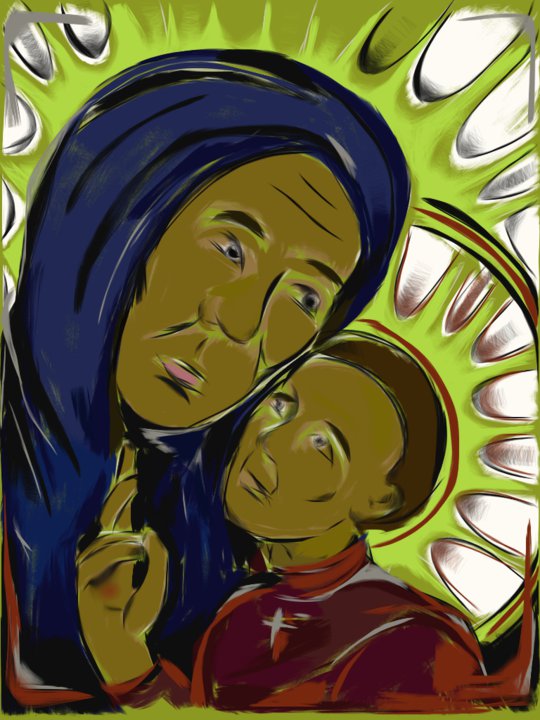 Why does it matter that Mary said behold? It matters because she is on the cusp of major life joys and changes, and God arrives to announce the impossible, the unlooked for and the unimaginable… and she buys in. She has her moment of how can this be?, and then she squares her shoulders, takes a deep breath, and gives herself to God’s insane sounding plan. This young woman hands it all to God and allows herself to be caught up in something she does not control, accepting all the repercussions to come. We think of Christ being incarnated in the Advent story, but this is an moment of faith being incarnated, strength incarnated and courage incarnated.
You Are a Powerful Woman (or Guy).
The story of Mary matters because it is our story as well. I want to be like Mary. I want to hear God’s crazy sounding will for peace and good news, grace and reconciliation, and believe it! I want to see a place for me in that plan, and I want to buy in like Mary.
I want faith to be advented in me, incarnated in my own behold! If we were all Mary in our own communities, Mary in our schools, Mary in our homes… if God’s insane grace, love and forgiveness were allowed to interrupt our daily plans and advent something new… if only. How many cycles of abuse would be stopped? How many cycles of insult and hurt would end? How many hearts would be reconciled in God’s peace? What do I miss when I insist on the plans I have made?
I’m not sure I can always be as strong as Mary when confronted with God’s work in the world. Many days I feel more like Zechariah, questioning and struck mute by my doubts. (Luke 1:5-25) But that’s ok, because Zechariah’s mouth was eventually reopened, his words are returned to him, and he sings a beautiful song…
“Praise be to the Lord, the God of Israel,
because he has come to his people and redeemed them…
…because of the tender mercy of our God,
by which the rising sun will come to us from heaven
to shine on those living in darkness and in the shadow of death,
to guide our feet into the path of peace.”
Let’s go advent some faith. And if we don’t have the words at a given moment, keep believing and the words will come. Yes, Mary was blessed among women, and she is also a prophet and a inspiration for us all.
AMDG, Todd
Adventing Grace: Living for People’s Honor
It’s the second week of Advent! Woot! At Church in Bethesda this past Sunday we dug into the first chapter of Matthew’s Gospel to explore his introduction to Jesus. Matthew begins with a lengthy genealogy of Christ (which we’ll skip over for now), but he then moves into a birth narrative, the subject of our discussion this week. Let’s take a peek at that in Matthew 1:18-25…
18 This is how the birth of Jesus the Messiah came about: His mother Mary was pledged to be married to Joseph, but before they came together, she was found to be pregnant through the Holy Spirit. 19 Because Joseph her husband was a righteous man and did not want to expose her to public disgrace, he had in mind to divorce her quietly. 20 But after he had considered this, an angel of the Lord appeared to him in a dream and said, “Joseph son of David, do not be afraid to take Mary home as your wife, because what is conceived in her is from the Holy Spirit. 21 She will give birth to a son, and you are to give him the name Jesus, because he will save his people from their sins.”
22 All this took place to fulfill what the Lord had said through the prophet: 23 “The virgin will conceive and give birth to a son, and they will call him Immanuel” (which means “God with us”). 24 When Joseph woke up, he did what the angel of the Lord had commanded him and took Mary home as his wife. 25 But he had no union with her until she gave birth to a son. And he gave him the name Jesus.
Matthew stands alone as the Gospel writer giving us the story of the annunciation to Joseph, something we usually associate with Mary (and which we’ll see in Luke’s Gospel). Joseph stands in a similar situation to Mary in that his marriage plans and future marital hopes seem to be coming apart at the seems… his betrothed has turned up pregnant. He would be understandably upset, angry and hurt. He would understandably feel betrayed, and most of us would lash out at Mary in our hurt and anger.
But Joseph is a good man, a righteous man, and that leads him to grace instead of disgrace in his dealing with Mary. He’s a righteous man. The Greek word there means that Joseph is a keeper of law, both human and divine, and is as he ought to be. And that leads him not to judge or to disgrace Mary, but to move in a way that protects her from any further hurt or harm. The circumstances look about as bad as they could be for Mary and as hurtful as they could be for Joseph. She’s not yet fully married, but now unexpectedly pregnant, and Joseph moves to shield her from further trouble.
When it says that Joseph did not want to expose Mary to public disgrace the word in the Greek does mean to put on display. Isn’t that what we so often do to deflect any blame or wrong-doing that might be accredited to us? Isn’t this what we do to punish people when they hurt us? We usually make sure everyone knows who deserves disgrace and blame. Joseph shows us a better way, a way of grace.
Still, Joseph does plan to divorce her, right? He does plan to end their betrothal. I’m glad he is a righteous man and plans to do so quietly, but I’m even happier that God steps in and expands on the grace Joseph would show Mary. When God enters the picture Joseph is called to greater faith and less fear. He is called to courageously embrace the very circumstances which had caused him pain and embarrassment, and to love Mary without fear.
This Advent Season let us remember that the arrival of Jesus is shrouded and immersed in grace, grace shared between people. Can we become a people who daily advent grace into our lives and communities? Oh, yes. We can choose to put aside a righteousness that demands others be judged and demeaned and choose a righteousness that honors others and protects them, even in the worst of circumstances.
Choose grace. That is our Advent message for the week. Choose to look past the circumstances and be not afraid. Protect those around you, even if they seem to deserve worse than they are getting.
God of no fear,
and God of greater love…
May we not ever be a people of disgrace,
but a people who plant a seed of grace
in the worst circumstances of life,
and then watch you it into grow a beautiful thing!
May our righteousness always be a gift
to those most in need of our best.
People are worth the effort and the cost,
now and ever more, world without end. Amen
AMDG, Todd
Light Not Overcome by Darkness
 In this first week of Advent many of us are asking hard questions about race and justice. Many of us are trying to understand how we can repair the hurt and divisions in our nation and among our people. But others of us don’t seem to even be trying to understand the pain and view from the other side, more comfortable in a perceived sense of rightness.
At Church in Bethesda we begin Advent with the introduction to Jesus from John’s Gospel; it’s a cosmic intro like none of the other accounts. Here’s John, speaking of Jesus, John 1:1-5…
In the beginning was the Word, and the Word was with God, and the Word was God. He was with God in the beginning. Through him all things were made; without him nothing was made that has been made. In him was life, and that life was the light of all people. The light shines in the darkness, and the darkness has not overcome it.
John begins to tell us about Jesus by going back to the beginning of the beginning with language that sounds very much like a creation narrative. John goes to the beginning of the beginning to make Jesus central in the creative power and meaning of God’s presence and work to bring the world into being. In doing so John calls Jesus the Word, the logos of God. The Word was of God, with God and was God’s activity.
This is a special way to present Jesus. Though we may think it easy to relate to Jesus as a baby in Luke’s Gospel, a child and a human being, I think John is doing a cool thing by calling Jesus Word. I think John is teaching us about Jesus by reminding us about ourselves.
Word.
Is there another species on the planet using words as we use them? We have the singular gift of speech and word, written and spoken. We tell stories, our stories. We write our stories down and share them. You’re reading my blog. I can’t help myself, I have to craft some words and throw them out there in the hopes that someone else will read, comprehend and maybe even appreciate them.
Jesus is Word just as he is light and life. This is a connection point to for us to the divine. One of the beautiful movements of John’s passage is highlighted later in these verses, John 1:12-14…
Yet to all who did receive him, to those who believed in his name, he gave the right to become children of God– children born not of natural descent, nor of human decision or a husband’s will, but born of God. The Word became flesh and made his dwelling among us. We have seen his glory, the glory of the one and only [Son], who came from the Father, full of grace and truth.
Jesus entered creation to bring us into the divine. He came into our world to raise us out of it and into the world beyond us, born of divine will. He was begotten so that we might be begotten again into newness. He came here and identified with us so we could be identified anew into the thereness of heaven’s will. This is story, word and meaning.
Our words have power and meaning just as the Word in John’s introduction was also the life and light of all people. Jesus will later call us the “light of the world” in Matthew’s Gospel, further emphasizing our shared role in his story of bringing light and life to our planet, to our people.
We relate to Jesus not only in our shared human infancy, but in our shared words of light and life, a shared mission and purpose in creation. We are a blend of human and divine, as was Christ, made so by Christ, and now continuing the great work of Christ begun at the beginning of beginnings.
The Work of Advent.
I know we usually talk about the waiting of Advent, but John reminds us that we stand singularly among creation as co-light and co-life with the Word and the Word’s work in Advent. Even in the first week, with only one candle lit, and the light seeming so small, the work moves on. Even in a broken world, in broken times, when the darkness seems so strong and justice so elusive, our words are still so needed.
 Shine your light. Speak life. Believe. Own your begottenness and know that the darkness runs before your light. The darkness cannot overcome or commandeer your light. Even if some don’t understand and even if your own don’t celebrate your light, it must still shine. Your words must still be life giving and creative.
This is an Advent Season to embrace our calling. In the face of whatever frustration or disappointment or darkness we see, shine on in life and love! And let’s make our Advent prayer one of purpose and joy to our God, Psalm 19:14 adapted with John 1…
“May all the words of our mouths be life and light in the world,
and the meditations of our hearts be pleasing and part of your great work,
oh God of Creation, our Hope and our Divine Parent!”
AMDG, Todd
Yesterday I Prayed
 Most of us rolled out of bed yesterday morning and reached for the nearest device that would link us to Tuesday’s election results. We saw the list of winners and losers. We felt like winners and losers.
And I prayed. I was both a winner and loser yesterday, my vote at times landed on a candidate who prevailed and at other times upon a candidate who will not lead us in the coming years. I would imagine that we all faced some wins and some losses as the ballots were tallied. We each will have issues and interests at stake in who leads us forward. We’ll all have hopes and we’ll all have fears.
Today, I’m still praying. Tomorrow, I’ll pray some more. Prayer is not a consolation prize or an escape from the realities of life. Prayer is the ever-present expression of what is timeless, what is transcendent, what is hopeful. Beyond the arguments, the political parties and caucuses, and all the maneuvering of the powers that be, there must exist a truth and a reality undiminished by our collective failure to express God’s love, justice, grace and charity to one another. It must.
When I pray I beg for wisdom and for graciousness to inhabit the winners and losers of Tuesday’s contests. I beg for wisdom to overwhelm them all. I pray for the Spirit of the Divine to overlay them, even if they do not recognize the source of their growing empathy, mercy, grace and courage.
We keep moving, praying and hoping. I know what issues and values I have at stake in these many new leaders, and in the old leaders who will continue in their positions of power and influence. I know what many of you, a diverse group of people I dearly love, have at stake in these leaders. But we cannot let our fear ever extinguish our hope. We cannot allow our disappointments or even our victories to erode our commitment to justice, mercy and equity for all people.
I hope we’re surprised and not surprised. I hope that in the coming months and years we realize more justice, more equality, more joy, more freedom, and more of the rich life that we have to share. I hope that we see less poverty, less disease, less violence and less hatred, beginning in the halls, offices and rooms of our own Capitol. I pray that the good stuff God brings us is surprisingly beyond what we can today articulate or hope. And I hope we’re faithful enough in our anticipation to not be too surprised.
Ad Majorem Dei Gloriam. To the greater glory of God. This is my daily prayer, inscribed upon my flesh with ink, that God’s glory grows and abounds in this world. This is my prayer because I am convinced that God’s glory is found in our love, grace, mercy and service to one another. Now and always, world without end. Amen.
AMDG, Todd
I Want To Be Your Pastor Because I Need You
 Indeed, I need you. I’ve grown up with various ways of expressing an old idea that each of us has “a God-shaped hole in our soul” that draws us to the divine. It’s been expressed in various ways from Augustine of Hippo in the 4th Century, Pascal in the 17th Century and our beloved C.S. Lewis in the 20th Century. I’ll let you do the Google work if you really want the quotes, but watch out for the misquotes! =)
It’s also a biblical idea that rings though in lots of scriptural passages like Acts 17 when Paul recognizes the religious nature of the people of Athens and in various bits of Ecclesiastes. Some have also linked teachings of Jesus to the idea, such as the “well of life-giving water” from within that he promises. And of course, it’s been sung, and sung and sung, by many in our lifetime.
Ok. I don’t have much of a complaint about that idea and have in fact felt an anecdotal affirmation of it in my own life. Yes, I have tried to walk away from faith, often to simply give myself some distance, but always have been inexorably pulled back. My doubt has always been as strong as my faith. I rest in a great tradition of faithful doubters involved in sacred vocation, Matthew 28:16-20. Still, I think there’s just as valid an idea and truth in these words: In each of us there is a need of one another that cannot be safely denied, completely ignored, or fully satisfied in anything but community.
In each of us there is a need of one another that cannot be safely denied,
completely ignored, or fully satisfied in anything but community.
There are many scriptural passages and themes that support this idea, and I’m happy to lay out a few that illustrate our need of one another and the value of practicing good community, found especially in the life of Jesus and community of the early disciples: Psalm 133; Micah 6:8; Matthew 5:13-16, 21-26, 43-48; Matthew 7:1-6; Matthew 22:34-40; John 11:1-44; John 13:1-20; Romans 13:8-10; Romans 14; Galatians 5:13-26; Ephesians 4:1-16; Colossians 3:1-17; and 1 John 4:7-21. And now think of the “communal correctives” embedded in the Ten Commandments and the teaching on prayer by Jesus: Exodus 20:1-17 & Matthew 6:5-15.
When I say I need you I really do mean it. We share life and we share caring, and that doesn’t lessen my value or expressiveness as an individual, but enhances and enlarges it. Yes, we are capable of doing community badly, but that doesn’t mean we no longer need community. The vast majority of religious moral and ethical ideas cannot find any fruition without our neighbor. And likewise, I believe that the deepest spiritual fulfillment, giving and receiving love, is also found with others.
I need you to give and receive love with me. My chosen vocation means that I am going to do everything in my human abilities to make that exchange pure and up-building. Pastors are never perfect, but in community, we find a rhythm of life and love that helps us share well. I’ll need your grace and your forgiveness at times. And you’ll have mine. I cannot be fully realized as a person, either religiously or spiritually, without you.
This is all exciting, scary and endlessly promising! And though it’s not always easy, community is always needful. Talk and I’ll listen. Share and I’ll hold your truths in confidence. Struggle and I will struggle along with you. Face victory and I’ll dance alongside you.
Life is ours.
AMDG, Todd
 P.S. And I love, love, LOVE me some Mother Teresa of Calcutta. She has a couple of a quotes that have become very dear to me, often shared and never old…
“Today, if we have no peace, it is because we have forgotten that we belong to each other.”
And the Simple Path of Mother Teresa: “The fruit of silence is prayer, the fruit of prayer is faith, the fruit of faith is love, the fruit of love is service, the fruit of service is peace.”
Where The Cross Has Been
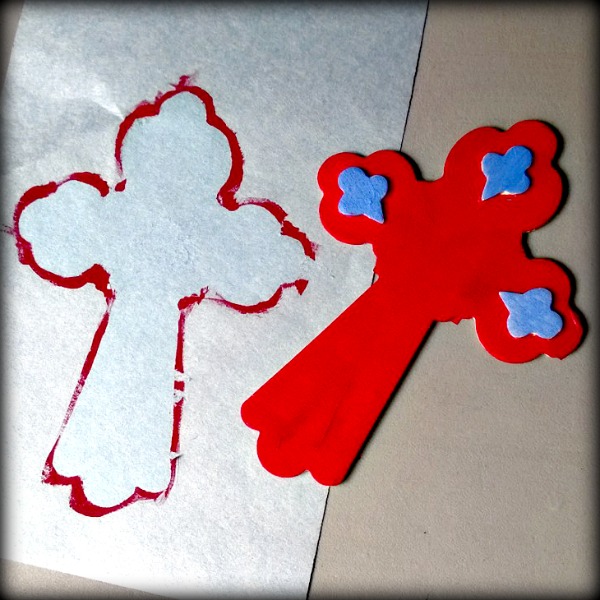 We’ve been painting little hearts, hands and crosses in worship at Church in Bethesda as we talk about service, sharing and the impact of our faith and lives on the world around us. To make cleanup a little easier I’ve been taping the little wooden pieces to half sheets of construction paper. I thought it would make it easier to paint to the edge of the pieces while keeping fingers clean.
Later, I come along and pull the pieces off to lay them around on the altar. What I didn’t plan on was the awesome way many of our people painted onto the paper, using it as an extension of the canvas. I was also struck by this image of a piece of paper with the outline of a cross after I removed the wooden piece.
When we work so hard to create a life that has beauty and intention, we don’t know how far that life will reach or how much it changes the world around it. Painting that little red cross created two images, the cross itself and the place where it was made. How like that is my own life? How like that is your life? Let’s keep painting and working on our little lives, our efforts of colors and shapes of grace, and let’s stop every now and then and look to marvel at the patterns and imprints we leave behind.
One of the sweetest elements of community is sharing the surprises, the unexpected and the leftovers. One of the deepest blessings of our faith is what we don’t easily see it creating in us and our world. Thanks be to the God who paints alongside us. Thanks be to the God who overpaints our edges and covers the world anew in grace each day. Thanks be to God.
AMDG, Todd
P.S. There are more photos of our crosses, hearts and hands on my Facebook page and on the Church in Bethesda Facebook page!
 toddthomas.net