
love
Show Me The Love!
 Love
Love

A Funny Thing We Do:
We take a passage like First Corinthians 13 and we romanticize it; we reserve it for weddings and greeting cards instead of struggling with it in everyday life.
Let’s start with that famous of texts: (in three versions)
1 Corinthians 13:4-8, TNIV
Love is patient, love is kind. It does not envy, it does not boast, it is not proud. It does not dishonor others, it is not self-seeking, it is not easily angered, it keeps no record of wrongs. Love does not delight in evil but rejoices with the truth. It always protects, always trusts, always hopes, always perseveres. Love never fails.
1 Corinthians 13:4-8, NLT
Love is patient and kind. Love is not jealous or boastful or proud or rude. Love does not demand its own way. Love is not irritable, and it keeps no record of when it has been wronged. It is never glad about injustice but rejoices whenever the truth wins out. Love never gives up, never loses faith, is always hopeful, and endures through every circumstance. Love will last forever…
1 Corinthians 13:4-8, KJV
(the Greek in verse 5 is in the feminine form, heautēs)Charity suffereth long, and is kind; charity envieth not; charity vaunteth not itself, is not puffed up, Doth not behave itself unseemly, seeketh not her own, is not easily provoked, thinketh no evil; Rejoiceth not in iniquity, but rejoiceth in the truth; Beareth all things, believeth all things, hopeth all things, endureth all things. Charity never faileth…
What has been happening in Corinth? What has Paul been speaking about up to this point? There are many corrective themes which he will touch on, expressive of the daily love he ultimately prescribes in Chapter 13… here’s a quick look:
Chapters 1-4, correcting division and pride
Chapter 5, beware of sexual impurity and its influence
Chapter 6, lawsuits against each other and prostitution
Chapter 7, mutual care in marriage and care of self and others in all instances of life
Chapter 8, having concern for other people’s weakness
Chapter 10, again having a concern for other people’s religious journey
Chapter 11, neglecting one another and showing favoritism in worship and at table
Chapter 12, personal gifting is for mutual benefit and service…
So what is the corrective for a life guided primarily by dividing self-interests and pride, a life that is willing to abuse and use people for gain, through litigation or sex, without a care for their well being or even their basic needs of food and healthy supportive relationships? The corrective is LOVE.
Love is changing the way we listen and speak, how we see one another, how we value one another and forgive; we fundamentally change the way we regard people. We know this word, right?
regard… v. consider or think of (someone or something)
in a specified way.
Let’s be real and be daily, and bring these corrective verses on love into our lives with all people, not just our romances. Let’s regard other people the way we should, the way God desires us to see them.
Love is patient, love is kind.
Love calls me to wait for you, when you’re slow and don’t think as fast or as well as I think you should, or as well as I think I do. Impatience will give way to kindness, a cultivated response that is tailored to your needs and not expressive of any frustration or judgment of my own.
It does not envy, it does not boast, it is not proud.
Love calls me to stop talking about myself all the time, defending myself and fighting my fights to make sure everyone knows how right and good I am. Love demands that I admit that I’m no better or more valuable then you. Instead I am called to listen to you, to value you and to speak about your worth and goodness.
It does not dishonor others, it is not self-seeking, it is not easily angered, it keeps no record of wrongs.
Love demands that I control my speech, bending my efforts and intentions to purifying my words, purging my thoughts and speech of anger, ridicule and demeaning slurs. I have to give up my grudges and give you a fresh start when I see you stumble, and not just once, but again and again.
Love does not delight in evil but rejoices with the truth.
Love asks me to be happy when you are blessed, when you are right, when you win, when you succeed. And I am to be hurt when you’re hurt, concerned when you’re concerned. I’m not seeking for you to suffer or experience evil, but working actively for your good.
It always protects, always trusts, always hopes, always perseveres. Love never fails.
This is maybe the most inspiring part of love! I may in fact see anger, violence and hatred as powerful weapons wielded in life, but love defeats them all. Love is what protects. Love is the foundation in which I can truly trust. Love is what will keep me going, not getting more stuff or better stuff, or bringing you down. Love is what will outlast all things and be the legacy of this world to which I did or did not join myself.
I know we can do this. I know God wants us to do this. Let’s not stand in the way of love for one more day for one more person. This is my Valentine’s prayer for 2015!
AMDG, Todd
I found this old graphic I made for a sermon series a while back, just a couple of years or so… it seemed to fit.

Advent Week Four: Love and Favor
 So Christmas week got a bit busy and I didn’t get a fourth blog out for the introduction to Jesus from Mark’s Gospel. I hope you all had a beautiful holiday with friends and family and I’m praying that you have an amazing new year! Today, I’d like to combine that missed week with the text we used this past Sunday at Church in Bethesda, because they are linked in a special way.
Mark doesn’t give us the dramatic birth narrative or any youthful Jesus at all. He begins with the prophetic voice of Isaiah and then the contemporary voice of John the Baptizer telling the people to pay attention, “The One is coming.” And the One who is coming is all about Good News.
1 The beginning of the good news about Jesus the Messiah, 2 as it is written in Isaiah the prophet: “I will send my messenger ahead of you, who will prepare your way”– 3 “a voice of one calling in the wilderness, ‘Prepare the way for the Lord, make straight paths for him.’ ” 4 And so John the Baptist appeared in the wilderness, preaching a baptism of repentance for the forgiveness of sins. 5 The whole Judean countryside and all the people of Jerusalem went out to him. Confessing their sins, they were baptized by him in the Jordan River. 6 John wore clothing made of camel’s hair, with a leather belt around his waist, and he ate locusts and wild honey. 7 And this was his message: “After me comes the one more powerful than I, the thongs of whose sandals I am not worthy to stoop down and untie. 8 I baptize you with water, but he will baptize you with the Holy Spirit.” Mark 1:1-8
Jesus is the awaited good news. Jesus is the intersection of the vast narrative of God with humanity in a special way, the fullest way, and he comes to us with Spirit. It’s a brief yet exciting introduction in my humble opinion.
And then the One arrives to be baptized by John and we finally have a bit of good narrative drama… the sky is torn wide open and that previously mentioned Spirit falls on Jesus as a dove and the voice of God proclaims, “You are my Son, whom I love; with you I am well pleased.” Mark 1:9-13
And so we meet Jesus, the very image and presence of God’s love and favor. In Mark’s Gospel we find the beginning of the story with Jesus rooted in the prophetic story of God and fueled by love and favor. God is pleased and announcing love. It must have been an amazing time for Jesus. I believe it was also formative for Jesus as love and favor become the core of his ministry and message.
Yesterday we turned back to Luke’s Gospel for a passage that is often described as the inauguration of Jesus’ public ministry. We know from the Gospel accounts that he has already been traveling and preaching, but it’s a special time in Nazareth when he sits in the synagogue and again we hear the words of the prophet Isaiah, which Jesus claims as his own. He truly is inaugurating something special…
14 Jesus returned to Galilee in the power of the Spirit, and news about him spread through the whole countryside. 15 He was teaching in their synagogues, and everyone praised him. 16 He went to Nazareth, where he had been brought up, and on the Sabbath day he went into the synagogue, as was his custom. He stood up to read, 17 and the scroll of the prophet Isaiah was handed to him. Unrolling it, he found the place where it is written: 18 “The Spirit of the Lord is on me, because he has anointed me to proclaim good news to the poor. He has sent me to proclaim freedom for the prisoners and recovery of sight for the blind, to set the oppressed free, 19 to proclaim the year of the Lord’s favor.” 20 Then he rolled up the scroll, gave it back to the attendant and sat down. The eyes of everyone in the synagogue were fastened on him. 21 He began by saying to them, “Today this scripture is fulfilled in your hearing.” 22 All spoke well of him and were amazed at the gracious words that came from his lips. “Isn’t this Joseph’s son?” they asked. Luke 4:14-22
God’s love and favor expressed at his baptism seems to become the core of what Jesus sees as his ministry, and he announces just that very favor in the synagogue of Nazareth. Again, there is the Spirit upon Jesus that now speaks through him to announce good news: favor for the poor, liberty for prisoners, sight for the blind, freedom for the oppressed, and a time of God’s favor. He sets his ministry firmly in the soil of God’s raging favor, rich love and grace for the least expecting, least powerful, most disenfranchised and often the least deserving.
He doesn’t announce a new reign of greater power for the powerful. He doesn’t promise greater glories for those in authority. He doesn’t come with reward for the faithful, but instead he offers hope to the hopeless and favor to those without merit. The weak and without power, the blind and captured ones, find sight and liberty. The guilty ones, the prisoners who have been captured in their own culpability, find freedom.
Jesus brings favor to those most needing it, not to those most deserving it. This is a fundamentally important aspect of his ministry and purpose that we must not lose. We must hold to the Jesus who brings God’s favor to all the unsuspecting and unexpected. This truly qualifies as good news.
So, what will your 2015 be like? Have you made plans? Have you laid out goals for the year? Do you understand that you are not trying to attain God’s favor, but you already have it? Have you breathed deep the love and favor of God to fill your lungs with vital life and readiness? Can you stop for a moment and imagine the sky torn asunder and the Spirit wrapping you in a warm embrace while God whispers, “I love you. You are amazing and I’m so happy you are mine.”
Go into the new year daring to stand in that embrace. Go into 2015 believing in the favor and the love of God. If you need to see, if you need to be freed, this is the what the favor does. If you struggle against a poverty of body, mind or soul, this is what the favor comes to help you with. Jesus is the image of favor offered, not favor earned. Claim it, for it is yours.
“You don’t have to change
for God to love you.”
Anthony de Mello SJ
AMDG, Todd
Light Not Overcome by Darkness
 In this first week of Advent many of us are asking hard questions about race and justice. Many of us are trying to understand how we can repair the hurt and divisions in our nation and among our people. But others of us don’t seem to even be trying to understand the pain and view from the other side, more comfortable in a perceived sense of rightness.
At Church in Bethesda we begin Advent with the introduction to Jesus from John’s Gospel; it’s a cosmic intro like none of the other accounts. Here’s John, speaking of Jesus, John 1:1-5…
In the beginning was the Word, and the Word was with God, and the Word was God. He was with God in the beginning. Through him all things were made; without him nothing was made that has been made. In him was life, and that life was the light of all people. The light shines in the darkness, and the darkness has not overcome it.
John begins to tell us about Jesus by going back to the beginning of the beginning with language that sounds very much like a creation narrative. John goes to the beginning of the beginning to make Jesus central in the creative power and meaning of God’s presence and work to bring the world into being. In doing so John calls Jesus the Word, the logos of God. The Word was of God, with God and was God’s activity.
This is a special way to present Jesus. Though we may think it easy to relate to Jesus as a baby in Luke’s Gospel, a child and a human being, I think John is doing a cool thing by calling Jesus Word. I think John is teaching us about Jesus by reminding us about ourselves.
Word.
Is there another species on the planet using words as we use them? We have the singular gift of speech and word, written and spoken. We tell stories, our stories. We write our stories down and share them. You’re reading my blog. I can’t help myself, I have to craft some words and throw them out there in the hopes that someone else will read, comprehend and maybe even appreciate them.
Jesus is Word just as he is light and life. This is a connection point to for us to the divine. One of the beautiful movements of John’s passage is highlighted later in these verses, John 1:12-14…
Yet to all who did receive him, to those who believed in his name, he gave the right to become children of God– children born not of natural descent, nor of human decision or a husband’s will, but born of God. The Word became flesh and made his dwelling among us. We have seen his glory, the glory of the one and only [Son], who came from the Father, full of grace and truth.
Jesus entered creation to bring us into the divine. He came into our world to raise us out of it and into the world beyond us, born of divine will. He was begotten so that we might be begotten again into newness. He came here and identified with us so we could be identified anew into the thereness of heaven’s will. This is story, word and meaning.
Our words have power and meaning just as the Word in John’s introduction was also the life and light of all people. Jesus will later call us the “light of the world” in Matthew’s Gospel, further emphasizing our shared role in his story of bringing light and life to our planet, to our people.
We relate to Jesus not only in our shared human infancy, but in our shared words of light and life, a shared mission and purpose in creation. We are a blend of human and divine, as was Christ, made so by Christ, and now continuing the great work of Christ begun at the beginning of beginnings.
The Work of Advent.
I know we usually talk about the waiting of Advent, but John reminds us that we stand singularly among creation as co-light and co-life with the Word and the Word’s work in Advent. Even in the first week, with only one candle lit, and the light seeming so small, the work moves on. Even in a broken world, in broken times, when the darkness seems so strong and justice so elusive, our words are still so needed.
 Shine your light. Speak life. Believe. Own your begottenness and know that the darkness runs before your light. The darkness cannot overcome or commandeer your light. Even if some don’t understand and even if your own don’t celebrate your light, it must still shine. Your words must still be life giving and creative.
This is an Advent Season to embrace our calling. In the face of whatever frustration or disappointment or darkness we see, shine on in life and love! And let’s make our Advent prayer one of purpose and joy to our God, Psalm 19:14 adapted with John 1…
“May all the words of our mouths be life and light in the world,
and the meditations of our hearts be pleasing and part of your great work,
oh God of Creation, our Hope and our Divine Parent!”
AMDG, Todd
Transgendered Day of Remembrance and Awareness

Two Videos for Transgender Day of Remembrance 2014
It’s November 2oth and I just learned this year that Nov. 20th is the Transgender Day of Remembrance. It’s a day to remember those murdered for their gender expression. This is also a day to face the violence and hate that is perpetrated against transgendered people, and to oppose it. I’m going to dedicate today’s blog post to our trans neighbors who have faced violence and hatred, those youth who have been rejected by families and made homeless, those who have been bullied and those who have been murdered for trying to live as they most authentically understood themselves.
On this day of remembrance I ask that we all make a communal effort to replace any anger, any fear, any confusion, any hurt or lack of empathy, with love and a renewed desire to oppose all violence, verbal and physical, against our transgendered neighbors.
I was blessed recently to stumble on a short snip of Laverne Cox’s speech on the violence and bullying that the trans community often face in daily life. I shared it on Facebook and I offer it again as a place to begin listening and empathizing. Whoa, I just learned how to insert a YouTube video instead of just linking! Sweet!
I’m also happy to share another video, the Thursday Night Keynote from Rev. Allyson Robinson at The Reformation Project conference in DC a couple weekends back. She’s transgendered and a great preacher! Her message was deep and inspiriting.
I do realize that many (LGBTQ and straight) may not share the optimism she expresses on where we are at with LGBTQ acceptance and inclusion, either in churches or civil society. However, this lady can preach! I was blessed to be present hearing her message that evening, and blessed by her humility and gifting.
Talk to ya soon, beloved!
AMDG, Todd
Let The Love Speak
 One of the most difficult parts of being a Pastor is not always knowing what to say, it’s that having said something you carry an extra special burden to live it. There’s a haunting scriptural reference you might be familiar with from James 3:1&2…
Not many of you should presume to be teachers,
my brothers and sisters, because you know
that we who teach will be judged more strictly.
We all stumble in many ways.
Thanks for that, James. I like you more when you’re making other people feel uncomfortable.
I was very recently asked to speak with a friend’s child about some naughty behavior at home. The child was acting out when disciplined and escalating the bad choices already made instead of learning from the discipline and doing better. I agreed to speak with the child and had I think we had a good conversation. We’ll see if the behavior changes, but here’s the gist of what I said…
First, you’re awesome, and that’s a fact, and it’s why such bad behavior is surprising.
I love this child I was speaking with, and I’ve been blessed to be part of the child’s extended family. Any time we have to stop and evaluate our behavior, it’s not a time lose faith in either God or ourselves. We act for the better out of an understanding and appreciation of how valuable we are to God and others. I think this is the difference between contrition and depression, between feeling bad and feeling worthless, and between healthy sorrow and unhealthy self-loathing. There’s no room for “you are bad” even when we’re talking about “your behavior was bad.”
Too often I extend graces to others that I deny myself. You ever do that? I can keep a growing list of how good others are, while my personal tally is mostly on the negative side. I can let my own failings drag behind me clamoring like tin cans on strings and reminding me with every step that I have failed. I need to learn to cut those strings, look carefully that those failings, and dream my way forward without them. This isn’t going to make the failings magically not matter any more, but I need to deal with my faults instead of letting them deal with me. I started the conversation with how loved and how good my little friend has been, is, and will be. But, what about the choices we make?
Second, it’s ok to be mad, but not to listen to the mad.
Here’s another reminder from scripture, this time from Paul in Ephesians 4:26&27…
“In your anger do not sin”
Do not let the sun go down while you are still angry,
and do not give the devil a foothold.
Anger is a inner voice, and it’s not often a very wise voice of counsel. Somewhere along the way we have to learn to stop listening to the mad, and the sooner the better. Yes, it’s not as easily said as done. That’s why self-control is such a difficult thing to master… not because of the control part, but the self part. Things happen, things are said, and mad happens. There’s not always a lot of choice there, but what we do next is a choice. Instead of listening to the mad, we can stop and listen to another voice… I recommend the love.
Love will tell me to do something totally different than the mad. It doesn’t matter if the mad is directed at me myself or someone else, love for myself or another will always give me better counsel. Even a child, including the one I was having a conversation with, knows the difference between acting on how mad I am versus acting on how much I love. When I am mad, I have to stop making choices until I can let the love speak. It takes time, effort, practice, and above all choice. James says it famously in his first chapter, James 1:19&20…
My dear brothers and sisters, take note of this:
Everyone should be quick to listen, slow to speak and slow to become angry,
because our anger does not produce the righteousness that God desires.
Oh, James. The mad is so much more fun! The mad can give me a sense of power! The mad can make me feel less like I need to change anything and put all the burden of change and recompense on the other person! I kinda like that, to be honest. It’s way more effort to stop, to slow down, and to move past the mad.
You know, I made a statement just a moment ago that I want to add something to before I finish and move on with other things. I said, “Things happen, things are said, and mad happens. There’s not always a lot of choice there, but what we do next is a choice.” I do believe that mad happens, and there’s often not a lot of choice about being mad, and yet… I also believe that along the path of choices we make in life, we can unlearn and lose a lot of the mad along the way. We don’t have to be slaves to the mad. I think that the more I slow down, the more I listen, the more I love, the less I will get mad. Like any muscle, if I exercise the mad all the time it will get bigger and stronger. It might be a long road from my first choice to let love speak instead of my anger until I start to realize that there’s a lot less anger in my life to silence, but it’s a worthwhile journey.
Since I spoke, I now have a greater burden to do. I should be judged more strictly. I agree. We’re all human and we do stumble in many ways, and we all need the grace of stumbling into one another’s shoulder, feeling that arm of support wrap around our backs, and get that helping lift back onto our feet. Please, forgive me my mad. Forgive me when I haven’t kept my mouth shut long enough to hand the reigns over to the love. Forgive me when I’ve sat and cultivated the mad, reveled in the mad, and then followed where it led.
Paul again, captures some of the struggle so well, feeling the chagrin of failure and yet the hopefulness of what can be and what will be… Romans 7:21-25:
So I find this law at work: Although I want to do good, evil is right there with me. For in my inner being I delight in God’s law; but I see another law at work in me, waging war against the law of my mind and making me a prisoner of the law of sin at work within me. What a wretched man I am! Who will rescue me from this body of death? Thanks be to God, who delivers me through Jesus Christ our Lord!
I will do better. I will learn. I will grow. I will let the love speak. That’s what I hope for my little friend and for myself… to grow into a joyful expression of love. To grow, choice by choice, into a life less governed by the mad and in which the love speaks.
AMDG, Todd
The End of NaPoWriMo, #NaPoWriMo April 30, 2014
Well, I probably only wrote a week’s worth of poems for the “month,” but I still value the time and am so appreciative of all the amazing poems I have seen from friends and strangers in April! You all rock, and love ya! I tend to write only when I feel the Spirit move, as I paint, and so for me the month was a stretching and a challenge. As usual, I started with a shout and ended with a sigh. Still, it was good.
 bending, tending
rending, trending
pending, sending
lending, spending
no more pretending
no condescending
a month of contending
is now at its ending
’til next we’re intending
our words for appending
to share the ascending
our souls for befriending
rhymes over-extending
but hearts for commending
on our love
i’ll be depending
AMDG, Todd
trying to find some words #NaPoWriMo 04/15/2014

hate be gone
hate be done
for we renounce you
we deny you
and the death
in which you revel
will never be
victory
hate
you have no hope
you birth
no future
we will
withstand you
we will
outlast you
when you are
a sick memory
a stain
upon our past
we will sing
a new song
beyond
your prison
because walls
of hate
will not stand
for long
and the peace
for which
we pray
will come
sung
upon the strands
of the love
we share
neighbor
friend
human
beloved
dark hatred
will be scattered
weak and undone
before love’s flame
I always begin things like #NaPoWriMo with high expectations and lots of energy – but it’s never long before I run out of words. So I start to strain to make some poems and my frustration mounts. Usually I end up a bit indignant that I would so arbitrarily be asked to make a poem a day. But that’s just silliness. I volunteered to be part of the exercise, I just didn’t think I’d have so many days of dryness when no words come to me when called.
And then the news comes on, and I see things like the hateful shootings, the murder of our Jewish neighbors in Kansas, a hateful crime I suppose was meant to stain their holiday. I want to scream. I want to deny that this still happens. I want to deny that anyone can be so broken as to choose such hate and it’s bile, it’s loss, it’s theft, it’s shame.
Words came back to me, today, after a week or so of not answering my call. Today, I protest the hate. I deny the killing stupidity and waste. I renounce any and all of the ignorant paranoia and fear. I call out to the humanity that is buried under the weight of such darkness.
I pray for the families affected by that hateful touch. I mourn with them, though not as them. They have been broken apart and touched so forcefully by the killing hatred. May their peace be restored and love wrap them in the divine embrace.
AMDG, Todd
a poem for #NaPoWriMo 04/02/2014
 So many of my friends on Facebook are jumping into the National Poetry Writing Month that I’m feeling the peer pressure! I’ll do a make-up poem this afternoon, since I missed the monthly opener, yesterday!
Here’s my little poem for today:
i love you
this is my choice
seen in motion
heard in voice
but should it not
don’t think i lied
even if i fail
please know i tried
04/02/2014
Nov. 27, 2013 Civility in Xian Scripture
 November 27: Civility is a bear, and so is incivility.
Colossians 3:13-15, “Bear with each other and forgive one another if any of you has a grievance against someone. Forgive as the Lord forgave you. And over all these virtues put on love, which binds them all together in perfect unity. Let the peace of Christ rule in your hearts, since as members of one body you were called to peace. And be thankful.”
Bear with each other. What a great twist of language that the word bear gets to be an expression of gracefully putting up with each other and a 400 pound mammal that might pull your head off. Maybe civility can feel that way sometimes, like trying to smile in the face of a raging beast? Maybe.
One of the hardest things about the teaching on forgiveness in scripture is that we are so often told to forgive without any mention of waiting for an apology. It seems that when incivility is done to us, our forgiveness is supposed to kick in without even waiting on that other person’s recognition that they need it. Honestly, that’s tough for me. I’ve managed to rationalize this away at times with arguments about not wanting to “enable” their continued naughtiness, but that wears thin after a while.
Someone might be a real bear towards me, and make it hard for me to bear with them through it, but I have to dig deep and find that needed strength to carry my own responsibility to restoring peace. Let’s be clear, I don’t always want to do that! Sometimes I would much rather respond in kind, making it just as unpleasant for them as it is for me. For a Christian it comes down to relating to Jesus and the way he modeled forgiveness in the biblical narrative. His words “forgive them” from the cross didn’t wait on an apology.
I suppose what I want to say today is that it’s ok to struggle with civility, but not to give up. I wouldn’t want this whole month of blogging to just be a “pie in the sky” dream of what things could be if we were all perfect. Sometimes I’m the bear, and sometimes I’m doing the bearing. Sometimes I fail in the civility realm and move from being a victim of incivility to a co-combatant in a contest of incivility. But I’m trying, and if anything I’ll try harder next time.
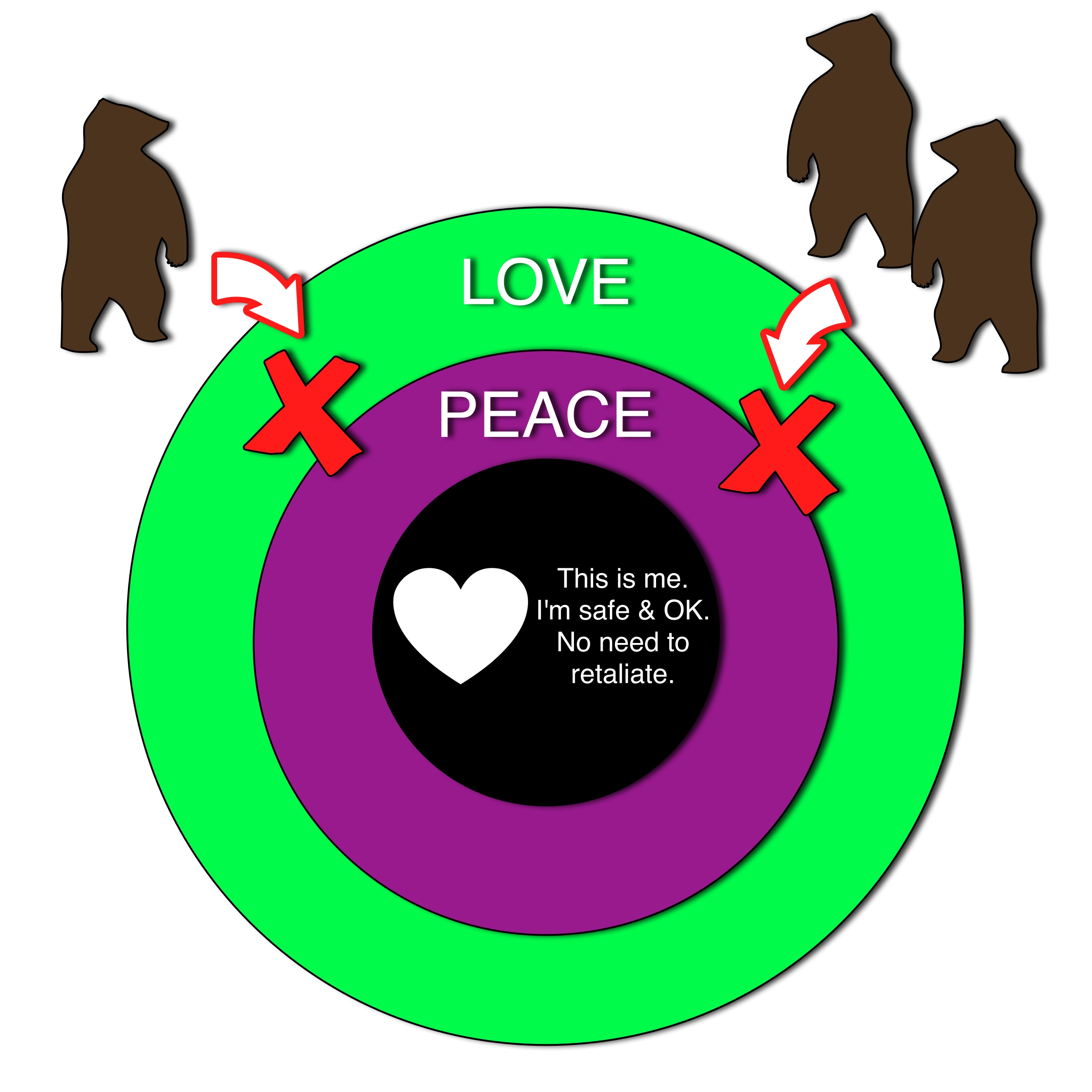 I’m going to meditate today what I might call cruciform timing, living a forgiveness that doesn’t wait. If I can do that better, civility has a chance to grow in me. If a peace and thankfulness can be rooted in me, and be bounded by love, as the passage today images for us, then maybe a little more bearishness can be tolerated and forgiven. I’m going to splurge and have two graphics today because I think the passage makes a cool illustration. It’s that mentioned peace and love that can make all this possible. That peace and love are layers that help protect the true me when bears attack.
Easier said than done? Yes it is, but so is everything worth working hard to obtain. It’s the same love and peace that protects me that will be extended to one who attacks me. It’s a hope of mutual assured survival.
AMDG, Todd
Nov. 25, 2013 Civility in Xian Scripture
 November 25: Civility is raising the expectations.
Galatians 5:22 & 23, “But the fruit of the Spirit is love, joy, peace, patience, kindness, goodness, faithfulness, gentleness and self-control. Against such things there is no law.”
I have to admit that this passage from St. Paul has been a favorite of mine my whole life. It’s not that I have in some way mastered it or think that I’m a great example of it, but it reminds me to raise my expectations for myself, and even for you. I’ve been accused of having a “thin skin” when someone’s rudeness or naughty behavior will be hurt or disappoint me, but I don’t want to let my expectations slip! I’m a textbook Gen-X in some respects, and I always struggle to keep a high level of pessimism and cynicism at bay.
If you want to go and see the list that St. Paul has of the “sinful fruits” (Galatians 6:13-26) you’ll find many of the things we’ve identified and renounced as incivility throughout our exploration of scripture: rage, discord, selfishness, divisiveness. But I’ve never spent a lot of time on the sinful fruits; I know them too well. My imagination is better fed on the fruit of expecting and identifying God in action in me or in you. I want to dwell on those moments when our goodness shines. I like seeing our patience surprise someone, our kindness meet a need, our self-control end a conflict, our love warm a soul, our joy become infectious, and our peace break down barriers and make us a family.
The fruit are a strong reminder that civility is not just what we don’t say, but what we do say. Our faith and spirituality are the same in respect to renouncing some things and embracing some things. Renouncing and letting go of some things can be seen as a bit passive, simply making sure that some things are absent from our lives. Choosing to embrace other things that we wish to manifest in our lives can be a bit more active, even aggressive.
This morning I’m meditating on these on these things that I can embrace, things against which I will never find a law or an obstacle outside of my own heart. I’m going to include a photo with this blog, a six foot goose that my wife and I hand-made and painted for an arts festival a few summers ago. In Celtic spirituality the Holy Spirit is sometimes pictured as a wild goose, and I want God’s presence today in my life to be a goose, to be flamboyant and noisy, aggressive and loud. I want God’s presence in me to take flight.
AMDG, Todd
- ← Previous
- 1
- 2
- 3
- 4
- Next →
 toddthomas.net