
Civility
Finishing a Month on Civility
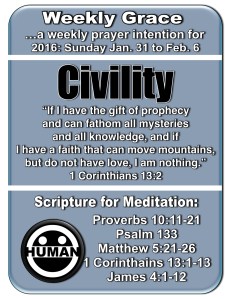 I realized today that with the drama of Snowzilla last Sunday, I forgot to make a Weekly Grace! I mean, wow. I haven’t missed one in a few years. So, I wanted to make sure we finished and finished well this month of intention based around civility.
It’s an election cycle year, and it’s a pretty heated race for all concerned. That’s one reason I wanted to start the year on civility. Another reason is that sometimes it’s so hard to keep my words flowing from love. It’s so easy to let something else step in and drive my speech.
In our focal passage written to the church in Corinth, Paul says that nothing is as important as love. Nothing should be allowed to take it’s place. There’s no miraculous spiritual gift, no self-denial, not even any great knowledge or correctness that surpasses love. This is not a message that religious people like to hear. We are very enamored of our personal gifts and, oh my… our correctness? We often like to stake our very salvation on it or deny another person theirs.
1 If I speak in the tongues of mortals and of angels, but do not have love, I am a noisy gong or a clanging cymbal.2 And if I have prophetic powers, and understand all mysteries and all knowledge, and if I have all faith, so as to remove mountains, but do not have love, I am nothing.3 If I give away all my possessions, and if I hand over my body so that I may boast, but do not have love, I gain nothing.4 Love is patient; love is kind; love is not envious or boastful or arrogant5 or rude. It does not insist on its own way; it is not irritable or resentful;6 it does not rejoice in wrongdoing, but rejoices in the truth.7 It bears all things, believes all things, hopes all things, endures all things.8 Love never ends. But as for prophecies, they will come to an end; as for tongues, they will cease; as for knowledge, it will come to an end.9 For we know only in part, and we prophesy only in part;10 but when the complete comes, the partial will come to an end.11 When I was a child, I spoke like a child, I thought like a child, I reasoned like a child; when I became an adult, I put an end to childish ways.12 For now we see in a mirror, dimly, but then we will see face to face. Now I know only in part; then I will know fully, even as I have been fully known.13 And now faith, hope, and love abide, these three; and the greatest of these is love.St. Paul in 1 Corinthians 13:1-13
Paul says that his ability to understand every question and mystery is nothing if he does not have love for others. The capacity to love matters more than the capacity to be right. I won’t belabor this point too long, but come on! I think it’s one of the clearest passages that teach us that we should let our love help us understand more often than letting our understanding teach us to love.
Our civility will grow as we move more fully toward letting love take it’s place of preeminence in our lives. Our words will grow to reflect that we have matured past the idea that our own perceived correctness gives us license to fight, humiliate, defame or condemn. We will listen better, with more desire to understand one another. We’ll ask good questions, meant to free and not to trap. We’ll grow together as we share and understand one another better. This could be a good year, even with a presidential election.
AMDG, Todd
I Feel No Need to Destroy You
 I don’t like what you said. I think your ideas and conclusions are flawed. But, I don’t need to hate you. I don’t need to silence you or destroy you. My ideas are not right by how wrong I make you sound, or by how much I manage to embarrass you. I will simply state with conviction my ideas and beliefs, and I’ll let you do the same.
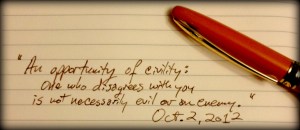
I’m going to pull up a little reminder from my Civility exercise circa late 2012… for us to think differently, believe differently, and even fundamentally be different people, does not necessitate that you be “destroyed.” You don’t need to be labeled stupid, less, evil or a hypocrite, just because we are dissimilar.
Back in 2012 I said it this way, “An opportunity of civility: One who disagrees with you is not necessarily evil or an enemy.”
Here are a few screenshots of what I’m talking about…




Dang, everyone is being destroyed. Can you guess what verses from scripture this makes me want to quote? Yep…
“For you were called to freedom, brothers and sisters; only do not use your freedom as an opportunity for self-indulgence, but through love become slaves to one another. For the whole law is summed up in a single commandment, “You shall love your neighbor as yourself.”
If, however, you bite and devour one another, take care that you are not consumed by one another.”
Galatians 5:13-15, NRSV
It’s a thing these days in social media for someone to be destroying someone else, but doesn’t mean we have to participate. I see it online everyday, and I see the term “destroy” used in religious debates, social debates and political debates. It doesn’t seem to be enough for a person to hold an opinion or a conviction, but there must also be some destruction going on.
When we do away with the need to be destroying someone, we open that door of opportunity. Stop and spend a few moments of time imagining ways to be a person of conviction without needing to be a person of competitiveness. Imagine conviction without condemnation (Need an image of conviction without condemnation? Try the story in John 8:1-11.) Imagine your cherished ideas being valuable in their own right, without needing to demean another person’s thoughts or ideas.
The fact is, if I destroy everyone who thinks differently than I do, I become less wise for the effort. I will grow less. I will face fewer challenges, which means I will spend less time reflecting and deepening my cherished ideas. I am simply lessened by destroying (I suppose this really means silencing) people who think differently than I do.
Now, I’m not trying to destroy people who have shared an article lately in which someone was destroyed. I’m asking if we can stop a minute and distance ourselves a bit from the sensationalist wording and headlines? May we also stop and reflect on the need to be so competitive and demeaning in our disagreements? State your convictions. Elaborate on them. Support them. But if you can’t do that without attacking someone else and demeaning them, please consider your ideas and how you formed them. Are they factually based and relevant, or are they simply more of the divisive fighting between “us and them” that we get so much of every day? Are we simply playing a game of who insults and demeans the other the best? I’ll leave that discernment to you.
AMDG, Todd
Lift Them Up!
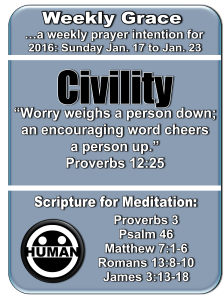 One of the uses or blessings of civility is it’s ability too turn things around, to take a bad situation and make it better, to help a person having a bad day begin to have a better day. An important part of civility is acting out of that civil impulse to positively engage and support one’s community.
Do you see someone around you struggling? Do you see someone who needs encouragement? Lift them up! Be a person who spreads joy and increases peace in the world with kind words, encouraging and positive contributions.
The proverb in our Weekly Grace is at once obvious and such a needed reminder. Our words have an effect, so let’s plan for the best effect possible. As children in Sunday School classes we often put our fingers over lips and sang “O be careful little lips what you say!” and I hope we never grow too old for that lesson.
AMDG, Todd
Our Prayer Intention of Civility
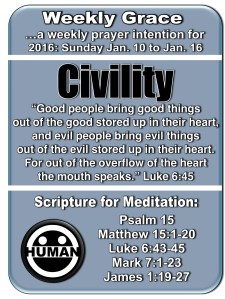 Civility begins within and then manifests in speech and action. This is true of everything, good and bad, better and worse. Out of our hearts we incubate ideas and expressions that take form in our words and responses. For this reason our God is not just standing around waiting to slap our wrist and cluck at us, but God is working to rehabilitate our heart and inmost being!
Are we open to this? It’s one thing to capitulate and obey a greater power or a higher influence, but are we ready to allow ourselves to be fundamentally changed from the inside out? This is the difference between obeying the great sermon points in Matthew 5, 6 and 7 out of legal and religious obligation or allowing the Beatitude Statements in Matthew 5 to frame a change of our hearts and minds as we navigate the reorienting of life that Jesus presents for us to follow.
This is not Christianity 2.0 or any new innovation or deeper level… this is actually the beginning of religion and faith. Jesus often gave this invitation to people, “Follow me.” This is the invitation of a teacher, mentor and life-changer. This is an invitation to reflect on who we are and how we are, with Jesus’ help. And it’s an invitation to change.
Want to change the urges and reflexes of destructive negativity in your life? Begin by reflecting on your heart and cultivating a change there… work with energy and consistency to remove the negative things and plant beautiful things in their place. Where their is hurt and injury, sow some forgiveness. Where there is anger, sow some quiet and prayer. Where there is hatred, sow some empathy and hope. Christian saints and mystics often rooted this in their prayers: St. Catherine of Siena, St. Ignatius of Loyola & St. Francis of Assisi.
Even as I begin a new year no longer serving a congregation as pastor and shepherd, I want to renew my commitment to being a spiritual friend and brother to you. And I have to remind you that I need you. Jesus didn’t invite one person or single individuals to follow this path of change, he called us into community, together. Let’s do this together. Let’s chat.
AMDG, Todd
A Weekly Prayer Intention?
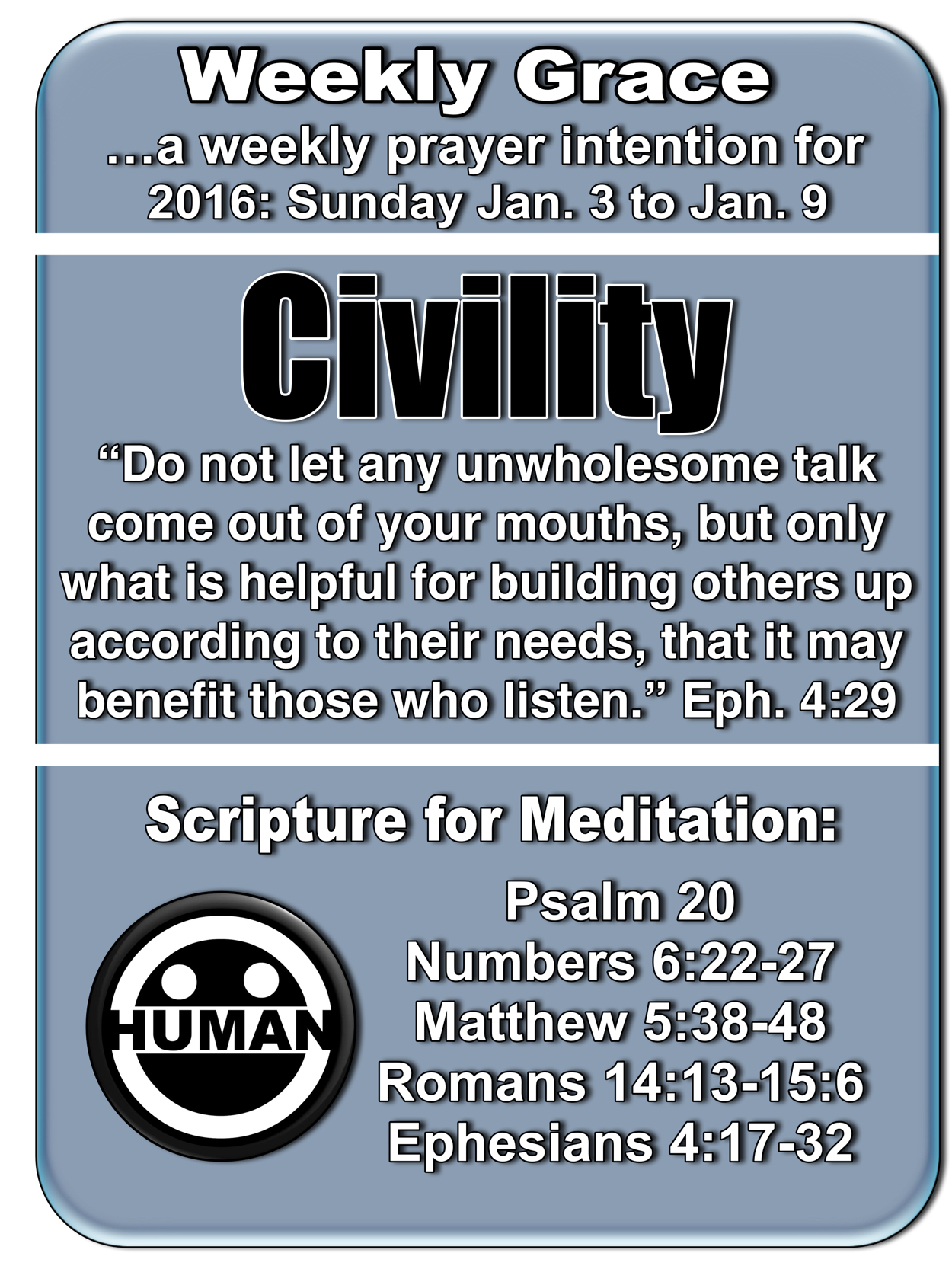 I’ve been making a weekly prayer intention for several years for our congregation at Church in Bethesda and for myself, but I’ve been wondering about continuing the practice now that I have left my pastoral duties with the congregation. After some thought and prayer I’ve decided to continue.
First, I do hope it blesses someone to have some weekly help with prayers. We all have time and even seasons when prayer is drier and more difficult to start. Second, it does help me to have it in mind and carry it as a daily reminder. Third, it’s a practice of intention, study and creativity that I don’t want to lose. Instead, I’m thinking of ways to expand on the weekly grace and what it’s intended to be.
This is a Presidential election year… oh my. In honor of the coming strife and internal warfare that we are about to incite, I thought we’d begin the year with another reminder of civility. For people of faith civility is actually at the core of who and how we are to be interacting with our communities, nation and world. Civility is scriptural. Civility is Christian. Civility is a core element of a life of faith.
I’m personally so tried of the arguing around the phrase “politically correct.” It gets used too often, sometimes to minimize our responsibility to one another, the exact opposite of its intention. Some people proudly say that they don’t care about being politically correct as an excuse or a prelude to their incivility, rudeness and meanness. Being non-politically correct has become a badge of honor to many, as they see the need for sensitivity toward others as a type of censorship. Nothing could be further from the truth.
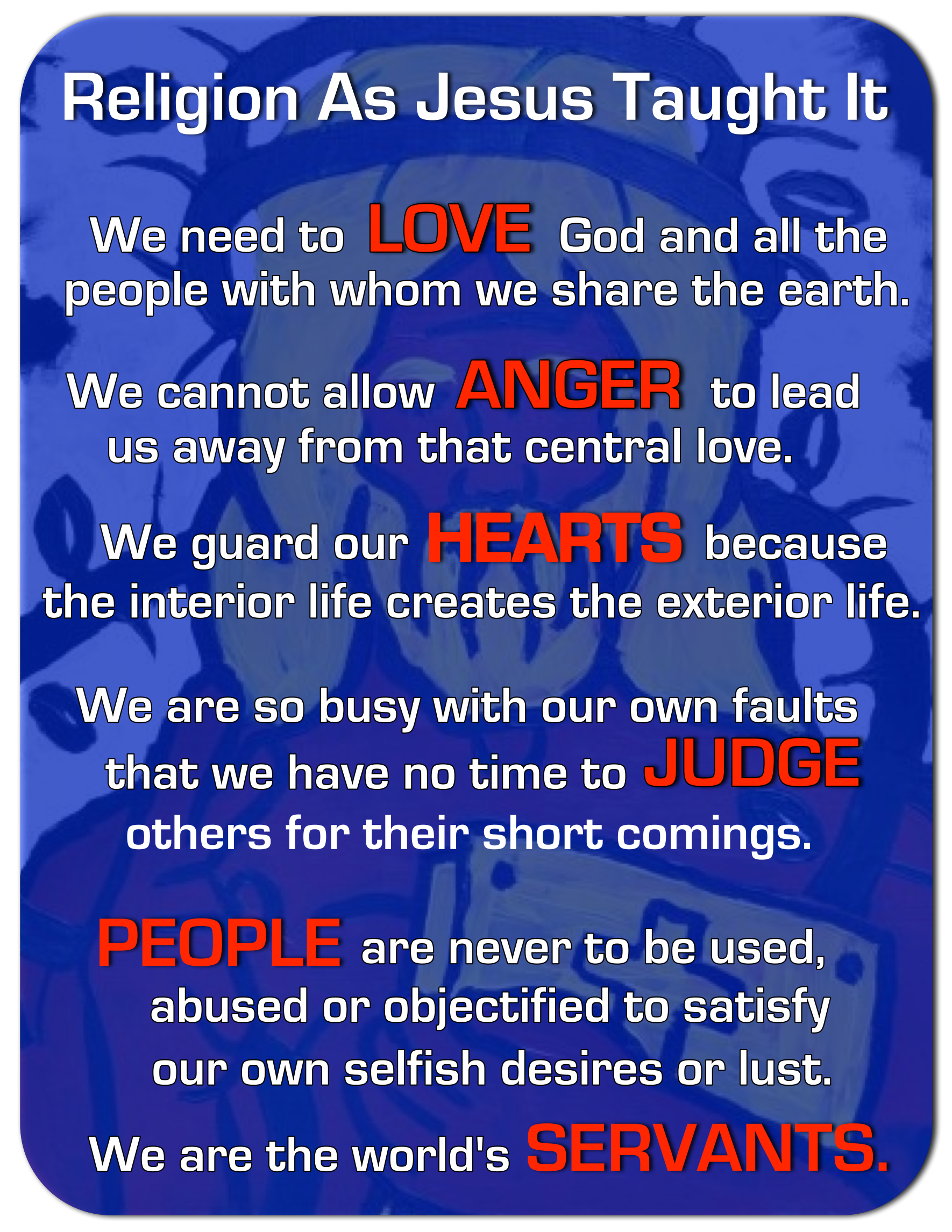
Being sensitive of others is a foundation of civil discourse and a very deep, important spiritual practice. We must work hard to remove racial slurs and demonizing language from our daily and shared conversation. We need to speak and act in ways that welcome the other and invite the other to participate in life with us, even in disagreement and dissimilarity. Christian Dominion, our elevation and dominance in religious, political and social affairs where all others are supposed to be made to conform to speak and act and think as we do, is not a scriptural idea. Truly, our scriptures teach the opposite. We are the world’s servants, broken and spent for the world’s good.
God blesses all. God’s blessings are for all. This is a teaching of our Christ, and maybe one that we by and largely ignore as we deeply fear its implications. (Matthew 5:43-48) The faithful are not the sole object of God’s love and peace… we are invited to share God’s burden of being used to bring more love and peace to the human family and all of creation.
So, as we begin the new year and look forward to electing a new President to lead our country, let’s renew our intention of civility in speech and action. Let us refuse to follow voices of indignity, disrespect and disharmony. Seek the voices that speak to bind us in love and peace. Be a voice that builds others up.
AMDG, Todd
Begin the Day Well
 I’m just having some morning coffee, meditating on the day and thinking of all the discord in our country with the presidential debates and fighting, the violence in our streets and wars around the globe… leads me to pray for our species.
And it leads me to renew a vow that:
Today, I will speak with more civility, express myself with more genuine love and welcome for others, and I will speak and act to impart dignity to all people, especially those least like me or least liking me.
The Book of Common Prayer (and it’s online if you don’t have a copy) provides many helps to assist with daily prayer, often giving good words to the hurts and hopes of the heart…
28. In Times of Conflict
O God, you have bound us together in a common life. Help us,
in the midst of our struggles for justice and truth, to confront
one another without hatred or bitterness, and to work
together with mutual forbearance and respect; through Jesus
Christ our Lord. Amen.BCP pg. 824
 And of course, our prayers often begin to be answered in our own lives, in our words and actions. If we’re going to ask God to increase peace in the world, then we are rightly reminded to acknowledge that we will have to be part of the increase. It begins with our hearts and the overflow of our hearts into the things we say and things we do.
How can you increase peace in the world, today? Is there a personal conflict with someone you can resolve? Is there a good greeting to practice giving others? Is there a need you can meet? Is there a friendship to renew or develop?
The day is ours, a gift of God. Let’s begin it well, seek the best that we can achieve in it, and in the last give all thanks to God.
AMDG, Todd
Three Reasons I LOVE This Video
You’ve maybe seen this gem floating around Facebook…
I love this video. Really. I LOVE it, and I have three reasons why I think it’s great.
REASON NUMBER ONE…
I love this video because it truthfully expresses that a woman should not bear the burden of any man’s unwanted attention or sexual aggression. Period. A man at no time or in any place has the right to force his unwanted sexual attention upon a woman. Coercive and aggressive behavior that causes fear or anxiety is wrong and should be stopped. We need to be saying this loudly and often and in every way possible, and the video is a wonderful example of saying it loud and clear.
REASON NUMBER TWO…
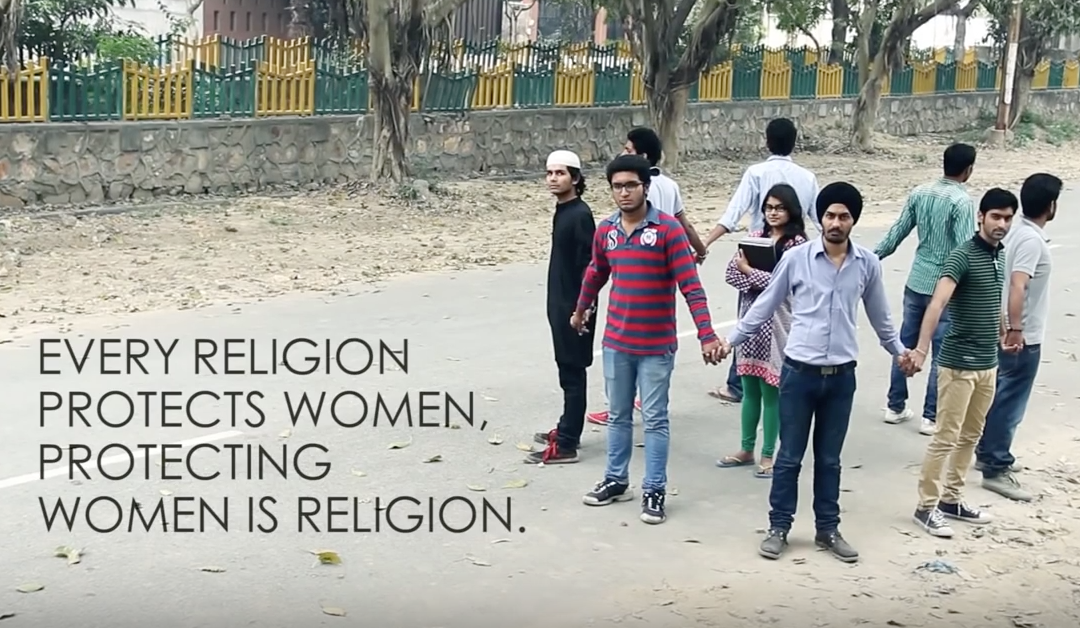 I love this video because it correctly references and relates to all religions and their concern for women. All religions are found steeped in and in conflict with their host cultures. I love that the video appropriately makes room for all of us to engage this important topic. Too often we use important issues like this to score points for our own group and condemn another group. This issue of responding to sexual aggression belongs to all. And before anyone from my group gets too tweaked over the video’s tagline that “Every religion protects women, protecting women is religion” allow me me remind you that such sentiments come straight from our scriptures. James 1:27 in the NLT, Pure and genuine religion in the sight of God the Father means caring for orphans and widows in their distress and refusing to let the world corrupt you. And Jesus in Matthew 22:37-40 Jesus replied: “‘Love the Lord your God with all your heart and with all your soul and with all your mind.’ This is the first and greatest commandment. And the second is like it: ‘Love your neighbor as yourself.’ All the Law and the Prophets hang on these two commandments.” Caring for one another and loving our neighbor means protecting women from sexual violence, fear and aggression. Such truly is religion.
REASON NUMBER THREE…
 I love this video because it doesn’t advocate violence. We are so addicted to violent responses. We all want to be Batman, kicking butts and taking names. It’s sad that so many of us grew up only seeing violent responses modeled in media and life. I love loVE LOVE that image of the nonviolent circle of protection created around the woman in this video. Powerful stuff! We don’t need to fight one another. We need to stand together.
AMDG, Todd
October 2015 and Diversity
“Diversity is not a weakness for faith, but a strength.
Our diversity is not discouraged by scripture, but validated.
Diversity is not disunity, but should help us be a unified whole.”
 It’s October and I’ll be starting a couple of things this month: 1) I’ll start working on my winter beard… and I know it’s never much of a beard, maybe more of a beardlette, but I’ll see what difference another year on the march to manliness means for me, and 2) I’ll be investing the month in writing out my thoughts on diversity as a core element of Christian faith that is too often given short shrift or completely ignored.
Diversity of Faith Expression/Identify
I’m not choosing diversity because it’s a buzz word. I’d like to focus on what our scriptures, especially in the New Testament and the words of Jesus, have to teach us about being different. Too often I’ve heard much more about being the same. In my own lifetime I’ve heard sermon after sermon about conforming to a single ideal, a single belief and a singular expression of faith and church. The church of my youth was devoted to a single refined expression of doctrine and ecclesiology to the exclusion and utter rejection of all deviance from that expression. We fantasized about our ability to come to conclusions and decisions about theological and doctrinal matters outside of personal experience and enculturation, and therein find the single answer to all questions for all people in all times in all places. Today, I’d call that misguided and un-hopeful.
Our scriptures present a different picture of life and faith. The ministry of Jesus showed a diversity of disciples and gifts surrounding Jesus, and times of Jesus himself affirming the existence and authenticity of others. In fact, Jesus often did this over the protests of his disciples who desired exclusivity and personal greatness, uniqueness.
Diversity of Gifts
We have often spoken of diversity in the realm of giftedness and abilities. It’s appropriate when we speak of individual calling and giftedness to recognize our diversity, and we’ll chat about that in October. We just won’t leave our diversity solely to the realm of gifts and abilities.
Diversity of Calling & Being
More than ever we are being challenged to be open and welcoming to differences. We are being asked to be comfortable with our differences. So where and how do we plant our feet solidly in our understanding of faith and scripture and tradition to do that? We’ll be exploring that question through the coming month. My central hope in this month is to show that we are able to be both faithful to God and respectful of one another’s dignity by becoming more open and tuned into the value and strength of our differences.
I’m excited to push back against many misconceptions about people, scripture and faith. I’m hopeful that we can live and worship with a greater love and sincere appreciation for one another, even in our differences. I have come to hold diversity as one of our greatest strengths, one thetas validated by scripture and necessary for us to realize lasting wholeness as a community.
AMDG, Todd
The Love But Lifestyle
 Let’s talk about love.
Within my own faith tradition (and maybe yours) God is love, the driving and primary orientation of God toward us is love, the reason for the incarnation of Christ is love and the love of God for us is unending, complete and steadfast, not able to be removed by any other power or circumstance of life. These are some of the assurances from our scriptures about love. Love is the greatest command, the identifier Jesus wanted associated with his followers and the fulfillment (summation, pinnacle, totality, completion) of religious aspiration. Are those just poetic words from our scriptures or actionable realities that people of faith need to weave into life’s fragmentation and pain?
To hear so many of us chattering away on a daily basis, you’d think that “God is love, but…” You might think, from the current divisive posturing and fighting about flags and marriage equality on the internet and around dinner tables, that God’s love for us is on hold, waiting for us to be a little more deserving, a little more compliant, a little more something other than we seem to be.
We are quick to assign hate and happy to alienate. We are quick to be threatened and shameless in our rejection of people in their noncompliance to our assumptions about life. We live the love, but lifestyle so often that we forget rightness isn’t really the point of either faith or of following Christ. The moment we choose a posture of rightness with/from God and others that assumes our deservedness to be sharing that love, it is no longer the love of God that scripture witnesses to us.
I know, we’re talking about love, but and not love butts. Sorry. That was a gratuitous attempt to garner clicks. =) And a way to label a problem we have in our current disagreements around the reading of scripture and history. Rarely has love got a thing to do with the questions we’re posing (or screaming) to one another and the drive to dominate conversations and win arguments. We’re arguing from a love, but position that assumes too much about the “other side.”
Maybe to keep love at the center, we need to move these conversations off the Facebook timelines and away from the dinner table, and chill ourselves out. Maybe we need some quiet time (some really need a paddling & time out, to be honest) to regain our center with the God of love, the love of God, God, Love.
I’d like to offer two suggestions, simple things that can have an impact. We can do these things right now, and start now even if we’ve been running the opposite direction. I have nothing here new and certainly not unique to me or my own life, but these are real, timeless and helpful. They can help us leave behind the love, but lifestyle and reengage with one another in our diversity, imagining new ways forward together.
1. Take a deep breath and celebrate God’s love for you.
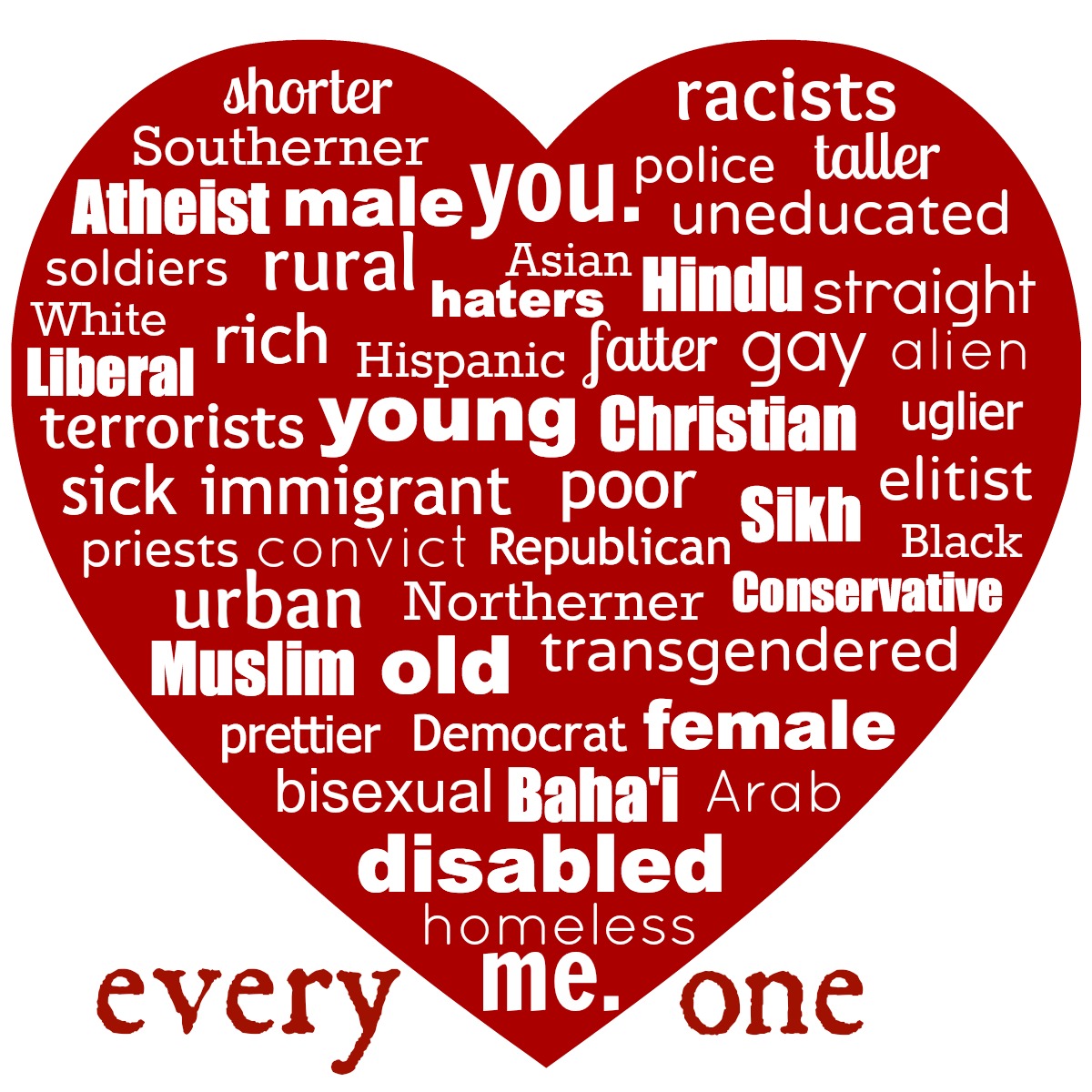
Really. This is for everyone, white or black, and every shade of the beautiful human experience. This is for my gay friends, my straight friends and my friends trying to make an authentic life all along that spectrum of orientation. This is for my gender conforming friends and my gender fluid friends. This is for my rednecks, my Democrats, my Republicans and my independents. This is for my Christians, my Buddhists, my Hindus, my Muslims, my Wiccans, my Jews and my atheists. This is for my humans, and any trees or cats that happen to read my blog. This is for all: God loves you. God loves you. God loves you. Anthony de Mello spoke it simply and truly, “You don’t have to change for God to love you.” God’s love does not just pursue you; that love has already overtaken you and is yours right now. Breathe it in. Ignore all the voices that deny this truth. Let your heart be still and calm. Let your soul rest in God’s love.
We each need to begin our day with a reminder that this love is the house in which we awaken, the clothes in which we wrap and present ourselves. It’s the food of our soul throughout the day. We may and often do hear the untruth of not having God’s love during the day, but we can recognize it for the untruth it is, and roll on. Words may still have the power to hurt us and rejection from our fellow humans can still pain us, but we have a reservoir of truth to salve the wounding.
Really, please grab hold of this and make it your own. When someone hates you or mistreats you, that is the lie. Their lack of love or outright hatred is an untruth. It’s not true. Your value and worth are the truth. You are a recipient of God’s love. Their injury to you is not who you are or a true reflection of your value and dignity. When we know the love of God in which we stand we can then recognize the untruth in another person’s words and actions and avoid the danger of our soul feeding on that lie and faltering in health and growth.
Having been able to recognize the untruth in another’s words and actions, we can honestly love them, as they are. Maybe we can move past their hurtful words and see or hear something deeper in them, the pain and hurt that has caused them to be makers of pain and hurt. This is how God loves, without reservation and without any needed reciprocity. Jesus taught this kind of love, “Love your enemies and pray for those who persecute you.” Only by seeing the untruth in others and loving them anyway can we begin to forgive them and avoid letting the untruth take root in our heart and soul.
2. Stop the fighting, all the fighting.
There’s no culture war if we don’t show up on the front lines loaded and ready to get it on! Really, stop viewing everything as a fight and a conflict. Stop buying the rhetoric of political and religious leaders who claim you have to wage a war for your belief and opinion. We’re being herded by powers that deal in human misery when we answer a call to battle our neighbor. Neighbors are for loving. (Jesus said that, too.)
We are not going to wake up tomorrow to a world that agrees with you. You may be in the majority one day and minority the next. Your candidate might win, and yours might lose. Jesus gave us no marching orders to dominate this world… even Paul knew the difference between every knee bowing to Jesus and bowing to us. We are not promised world domination and we are not asked to attempt it.
Every time we speak in competition, every time we speak in conflict, every time we try to win a point, win an argument, out shout or out think or out debate someone, love loses. You know that passage about love from Paul, the one we always read at weddings? Yes, the one from 1 Corinthians 13 that is the “but have not love” and “love is” stuff… it has nothing to do with marriage and weddings. At least, no more to do with weddings and marriage than any and every day of life. That passage is about us sharing the world together, all of us and every day. It does not leave room for power games or cultural wars over tradition and personal opinions. All of the religious posturing about the fragility and offense of our faith is ridiculous and just comes across as a clanging symbol, selfishness and comical self-matyrdom. Claiming your rights over someone else’s on a religious basis is not kind, patient, humble or honoring of others. We fight or we love. What will it be?
Please. Whatever side of whatever issue is most compelling and meme-worthy of the moment, love will outlast it. Love will win. Love will be here. But will we be here? Will there be anything or anyone left on either side of any issue to enjoy the pride and power of dominance? You want to be amazing? You want to make God smile? Love somebody near you like they’ve never been loved before. And if you just can’t love them right now, at least take some quiet time to yourself until you can reboot the heart and catch a breeze of that free-flowing grace that God has woven into our DNA and the very elements of our world.
You, my brothers and sisters, were called to be free. But do not use your freedom to indulge the sinful nature; rather, serve one anotherhumbly in love. For the entire law is fulfilled in keeping this one command: “Love your neighbor as yourself.” If you keep on biting and devouring each other, watch out or you will be destroyed by each other.Paul, Galatians 5:13-15
Praying for Baltimore
 It is most definitely a whole new thing when you’re praying for peace in a nearby sister city, thinking of friends, family and colleagues who call it home. It’s important we are praying. And it’s important we are being peacemakers, even in the distant roles we may have as spectators and commentators. With this in mind, I’d like to offer a few reminders…
Our judgements aren’t needed. I see a lot of judgmental statements flying around social media, accusations and generalizations that are more damaging than healing. As a people of faith, I would ask us to hold to the admonition of James that we “take note of this: Everyone should be quick to listen, slow to speak and slow to become angry, because our anger does not produce the righteousness that God desires.” (From James 1:19-20) As prayerful and concerned people viewing the hurtful events in Baltimore, our indignation and anger does not further the reconciliation and healing that God desires for the city.
There are peacemakers on the streets, support them! Pray for the peacemakers, talk about the peacemakers, encourage them and share their work. It’s too easy to be angry about looting, and far more difficult and helpful to give support to those in the community trying to be reconcilers. Pray for the family of Freddie Gray as they ask for peace. Pray for local clergy as they march for peace. Sometimes, for us not in the city, this is how are to be fellow peacemakers. If our words and commentary simply incite feelings of division, anger and judgment, then we are working against God’s will in the world. Jesus endorses a reconciling view of life saying, “Blessed are the peacemakers, for they will be called children of God.” (From Matthew 5:9)
Pray the ones you feel least like loving. And while we’re talking about Jesus and about prayer, we are clearly taught that our prayers are not just for the ones like us, or the ones who like us, or the ones we happen to like. Who do you feel least like loving in Baltimore, today? It is the police? Is it those looting? Is it a racial distinction or an economic distinction? Is it a political distinction? Those you feel least like loving should be the target of your prayer, concern and love. This is the way Jesus taught us to live… “You have heard that it was said, ‘Love your neighbor and hate your enemy.’ But I tell you, love your enemies and pray for those who persecute you, that you may be children of your Father in heaven. He causes his sun to rise on the evil and the good, and sends rain on the righteous and the unrighteous. If you love those who love you, what reward will you get? Are not even the tax collectors doing that? And if you greet only your own people, what are you doing more than others? Do not even pagans do that? Be perfect, therefore, as your heavenly Father is perfect.” (From Matthew 5:43-48)
Finally, maybe a try a new way to pray. I often begin my devotions with some centering around the ancient Jesus Prayer, “Jesus Christ, Son of the Living God, have mercy on me, a sinner.” I will repeat the prayer, meaning it, hearing it, believing it and wanting it. And when I begin to feel the rhythm of the prayer, I’ll start to make some changes. Once the humility of being “a sinner” is rooted in my prayer, I’ll change it to “your beloved.” I’ll make claim the love that is promised to me by God in Christ. Then, I’ll change “Son of the Living God” to something like “my truest spiritual friend and teacher.” Eventually, after various shifts and changes, I’ll be praying for others instead of myself, claiming for them the love of God and presence of Christ. It may eventually sound something like “Jesus Christ, divine hands and feet bringing peace to the world, bless the streets of Baltimore through people of peace.”
Above all, love and pray. Love and pray.
AMDG, Todd
 toddthomas.net