
Just Life
Praying for the Gulf Coast…

Well, it’s been a while since I shared anything here; life’s been a little busy. But this week the oil spilling into the Gulf Coast has been heavy on my heart. So, I thought I’d try to unpack a little.
I’m going to ask you to suspend your political sensibilities for a short season. As I’ve listened and reflected on the oil spill, I’ve found the political dynamics to be distracting. Truth is, this is moral issue and an issue of empathy for our friends most impacted and for God’s good creation.
My mother-in-law’s family hails from Southern Louisiana, and so my heart is tied to a region that has partly existed for so many millennium just to bring me my wonderful wife. I and my kin hail from the great state of Texas which shares that same gulf with our neighbors in Louisiana, Mississippi, Alabama, Florida, Mexico and Cuba. Though not all the gulf is like the pristine waters I have relished along the coast of East Africa, it’s still part of my home.
We really need to be praying for and listening to our neighbors in the killing, thieving path of this spill. We need to be broken for the destruction that this spill is creating within the coastal animal, bird, fish and vegetative communities. We humans are a species of risk takers, often to our gain and sometimes at great cost. I get it; I’m not immune to the thrill of taking a chance and doing what seems impossible. I marvel at the complexity and seemingly preternatural audacity that makes deep sea drilling a reality. But I’m starting to really hurt that the same energies are not given to a love of our God’s good earth and to being present with our neighbors. Did you mark the 45th day of the oil this week? The forty-fifth day! And now BP finally manages to be able to catch a small percentage of the escaping oil… and I can’t muster much joy at the news.
I’m sick and angry as the stories of the ruined lives and livelihoods begin to seep out of LA as the oil seeps into it. I’m embarrassed by a culture of consumption that creates the need for such risky drilling. And I’m so dependent on and appreciative of the mini van and it’s petroleum munching, combustion engine that will soon carry us around on a road-trip to see our family in other states. *sighs* What shall we say to our neighbors in the Gulf Coast in the coming months and years? What will they say to us?
Have I ever mentioned how much I love alligators? I visited an alligator farm in LA some years ago, and have played with the idea of having my own such farm ever since. Fascinating creatures. I’m incredibly angry that their marshes are in danger.
And I’m having a hard time praying for BP. I know. Just typing the words made my fingers itch.
God has made a good world, and it’s wonderfully resilient in the face of such catastrophes. But it pains me to say that I’ve heard people, people self-identifying as followers of Christ, use this truth as a license for apathy about the oil spill. As if in making such a wonderful creation our God abdicated the right of wrath and disgust at the carelessness of any one species within it. Let us not be tempted by such a foolish notion.
This may be an unwelcome observation to you (honestly, it is for me, too), but I’m thinking God’s people need to do some soul searching right about now. Dare we toy with the word? Let’s. Change. It’s time to have a discussion about changing some things. I have an overwhelming feeling of need to do some hard penance for the mess we have made… and I’m not sue what to do about it. Any ideas?
“Saving God… I’m sorry. I’m sorry for unthinkingly embracing a life of no limits on my consumption except those imposed on me by my salary and earthly creditors. I repent of it, and ask for wisdom in the coming days as I try to see a better path, a faithful path. Amen.”
The Checklist Manifesto, a Book Review

One of my joys in life is finding good material for cross-discipline reading, and I found a lot of great stuff to digest in Dr. Atul Gawande’s work entitled “The Checklist Manifesto: How to Get Things Right.”
Dr. Gawande is a surgeon who has worked with the World Health Organization to study, craft and implement simple checklists as a precaution against surgical mistakes, complications, infections and deaths. This is a fascinating book written with humor and style. I owe a lot of thanks to the venerable Diane Rehm for having the author on her show recently and introducing me to the book. Diane rocks!
The book introduces some solid ideas for those of us in spiritual vocations to consider. I’ve made a short list of four big ideas and will add in a few quotes from the book. The ideas aren’t necessarily new, but definitely under-enacted in many of our professional lives and faith communities.
1. The Burden of Knowledge. Dr. Gawande touches on a huge problem facing many fields of science these days, not that we are ignorant, but that we actually know so much. He does not say we know too much, but points out that as our knowledge base has grown so much that we have begun to face more difficulty in assimilating the knowledge into consistent, accurate and dependable practice. He says it this way on page thirteen, “…the volume and complexity of what we know has exceeded our individual ability to deliver it’s benefits correctly, safely or reliably. Knowledge has both saved us and burdened us.”
If you’ve delved into the realm of theological studies then maybe you’ve also faced a frustration that has haunted me through the years: I can’t process all this stuff! I find that I cannot hold, in my sorry excuse for a brain, everything I need to know and remember about 2,000 years of Christian thought, much less what I add from thousands of more years of Jewish thought and all the other spiritual traditions of the world around me. So, can I create a model, even a checklist of sorts, to help me anchor a point from which I can operate in a daily way but also take deeper forays into the deeper realm of theology when needed activities and tasks arise? I’m both afraid and intrigued by such an idea, and to date I haven’t even tried to make such a list/process. The question may sound stupid and even primitive to you smarter folks, but the second point I’m pulling from the book may help you see how such a checklist would function.
2. The Cognitive Net. Dr. Gawande describes the checklist, not as a robotic brain-sucking, inanimate object that tells us what to do or what to think, but as a “cognitive net” that frees us to concentrate on the important, immediate stuff while not risking the important, yet peripheral things. He says on page 48 that such a checklist would “…catch mental flaws inherent in all of us – flaws of memory and attention and thoroughness. And because they do, they raise wide, unexpected possibilities.”
OK, that quote gets me a little excited. Not just in theological studies, but also in the weekly activities of a church family. In our daily tasks within the religious vocation we face a myriad of activities and responsibilities that present us with a combination of complexity, mind-numbing detail and often repetitiveness. What would a cognitive net for the full-time or part-time pastoral staff look like? Would we develop a set of checklists to get the main tasks of a week finished and to track the Sunday AM preparations? If so, what would such lists look like, and how would they be made accessible and function with us?
3. Team. One of the strongest points made by Dr. Gawande is the power of a team versus the strength of the single hero whom he calls the “audacious expert.” This is something that many disciplines have struggled to understand and implement. At Church in Bethesda we work toward valuing the team effort over the single expert’s audacity by creating a flat and participatory organizational structure and then implementing a visionary-consensus model of making decisions (no voting, only group think). We assume that the group can be more creative, wise and better equipped than any individual, no matter how trained and competent that individual might be. Such individuals are still important and needed, but are helped and made better by the group.
Dr. Gawande mixes this in with the concept of decentralizing power to better enable and empower the many members of a team (or community) to carry shared responsibility for solutions and outcomes. I like that idea, and I like what he says about building team in easy ways on page 108, in discussing the simple yet powerful idea of everyone speaking and being heard, even if just in giving their names: “The researchers called it an ‘activation phenomenon.’ Giving people a chance to say something at the start seemed to activate their sense of participation and responsibility and heir willingness to speak up.”
Really. How many times have we failed to emphasize the voice of every member of our faith communities? And I don’t just mean in business or ministry meetings.
4. Failure and Discipline. Dr. Gawande raises some very cool points to conclude the book. He begins by talking about a professional’s lack of discipline. I think I agree when he says that most helping/serving professions have a code of conduct, implicit or explicit, which emphasize the importance of selflessness, skill, and trust. He then adds a fourth that is often over-looked: discipline. He believes discipline to be much more difficult than the first three. Discipline is the commitment to process and procedure, the bane of any talented, driven, audacious and heroic leader, right? We want our heroes to be improvisational and amazing, not team players who can recognize and implement procedure and process to solve complex problems! Boring! But a new kind of hero is what many situations and problems most need.
Wow. This really frames a lot of angst in the church. We have and cherish the mythos of the charismatic, inventive, talented and unique pastor/leader/thinker/writer who stands alone, without peer, to break the path for us into new and exciting territory. We love and value the pastor/author/guru who can catapult us to the next level of coolness. St. John of the Cross, the Spanish mystic and poet of a bunch of hundreds of years ago, chastised this kind of thinking, a fevered dependence on the latest and greatest spiritual sermonizing and writing, as a pitfall for the spiritual adolescent. Dr. Gawande says on page 173: “Maybe our idea of heroism needs updating.”
Valuing both the audacious expert and the wisdom and power of the group can be a tough balance, but one that empowers a team/community to accomplish more and better action. He says succinctly on page 162 that “…good clinicians will not be able to dispense with expert audacity. Yet we should also be ready to accept the virtues of regimentation.” I think that it’s often either the over-regimentation or the lack of regimentation, a crucial imbalance, that holds some of our faith communities back from realizing their greatest impact in the world, locally and globally. What do you think? I’m intrigued and challenged by the question and it’s possible impact on how I do my job.
And finally, most of us aren’t too enthusiastic about really digging into our failures and the possible patterns that might be discovered, studied and changed. How many of us serving church congregations have reeled from job to job thinking, “Oh well, these folks just weren’t ready for me. One day I’m going to find a bunch of people who appreciate the greatness I bring to my profession!” Dr. Gawande points to the amazing process of and value placed upon investigating failures in the airline industry. No one else seems to come close to the kind of scrutiny they bring to bear on failures. Who would want to?
Still, if we are serious about the selflessness, skill, trust and discipline that come along with our professional and spiritual responsibilities, we must stop and do the scary work of poking around in our painful pile of failures. The hero, the audacious expert doesn’t often do this… that individual is expected to be above failures. To have a failure, it is thought, is to be a failure. Seriously, look at the professionals around us in just the field of politics. If someone makes a mistake they must resign, be fired and never grace our TV screens or webpages again.
Our author laments the situation on page 185, “We don’t study routine failures in teaching, in Law, in government programs, in the financial industry, or elsewhere. We don’t look for the patterns of our recurrent mistakes or devise and refine potential solutions for them.” And it’s exactly those potential solutions that we so badly need! So avoid our failures and continue to perpetuate them.
I think, in general, he’s right. We’re very aware of the failures in all those fields, as we are often aware of the failures of people within the spiritual vocations. Our problem is that we generally treat such failures only in the realms of figuring blame and enacting punishment. When I’ve tried to reflect and process on my own failures in my chosen vocation the typical response from friends and other church leaders has been one of “Well, just don’t worry about it. You’re a good guy and we know that.” Hey, I know that, too! Few, myself included, have been ready to sit and really hash into possible patterns of failure and the potential solutions to which Dr. Gawande alludes.
Conclusion: This is a good read! The author made me laugh out loud several times and consistently challenged my thinking on systems and process. I’m still working through the ways his ideas and thoughts might impact me as a professional. I’m not sure what I might end up doing with the experience of his little book, but do know that I’ll be changed by it, my work will be changed by it, and all that change will be for the better.
Stop, Drop and Paint…
I’ve been working on “Thoughts on Preaching: Part 2,” but this afternoon I just had to stop thinking for a while and do some painting. Painting is prayer, a form of meditation for me. I make no claims to be good at it or have a style I can all my own, but it is one of the most freeing times for me.
I’ve been reading and thinking about St. Francis of Assisi for a few days and I was thinking of doing a self-portrait, so I combined the two and came up with this painting, today… an acrylic meditation on the first line of St. Francis’ formative prayer,
“Lord, make me an instrument of thy peace.”
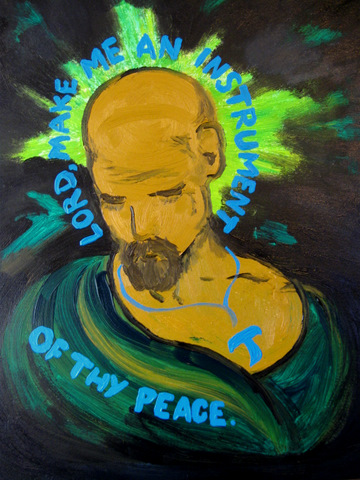
I worked two hours straight on it from the beginning to completion, and it’s drying now in our bedroom. I have a spot on the wall all picked our for it. Don’t worry, I am under no delusions about the difference between myself and the great saint. I just used a little artistic liberty to focus my efforts.
Our congregational email on Praying for & Helping Haiti… 01-14-10
Good morning, folks…
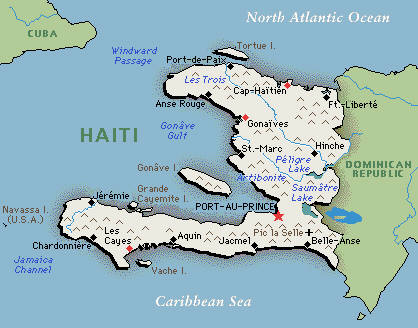
It’s been a horrific few days watching the images and scenes coming from the devastated streets and lives of our neighbors in Haiti. Time and time again we’ve seen the prayers being lifted for the suffering in Haiti and we’ve lifted our own. Many efforts have begun to get aid to the people who need it most, and to get it to them in ways that will be effective and handled with the greatest care and stewardship. I wanted to drop a note today to share a few thoughts on praying for Haiti and an opportunity to help with the needs brought by this disaster.
First, I did not know until this week that our own Luke Campbell has a sister (Deborah Baker) living outside of Port Au Prince, living and working with her husband (Kyrk Baker) and children, for Baptist Haiti Mission, assisting churches and operating hospitals and school programs. They are weathering the storm as best as possible with no loses of life within their family, but now the huge stresses of being first responders and completely overwhelmed. Fortunately, they have medical facilities still standing and are receiving people coming from the city. They have a blog about their life and work in Haiti, and I’m listing it along with a link to Baptist Haiti Mission:
http://www.ourlifeinhaiti.blogspot.com/
http://www.bhm.org/bhm/index.php
With the myriad of ways offered to us to contribute and send aid as individuals to the hurting people of Haiti, I was glad to know that we have a connection with people there working and serving in such an immediate way. We will have a prayer station set up this Sunday to offer not only prayers but also contributions as a church family that will be sent to help the Bakers as they respond to the crisis as God’s hands and feet in the midst of such pain.
Praying for the People of Haiti…
It’s going to be a given that we are offering prayers for the hurting souls of this devastation. Some of the poorest and most disenfranchised people are suffering through a situation that no one is ever prepared to face. So, we pray for the people of Haiti, for the hurting and the for the dead. Your prayers are so important in the coming days as victims and responders deal with the loss and pain they face. I’m including a link to Gratefulness.org where you can light a virtual candle in prayer for Haiti. We also used to have the “Prayer Lava Lamp” set up in our Sanctuary, though it’s been a while. If you’d like to open it and have it on your desktop to remind you and facilitate prayers, I’m linking it in as well.
http://www.gratefulness.org/
http://www.emergingchurch.info/prayer/lamp.html
Praying for the First Responders…
I’d also like to ask you to pray for the first responders, the folks like Luke’s family and many other aid workers, working for different types of church missions and for the many governmental agencies, who are on the ground in the midst of the situation. Some of them have lost a lot in the last couple of days, and still will be looked to for help. I’ve also been touched by the stories of Haitians tearing through rubble with bare hands to affect rescues and recoveries of people trapped in collapsed buildings or giving what medical and rescue assistance they could, even with no training. We pray for the people who are saving and serving their neighbors, right now. They will have a long road of healing of their own. There’s a good list of prayer points on the National Prayer Center’s website, and I’m linking it in (shortened by Tiny URL).
http://tiny.cc/haiti812
And we pray for the US Military and US Rescue Personnel…
I’m including a link about our mobilization of military medical personnel, supplies and ships, and many other responders who are on their way to Haiti to serve. These folks will face some very harrowing days ahead, and they need our prayers of support. I am always so proud when our military’s medical fleet is prepped and sent to respond to disasters around the globe, providing supplies, help and security.
http://www.msnbc.msn.com/id/34832613/ns/world_news-haiti_earthquake/
So, I hope to see you on Sunday. I know that there are many ways to send aid and support to the people of Haiti, and I would never expect you to neglect the other connections you might have to directly serve with friends and family who are there helping in the aftermath. However, I’d also ask you to think about the amount which you would be able to bring on Sunday to help with the needed supplies and materials for helping stabilize and heal our hurting neighbors in Haiti. We’ll pray and do what we can as a church family to be the neighbors they need in us, now. And I’d invite you in your prayers to even consider what the future may hold for our church family as global neighbors with Haiti. Just a few weeks ago I shared with you that I’ve had it on my heart to find the way in which we might engage the world this year in missions, and from our previous support of Brooke in Haiti, to the connections we find developing now, I wonder if we’re not being asked to consider a longer-term commitment of prayer and service to the people of Haiti? Let’s lift that question to God as well. Thanks.
With All Peace,
Todd Thomas
Church in Bethesda
I have a verse for Mr. Pat Robertson…

Wise words from Romans 14:22
“So whatever you believe about these things
keep between yourself and God.”
Why don’t we ever hear more sermons on such a great idea? Why don’t I preach on it more? There’s a truth loose in the world and it goes something like this… “You don’t need to hear my views on everything, or vice versa.” Please, Mr. Robertson, enough.
Paul has struggled through a very sticky situation in his Roman letter. It’s a moral, ethical and spiritual question with huge impact on the civil, secular, communal and daily lives of believers. Should a believer eat food that is consecrated to another god? And if so, or if not, to what lengths do they go to discover if it has been consecrated or not? The whole thing has very little meaning to many Christians today, but we do have our own big questions, moral questions, ethical questions, questions that impact our daily lives. And we spend a lot of time expressing opinions, many of which are hurtful and uncharitable.
Paul’s solution? In part, silence. Respectful. Silence. Quiet time with God.
I don’t question Mr. Robertson’s right to hold views on the causality of earthquakes or the relationship between what we call natural disasters and the impact of spiritual powers in the world. I just wish he’d keep most them to himself. Instead, he heaps blame and shame on an already suffering, impoverished and destitute population. Not what I define as a “Charitable Act.”
I could go on, but that’s pretty much it.
Lord God, in your mercy,
hear our prayers and pour out your peace,
hope and blessing on the people of Haiti.
Amen.
Prayer Stations in Our Worship Experience
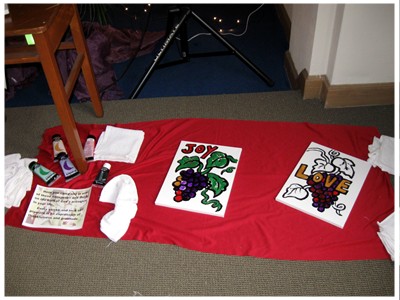
It dawned on me after writing yesterday’s post that most folks don’t have “prayer stations” in their worship experience and might not really have a ready mental image or knowledge of what I’m talking about.
Firstly, cool. You don’t have to have prayers stations. No one has to have them. We do, because we find it helps us 1) to move around in the worship time, 2) to have some tangibles surrounding us when we deal with big life issues, and 3) to add a dynamic of experience to something that is too often just observed and/or heard. All three ideas are interrelated.
We believe it’s good to move in worship.
That’s not to say I didn’t grow up moving in worship services, but it was usually just things like, sitting, standing for songs, passing trays during communion, etc. Some of you added clapping and even a little dancing to that list. Others of you grew up with the word “Spirit” being a verb and you don’t need any convincing of movement’s worth. On a weekly basis at CiB we try to move. We have the old-school church building with pews, but we don’t let them corral or contain us. I enjoy the practice of walking forward to receive communion. We usually practice intinction as our communion method. (Intinction: tearing away a piece of bread, dipping it in the up and eating.) I also love the sharing nature of one person serving another the communion elements. Each Sunday we are practicing active service. I love to say or to hear words like, “This is the Cup of Salvation.” Most Sundays we simply call for volunteers to come up and serve… and they come, younger, older, male, female.
So communion is truly a journey for us. We move forward to receive the bread and cup, and then we begin to move through experiencing and exploring the “stations” that inhabit the Sanctuary. There are almost always candles to be lit in prayer. We have kneelers in a quiet corner where we practice different postures of prayer. Then we have a variety of stations that invite action, writing, contemplation, service, or some other mode of addressing God’s presence in our lives. For a couple of months in 2009 we had a “vineyard” with soil, flower bulbs, painting, grapes to eat, and much more. Get moving, get the blood flowing… it helps the heart and the mind!
We believe that people need tangibles.
Let’s face it, one of the hardest things we do is often bringing our hopes, faith, desires and passions into real life. We struggle to translate our ideas and ethereal faith concepts into action. So, when it is difficult to pray, light a candle and let your soul dance for God with that flame. Scripture assures us that God’s Spirit dances and prays with/for us. If we talk about the “soil” of our hearts, why not feel the dirt in your hands and see the stones that must be removed before planting a garden? Why not eat some grapes or taste some more bread when talking about “fruits” and the “Bread of Life.” Take the time, while you’re in worship and gathered with your church family, to do some small action of service or ministry for someone else. “Taste and see…”
If we are wrestling with concepts that we want to have an impact on our daily lives, then it can only help to add a dynamic of the material life into which God has made/placed us. I’ve watched many churches move in some new directions in the last couple of decades, adding new elements like dramatic skits, videos or more lively songs, and many pastors have discovered the power of visual aids. (Visual aids have tended to be items in hand, on stage, or most of what is projected at some churches during the sermon time.) And truly, visuals are powerful. I’m excited that so many churches are doing this, because I feel it is part of a recognition that people need more connective buy-in and sensory engagement in worship. The only caveat I have with all those innovations is that they tend toward just being more observation. Those things are often tangible, but still at some distance. What a great segue paragraph (I said these are all interrelated)…
We believe that participation is more than consenting observation, but should include a more complete sensory experience.
God gave us many senses, but honestly, we’ve tended to prioritize them in worship services and ignore some. God worked to provide us with a great collection of experiences… circumcision, baptism, communion, voicing song and scripture, “holy kisses,” etc. We’re given hands and feet and eyes and ears and nerve endings, olfactory senses and taste buds. We’re asked to do things like follow, “walk humbly,” offer cups of water and “build houses on rock.” Let’s revel in that! The scriptural idea of fearing God is not a fear of accidentally over-worshipping or being too present and experiential of a God just waiting to slap us down. I believe it’s a deep, abiding, humble, reverencing, driving, seeking-while-fleeing, burn in a soul that knows what it is to be loved. The love of our significant others is often frightening, and God’s love is big enough to be downright fearful. Reverence doesn’t necessarily exclude dirty finger-nails, wet paint on canvases, or rubbing shoulders at a prayer station of service. We’ve long been asked to consent to belief, and now we’re discovering that there’s also value to an active experience.
One of my greatest joys is when people come to me to share a good experience (feeling, insight, thought, conclusion, vision) that they had from visiting a prayer station that was not part of the experience I, as it’s designer, intended them to have. Be ready for God to use these stations and teach you a thing or two!
Any there some tips or practical advice for the whole prayer station exercise? Sure there are! Here’s a few:
- Don’t do this to be cool. Do this to better engage the things of God.
- Do this prayerfully. Bathe this stuff in prayer before, while experiencing, and after the experience.
- Don’t mandate this on your people. A lot of folks get scared and angry when surprised or confronted with the unexpected. Use a lot of grace with this stuff. Lead into it yourself. Talk about it before throwing people into it. Tell people some of what they might expect to find or experience in it. Share why you’re doing it. Even still, some folks won’t ever go to your prayer stations, and that’s ok. If they aren’t ready or willing, that’s fine. Don’t forget that they don’t have to do this.
- We always play music while in the communion time and time of experiencing the stations. That music is usually canned, sometimes performed live, and always helps fill the space and time.
- We do this during our communion celebration because we’re already up. If you try this as a stand-alone part of worship, then expect some time to be needed (or even resistance) for people to get up and get moving.
- Be meaningful. Let this inform your people.
- Don’t overdue one idea. Ask for input and invite others to help you develop creative ideas and implementation.
- Do this because you love your church family.
- Expect that this, as with any new practice or experience, will have to grow and gain momentum. It takes time for a community to fully embrace and grow into new methods.
- Don’t be overly discouraged by a “failed” station. Not all your ideas are good. Not all my ideas are good.
What would you add to all this?
Oh, here’s a document of notes I made a while back about “Experiential Worship.” I can’t remember what all I wrote (it was for a presentation to some colleagues), but there might be something in it of value. Surely there are some good thoughts and ideas I haven’t had or shared? One of the things I’m working on for 2010 is a good, internet-based way to broadly share things like prayer station ideas and inspirations… shared creativity is awesome!
When We Find Ourselves Lost

Maybe you’ve had the joy to be following the current stink going on between the NewSpring Church in Anderson , SC, Perry Noble (PN) it’s Pastor, and a local college prof named James Duncan (JD)… if not, here’s a couple of links that will (slowly, it’s quite a read) catch you up to speed: James Duncan’s Story: Holy Rage At The Spring and the Church’s recent Announcement. I appreciate the friends who were posting last week and put me onto the story.
I’ve read the story from JD’s side and I read the church’s announcement. I have gone through some of JD’s older posts to pick up some of his blog style and thought process. I watched some video clips and I’ve read some things that PN has produced.
I’ve gone thru this multi-day process of incredulity and shame, disbelief that Christians are out acting this way… PN and NewSpring seem to have failed their responsibility to lead with the Spirit of Christ from the top down, in some ways, and it opened the door to horrible things being done to JD and his family. (If only half of the things actually happened as JD sees them happening, it’s truly deplorable.) Also, having read thru JD’s blogs, he has exhibited a true proficiency (he is a communications prof) to nit-pick, spin and negatively portray PN and NewSpring no matter what they’re saying, and also forgets the Spirit of Christ in his blogging content.
NewSpring is a huge church that seems to have been relatively quickly built (10 years) on a tightly controlled, highly charismatic-personality-centered, high-budget, attractional model. OK. It seems to also have been built on things like enthusiasm, faith, service (local and global), evangelism, creativity, technology and high energy.
JD seems to be a concerned, learned and invested observer. I actually found myself shaking my head at most of his criticisms because they seemed far less founded than JD thought they were. OK, straight up… I don’t agree with hardly anything JD writes. But then, I don’t do church completely like PN and NewSpring either.
Where are things today, by my distant view from sifting the internet? PN doesn’t seem to have paid attention to aspects of his staff and staff behavior, and probably let his gifted hyperbole and sense of humor set the stage for some major misunderstandings among his staff at NewSpring. So, a few staffers and volunteers under PN were not prepared psychologically or spiritually for a challenge like JD and they responded way off the chart of appropriateness. The level of personal responsibility that PN carries for these circumstances is a “your guess as good as mine” thing until a jury is asked. But, I would bet you money that it hurts his soul right now. I see his actions and words as full of denial, hurt, fear and frustration… none of this fits his view of what he wants to be spending his time or the church’s time talking about. And I’m sorry, the church announcement was a hit job on JD’s credibility, well crafted and cleverly written. Didn’t look at all graceful.
JD is off and running, and seems to be enjoying himself, blogging, doing interviews, etc. I hesitate to call this “self-fulfilling prophecy,” but he sort of started the whole internet stalking game here, running down every usable quote from NewSpring staff to spin and blog and denigrate. But of course, he’s just a blogger, so his intentions are always pure and honest and calm, non-violent and selfless. Sorry, I was being a little facetious there. He just doesn’t seem to get it that his claim of PN and NewSpring’s responsibility to address his concerns is more than a little spurious. They are not obligated to answer every critic, nor to address every one of his complaints. Get used to it. So he offers to co-write a book with PN to adress his own concerns, and then is surprised when PN say no thanks? Prideful.
I’m just frustrated that both sides have failed to regulate themselves any better than this. And I’m sorry JD asked for loads of dough. Since they were at the point of lawyers and blah, blah… he could have presented a case for damages and pursued the point of restoration. Were there damages? Absolutely! Horrible things seem to have been done to JD. But then he also gave them a $3million “silent” option? What? Looks bad. Looks as “mafia” as the things done to him. Purchased silence, hm? How do all the claimed higher ethics and morals mesh with putting a price tag for silence on the truth?
Here’s the metaphor I am thinking about for this today… it’s like when a four-year-old continues to heckle an eight-year old sibling until the older sibling strikes out physically and then the younger gets to play the “He (she) hit me!” card, assuming the bigger, stronger siblings inherent culpability. So, JD gets to stalk and riddle PN and NewSpring with accusations and blog entries (which I think is not necessarily good), and then gets to play the “NewSpring hurt me!” card when the response from the NewSpring staffer and volunteers is absolutely bad and wrong? Truth of the story… both siblings need a spanking.
This is a story of today’s church in America. This is a story of Christians in today’s age and culture. This is a story of facing the lostness within our churches, our souls, our words and our energies. Not the kind of lostness that means we’re not Christians, but the kind that shows we often still struggle to know it means to be found. So far, the only moral I can see to the story is that when I’m being naughty I need to be sure to insulate myself with 1) a blogger’s inherent rights of free speech, criticism and verbal stalking, or 2) a rigid church structure and loads of lawyers thru which I can establish some plausible deniability. I’m still trying to make up my mind which I’ll choose.
Ink, the movie… see it!

There’s a new movie by Jamin Winans on instant viewing (if you’re a Netflix subscriber) that I’d like to recommend. It’s called Ink.
Here’s the deal… the maker of Ink is going for a high level of art and visual magic in his film, and in many ways he does succeed. But it is also fairly slow and enigmatic plot-wise at times, so let the visuals carry you when the story moves a little slower. Special effects range in intensity, but he nailed the “dream eyes.” If you’ve ever had a nightmare in which you just couldn’t get your eyes to focus, then you’ll know what I mean.
My bottom line with Ink is this: If you can hold on for an hour and a half of “OK” movie, then the last fifteen minutes will make it all worth while. I was not stunned by most of this movie, but the last fifteen minutes ate my lunch (in a good way). So, if the definition of a great movie includes taking you somewhere and making you want to stay there, then this might just be a great movie. I’ve already bounced to iTunes and purchased the soundtrack… great electronica!
Check it out! You’ll be glad that you did!
No, I’m sorry… God Loves.
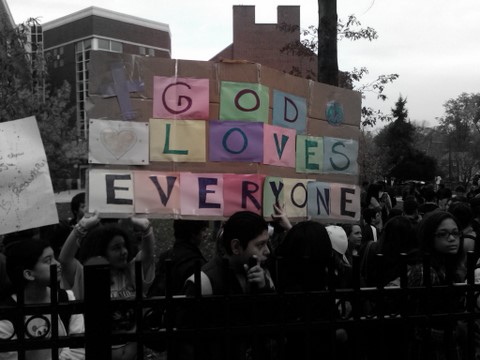
So, the sad folks of Westboro Baptist Church came to Bethesda today with a message of hate and condemnation; they’re the “God hates fags” folks. They stood outside my son’s high school with graphically disgusting signs, taunts of hatred and shameful messages of violence. I did not want to validate their illness by taking pictures of them. Instead I took a picture of the students’ response, one of love. That sign says it all.
I’m filled with parental pride that my son asked if he could go in early and stand with the other students of the school in quiet response to these people of hate. My son gets it. My son knows that the haters are wrong. My son is not growing up to be a hater. I was proud to stand with other parents and keep our cool while these people were protected in their right to speak their sick minds. I’m not sure how, but we kept our cool.
There’s nothing new about their illness. If you read their website it becomes obvious that they are completely messed up. And I’m no where near the first to say that they are wrong, but I’ll say it anyway. It’s important that we say they are wrong. It’s important that we stand against that kind of hate. They are wrong.
I’m back in my office now, myself somewhat sick in heart. I’ve got some Rich Mullins playing, trying to chase away the demons.
“Savior God, pour out your Spirit on these students in Bethesda. Bless them for their commitment to love, for love belongs to and flows from you… and deliver us from evil.”
Resolving Deadly Viper…
I just perused a very welcome update on the Viper interplay between the authors and the voices of protest. I’m glad to see the prayers of many answered in this obviously relational move to resolve the hurt and to move the whole kingdom forward. Amen!
Let’s be honest… like never before our predominantly Anglo majority in our country is having to come to grips with our heterogeneous society on levels and in arenas unimagined. We have to face the shallowness of the much lauded, historic “welcome” that we presented to other peoples who came to our country to share our space and raise their families with us. We also face this within the kingdom of God. The “Viper” parable can be an anchor as we move forward. White folks don’t just write and speak for white folks, and Asian folks don’t just speak and write for Asian folks, and so on… we share the movements of God in this world, and that means we share a heavy responsibility of love, grace and adaptation.
I think that this coming Sunday we will all lift the cup and bless the bread a little more one, and a little more in sync. That’s a good thing.
 toddthomas.net