
Civility
A Civil Repudiation of a Judgmental Viewpoint
 Things like this pop up in the news every now and again, and I took a hit for the team today and actually listened to Pastor Steven Anderson’s full sermon entitled: “AIDS: The Judgement of God.” It came as no surprise that he generalizes people, uses stereotypes and exaggerates, and does some pretty horrible handling of scripture.
This preacher is not mainstream Christianity. He’s not even mainstream for Baptists, even non-affirming Baptists. He’s not doing good exegesis of scripture. He abuses his concordance by picking and choosing uses of English words across the breadth and width of scripture. And I have to take a moment to repudiate his message and proclamation. I won’t join him in name calling and I won’t join him in screaming. But I won’t sit by and let this be done in the name of Christ, with the accompanying laughter of his congregation, without a strident denial of the message of vilification, violence and anger.
I had hoped to just mention a few things he did wrong, but it’s a long sermon. I ended up with at least 14 things he did that were disrespectful of people and/or disrespectful of our scriptures.
1. Jokes about HIV/AIDS and people’s health and suffering. Really, he laughs about AIDS rates and people having AIDS. He repeatedly jokes about their suffering and about efforts to help them. HIV is a laughing matter to him.
2. Backward reading of Romans 1 and dismissal of Romans 2. He ignores Paul’s point to the verses in chapter 1 which is made in chapter 2: Don’t judge. Since he ignores Paul’s point of not judging, he is then free to read the verses in chapter 1 any way he wants. I outline in depth this kind of problematic reading of Romans 1 in another post here at the blog.
3. Associating HIV/AIDS with Romans 1:27. I didn’t think people still did this, but he actually makes it the sermon title that he believes HIV/AIDS is the penalty mentioned in Romans 1:27. Do we have to go into the problem of reading a disease in our current time backward into scripture from 2,000 years ago? This is so disrespectful of scripture that it defies explanation when coming from someone so stridently claiming “biblical authority” for his message.
4. Use of the word “sodomite.” If we are honest about the destruction of Sodom as biblical writers spoke of it, then we have to know that using the word (which was created long after the scriptures were written) to reference a specific sexual activity is a warning sign that we’re listening to a severe lack of education on biblical topics and a lack of respectful interpretation. Again, I wrote on this in a previous post. Using sodomite as an adjective would more correctly denote gluttony, pride or a neglect of poor people as scriptural writers spoke of Sodom’s destruction.
5. Defining words with a concordance. He jumps around an English translation of the Bible to define biblical terms in one instance by the use of that term in another instance, as if it were all originally written in English, yesterday.
6. Setting up straw arguments which he of course wins. He says, “They said *blah blah” to which I say “blah blah*” and wins the argument… of course. He makes everyone who disagrees with him sound stupid both in their intention, content and inflection.
7. Advocating the execution of homosexuals. He claims that we can have an AIDS free world in short order by killing all LGBTQ people, as we were told to do in Leviticus. His words normalize and justify violence against sexual minorities.
8. Name calling. Psycho. Homo. Satanist. Freak. Hypocrites. Bastard (speaking of President Obama). Twinkie.
9. Vilification and criminalization of homosexuals in every possible sense. He says, “Homos are gross.” “Homos go both ways.” “No queers allowed in this church.” “All homos are pedophiles.” He actually asserts that all gay men are pedophiles. He asserts that all gay men are trying to spread AIDS to straight men and women. He says that gay men are to blame for any straight person who has AIDS, which of course he can assert by believing that God gave gay men AIDS in Romans 1:27. He claims that gay people only want to be married to be insulting to straight people. *Sigh*
10. Believing the gospel means that a person cannot become gay. He asserts that becoming a Christian means that a person cannot be then tempted to explore gay sex and negates any previous leaning toward gay sexuality. Since when does faith work that way with anything we might consider a sin? And of course, since I don’t believe that being gay is a sin, then I’m left further befuddled.
11. Misuse of a verse from Jude to link homosexuals with the destruction of Sodom. He misuses a phrase “strange flesh” from Jude’s short letter, almost as an afterthought, to link homosexuality with Sodom. The phrase is sarkos heteros in the Greek… very hard to link homo-sexuality with hetro-flesh, but it doesn’t stop our preacher in this instance. I hope we all know that hetro- means different not male. Therefore heterosexuality is attraction to the opposite sex.
12. He doesn’t know any gay Christians. Not just to repeat points 9 & 10, but it’s so sad that he doesn’t know any gay Christians, whose faith has at times put my own to shame. His narrowed and incorrect view of sexuality limits him from a fellowship which would do him such good.
13. “I’m not going to stone them with stones… this is not a violent sermon about harming anyone.” After asserting that we would have an AIDS free world if we’d only execute homosexuals, he then claims that he won’t himself use stones to kill anyone and isn’t meaning to advocate violence. Too late.
14. He engenders fear, “Don’t just put your kid on a school bus.” …because gay people are waiting everywhere to devour your children, with government support. He speaks with the language of fear and abuse. He himself is fairly stereotypical in his language when not only vilifying gay people but also the public educational system and politicians.
Now I have to pray and find a way to detox from this sermon. His anger, his venom and his excited joy in condemning and ridiculing people is injuring to the soul. Please, my LGBTQ sisters and brothers, don’t listen to this man. No one should be swayed by his screaming tirade and twist of scriptural passages and words. Don’t believe that he in any way speaks for our Christ, our God or our Church.
I can’t muster the spirit at this point to listen a second time, but I’m fairly sure he never once quotes Christ in this sermon. I can’t even recall that he mentions Christ. I do know he at one point makes fun of Christians who emphasize love. Hmmmmm. Let that sink in and be a warning flag for the future. If he did mention Jesus, then it was so passing as to not even register in my memory. Know that you cannot preach as this man preaches if you are tuned into the heart of Christ, a heart that breaks with every ridiculing joke and sneering dismissal of a human being from this man’s mouth.
AMDG, Todd
Hearing that Jesus had silenced the Sadducees, the Pharisees got together. One of them, an expert in the law, tested him with this question: “Teacher, which is the greatest commandment in the Law?” Jesus replied: ” ‘Love the Lord your God with all your heart and with all your soul and with all your mind.’ This is the first and greatest commandment. And the second is like it: ‘Love your neighbor as yourself.’ All the Law and the Prophets hang on these two commandments.” Matthew 22:34-40
Ferguson: The Need to Listen
Before Ferguson becomes old news in the wake of a more recent death or similar narrative to the sad loss of Michael Brown’s life, I want to ask just one thing of my beloved friends and neighbors who are not African American: Please, start listening and validating your African American neighbors’ stories, fears and feelings.
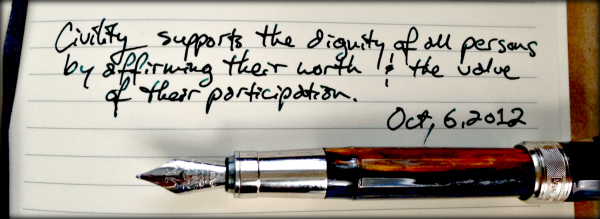
It’s time for us to fully hear and validate the narratives from our African American sisters and brothers across this country. We have to listen, to hear the fear and to hear the pain, and we must accept it. It can be such a blessing to be heard, and such a hurt to be ignored.
When something like the death of Michael Brown occurs, the fatal police shooting of an unarmed young African American male, we begin to hear the multitude of voices saying that this is status quo for their neighborhood. They say that this just part of being black in America, that it’s their fear for their own children, and that it’s just another white man killing a black man. We need to listen to these voices.
I resist listening because to do so is painful. Another armed white man has killed an another unarmed black man, and won’t face any charges, because that’s just the way it is in America. As a white man I cringe and want to look away, to “listen away” if only I could. I want it to not be true. I want it to be wrong. I want to deny the voices. But to deny the words, to ignore the words or to argue against the reality of my neighbor’s fear, pain and frustration, is to add insult to their injury. In fact, it’s worse than insult. It’s further injury.
It’s painful to validate the pain of my neighbor because I must then help carry it. I will sometimes do this for people I know and love, say the people in my family or my closest friends… but to carry the pain of a stranger? To carry the pain of a stranger, a pain that is also an indictment of me and the so near and present history that has been a huge part of me being who I am, and where I am, and what I have? That’s hard for me, a white man.
And yet, listening is exactly what I need to do. I have to listen and believe in the person speaking. I have to validate their story. I must value and give dignity to the experience of my hurting neighbor. If I cannot hear and value my neighbor, then I cannot speak to and journey with my neighbor. I will have already taken from them the value of their presence.
We all need to be heard and validated. When our African American neighbors speak, they must be heard. When their stories are told, we must welcome them to share. And when we are shamed by their words and begin to feel the hurt they are sharing, we must carry it with them. This is the only road to the future.
When our African American neighbors speak of their fear of raising children and the specter of death from police shooting, we must listen. When they speak of fearing the police, we must listen. When they speak of being misunderstood and harassed by white law enforcement, we must listen. When their story is painful to us, we must pay the price of listening.
There’s no way forward other than giving the dignity of thoughtful listening, and the validating worth of being heard. We cannot simply choose a side and hunker down with our arguments in our better neighborhoods and hope for compelling distractions to ease our disquiet… at least until the next shooting.
There are many narratives, and they must be equally heard. The Ferguson narrative is not the only African American narrative of contemporary America, but it is an authentic and valuable narrative that needs to stand alongside the other stories of being an American today.
There are also streams of experience that cut across the many narratives. We won’t begin to find a way forward between communities and their police forces as long as we ignore the real fear, the real pain and the real distrust engendered by histories of abuse, injustice and neglect.
A new narrative comes from our collective pain over the past and present, our redressing of wrongs and our belief in one another. When white Americans quote “black-on-black” crime statistics and point to the background looting that so often accompanies the peaceful voices begging to be heard, we do a deep injustice to the future, theirs and our own.
We cannot just say that we want to move forward. We have to be fully present now. We must trustworthy listeners. Although there is a goodness in attempting to be “color blind,” I’m afraid the weakness of that idea exists in it’s refusal to validate the divergent stories and experiences of different colors.
 So, I’m trying harder than ever to listen, and I ask you to as well. Seek out the stories. Let the voices have their say and be heard. I ask you to want to better understand. Toward that goal, I’m reading Black Like Me at the moment. What the heck, I grew up in Texas and didn’t read this in school!? I grew up a few miles from the author’s home town and never heard of John Howard Griffin!!! Come on, Texas! I only know of him now because my dear friend David Gerard, who is African American, mentioned him in a poem I’m going to share in this post. David is also a musician, a poet and a gracious soul.
 Years ago I was affected by reading Nathan McCall‘s Makes Me Wanna Holler, a book of pain that forced me to hear someone’s story that was so very different from my own. It was hard to read and I wanted to argue at times, but his story needs to be heard and understood.
Maybe you have heard of “the talk,” the talk given to young black men by their parents who fear for them? This is a real part of growing up in America for many families, and we should all own that shame and want a better future.
I ask you, to hear my friend David’s poem, and to love him as I do. I’m going to reproduce the poem here and try to get his arrangement as visually true to his pdf he sent me as possible…
THE RACE CARD
when I try to tell my friends
what it’s like to be a black man in America
they evoke a patronizing empathywhen I try to tell my friends
that there is one standard for me
and a double standard between us
they seek refuge in their denialwhen I try to tell my friends
how every black man ever stopped by the Police
wonders if he’ll be shot to death
they say I’m just being melodramaticwhen I tell them that i’m nothing
in the eyes of authority
and that my life is easily expendable
they try to change the subjectwhen I tell my friends
that every black teen from Trayvon Martin to Michael Brown
is six feet under due to prejudice and brutality
they ask me to look at “the other side” of thingswhen I tell my friends
to go undercover, as John Howard Griffin did
and notice the difference in how they are treated
they accuse me of “playing the race card”when I was twenty-two,
I was talking with a friend
in the lobby of a moviehouse
when a bunch of cops came inin search of a suspect
they pinned me to the wall and frisked me
because they were looking for a black man
when the victim saw me
and said to them, “That’s not him”
they took their hands off me and left
without apologywhen I try to tell my friends
the humiliation and shame I felt
and their casual disregard
they say, “they were just doing their job”when I try to tell my friends
they will never know what it is
to walk a mile in a black man’s shoes
they just don’t get itmy friends accuse me of playing “the race card”
but that hand was already dealt to me
the day I was born.18 August, 2014
I thank David for telling his story. I pray that we listen better, and that together we all can make a way forward, a way that tells and values our stories, and writes a better one for tomorrow.
AMDG, Todd
Social Media Requires a Social Conscience
 Let’s do something new.
It’s totally real and authentic, we all get indignant and fired up by things that cross our paths on social media platforms on any given day… and we go to sharing and posting away. Whatever our political, social, religious, philosophical or fiscal inclinations might be, there’s a whole world of memes and news stories out there to support our view and also to ridicule our view.
Are so many of those memes and stories just a bit biased, unfair, exaggerated or intended to cast one side in the worst light possible while giving the most generous presentation to the other side? Well, of course. Are those memes and stories intended to inflame and create controversy? Surely. Do they change anyone’s mind or alter anyone’s position on anything? I don’t think so.
Too many of us keep on breaking the internet’s #1 rule: Don’t feed the trolls. And we think we won something. We keep sharing and re-posting the jabs and skewers upon which we gleefully imagine “the other side” flailing in their death throes. But it’s not happening. No one is dying… only the discourse. The casualty is the space between us… it grows more and more dense and dark, deadly and confining.
Let’s try to make a change of the better, shall we? Let’s stop posting and sharing all the things that inflame and make us indignant. Let’s “lean in” as people are saying now, or “bear down” as we’ve said in the past, on making our shares and posts really count for good. You and I, each of us, in all our diversity and uniqueness, share this burden and this responsibility.
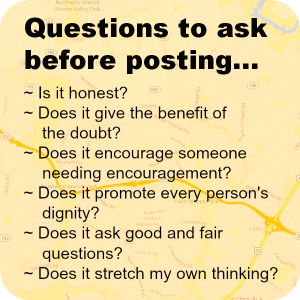
I quickly came up with six questions to ask myself before posting or sharing something. If I can answer yes to each, then I will share or post. If I cannot answer yes to each, then I need to stop, drop and rethink. Why am I posting? Is it what I really want to post? Why am I struggling with a yes on one of the questions?
Questions to ask before posting…
- Is it honest?
- Does it give the benefit of the doubt?
- Does it encourage someone needing encouragement?
- Does it promote every person’s dignity?
- Does it ask good and fair questions?
- Does it stretch my own thinking?
How would you adopt and adapt those questions and make them your own, for the good of more thoughtful and meaningful posts? Did I miss anything? I’ve written a little about Facebook Etiquette in the past, but this hopefully goes a little further. Let’s do something new.
Let me share a few thing additional thoughts real fast…
HUMOR: There’s a bunch of humorous things that can be posted without worrying about the heaviest questions of goodness and dignity. But don’t think that because we can post a cute kitten video without asking deep questions that we can then post any humor without asking good questions. Be wise. Think deep.
PERSONAL STUFF: Same thing goes here I think. If I post a proud pic of the salad I made for lunch, that’s cool. Many times we post and share things that are rather benign and don’t beg to be vetted by a thoughtful social conscience. But having some benign posts does not negate my responsibility to weigh my more meaningful posts and shares against these questions.
CONVICTIONS: I’m not asking us to stop having convictions and deeply held beliefs. I’m asking that we learn to share them in ways that are not combative or mean-spirited. Speak your mind and share your heart, but not just to score a point or one-up somebody in your feed.
Perhaps we need to have an inverse set of questions for when something seems benign or we aren’t sure how to apply the first set of questions.
The Inverse Questions to ask might look like this…
- Do I see a dishonesty or a stretching of the truth in the post/share? (Or better, have I looked into the background and sources to know if it’s honest, true or accurate?)
- Does it assign someone a set of motives they have not clearly themselves articulated? (Often this involves name calling and accusations of being a “communist” a “conservative” a “liberal” a “racist,” etc.)
- Does it openly ridicule and make fun of someone’s physical person, race, ethnicity, nationality, culture, language, religion, sexual orientation, gender or other personal expression or reality of their being?
- Does it devalue a person or a group of people or invite negative thoughts about a person or group of people?
- Does it only set out to win an argument without leaving room for dialogue and searching?
- Does it simply affirm what I already think without causing me to question deeper or more clearly, or to learn something new?
If you’re a follower of Christ, there’s a strong biblical case for this kind of discernment in our daily communication. If you’re a person of another faith, Jewish, Muslim, Sikh, Hindu, Buddhist or one of the world’s other great faith systems, I know that this is in your scriptures and creeds. I’ve seen it in many of your writings and heard it preached in each. If you are a person of no faith, I know you are completely capable of seeing the goodness in this idea.
As always, the question is what will we do? We can look back… looking. Or we can look forward, and do. Forward lies the the question, the answer and the hope.
AMDG, Todd
Here’s the question in some Christian scriptural terms…
Is the post/share:
- True (or false/deceiving)
- Noble (or unworthy of you)
- Right (or simply wrong)
- Pure (or makes you feel dirty)
- Lovely (or an image/word of hate)
- Admirable (or just winning at any and all costs)
- Excellent (or stooping too low)
- Praiseworthy (or just a quick laugh at someone’s expense)
Philippians 4:8
“Finally, brothers and sisters, whatever is true, whatever is noble,
whatever is right, whatever is pure, whatever is lovely,
whatever is admirable–if anything is excellent or praiseworthy–
think about such things.”
Recommitting to All People’s Dignity
Just a quick note!
 As I’m doing my whirlwind of usual Sunday morning stuff to get ready for our worship gathering and fellowship time, I’m struck by the intersection of two news stories coming across my desk… the first is of Pope Francis throwing in on peace in the Middle East, and the second is of a conference of atheists in “Bible Belt.”
Of course, the Middle East won’t have peace just because the Pope encourages them to have peace. And the article about atheists in the South probably has a lot of hyperbole and exaggeration.
But it’s undeniably powerful when a Pope speaks of everyone’s dignity, especially the value and dignity of Jewish and Muslim neighbors. And a little hyperbole doesn’t change the fact that many people in communities across America fear the reactions of their Christian neighbors and coworkers to their chosen lack of faith.
Today, let’s recommit ourselves
to upholding the dignity
of all our neighbors.
Let’s be people who sow peace instead of fear. Let’s be people who live grace instead of just singing about it. Let’s be people who transform the world by simple kindness and sincere friendship. This is again our day to shine. This is again our day to commit to salting the earth with joy and with love.
AMDG, Todd
Nov. 30, 2013 Civility in Xian Scripture
 November 30: We are reconcilers.
Matthew 5:21-24, “You have heard that it was said to the people long ago, ‘You shall not murder, and anyone who murders will be subject to judgment.’ But I tell you that anyone who is angry with a brother or sister will be subject to judgment. Again, anyone who says to a brother or sister, ‘Raca, ‘ is answerable to the Sanhedrin. And anyone who says, ‘You fool!’ will be in danger of the fire of hell. “Therefore, if you are offering your gift at the altar and there remember that your brother or sister has something against you, leave your gift there in front of the altar. First go and be reconciled to that person; then come and offer your gift.”
Jesus knew all about religious professionals. It was the professionals who were usually questioning him and his disciples about one regulation or the other on ritual purity or his own authority. He knew the game, following certain rules and using the right language could make you very religious, but though he valued those same traditions and valued religiosity, he never let it become elevated over the value of people. So he touched the untouchable. He associated with the social pariah. He told parables like “The Good Samaritan” which seemed to break down ethnic and religious barriers. He repeatedly healed on the sabbath.
Our final passage is a message to the religious professional in each of us. When we begin to value our religion above people, we begin to go through the motions even while our relationships are crumbling all around us. We can go to the altar to leave a gift and bless God, all the while ignoring the lack of blessing happening between us and our sisters and brothers. Jesus says, “Stop! Don’t go to play church when you know you have some rebuilding to do with your brother or your sister. Church just doesn’t work when valued above and outside your relationships.” (That was my paraphrase.)
What is civility to a Christian? Is it the recognition that we speak and act as reconcilers, seeking to break down the barriers and reconnect to one another. Civility is never just an “elective class” we can catch one semester or simply ignore and still graduate without it. It’s not an extracurricular activity. We speak and act to reconcile and remain reconciled. We are not called to be barrier builders. We are not called to giving insults, to humiliating or to tearing others down. We are called to restoration, restoring our broken selves one to another.
This is the way a person of faith goes about civility, recognizing that we’re maintaining some of the most important stuff that Jesus has called us to be and do. Civility is not our religion, but our religion leads us to be civil. God has never called us separate from one another, but together. Let us then see to it that our religion is pure and true to the value of one another. Let us show how people of faith live and breathe a civility that reconciles us to one another, mutually encourages one another, and gives everlasting glory to our great God. We’ll close the month of exploring our Christian scriptures with three final selections from Micah, Jesus and Peter.
AMDG, Todd
From Micah, Micah 6:6-8
“With what shall I come before the LORD and bow down before the exalted God? Shall I come before him with burnt offerings, with calves a year old? Will the LORD be pleased with thousands of rams, with ten thousand rivers of olive oil? Shall I offer my firstborn for my transgression, the fruit of my body for the sin of my soul? He has shown all you people what is good. And what does the LORD require of you? To act justly and to love mercy and to walk humbly with your God.”From Jesus, John 13:34&35
“A new command I give you: Love one another. As I have loved you, so you must love one another. By this everyone will know that you are my disciples, if you love one another.”From Peter, 1 Peter 3:8-11
“Finally, all of you, be like-minded, be sympathetic, love one another, be compassionate and humble. Do not repay evil with evil or insult with insult. On the contrary, repay evil with blessing, because to this you were called so that you may inherit a blessing. For, ‘Whoever among you would love life and see good days must keep your tongue from evil and your lips from deceitful speech. Turn from evil and do good; seek peace and pursue it.'”
Nov. 29, 2013 Civility in Xian Scripture
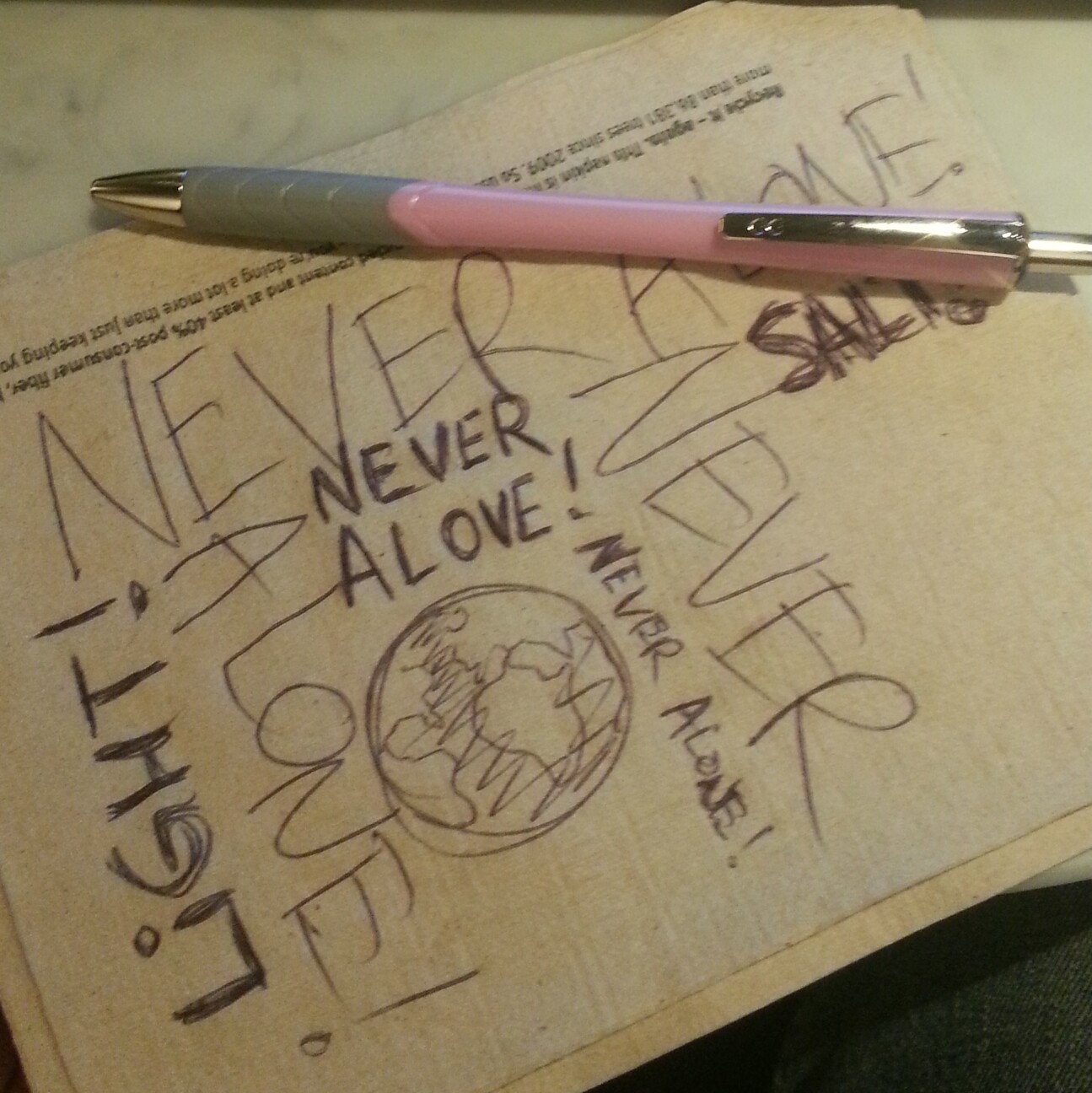 November 29: Never alone.
Matthew 5:13-16, “You are the salt of the earth. But if the salt loses its saltiness, how can it be made salty again? It is no longer good for anything, except to be thrown out and trampled underfoot. You are the light of the world. A city on a hill cannot be hidden. Neither do people light a lamp and put it under a bowl. Instead they put it on its stand, and it gives light to everyone in the house. In the same way, let your light shine before others, that they may see your good deeds and glorify your Father in heaven.”
We began this month of exploring Christian scripture to understand civility with Jesus, and we’ll end with Jesus. This is a very familiar passage to most anyone who grew up in church. Jesus loved to teach in symbols, and this is some of his best… it’s simple, we can relate to the content, and it inspires. We are called to be salt, seasoning the world for the better. We are to be light, a source of illumination and joy for those struggling to see. Amen and amen.
Jesus lays it all on the line for us in these simple words: we are salt, and we are light. No matter what you’re cooking, the salt becomes part of the dish, lost for any other purpose other than favoring and then never being seen again. Oh, it’s flavor is there, we know where the salt has gone… but that’s just it, the salt is gone. The dish remains. The dish is so much better for having been salted.
No matter the light source you choose, it burns up, it gives all it has and it’s gone. A lamp burns away it’s oil. A candle melts. A bulb eventually burns away it’s filament or it’s gases, batteries go dead… all lights on this earth end in their using. This is our calling. We are used up in service to this world. We are sent to make the world better for everyone else, and Jesus evens asks what we’re good for if we reject that calling! If we will not salt and we will not light, then what use do we have?
The word civil at the base of the word civility is a very fun study if you ever feel like digging in and chewing on it a while. It denotes both the meaning of responsible/polite behavior, but it also denotes this aspect of being a common member of society, a citizen. The two concepts are united in the word, both being a citizen and acting a citizen. Jesus does this with salt and light, both being and doing. Salt is our identity and our action. Light is both what we are and what we do. Our place in the world hinges on this calling… we exist in this capacity of purpose.
So what does all that mean? It means that I don’t salt the earth one day a week, or two days a week, or only when I choose to be salty. I must reflect on the needs around me and strive to be salt all the time. I must own the call to saltiness and pursue it with all my heart, mind and soul. It’s not just a thing I do on weekends or when there’s a Bible study. It’s in my walk, my talk, my laughter, my weeping, my falling, my failing, my dancing and my singing.
My light doesn’t have a on/off switch for my convenience. I am not choosing to be light for only those I have deemed worthy of the time or the effort. I am shining, shining on my worst day, my best day, in the rain, in the snow, in the pain and in the green of springtime joys. I am being what I am called to be, to the best of my ability and with all the joy of the call I can muster on any given day. And if we have come together to make a community like the one Jesus has described in the verses preceding this passage, in those amazing words we call “The Beatitudes,” then when my savor lessens and my light dims, it will be renewed in my kingdom fellowship with you. Together, we are called to be salt and light, never alone. Never alone.
I am salt with you. I am not salting the earth alone! I am light with you. I am not lighting anything by myself! Civil is not something I am or do alone. Civil exists within the community of the citizens! If we are to find a singular truth of civility in the teaching of scriptures then let it be the truth of our need for one another! I need you! I need you to myself be salt. I need you to myself be light. I need you, and that is why I am striving to be civil, to keep us in the bonds of love, mutual encouragement, sharing and growth.
Never alone. Thank you, God, I am not alone.
AMDG, Todd
Nov. 28, 2013 Civility in Xian Scripture
 November 28: Civility can grow from deep gratitude.
Colossians 3:15, “And be thankful.”
And be thankful. I’ve always liked the way that St. Paul would throw that in here and there, and he does it often. He does in his letter the Colossians in chapter 2 as well, speaking of being rooted and grown up in Christ he adds an “and be thankful” for good measure in verse 7.
When our passage ended with those words yesterday I knew I’d have to come back and use them again. I don’t think St. Paul scatters them around without intention and meaning… I think he sows his letters with the seeds of gratefulness hoping for a nice harvest in the lives of his readers!
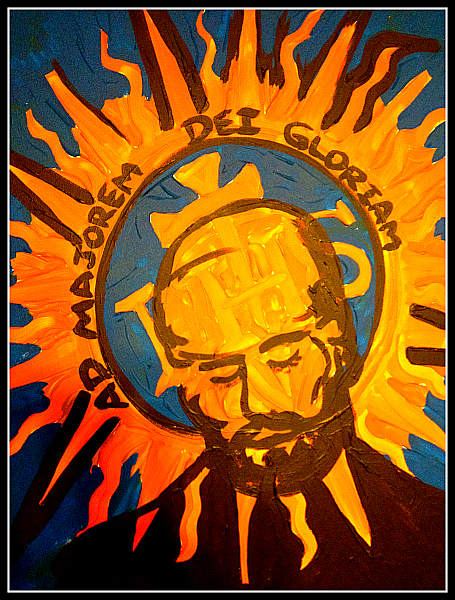
I believe that thankfulness, or gratefulness, or gratitude, whichever word we choose, is a seriously underrated theme in scripture and a solid foundation for civility. Ingratitude and being unthankful leads to a lot of harshness in our words and missed opportunities to build one another up. St. Ignatius said, “I think that that ingratitude is at the root of all sinfulness.” Amen. I’m declaring him the patron saint of our Thanksgiving this year and including a painting of him I made a couple of years ago. =)
Be grateful! Be joyous! Love with gusto!
AMDG, Todd
Nov. 27, 2013 Civility in Xian Scripture
 November 27: Civility is a bear, and so is incivility.
Colossians 3:13-15, “Bear with each other and forgive one another if any of you has a grievance against someone. Forgive as the Lord forgave you. And over all these virtues put on love, which binds them all together in perfect unity. Let the peace of Christ rule in your hearts, since as members of one body you were called to peace. And be thankful.”
Bear with each other. What a great twist of language that the word bear gets to be an expression of gracefully putting up with each other and a 400 pound mammal that might pull your head off. Maybe civility can feel that way sometimes, like trying to smile in the face of a raging beast? Maybe.
One of the hardest things about the teaching on forgiveness in scripture is that we are so often told to forgive without any mention of waiting for an apology. It seems that when incivility is done to us, our forgiveness is supposed to kick in without even waiting on that other person’s recognition that they need it. Honestly, that’s tough for me. I’ve managed to rationalize this away at times with arguments about not wanting to “enable” their continued naughtiness, but that wears thin after a while.
Someone might be a real bear towards me, and make it hard for me to bear with them through it, but I have to dig deep and find that needed strength to carry my own responsibility to restoring peace. Let’s be clear, I don’t always want to do that! Sometimes I would much rather respond in kind, making it just as unpleasant for them as it is for me. For a Christian it comes down to relating to Jesus and the way he modeled forgiveness in the biblical narrative. His words “forgive them” from the cross didn’t wait on an apology.
I suppose what I want to say today is that it’s ok to struggle with civility, but not to give up. I wouldn’t want this whole month of blogging to just be a “pie in the sky” dream of what things could be if we were all perfect. Sometimes I’m the bear, and sometimes I’m doing the bearing. Sometimes I fail in the civility realm and move from being a victim of incivility to a co-combatant in a contest of incivility. But I’m trying, and if anything I’ll try harder next time.
 I’m going to meditate today what I might call cruciform timing, living a forgiveness that doesn’t wait. If I can do that better, civility has a chance to grow in me. If a peace and thankfulness can be rooted in me, and be bounded by love, as the passage today images for us, then maybe a little more bearishness can be tolerated and forgiven. I’m going to splurge and have two graphics today because I think the passage makes a cool illustration. It’s that mentioned peace and love that can make all this possible. That peace and love are layers that help protect the true me when bears attack.
Easier said than done? Yes it is, but so is everything worth working hard to obtain. It’s the same love and peace that protects me that will be extended to one who attacks me. It’s a hope of mutual assured survival.
AMDG, Todd
Nov. 26, 2013 Civility in Xian Scripture
 November 26: Civility helps us transcend conceit.
Galatians 5:26, “Let us not become conceited, provoking and envying each other.”
Are you one of those folks who must make everything a competition? Is everything a contest for you with a first place, second place and third place, winners and losers? You might want to say no, but think about it. When someone shares something amazing in their life, is your first thought one of comparison to your own life?
I like to think I’m not all that wrapped up competitive ways, but I know that there are certainly areas of my life where I do harbor envy. There are parts of my life where I like to think I’m better than others. Better than most? Maybe. I have to admit it’s there within me, and it threatens my civility. I’ve never been an athlete, so I’m not all that into competitive sports, but I’ve found ways too make most everything else in life into a sport with winners and losers. In those other areas of life it’s the “I’m an expert” syndrome.
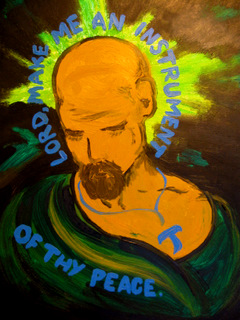
My image with this blog is a painting I did a few years ago of St. Francis of Assisi. I painted it intentionally as a picture of St. Francis and a little bit of a self portrait. His eyes are downcast and closed, not because he failed at anything, but because I know I fail so often to live up to the prayer he prayed, “Make me an instrument of your peace.” I’m too often a bit too self-serving to be used on anyone else’s behalf. His prayer makes me feel ashamed. The painting expresses a great paradox of my life: I want to live that prayer, but my conceit keeps me fettered to vanity and pride.
You might think a guy who likes to talk so much about humility wouldn’t be thinking how much better he is at something than you are, but then again that’s why I’m happy you’re not in my head. I hope you don’t mind a little more honesty, today. It’s simple human conceit, and I have it.
Conceit, too much pride in your own worth or goodness
I like to think I keep it well hidden, but I know it shows sometimes. When it does show, well that’s when I’m saying things that make you frustrated. It often shows itself in provocation, sometimes when I’m challenging your ideas and your accomplishments. I do it because I don’t want you as happy with yourself as you are. I do it because I want your success moderated a bit, lowered a bit closer to the level of my own (or just a bit under mine own). It’s not pretty, but it does happen.
A commitment to civility will help impose certain filters on me that not only help me not do this to you unnecessarily in our conversations, but also I hope it will shine a light on the inner conceits that trip me up. St. Paul is expressing this whole idea in the context of a discussion on personal freedom, a choice to serve others or myself. Your accomplishments can become part of my joy. Your wins can become my celebrations. Your joy is not then at my expense, but instead it is my gain. Honestly, I’m trying to love you that much.
AMDG, Todd
Nov. 25, 2013 Civility in Xian Scripture
 November 25: Civility is raising the expectations.
Galatians 5:22 & 23, “But the fruit of the Spirit is love, joy, peace, patience, kindness, goodness, faithfulness, gentleness and self-control. Against such things there is no law.”
I have to admit that this passage from St. Paul has been a favorite of mine my whole life. It’s not that I have in some way mastered it or think that I’m a great example of it, but it reminds me to raise my expectations for myself, and even for you. I’ve been accused of having a “thin skin” when someone’s rudeness or naughty behavior will be hurt or disappoint me, but I don’t want to let my expectations slip! I’m a textbook Gen-X in some respects, and I always struggle to keep a high level of pessimism and cynicism at bay.
If you want to go and see the list that St. Paul has of the “sinful fruits” (Galatians 6:13-26) you’ll find many of the things we’ve identified and renounced as incivility throughout our exploration of scripture: rage, discord, selfishness, divisiveness. But I’ve never spent a lot of time on the sinful fruits; I know them too well. My imagination is better fed on the fruit of expecting and identifying God in action in me or in you. I want to dwell on those moments when our goodness shines. I like seeing our patience surprise someone, our kindness meet a need, our self-control end a conflict, our love warm a soul, our joy become infectious, and our peace break down barriers and make us a family.
The fruit are a strong reminder that civility is not just what we don’t say, but what we do say. Our faith and spirituality are the same in respect to renouncing some things and embracing some things. Renouncing and letting go of some things can be seen as a bit passive, simply making sure that some things are absent from our lives. Choosing to embrace other things that we wish to manifest in our lives can be a bit more active, even aggressive.
This morning I’m meditating on these on these things that I can embrace, things against which I will never find a law or an obstacle outside of my own heart. I’m going to include a photo with this blog, a six foot goose that my wife and I hand-made and painted for an arts festival a few summers ago. In Celtic spirituality the Holy Spirit is sometimes pictured as a wild goose, and I want God’s presence today in my life to be a goose, to be flamboyant and noisy, aggressive and loud. I want God’s presence in me to take flight.
AMDG, Todd
 toddthomas.net