
Work Like You’re in Worship
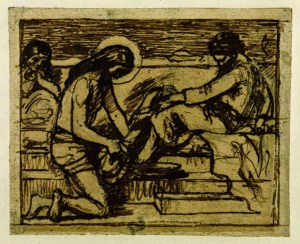
For the last ten years I’ve been very involved in Holy Week worship services, most often leading those services, always enjoying them, but not this year. For the first time in a long time my job is keeping me from being in services this week. So, no Good Friday and no Maundy Thursday services for me. No symbolic foot washing for me this year, but is that such a bad thing?
Jesus did say, “you also should do as I have done” not “Wouldn’t this make a great annual symbol of serving?” Even as I’m disappointed this year that work is keeping me from so many of the worship services I love, service has no end. Today at work, I can serve. I can go beyond expectations and set the bar higher and higher for helping and caring for people. I can work like I’m in worship.
If the story of Holy Week and the sacrificial love and action of Jesus are to be transformational, then it must leave the pages of scripture and take root to grow in our lives. It must become our story, not just our calendar or our symbolic remembrance. Let’s go into this day, all days, wherever we work, doing our job like we’re in worship.
12 After he had washed their feet, had put on his robe, and had returned to the table, he said to them, “Do you know what I have done to you? 13 You call me Teacher and Lord—and you are right, for that is what I am. 14 So if I, your Lord and Teacher, have washed your feet, you also ought to wash one another’s feet. 15 For I have set you an example, that you also should do as I have done to you…
33 Little children, I am with you only a little longer. You will look for me; and as I said to the Jews so now I say to you, ‘Where I am going, you cannot come.’ 34 I give you a new commandment, that you love one another. Just as I have loved you, you also should love one another. 35 By this everyone will know that you are my disciples, if you have love for one another.”from John 13, NRSV
AMDG, Todd
And if you haven’t seen it, here’s the
Easter message from our Episcopal Church’s Presiding Bishop Michael Curry.
I love his quote, “Don’t be ashamed to be people of love.”
3 Reasons Jesus Resonates With Me
 I love Jesus Christ, and I have some pretty definite reasons why I love him, as a person, as a religious figure, as a image of God relating to humanity. Yes, I was raised as a Christian, but that’s not the reason I’m a Christian, today. I’m a follower of Jesus Christ because he:
1) doesn’t feel the need to judge me before loving and living life with me,
2) isn’t afraid to challenge me and move me forcibly from my apathy, and
3) invites me to live my life in a Way that has proven rich and worthy of my time and effort.
This is not a post about why my religion is betters than yours, why my faith is deeper than yours, or why you should consider being more like me in any way at all. I just had a deep need this week to talk about how much I love and respect the man, Jesus Christ. And I’m going to explain these three reasons by sharing some stories from his life and teachings.
He doesn’t feel the need to judge me before loving me! Man, that’s just how Jesus liked to roll when walking the dusty roads of earth! He didn’t need to start with condemnation. Has that been your experience in churches? Have preachers needed to condemn you and then try to change you? Sometimes we approach sharing Good News in a burn it down and rebuild it mindset toward people, but that’s not the Way of Jesus. I’m sorry if you’ve had that kind of experience in church, we just don’t always get things right as human beings. Check out Jesus silencing an angry crowd in John 8:1-11. He didn’t need to condemn someone caught in the act! Jesus in John 4:1-42 doesn’t need to condemn a person who has messed up marriages and even worships in a different religion than his. What? Yup. Now wrap all that up with some sermonizing from Jesus in Matthew 7:1-5. Judging: we don’t. We shouldn’t. And if we are, we’re doing our Christianity wrong. Jesus has a special way of drawing me to himself and to Christianity because he doesn’t need to start by condemning everyone else and shaming their experience and effort, or mine.
Yet, he isn’t afraid to challenge me! Not needing to judge me doesn’t mean that Jesus won’t transform me. Just like with the woman in John 8, Jesus tells me to get my act together and do better. Jesus did sometimes have some pretty scathing words for people, but have you noticed that they tended to be for the religious professionals, as in Matthew 23:1-36? That’s right, when Jesus did take people task, it was the religious leaders. Jesus does not like religion that depends on fakery, form over substance or that neglects the essential core of religion: justice, mercy and faith. As a pastor and a life-long theology student, I need to take this heart. Being non-judgmental does not mean being less concerned about doctrine and life or having fewer personal convictions. Jesus challenges and provokes and moves us with a message of intrinsic value and worth, belief in ourselves and what we can actually be in this world. We are made to be light and flavor for the world around us! He said that in Matthew 5:13-16, and he modeled it in his daily life and ministry. Flavoring the world and lighting the path for our neighbor is our purpose, and he isn’t shy about pointing out what a tragic loss it is for us to lose that sense of purpose.
Speaking of purpose, the Way of Jesus is my constant guide and meaning. I’m so glad to have the formation of Jesus in my life, to teach me my true worth and the worth of others, and then to send me into a life of action and support for this world, God’s beloved world. That’s Gospel; it’s the Good News. Jesus came into our lives to remind us of something. He’s reminding us that God has not left, finished the work in and with us, or ever given up hope that we would rise above self-destruction and change the world. Think for a moment on one of the ways that Jesus announced his work, “The kingdom of God is near,” as in Mark 1:9-15. A simple statement that says so much: 1) God is near, 2) the sovereignty of God is active, 3) we are invited to citizenship in God’s kingdom, and 4) hope is not limited to the reach and efficacy of human kingdoms. We have a calling, an identify, and a hope. Think about the way that Jesus famously summarized the Law and Prophets, or put religion in a nutshell in the famous passage of Matthew 22:34-40: “Love God, and love others as you love yourself.” Encapsulated in this brief summary is the love of God, the love people and the love of self. I have been guilty of often paraphrasing this teaching as two loves, love God and love others, but it’s really three. I am free, invited and needed to love myself as basis for empathically loving and caring for others. We are connected, bound up and whole in the love of God. The love of God is the foundation upon which we build life, and that love as the mortar between every stone and person. This is the Way of Jesus.
This morning, finishing up this blog post and trying to start my day with a big bottle of water (I tend not to hydrate enough), I’m recommitting myself to opportunities to live my daily prayer: let me love, let me learn, let me serve. All that I’ve learned of Jesus over the years can be expressed in these three values: love, growth and service. May the world be enriched for our time within it, and may God be made glad as we give ourselves to the Way of Jesus. May my actions and words support my own value, yours, and the worth of God’s beautiful world.
AMDG, Todd
Loving the Unseen to Love the Seen
 I must confess something to you: I’ve always doubted, at least a little, John’s statement that we cannot love a God we do not see if we do not love a sister or brother we can see. It always seemed to me that an opposite principle would be truer, that loving what can be seen is far easier than loving what is not seen, and not loving the seen is also easier. I mean, I see the failings and suffer the injury of these seen brothers and sisters, don’t I? I also see their beauty and goodness at times. So then, how can my love of God be doubted by my lack of love for other people, especially when they can sometimes be seen as not very deserving of that love?
18 There is no fear in love, but perfect love casts out fear;
for fear has to do with punishment, and whoever fears
has not reached perfection in love.
19 We love because he first loved us.
20 Those who say, “I love God,”
and hate their brothers or sisters, are liars;
for those who do not love a brother or sister
whom they have seen, cannot love God
whom they have not seen.
21 The commandment we have from him is this:
those who love God must love their brothers and sisters also.
1 John 4:18-21
Have you ever read some of the old prayers of saints gone by, the prayers that are rich hymns of love for our unseen God? Those prayers have drawn me like a moth to the flame for years, and also left me a bit confounded. How do these prayers come into being? How do I love an unseen God that way, and not just be celebrating the ideas of that God which I’ve been taught?
Let us pray…
“I entreat thee, dearest Saviour,
come and reign over my heart.
Far from me for ever be all other loves but thine,
my Supreme Good.
Burn me with the fire of thy beauty,
O sovereign of my heart;
to thee I sacrifice all, even my inmost being.
Jesus, lord of my heart, mighty and strong, all hail!
O Saviour, reign absolutely over this heart of mine.
Oh! How happy I am to think
that thy reign can have no end.
Thousands of hearts have loved thee tenderly,
thousands of hearts will cherish thee in time to come.
Would that they were all united with mine
to love and cherish thee as thou deservest.
Would that I could make thee sought for and loved
by all the sons of Adam, Lord who art all lovable!
Triumph, my love, my beginning, and my all!
I want thee only, desire thee alone!
My joy, my great joy is that thou art God,
a God that is good, perfect, immeasurable,
infinte, just, wise, powerful.
I love thee for thy own sake, and I rejoice
in thy favours for the sole reason that they are thine!
I throw myself into thy arms, Jesus,
with all the fervour of my soul.
I sing for joy that all of the angels
and saints adore and praise thee.
Oh! That I could love thee in proportion as thou art lovable!
But since this is impossible for any creature,
let me at least love thee as much as I can and ought.
Fill my soul with thy love, my God,
so that I may die in its embrace,
wholly devoured and burnt up in its flame.
How much I repent having loved anything else but thee!
Oh! Would that I might have my life over again,
and drown it in thy love!
Sweet life of my soul, let my heart faint away in thee!
What else can I desire in heaven,
what else can I seek on earth,
but thou?
I have asked of thee one favour alone,
and it is all that I shall seek, Lord, at thy hand:
to dwell in thy house all the days of my life.
May my last breath be a sigh of love.
May I die of thy love, my God.
May my life, if it did not begin with love,
at least end in it;
and let my last act be an act of love.”
from the Aspirations of Cardinal Bona
I have prayed these aspirations with the good Cardinal many times over the years, always caught and entranced by the deep poetry and power of the words. This morning as I was praying my own small daily aspiration “let me love, let me learn, let me serve” I was reminded of this prayer of love and I turned to love God with my whole self. I turned all my inner strength to focus on loving my God, my unseen God, my hope and center of faith. From that exercise of loving God, straining to love and embrace the unseen, I felt another door open, a door to a treasure room of strength to love the people around me.
I think now that John was actually saying something along these lines… that we can’t have truly given ourselves to the act of loving God, a God we do not see, if a greater love for those who are seen around us has not been manifested in our lives. He’s not essentially contrasting the ability to love what is seen versus what is unseen, but he’s teaching a principle: Turning our hearts to God in a deep stream of affection and love will automatically cause us to have a deeper affection and love for the people around us made in the image of God and so beloved by God. If I’m not loving people, and I find it so difficult to do so, then I need to turn back to applying myself to loving God, for that love is being lost.
In truth, in living the religious life, walking in faith for years, there are many pitfalls that can sneak in and replace my love of God: love of self, feelings of correctness, personal piety, personal giftedness, pride, anger, impatience, fatigue. Love takes effort. Remember how our scriptures tie the love of God and the love of other people together in several ways, from this passage in John’s letter to the famous summary of Law and prophets that Jesus gives in Matthew 22:34-40 that is repeated by Paul in his letters: 1) love the Lord your God and, 2) love your neighbor as your very self.
But somewhere past simply agreeing that those two commands constitute a summary of the Law, past agreeing that these are two important streams of love, there is a reality that John’s seems to hint at for us, that there is an intrinsic connection between those loves. Instead of getting caught up in arguing with John about ways to love those seen and unseen, I need to immerse myself in loving the unseen so that the tidal surge and burning sweep of that love may overflow to the people around me. May I love my God in such a giving of myself, such a visceral application of my strength and being, that when my eyes move to those around me my eyes still see only God. And then I not only am loving the people I see, but my cherished unseen God suddenly has a face as well.
AMDG, Todd
Playing With Glyphs
 I’m sitting at Starbucks before heading to work and I get a the urge to play with making glyphs. Now, I’m no linguist and I’ve not spent time with any ancient glyphs, so I’m no authority here. I simply had a canvas that I had prepared in Procreate on my iPad and was thinking of looking up a cool Japanese symbol to add to it. But, since I don’t know any Japanese symbols, I’m at the mercy of websites to supply me the image and the meaning.
I don’t know about you, but that always scares me. Like what happens if the website says this is the symbol for purity, but it’s actually the symbol for dunce, as in “Look at this dunce who saw something on the Internet and copied it!” I decided instead to work through a short exercise of what it might be like to create my own glyphs, my own symbols to convey an idea.
It wasn’t terribly easy, and I’m aware that we’ve all seen symbols and used them all our lives. I can’t do this in a vacuum of experience or culture, but can I move somewhat outside of my own experience to make something a little new? It won’t be totally new, but maybe a little novel?
I chose to convey the idea of compassion, compassion being our ability to see the suffering of someone and feeling moved to alleviate the suffering. My glyph is read left to right, top to bottom. I decided to convey four distinct ideas with the glyphs to represent compassion. First, there is awareness, the eye, that is looking upon a person. Second, that person is suffering, as seen by the downward movement of the arrow. Third, there is identifying with that person and making a communal bond, when the curving walls bring us together, like cupping hands. The final and fourth idea is a reversal of the downward trend of life to an alleviation of the suffering, an upward arrow.
The value of this little exercise of mine was not the work of deciding how to draw a person or make an stylized eyeball, but it was the meditation on compassion as a movement, an action and a process. Can I live this way? Can I see people and move to identify with them and work together to bring healing? Do I want to? It seems to me that we have a daily choice to go beside people in their worst of times, or to retreat and hope that less is asked of us when next we meet someone. This decision was poignantly played out in the story Jesus told about the man we now call The Good Samaritan.
In that story we see two people choose to ignore the suffering of another person, and one person choose to face the suffering and help alleviate it. Jesus taught this story to illustrate love for one’s neighbor, for all of ine’s neighbors. The story transcended ethnic divides, religious divides and national divides. The story unites us as a single humanity that cares for one another. That’s a concept worthy of some imagination. That’s a story worth doodling and imagining as a template for our own walk down the road.
AMDG, Todd
Why Ashes?

It’s Ash Wednesday again, and if you don’t have plans tonight I’d like to invite you to join my family at St. John’s Episcopal Church for the imposition of ashes and celebration of the Holy Eucharist. (I’m working all day and can’t make an earlier service.) We’ve come to another Lenten Season, a time of reflection, repentance, sometimes rededication. But, why ashes?
I think it’s fair to say that most of us don’t think about our death each day. And really it’s probably healthy for us not to be too focused on our impending deaths. Once in a while though, it’s good and it’s healthy to remember that our journey here on earth needs to be made with intention, and it needs to be made in view of the end and the destination of our journey.
4 Look, you fast only to quarrel and to fight and to strike with a wicked fist. Such fasting as you do today will not make your voice heard on high.5 Is such the fast that I choose, a day to humble oneself? Is it to bow down the head like a bulrush, and to lie in sackcloth and ashes? Will you call this a fast, a day acceptable to the Lord?6 Is not this the fast that I choose: to loose the bonds of injustice, to undo the thongs of the yoke, to let the oppressed go free, and to break every yoke?7 Is it not to share your bread with the hungry, and bring the homeless poor into your house; when you see the naked, to cover them, and not to hide yourself from your own kin?
 Our lives are often long and they are sometimes short. Our lives are marked by ups and downs, and our lives are often spent learning lessons and trying to remember the things we’ve been taught. Like the ashes which will wash away when you get home, or the next time you take a shower, our lives have a beginning and an end. The beginning is set for us, and is out of our hands. The end is also often provided for us without a lot of input from our wishes, desires or ideas of timing. But all those in-between days are the open fields in which we run, they are the canvases upon which we paint, and they are the paper upon which we have the opportunity to help write our stories.
Mutual Love, February’s Intention
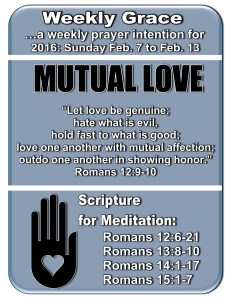 As we enter into February and the Lenten Season, let’s pray for a mutual love to deepen and expand among us, against all odds. Each week we’ll dig into a single biblical author’s thoughts or account of mutual love and we’ll re-affirm our own commitment to the love that should be growing between us.
It’s going to be my personal prayer this month that I will be able to grow in deeper love for the people who are least like me and think least like me. I believe I have more often been taught to try to change those people, or at least to avoid them. If I wasn’t taught to do so, then I have certainly learned through experience that this is usually the easiest course.
Perhaps with some prayerful creativity and reflection I can discover ways to listen to them better; I may even find some ways to more fully offer them the benefit of the doubt. Hopefully, I will imagine some new ways for us to maintain our unique experiences and perspectives, but still coexist in harmony and shared love. It seems that when Paul was speaking to the church in Rome he fully expected them to be a diverse people, but never released from that debt of shared love.
Let’s just go ahead and accept it: we won’t awake tomorrow to find that everyone thinks and believes like we do, even in our own families or congregations. So, what’s next? Without a universal agreement on all doctrine and faith issues, may we still maintain a sense of mutual love and shared harmony? Without our complete similarity of conviction, may we nonetheless value and support one another’s spiritual journeys and affirm the mutual love and things we do share in common? It may go “against the grain” by some human sense, but that may just be the signal that we’re moving into a truly transformative practice. Lord, teach us to pray.
AMDG, Todd
An Unfinished Sketch
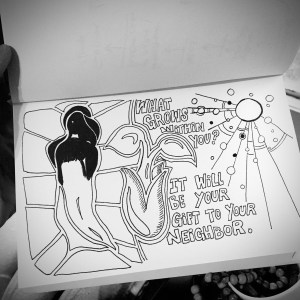 I rarely show anything I’m doodling until it’s completely done, but I realized this morning that I haven’t opened my sketch book in a week! This is a piece I started a couple of weeks ago that I need to finish.
I recently made another move in my job with Apple, from retail sales back into the tech support group. It’s a step on my journey into a new role with Apple as I go full-time. I’m one our store’s newest Creative, joining the team that leads workshops and does training sessions. Until I finish my own training for my new position, I’m doing a lot of tech support for mobile devices again, and that can be a stressful job. We work with people in stressful situations. From the failure of a device to incidents of accidental damage, we are helping folks get through some anxiety filled time as they feel the withdrawal pains of being momentarily unplugged from our tech-connected lives.
One thing I do to prepare for each day at work is practice my work mantra on my drive to the store. It goes something like this:
I love my customers.
I am so glad I can serve them.
I love my customers.
I’m going to do my best for them, today.
This mantra helps me get in the mindset of service. It helps me center on the truth that our customers are coming to us with real needs, and my response must focus on those needs. It would be too easy to just become defensive or upset, to reflect back their anxieties and stress. No, I have to let their anxieties and frustrations be authentic and real, spoken and experienced, and let those anxieties and frustrations pass through me and past me without landing in my own spirit. Then, I’m ready to get down to business with helping them determine the best solution for their situation.
My mantra is an action of intentionally deciding what will be planted within me so that I can choose what I’ll be producing from the soil of my heart and mind. This is not just a service industry principle, but a life principle. I must choose the seeds of peace, compassion, empathy and love as what I cultivate within myself if I want to have those things to share with others. This is a daily effort, forever unfinished and being finished. I guess it’s ok to share a doodle before it’s done, as its unfinished state can meaningfully reflect the on-going becoming of life.
AMDG, Todd
Finishing a Month on Civility
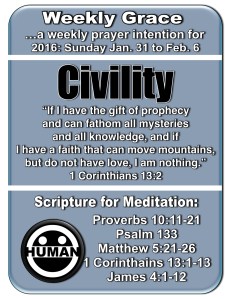 I realized today that with the drama of Snowzilla last Sunday, I forgot to make a Weekly Grace! I mean, wow. I haven’t missed one in a few years. So, I wanted to make sure we finished and finished well this month of intention based around civility.
It’s an election cycle year, and it’s a pretty heated race for all concerned. That’s one reason I wanted to start the year on civility. Another reason is that sometimes it’s so hard to keep my words flowing from love. It’s so easy to let something else step in and drive my speech.
In our focal passage written to the church in Corinth, Paul says that nothing is as important as love. Nothing should be allowed to take it’s place. There’s no miraculous spiritual gift, no self-denial, not even any great knowledge or correctness that surpasses love. This is not a message that religious people like to hear. We are very enamored of our personal gifts and, oh my… our correctness? We often like to stake our very salvation on it or deny another person theirs.
1 If I speak in the tongues of mortals and of angels, but do not have love, I am a noisy gong or a clanging cymbal.2 And if I have prophetic powers, and understand all mysteries and all knowledge, and if I have all faith, so as to remove mountains, but do not have love, I am nothing.3 If I give away all my possessions, and if I hand over my body so that I may boast, but do not have love, I gain nothing.4 Love is patient; love is kind; love is not envious or boastful or arrogant5 or rude. It does not insist on its own way; it is not irritable or resentful;6 it does not rejoice in wrongdoing, but rejoices in the truth.7 It bears all things, believes all things, hopes all things, endures all things.8 Love never ends. But as for prophecies, they will come to an end; as for tongues, they will cease; as for knowledge, it will come to an end.9 For we know only in part, and we prophesy only in part;10 but when the complete comes, the partial will come to an end.11 When I was a child, I spoke like a child, I thought like a child, I reasoned like a child; when I became an adult, I put an end to childish ways.12 For now we see in a mirror, dimly, but then we will see face to face. Now I know only in part; then I will know fully, even as I have been fully known.13 And now faith, hope, and love abide, these three; and the greatest of these is love.St. Paul in 1 Corinthians 13:1-13
Paul says that his ability to understand every question and mystery is nothing if he does not have love for others. The capacity to love matters more than the capacity to be right. I won’t belabor this point too long, but come on! I think it’s one of the clearest passages that teach us that we should let our love help us understand more often than letting our understanding teach us to love.
Our civility will grow as we move more fully toward letting love take it’s place of preeminence in our lives. Our words will grow to reflect that we have matured past the idea that our own perceived correctness gives us license to fight, humiliate, defame or condemn. We will listen better, with more desire to understand one another. We’ll ask good questions, meant to free and not to trap. We’ll grow together as we share and understand one another better. This could be a good year, even with a presidential election.
AMDG, Todd
I Feel No Need to Destroy You
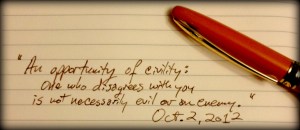 I don’t like what you said. I think your ideas and conclusions are flawed. But, I don’t need to hate you. I don’t need to silence you or destroy you. My ideas are not right by how wrong I make you sound, or by how much I manage to embarrass you. I will simply state with conviction my ideas and beliefs, and I’ll let you do the same.
I’m going to pull up a little reminder from my Civility exercise circa late 2012… for us to think differently, believe differently, and even fundamentally be different people, does not necessitate that you be “destroyed.” You don’t need to be labeled stupid, less, evil or a hypocrite, just because we are dissimilar.
Back in 2012 I said it this way, “An opportunity of civility: One who disagrees with you is not necessarily evil or an enemy.”
Here are a few screenshots of what I’m talking about…




Dang, everyone is being destroyed. Can you guess what verses from scripture this makes me want to quote? Yep…
“For you were called to freedom, brothers and sisters; only do not use your freedom as an opportunity for self-indulgence, but through love become slaves to one another. For the whole law is summed up in a single commandment, “You shall love your neighbor as yourself.”
If, however, you bite and devour one another, take care that you are not consumed by one another.”
Galatians 5:13-15, NRSV
It’s a thing these days in social media for someone to be destroying someone else, but doesn’t mean we have to participate. I see it online everyday, and I see the term “destroy” used in religious debates, social debates and political debates. It doesn’t seem to be enough for a person to hold an opinion or a conviction, but there must also be some destruction going on.
When we do away with the need to be destroying someone, we open that door of opportunity. Stop and spend a few moments of time imagining ways to be a person of conviction without needing to be a person of competitiveness. Imagine conviction without condemnation (Need an image of conviction without condemnation? Try the story in John 8:1-11.) Imagine your cherished ideas being valuable in their own right, without needing to demean another person’s thoughts or ideas.
The fact is, if I destroy everyone who thinks differently than I do, I become less wise for the effort. I will grow less. I will face fewer challenges, which means I will spend less time reflecting and deepening my cherished ideas. I am simply lessened by destroying (I suppose this really means silencing) people who think differently than I do.
Now, I’m not trying to destroy people who have shared an article lately in which someone was destroyed. I’m asking if we can stop a minute and distance ourselves a bit from the sensationalist wording and headlines? May we also stop and reflect on the need to be so competitive and demeaning in our disagreements? State your convictions. Elaborate on them. Support them. But if you can’t do that without attacking someone else and demeaning them, please consider your ideas and how you formed them. Are they factually based and relevant, or are they simply more of the divisive fighting between “us and them” that we get so much of every day? Are we simply playing a game of who insults and demeans the other the best? I’ll leave that discernment to you.
AMDG, Todd
Lift Them Up!
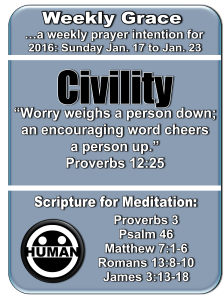 One of the uses or blessings of civility is it’s ability too turn things around, to take a bad situation and make it better, to help a person having a bad day begin to have a better day. An important part of civility is acting out of that civil impulse to positively engage and support one’s community.
Do you see someone around you struggling? Do you see someone who needs encouragement? Lift them up! Be a person who spreads joy and increases peace in the world with kind words, encouraging and positive contributions.
The proverb in our Weekly Grace is at once obvious and such a needed reminder. Our words have an effect, so let’s plan for the best effect possible. As children in Sunday School classes we often put our fingers over lips and sang “O be careful little lips what you say!” and I hope we never grow too old for that lesson.
AMDG, Todd
 toddthomas.net