
Just Life
Lift Them Up!
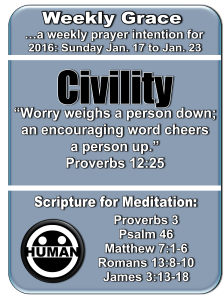 One of the uses or blessings of civility is it’s ability too turn things around, to take a bad situation and make it better, to help a person having a bad day begin to have a better day. An important part of civility is acting out of that civil impulse to positively engage and support one’s community.
Do you see someone around you struggling? Do you see someone who needs encouragement? Lift them up! Be a person who spreads joy and increases peace in the world with kind words, encouraging and positive contributions.
The proverb in our Weekly Grace is at once obvious and such a needed reminder. Our words have an effect, so let’s plan for the best effect possible. As children in Sunday School classes we often put our fingers over lips and sang “O be careful little lips what you say!” and I hope we never grow too old for that lesson.
AMDG, Todd
A New Website for Being Human
 I launched a website today that I have pondered for a couple of years and worked on for the last week: showsomehumanity.com
The website is a hope and a prayer that we can have some deep conversations about being better human beings in the midst of our amazing diversity. It’s intended to be for everyone, people of any or no religion, of any and all traditions and backgrounds. It won’t be perfect, and it’s starting small, but I hope it grows and becomes a voice for good.
One aspect of the site will be exploring monthly human values. We’re starting off with January’s human value of kindness, and then in the coming months we’ll explore compassion, empathy and forgiveness.
Let’s get real. We won’t wake up tomorrow to find that we all suddenly look, think or want alike. You won’t wake tomorrow to be just like me, or vice versa. We will always have our dissimilarities just as we’ll always have our similarities. We will always be diverse and we will always be one human family sharing one earth. It’s time to recommit to showing some humanity. It’s time to affirm that we love this big human family into which we are born, and we’ll work to make it the best family it can be for all.
You’ll see a lot of my own DNA in the new website, but I hope that changes over time. My daily prayer of loving, learning and serving is being recast there as a “hope” for folks who don’t pray, or a mantra for daily action and life. I still believe in prayer, of course, and it is a prayer for me. But those words may not function as a prayer for everyone. Even deeper is my belief in loving, learning and serving. These are themes that transcend and surpass me and my experience. They are hopes for who I can be and how we can share life together. They are gifts for the whole species, and so however I come to them or you come at them, they are good and needed.
I appreciate your friendships and encouragement. I will appreciate your help and direction in the coming months as the new website is established and grows. I have some guides for making content for the site, and if you’d like to write something, I’ll check it out and help get it posted on the site. General guides are: 1) your writing needs to be brief and concise, as in 500 words or less, 2) if your writing includes a graphic, we cannot break any copyright laws, so don’t just grab a picture off the web; make one yourself or ask me and I’ll help make some orignial artwork, and 3) you should love the people you hope will read your words and write for their benefit. And past those guides, I ask that: 1) the website not become a place to share judgements, 2) that the website is not a place for competition between ideas, religions, traditions or philosophies, 3) that the website is a place to listen, and 4) that this website is a place to ask good questions.
If you’re interested in the way I am processing and thinking about these things, and especially if you’re thinking I’m moving away from spirituality and my religious faith, then I offer a past blog post about recognizing how some things are greater than and transcendent of our frameworks and words. For me, everything I do is religious. Everything I do is an act of faith and an act in faith. In the end, I’m going to be very vulnerable to an accusation of becoming a humanist in the contemporary anti-theistic application of the word. That’s ok, even though it’s not true. I like an older more classical understanding of the term which indicates a general love of humanity and belief in humanity’s potential and goodness. That’s where I am, as a human and as a human who is a Christian.
AMDG, Todd
A Weekly Prayer Intention?
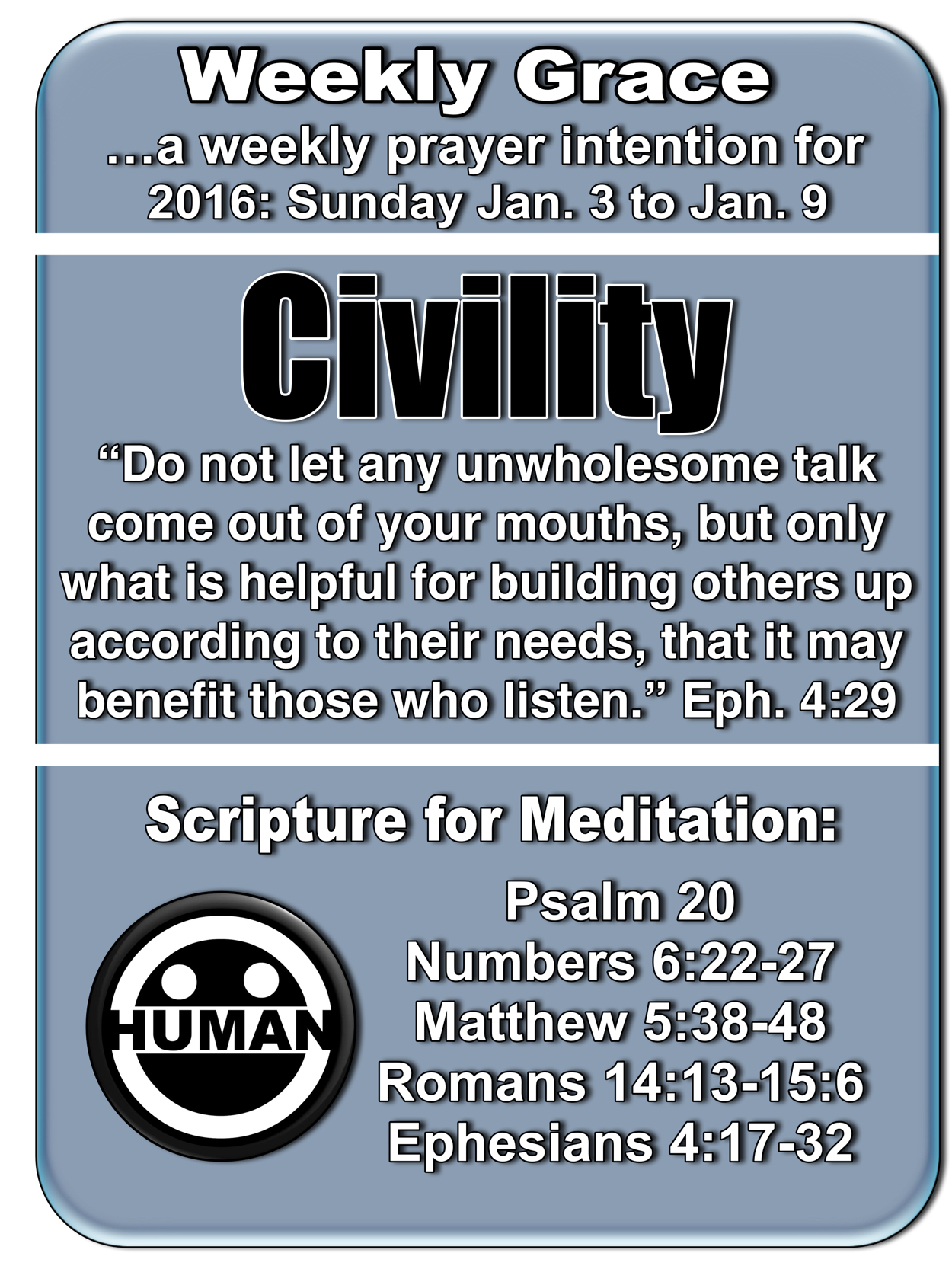 I’ve been making a weekly prayer intention for several years for our congregation at Church in Bethesda and for myself, but I’ve been wondering about continuing the practice now that I have left my pastoral duties with the congregation. After some thought and prayer I’ve decided to continue.
First, I do hope it blesses someone to have some weekly help with prayers. We all have time and even seasons when prayer is drier and more difficult to start. Second, it does help me to have it in mind and carry it as a daily reminder. Third, it’s a practice of intention, study and creativity that I don’t want to lose. Instead, I’m thinking of ways to expand on the weekly grace and what it’s intended to be.
This is a Presidential election year… oh my. In honor of the coming strife and internal warfare that we are about to incite, I thought we’d begin the year with another reminder of civility. For people of faith civility is actually at the core of who and how we are to be interacting with our communities, nation and world. Civility is scriptural. Civility is Christian. Civility is a core element of a life of faith.
I’m personally so tried of the arguing around the phrase “politically correct.” It gets used too often, sometimes to minimize our responsibility to one another, the exact opposite of its intention. Some people proudly say that they don’t care about being politically correct as an excuse or a prelude to their incivility, rudeness and meanness. Being non-politically correct has become a badge of honor to many, as they see the need for sensitivity toward others as a type of censorship. Nothing could be further from the truth.
Being sensitive of others is a foundation of civil discourse and a very deep, important spiritual practice. We must work hard to remove racial slurs and demonizing language from our daily and shared conversation. We need to speak and act in ways that welcome the other and invite the other to participate in life with us, even in disagreement and dissimilarity. Christian Dominion, our elevation and dominance in religious, political and social affairs where all others are supposed to be made to conform to speak and act and think as we do, is not a scriptural idea. Truly, our scriptures teach the opposite. We are the world’s servants, broken and spent for the world’s good.
God blesses all. God’s blessings are for all. This is a teaching of our Christ, and maybe one that we by and largely ignore as we deeply fear its implications. (Matthew 5:43-48) The faithful are not the sole object of God’s love and peace… we are invited to share God’s burden of being used to bring more love and peace to the human family and all of creation.
So, as we begin the new year and look forward to electing a new President to lead our country, let’s renew our intention of civility in speech and action. Let us refuse to follow voices of indignity, disrespect and disharmony. Seek the voices that speak to bind us in love and peace. Be a voice that builds others up.
AMDG, Todd
Be The Peace
 My message this morning at Church in Bethesda for the Fourth Sunday of Advent, lighting out Peace Candle…
We’ve been lighting candles each week for the themes of Hope, Love, Joy and now Peace.
I pray that your holidays are blessed, safe and joyful!
Fourth Sunday of Advent: Peace
December 20, 2015I’m a life-long Shakespeare fan. Back when I lived in East Africa at the ripe old age of nineteen I bought a paperback complete works of Shakespeare at a bookstore in Mombasa, Kenya, and I read many if not most of his plays. Perhaps you know the opening scene of conflict in Romeo and Juliet, when young men of the Montoague and Capulet families square off for a public brawl, and one young man tries to keep he peace…
BENVOLIO
I do but keep the peace. Put up thy sword,
Or manage it to part these men with me.TYBALT
What, drawn, and talk of peace? I hate the word,
As I hate hell, all Montagues, and thee.Shakespeare in Romeo and Juliet, Act 1 Scene 1
How easy it can be to choose another path than peace. How easy it can be to choose conflict. How exciting and romantic it can be! And how elusive peace can be in this world when we can so easily fight and rip and tear at one another. It seems too often that live in a world which when we ask for peace replies, “We hate the word!”
Our peace candle is lit, but peace is still far from so many in our world. So, let’s talk about peace, about our passing the peace, about the little choices we make which bubble up into a redeemed world. One of the things that has been catching on in the Protestant Christian world for the last few decades is the practice of passing the peace in worship, sometimes called a “love feast” or just a few moments of greeting. This is an old practice for the Catholic, Orthodox and older Christian communities.
In fact, it’s sometimes been a point of controversy for communities as it is can be considered too raucous a celebration that breaks the solemnity of the worship service! I guess we can have controversy about anything, including passing a bit to peace to one another.
But I’m a fan. I like the passing of the peace. As a worship element and as a celebration it’s not something explicitly seen in scripture or commanded of us, but it is such a beautiful expression of scripture and a way of life that was taught and modeled by Jesus. Scripture references associated with the passing of the peace begin in Matthew 5 when Jesus blesses the peace makers and then goes onto explain in the same chapter the importance of reconciliation between us, even over and before worship and religious obligations.
Scripture also shows us that Paul begins his letters to churches in a very formulaic way, offering peace each time to his audiences. And so the idea of reconciliation and offering peace becomes today’s ritual and exercise of greeting. I have also heard that it is importantly placed before the Table practice of worship to realize the admonition of Jesus to do reconciliation before approaching the altar. So before we gather at the Table we make sure that we have restored our relationships. Can it be a bit perfunctory and less meaningful as a weekly practice? Of course, like anything we say and do, we carry the burden of making it meaningful with our intent and sincerity. And I hope we always do just that… sincerely offer peace to one another.
I like the peace passing because it reminds us of a couple of important ideas. First, God is our peace. Peace is God’s inclination toward us: peace in reconciliation and peace in our lives. Secondly, peace is one of our prayers that we begin to answer even as we speak it. Peace is not relegated to a far-away time and place, a hope and a dream of days to come… peace is our now when we choose it. We pray for peace and can immediately begin with God’s help to answer the prayer in our words and our actions, today.
Paul eloquently warns of the other side of our choices, when peace is left far behind… to the Galatians, a church wherein he himself has been held suspect by some and come under accusations: “You, my brothers and sisters, were called to be free. But do not use your freedom to indulge the sinful nature; rather, serve one another humbly in love. For the entire law is fulfilled in keeping this one command: “Love your neighbor as yourself.” If you keep on biting and devouring each other, watch out or you will be destroyed by each other.” Galatians 5:13-15
There are consequences to choosing conflict over peace, but the real motivation is the wealth of dividends that are paid by choosing peace. Peace is bound up in the presence of God and peace is the chance we give to one another to restore brokenness, advance joy and heal the hurting. Peace is a gift that we can share among ourselves, like a fine meal, like a treasure. It’s a prayer that we not only say, but do. Peace is a plea that we ask and beg, and then begin to answer and realize, with God’s help. We are not without the ability or the opportunity to be the peace. Everyday, every greeting, every person in our lives, every disagreement we have: these are opportunities to plant the peace we would see cover the earth.
In the next line of the play Romeo and Juliet, Tybalt says to Benvolio, “Have at thee, coward!” and attacks. Tybalt sees peace and an effort to keep the peace among neighbors as a weakness and a cowardliness in Benvolio. How little we’ve changed since the days when Shakespeare played out our prideful lives on his stage. We too are often lulled into the romance of conflict, the adrenaline of violence and the hope of domination. We fall into the Tybalt Trap of seeing peace as a weakness or a fear. It is in truth a strength. And as Benvolio in Shakespeare’s story, we will pay a price for standing for peace. But unlike a fictional character upon a stage, we stand in the reality of God’s good world and God’s kingdom business of making peace. With God’s help, we will be the peace. We will do the peace. We will plant the peace. Amen.
Peace, my beloveds… Todd
My First Sermon In The Episcopalian Way
 I was blessed on November 22nd to give my first ever message during a worship service in the Episcopal Church. It’s been such a blessing to get to know people at the 5pm Sunday Service at St. John’s, and a true gift to be asked to speak. In the message I reflect on the Gospel passage of the day in John 18 and the richness of our liturgical calendar.
Here’s the link to the message on St. John’s website: http://stjohnsnorwood.org/a-different-kind-of-kingdom/
I’ll also drop in my transcript, which I only loosely follow. =)
Last Sunday After Pentecost Christ the King Nov 22 2015
AMDG, Todd
I Am An Episcopalian
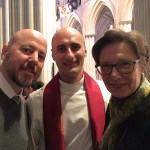 Life is a journey and our spiritual life mirrors this with twists and turns and fun developments… a recent fun event in my journey was being confirmed in the Episcopal Church and the worldwide Anglican Communion on Saturday, November 14th, 2015 at the National Cathedral in Washington DC. In the picture with me is Reverend Sari and my new friend Anne, both from St. John’s Norwood Parish.
It was also an intentional move, not an accident. I’ve been looking for a Christian faith tradition for the second half of my life, even making a short-list of fellowships to explore and question, and we ended up choosing the Episcopal Church for many reasons. I’ll describe three of those reasons here, things that the Episcopal Church stands for and some deep blessings of being around this tradition.
The Middle Way. In my life as a Christian and a Pastor I have often found myself holding the center among a variety of people and viewpoints. I have pastored a community for many years that included conservatives and progressives, Republicans and Democrats, many ethnicities, differing sexualities, beautiful colors, varied traditions and diverse backgrounds. I was intentional about trying to make all welcome and keeping them respected and I called it a sacred tension of doing life together in our diversity. I’ve found the Anglican Communion to have already named this: the middle way. With a foot in both the Catholic and Protestant traditions, and a diverse family of people, the middle way is that path of unity and shared dignity without a forced conformity or loss of vital historicity.
 Tribal Without Tribalism. Our family has been blessed to find a balance of openness and identity in the Episcopal Church that I describe as being tribal without the tribalism. We have an identity as a group, a faith family, without needing to judge or exclude others. We have a belonging system, which is important, without needing to also draw bold lines of division and keep others from our Table or our full welcome in worship. As a guest dropping in often over the last decade I was able to find solace in the Rites and share the Eucharist with this communion of faith long before my confirmation. I am so thankful for that gift through the years.
Living As A Communion. I’ve been a prayer book collector for many years, and the Book of Common Prayer has been one of my favorites. I didn’t know that it’s existence represents one of the central ideas of the Anglican Communion, that instead of being in joined in fellowship because we all think and believe exactly alike, we are one because we pray together. This resonates with me as both a foundation of unity and peace in our life as a communion and in my daily devotional practice. We are one in our mutual reaching out to God.
I’m not here asserting that the Episcopal Church is the best faith family for everyone, and I have no interest in any my church is better than your church competition. I just want to share what a blessing it has been to find my tribe and be welcomed therein. It’s been an interesting journey for our whole family and we are excited about the coming years with the church. And yes, the cool Episcopal shield is probably going to be my next tattoo, but we’ll see. =)
AMDG, Todd
Attacking the Most Vulnerable
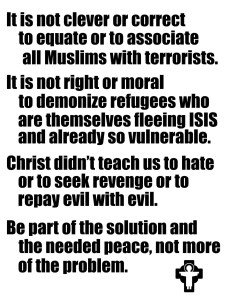 We face a moral challenge as a global people and a nation. Our species faces a moral challenge. It’s the question of turning on the most vulnerable and needful to vent our fear and rage. It’s the question of targeting the refugees of Syria as scapegoats for the sins of ISIS.
Even as State Governors embarassingly and proudly announce that they will not welcome refugees we need to be heard loud and clear as people of faith: attacking the most vulnerable is a moral outrage and wrong.
I cannot speak to the Muslim faith with authroity, nor to the scriptures and faith of Hinduism, Sikhism or Buddhism. These are neighbors and belief systems with which I am familiar and I respect, but am not an insider. I have spent a good bit of time with the Jewish and Christian scriptures, and there is a strong witness from both of our being a safe place for the hurting, a refuge for the vulnerable and peacemakers for the afflicted.
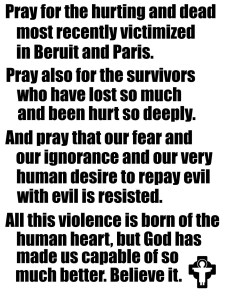 In the Jewish scriptures we find a beautiful image and phrase the heart of the stranger (Exodus 23:1-9, Laws of Justice) to describe the turning of one’s heart to the foreigner, the alien, the needful, because of our shared human experience. There are many ways that Israel was commanded to care for the stranger among them, but I have always felt that the reminder that we are all strangers was one of the most compelling.
Christians have a life and faith framed by what we call the Beatitudes (Matthew 5), an ordering of life based on the mutuality of human needs, experiencing life together and making peace. Those ideas frame the sermon in which Jesus says we are to love our enemies, refrain from striking back and to pray for those who hate us.
The West has been supposedly built on these Judeo-Christian faiths, ideas and teachings, but in fact many politicians today appeal to their faith in one moment and attack the most vulnerable of fellow human beings in the next. Perhaps we have lived too long with these teachings without an opportunity or the will to actually practice them?
We need to be loud and clear: Targeting the Syrian refugees in fear and anger, further compounding their pain and loss with our demonization of them and a denial of their basic human needs, is immoral and wrong on every level imaginable. Any political figure who does so is not worthy of your time or attention.
Instead, let us embrace the chance to live our faith in amazing ways, letting our hearts enlarge to surround and serve the most needful, and possibly to even be broken in service to the least. While together we pray…
35. For the Poor and the Neglected
Almighty and most merciful God, we remember before you
all poor and neglected persons whom it would be easy for us
to forget: the homeless and the destitute, the old and the sick,
and all who have none to care for them. Help us to heal those
who are broken in body or spirit, and to turn their sorrow
into joy. Grant this, Father, for the love of your Son, who for
our sake became poor, Jesus Christ our Lord. Amen.36. For the Oppressed
Look with pity, O heavenly Father, upon the people in this
land who live with injustice, terror, disease, and death as
their constant companions. Have mercy upon us. Help us to
eliminate our cruelty to these our neighbors. Strengthen those
who spend their lives establishing equal protection of the law
and equal opportunities for all. And grant that every one of
us may enjoy a fair portion of the riches of this land; through
Jesus Christ our Lord. Amen.From the Book of Common Prayer page 826
And amen.
AMDG, Todd
Shaping the Day
 Let’s chat about intention for a few minutes. Yes, there are days that drive us, and days that we need to leave open and easy for some sabbath rest… but I’m a believer that we need to be shaping our days with reflection and intention.
There’s nothing new in that opening statement. And there’s probably nothing terribly new in the following words, as we all know that “there’s nothing new under the sun.” Still, as I start today with some reflection and intention I find myself with the blogging itch, so I’d like to share with you one of the ways I begin many of my days.
A couple of years ago I preached a message series at Church in Bethesda on seven practices that help facilitate transformation in our lives. The idea sounds terribly deep, but it’s actually a simple idea that there are things upon which we can focus thought and action that will affect the kind of positive change in life we desire. If you’re completely content and never want a single thing to change, then I don’t recommend this exercise.
 The seven practices are repentance, prayer, stillness, study, sharing, service and ritual. Within the seven practices I tried to imagine the corresponding values or virtues they cultivate in life, things like integrity, vision, strength, wisdom, maturity, love and action.
In any given morning I take some time to pray and then think about the last few days and the coming day. How’s it been going? What have I not liked about my days? What has not gone as right as I would have liked? What can be better? What has been good? What do I want to keep going? I will often use my list of practices as well as the list of values to see if I am led to choose one or two of them to make some micro goals for the day.
As an example, I might be feeling a distinct lack of vision one day or come to realize that I am not really sharing with others as I ought. Maybe I’ve been frustrated and allowed myself to ignore some important needs in my life or my family, or I’m acting defensively over a hurt or a perceived hurt. Maybe I’ve slipped into being overly critical of others and not as supportive as I should be? Once I have a couple things I have identified for my focus, then I pray a little more and think of concrete action to take that day to address the needs in life I have identified.
So, below is the way that I list the practices, their corresponding values and under each a brief list of things I associate with each of them. Any given day I will reflect and choose one or two of the practices or the values, and make a goal or two for the day…
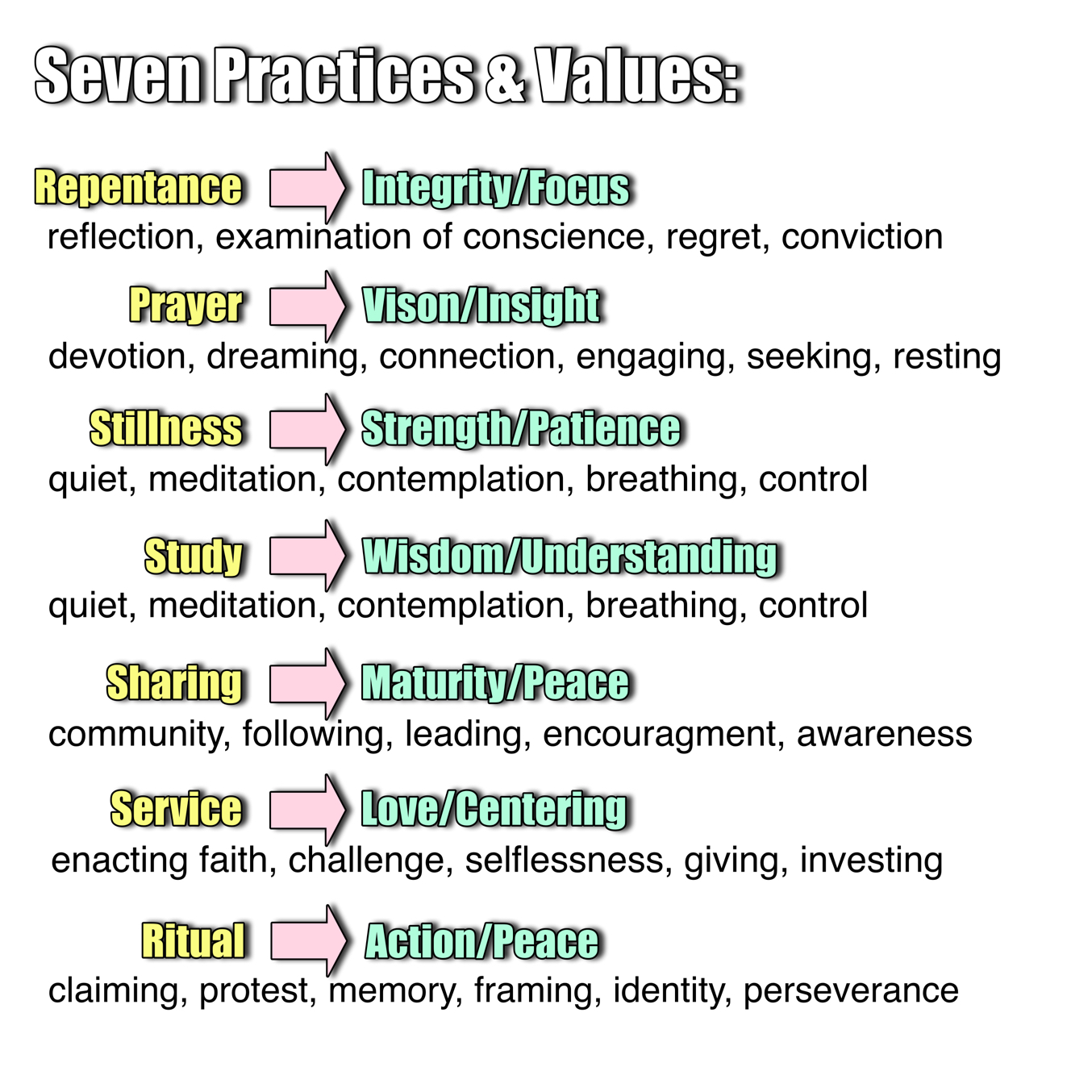
What do my micro goals look like? Let’s say I choose to zero in on ritual and wisdom. Upon reflection I have identified that I’m feeling but disconnected from daily prayer exercises; prayer has become a bit hit or miss for me. And I have thought that I’m needing to brush up on some deeper study on an issue that is giving me trouble. I’ll need to set some goals for the day so I don’t let another bunch of daylight hours slip away. I’ll make the following goals: 1) I want to be involved in the ritual of prayer more, so I’m going to set reminders on my phone to stop me at noon, 5pm and at 10pm to pray with Psalm 116, and 2) I’m going to cruise Amazon for a good book on the passage or theme I’m struggling with and borrow it with my Prime membership, before dinner. Your goals might be simpler or more involved, but should reflect your way of doing life.
One concrete goal I have made several times as I prepped for work at my Apple Store is to focus on sharing by really emphasizing a clear and sincere welcome/greeting for every person I meet that day, whether at work or out of work, whether another employee or a customer at the store. Good greetings involve things like a smile, eye contact and sincerely expressing “I’m glad you’re here.” One important thing to convey, though in presence and spirit and less in exact words would be “you’re safe with me.” =) You know when you’re nailing that one because you’re interactions suddenly get deeper and more transformational.
Now, I’m no guru, professor or Saint. This list is simply a way I organize some thoughts on my daily life and the change I want to experience and become in this world. I invite you to improve the list. Make it your own. Pray and play with it, and leave it better for having been sifted though the matrix of your own life and faith. Make some goals today and be the change, be changed!
AMDG, Todd
Dealing With Theological Diversity
 One of the hardest things that people of faith have to contend with at times can be our diversity of theology and doctrine. The truth is that we will all have various levels of experience, educational, investment and opinion when it comes to forming doctrinal conclusions and forming our basic theologies.
As human beings we will always relate to God in participation with language, personal history and experience, and the many diverse communal influences and histories. We are often working with concepts and expressions that demand we think and express ourselves in forms and terminology that range from the literal to the metaphorical. Our scriptures employ every conceivable literary and expressive genre to help us do this… we have histories, birth records, personal correspondences, romantic poetry, moral parables, axiomatic wisdom literature and songs to name a few. How could we all, in our diversity, find a home with our scriptures if they weren’t so welcoming of us in so many ways?
And yet we have spent a lot of time trying to make everyone think alike. We pick and choose a few words here and a few there to justify the idea that we all need to have exactly the same theology and doctrine. And please don’t misunderstand me… I do think there is some bad theology in the world. I have seen scriptures twisted and deep truths ignored. I have also seen deep truths revealed in the wonderful diversity of thought and expression revealed in a community of people who authentically bring themselves to God and listen to one another.
What does exclusionary theology do to us? What does it look like and sound like in community? Maybe you know someone with a single magical question by which they determine if another person is a Christian or not? Even as a pastor I have faced this many times with guests and members here at Church in Bethesda, and I’ve been told that I probably wasn’t a legitimate pastor or a Christian when I failed their litmus test on a particular theological point of interest. I once years ago heard a biblical teacher say, and I quote, “I can tell you in three minutes if someone is a Christian or not.” This is what theological exclusion sounds like, and it’s not a spiritual gift or an action supported by our scriptures.
I’d like to offer three suggestions for how we deal with our diversity of theological experiences, expressions and conclusions as I reach as I read Paul’s advice and instructions to the church in Corinth. That was a church divided in many ways; they argued over leaders, theological matters dealing with food, and much more. They neglected their less economically viable members and even made lawsuits against one another. Paul’s task as an apostle was to help them grow in unity and closeness, even while remaining diverse in thought and opinion; he never implies they will all suddenly, or should suddenly, think alike on everything. We see the divisions being described in 1 Corinthians chapter 1 and pick up some of the advice and instruction, themed around the preeminence of love, especially in later chapters like 8 and 10.
Here’s where I believe we should start… 1 Corinthians 8:1, Now about food sacrificed to idols: We know that “We all possess knowledge.” But knowledge puffs up while love builds up. And then we continue with the same kind of thematic love and mutual concern in 1 Corinthians 10:23-24 & 31-33 “I have the right to do anything,” you say–but not everything is beneficial. “I have the right to do anything”–but not everything is constructive. No one should seek their own good, but the good of others… So whether you eat or drink or whatever you do, do it all for the glory of God. Do not cause anyone to stumble, whether Jews, Greeks or the church of God– even as I try to please everyone in every way. For I am not seeking my own good but the good of many, so that they may be saved.
Listen to these heartbreaking questions about legal actions against one another… 1 Corinthians 6:1-8, If any of you has a dispute with another, do you dare to take it before the ungodly for judgment instead of before the Lord’s people? Or do you not know that the Lord’s people will judge the world? And if you are to judge the world, are you not competent to judge trivial cases? Do you not know that we will judge angels? How much more the things of this life! Therefore, if you have disputes about such matters, do you ask for a ruling from those whose way of life is scorned in the church? I say this to shame you. Is it possible that there is nobody among you wise enough to judge a dispute between believers? But instead, one brother goes to law against another–and this in front of unbelievers! The very fact that you have lawsuits among you means you have been completely defeated already. Why not rather be wronged? Why not rather be cheated? Instead, you yourselves cheat and do wrong, and you do this to your brothers and sisters.
Paul says that the very idea that they have lawsuits between them means that they are already defeated… wow. Their lack of concern for each other overshadows their disagreement. They’ve lost the relational aspect of being a people. There’s a lot in the passage about us judging the world that I’m not sure exactly what to do with, but I can plainly hear Paul’s pain that the people are pursuing their own interests and concerns to one another’s detriment. He asks pointedly if it wouldn’t be better to be wronged than to fight for your own rights? Yes, someone might cheat us, but isn’t it better to be a cheated person than to be a person who attacks and slanders a sister or neighbor in response? Ouch. We can really hear how divisions among us can become cycles of violence and vengeance.
Paul calls for a model of behavior built not through enforced conformity, and not through wild independence, but through a balanced approach of maintaining our personal freedom in relation to caring for those around us. Of course, it would be easiest to simply demand my own way or be coercive toward others, but Paul speaks instead of mutuality of love and concern. Even though we may have different cultural concerns and divisions today, we can still learn a few things from our ancient teacher, Paul. The following three points I’d like to make are drawn from Paul’s wisdom, but not just a repeat of the words written to the church in Corinth. We may rarely have to deal with internal lawsuits and never with food offered to idols, but we do have disputes about leadership and many other daily theological concerns that vex us as a community.
1) We must remember that though God and faith communities have always employed and appreciated clergy, theology does not belong exclusively to anyone based on education or experience. In fact, theology should never belong to any individual. While education is very important in growing a deep historical engagement with many theological concepts and questions, we all do theology. You are a theologian. Maybe you aren’t a theologian in the academic or vocational sense, but you do theology when you think of God and process faithful decisions in your daily life. Too often we rely on or search for a teacher who has an exclusive hold on truth and is willing to share it. And we like to be in that teacher’s position, if we’re being honest. We also like arguing our opinions and being smart. *sigh* Can our egos handle a loss of power and prestige if others are not looking to us for exclusive truth and expression? As Paul says we all have knowledge and we can also say that we are all doing theology, and safely conclude that we need to: Keep community in theology. Theology is a team sport and we all have a variety gifts and abilities to bring to the playing field. Humility helps us be better listeners and learners, and listening and learning helps us form better theologies.
2) We must always be guided by right love and action toward one another. We have too often believed that someone’s dissimilar theology or belief was our license to love them less, treat them less well, and end our responsibility of fellowship and community with them. You know what I mean? We act like someone being in disagreement with us over theological concerns is grounds for hating them, slandering them and dividing from them. Sometimes we have done this over the least significant of reasons and topics. When we decide to maintain right action toward one another we are speaking of orthopraxy as distinct from orthodoxy; that is right action versus right thinking. This is not to say that right thinking and right action need to be opposed, but to point out that they are often distinct interests even when working together in concert. Sound counter-intuitive to what church has taught you in the past? I was raised to believe that I would be saved by my doctrinal correctness. But how do we reconcile that idea with the judgment scene described by Jesus in Matthew 25:31-46 where the good and bad, the saved and unsaved, are divided from one another by how they treated other people? That’s a rock solid example of orthopraxy in Matthew 25. In fact, it’s a great example of orthopraxy and orthodoxy working together as Jesus explains to the people that their treatment of others is tied directly to how they think of others, seeing Jesus himself in them or not. Paul, following the lead of Jesus, taught the early Christians a form of orthopraxy to use in times of diversity and disagreement. Humility and mutual concern frame a love for one another that guides us in times of disagreement and diverse thought and theology. And we can conclude that we should: Keep love for one another in it’s place of preeminence. Getting our thoughts and actions in concert around love will set the stage for safe disagreement.
3) We can watch for bad theology, most often recognized by it’s fruit in the lives of people, while maintaining orthopraxy. Sometimes we’ll encounter a theological idea or conclusion about God that seems to move counter to scriptural witness, and we have to engage that idea to see if it can be reconciled with our greater community, textual and historical understandings. But even as we watch for bad theology and challenge it, we do so in the practice of orthopraxy. So bad theology doesn’t necessarily identify a bad person. I need to say that again: Bad theology doesn’t necessarily identify a bad person. Remember that our diversity may at times signify that one or another person is weaker or stronger in conscience and faith, but that is not grounds to judge them. Paul teaches a seeking of the other’s good that demands us to be graceful, lenient and careful with the people around us. He considers it an emulation of Jesus, and thinking back on the way Jesus dealt with countless people in his own ministry, I agree. Whenever we start leaning toward a purist orthodoxy that relegates people to second-class citizenship or excludes them altogether, let’s remember that Jesus taught the principle that “the Sabbath was made to serve humanity, not humanity made to serve the Sabbath.” (Mark 2) Doctrine, theology and religiosity are mechanisms to serve us, not vice versa. Even in our efforts to craft and live the best theology, we do not have license to hate or disregard others for their own efforts that end up dissimilar to our own. Maybe we can say it like this: Keep grace in a place above doctrine. Another way to summarize such an idea might be the words of James when he said that “mercy triumphs over judgment.” (James 2)
I say we all memorize those words from Paul… 1 Corinthians 8:1 from the New Living Translation…
“But while knowledge makes us feel important,
it is love that strengthens the church.”
October 2015 and Diversity
“Diversity is not a weakness for faith, but a strength.
Our diversity is not discouraged by scripture, but validated.
Diversity is not disunity, but should help us be a unified whole.”
 It’s October and I’ll be starting a couple of things this month: 1) I’ll start working on my winter beard… and I know it’s never much of a beard, maybe more of a beardlette, but I’ll see what difference another year on the march to manliness means for me, and 2) I’ll be investing the month in writing out my thoughts on diversity as a core element of Christian faith that is too often given short shrift or completely ignored.
Diversity of Faith Expression/Identify
I’m not choosing diversity because it’s a buzz word. I’d like to focus on what our scriptures, especially in the New Testament and the words of Jesus, have to teach us about being different. Too often I’ve heard much more about being the same. In my own lifetime I’ve heard sermon after sermon about conforming to a single ideal, a single belief and a singular expression of faith and church. The church of my youth was devoted to a single refined expression of doctrine and ecclesiology to the exclusion and utter rejection of all deviance from that expression. We fantasized about our ability to come to conclusions and decisions about theological and doctrinal matters outside of personal experience and enculturation, and therein find the single answer to all questions for all people in all times in all places. Today, I’d call that misguided and un-hopeful.
Our scriptures present a different picture of life and faith. The ministry of Jesus showed a diversity of disciples and gifts surrounding Jesus, and times of Jesus himself affirming the existence and authenticity of others. In fact, Jesus often did this over the protests of his disciples who desired exclusivity and personal greatness, uniqueness.
Diversity of Gifts
We have often spoken of diversity in the realm of giftedness and abilities. It’s appropriate when we speak of individual calling and giftedness to recognize our diversity, and we’ll chat about that in October. We just won’t leave our diversity solely to the realm of gifts and abilities.
Diversity of Calling & Being
More than ever we are being challenged to be open and welcoming to differences. We are being asked to be comfortable with our differences. So where and how do we plant our feet solidly in our understanding of faith and scripture and tradition to do that? We’ll be exploring that question through the coming month. My central hope in this month is to show that we are able to be both faithful to God and respectful of one another’s dignity by becoming more open and tuned into the value and strength of our differences.
I’m excited to push back against many misconceptions about people, scripture and faith. I’m hopeful that we can live and worship with a greater love and sincere appreciation for one another, even in our differences. I have come to hold diversity as one of our greatest strengths, one thetas validated by scripture and necessary for us to realize lasting wholeness as a community.
AMDG, Todd
 toddthomas.net