Some of my favorite Lenten music is from the Benedictines of Mary. You can find them on Apple Music, Spotify or their website.
It’s Ash Wednesday again, and if you don’t have plans tonight I’d like to invite you to join my family at St. John’s Episcopal Churchfor the imposition of ashes and celebration of the Holy Eucharist. (I’m working all day and can’t make an earlier service.) We’ve come to another Lenten Season, a time of reflection, repentance, sometimes rededication. But, why ashes?
I think it’s fair to say that most of us don’t think about our death each day. And really it’s probably healthy for us not to be too focused on our impending deaths. Once in a while though, it’s good and it’s healthy to remember that our journey here on earth needs to be made with intention, and it needs to be made in view of the end and the destination of our journey.
The ashes remind us in a very tangible way that our bodies are not eternal. The imposition of ashes and the words that are spoken in the services every year on Ash Wednesday remind us that our bodies will be a memory one day. Yet, we are also reminded that we are eternal beings, linked to the divine for all times. These shells, our mortal bodies, have meaning and purpose, but also have a timeframe in which they operate.
With this in view we begin a another 40 day journey of reflection, of introspection. We begin a 40 day journey of looking over our lives and dreaming about what our lives may yet become. This is a journey that is taken in prayer, fasting and often with extra time built into each day for study and meditation. Lent can be an important time of spiritual reset, emotional strengthening, intellectual inspiration and much needed rest from the diversions that plague us and fatigue us throughout the rest of the year.
Yes, I encourage you to fast during this time. I will be beginning my usual meat fast for the next 40 days. But more than just fasting from something, I would like to join the many voices every year that remind us that fasting is also about attaining something not just giving something up. Fasting also has a component of connection with others. I encourage you to think creatively, to dream and to imagine ways to go deeper with your faith, to grow deeper with others. I encourage you to think about your daily spiritual practices, and maybe put a finger on something that has been dropped or an important part of life that you’ve neglected. When we’re doing this kind of reflection, then we can take steps to strengthen up our spirits, to rebuild our intentions, and to refocus on the central things of life, both for ourselves and others. We’ll be blogging and working along these lines during the Lenten Season. Here’s a piece of one of my favorite passages about fasting, Isaiah 58; I’ll just leave it here…
4Look, you fast only to quarrel and to fight and to strike with a wicked fist. Such fasting as you do today will not make your voice heard on high.
5Is such the fast that I choose, a day to humble oneself? Is it to bow down the head like a bulrush, and to lie in sackcloth and ashes? Will you call this a fast, a day acceptable to the Lord?
6Is not this the fast that I choose: to loose the bonds of injustice, to undo the thongs of the yoke, to let the oppressed go free, and to break every yoke?
7Is it not to share your bread with the hungry, and bring the homeless poor into your house; when you see the naked, to cover them, and not to hide yourself from your own kin?
Our lives are often long and they are sometimes short. Our lives are marked by ups and downs, and our lives are often spent learning lessons and trying to remember the things we’ve been taught. Like the ashes which will wash away when you get home, or the next time you take a shower, our lives have a beginning and an end. The beginning is set for us, and is out of our hands. The end is also often provided for us without a lot of input from our wishes, desires or ideas of timing. But all those in-between days are the open fields in which we run, they are the canvases upon which we paint, and they are the paper upon which we have the opportunity to help write our stories.
I bless you in this Lenten season. And I ask you to bless me. May we each be reminded in the best way and the most healthy way that we are not eternal upon this earth, but our lives are still pregnant with meaning and infused with God’s presence, God’s will and God’s love. Reflecting upon these things, it is my prayer that in the next 40 days we will be able to go deeper, deeper as individuals beloved of God and deeper together as the family God has made upon this earth.
Oh, one last thing… I was asked if I would preach the sermon this coming Sunday night at the 5 PM service, February 14. If your Valentine’s Day plans will be concluded by five, I’d invite you to come worship with us at St. John’s Episcopal Church in Bethesda, MD. It’s a blue jeans and sweatshirt kind of service, and an inclusive congregation that welcomes you as you are, so please feel a full and a complete invitation to come be with us.
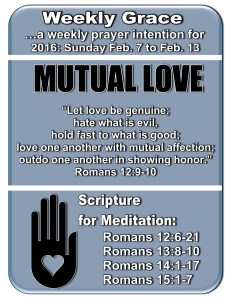
As we enter into February and the Lenten Season, let’s pray for a mutual love to deepen and expand among us, against all odds. Each week we’ll dig into a single biblical author’s thoughts or account of mutual love and we’ll re-affirm our own commitment to the love that should be growing between us.
It’s going to be my personal prayer this month that I will be able to grow in deeper love for the people who are least like me and think least like me. I believe I have more often been taught to try to change those people, or at least to avoid them. If I wasn’t taught to do so, then I have certainly learned through experience that this is usually the easiest course.
Perhaps with some prayerful creativity and reflection I can discover ways to listen to them better; I may even find some ways to more fully offer them the benefit of the doubt. Hopefully, I will imagine some new ways for us to maintain our unique experiences and perspectives, but still coexist in harmony and shared love. It seems that when Paul was speaking to the church in Rome he fully expected them to be a diverse people, but never released from that debt of shared love.
Let’s just go ahead and accept it: we won’t awake tomorrow to find that everyone thinks and believes like we do, even in our own families or congregations. So, what’s next? Without a universal agreement on all doctrine and faith issues, may we still maintain a sense of mutual love and shared harmony? Without our complete similarity of conviction, may we nonetheless value and support one another’s spiritual journeys and affirm the mutual love and things we do share in common? It may go “against the grain” by some human sense, but that may just be the signal that we’re moving into a truly transformative practice. Lord, teach us to pray.
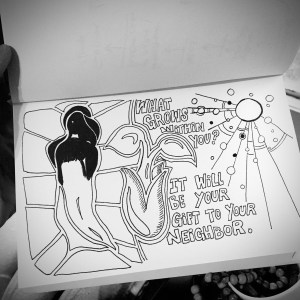
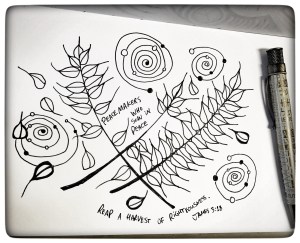
I rarely show anything I’m doodling until it’s completely done, but I realized this morning that I haven’t opened my sketch book in a week! This is a piece I started a couple of weeks ago that I need to finish.
I recently made another move in my job with Apple, from retail sales back into the tech support group. It’s a step on my journey into a new role with Apple as I go full-time. I’m one our store’s newest Creative, joining the team that leads workshops and does training sessions. Until I finish my own training for my new position, I’m doing a lot of tech support for mobile devices again, and that can be a stressful job. We work with people in stressful situations. From the failure of a device to incidents of accidental damage, we are helping folks get through some anxiety filled time as they feel the withdrawal pains of being momentarily unplugged from our tech-connected lives.
One thing I do to prepare for each day at work is practice my work mantra on my drive to the store. It goes something like this:
I love my customers. I am so glad I can serve them. I love my customers. I’m going to do my best for them, today.
This mantra helps me get in the mindset of service. It helps me center on the truth that our customers are coming to us with real needs, and my response must focus on those needs. It would be too easy to just become defensive or upset, to reflect back their anxieties and stress. No, I have to let their anxieties and frustrations be authentic and real, spoken and experienced, and let those anxieties and frustrations pass through me and past me without landing in my own spirit. Then, I’m ready to get down to business with helping them determine the best solution for their situation.
My mantra is an action of intentionally deciding what will be planted within me so that I can choose what I’ll be producing from the soil of my heart and mind. This is not just a service industry principle, but a life principle. I must choose the seeds of peace, compassion, empathy and love as what I cultivate within myself if I want to have those things to share with others. This is a daily effort, forever unfinished and being finished. I guess it’s ok to share a doodle before it’s done, as its unfinished state can meaningfully reflect the on-going becoming of life.
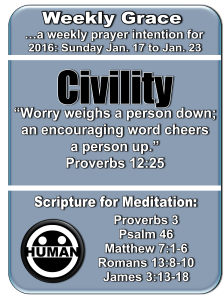
One of the uses or blessings of civility is it’s ability too turn things around, to take a bad situation and make it better, to help a person having a bad day begin to have a better day. An important part of civility is acting out of that civil impulse to positively engage and support one’s community.
Do you see someone around you struggling? Do you see someone who needs encouragement? Lift them up! Be a person who spreads joy and increases peace in the world with kind words, encouraging and positive contributions.
The proverb in our Weekly Grace is at once obvious and such a needed reminder. Our words have an effect, so let’s plan for the best effect possible. As children in Sunday School classes we often put our fingers over lips and sang “O be careful little lips what you say!” and I hope we never grow too old for that lesson.
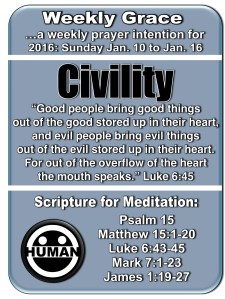
Civility begins within and then manifests in speech and action. This is true of everything, good and bad, better and worse. Out of our hearts we incubate ideas and expressions that take form in our words and responses. For this reason our God is not just standing around waiting to slap our wrist and cluck at us, but God is working to rehabilitate our heart and inmost being!
Are we open to this? It’s one thing to capitulate and obey a greater power or a higher influence, but are we ready to allow ourselves to be fundamentally changed from the inside out? This is the difference between obeying the great sermon points in Matthew 5, 6 and 7 out of legal and religious obligation or allowing the Beatitude Statements in Matthew 5 to frame a change of our hearts and minds as we navigate the reorienting of life that Jesus presents for us to follow.
This is not Christianity 2.0 or any new innovation or deeper level… this is actually the beginning of religion and faith. Jesus often gave this invitation to people, “Follow me.” This is the invitation of a teacher, mentor and life-changer. This is an invitation to reflect on who we are and how we are, with Jesus’ help. And it’s an invitation to change.
Want to change the urges and reflexes of destructive negativity in your life? Begin by reflecting on your heart and cultivating a change there… work with energy and consistency to remove the negative things and plant beautiful things in their place. Where their is hurt and injury, sow some forgiveness. Where there is anger, sow some quiet and prayer. Where there is hatred, sow some empathy and hope. Christian saints and mystics often rooted this in their prayers: St. Catherine of Siena, St. Ignatius of Loyola & St. Francis of Assisi.
Even as I begin a new year no longer serving a congregation as pastor and shepherd, I want to renew my commitment to being a spiritual friend and brother to you. And I have to remind you that I need you. Jesus didn’t invite one person or single individuals to follow this path of change, he called us into community, together. Let’s do this together. Let’s chat.
I’ve been making a weekly prayer intention for several years for our congregation at Church in Bethesda and for myself, but I’ve been wondering about continuing the practice now that I have left my pastoral duties with the congregation. After some thought and prayer I’ve decided to continue.
First, I do hope it blesses someone to have some weekly help with prayers. We all have time and even seasons when prayer is drier and more difficult to start. Second, it does help me to have it in mind and carry it as a daily reminder. Third, it’s a practice of intention, study and creativity that I don’t want to lose. Instead, I’m thinking of ways to expand on the weekly grace and what it’s intended to be.
This is a Presidential election year… oh my. In honor of the coming strife and internal warfare that we are about to incite, I thought we’d begin the year with another reminder of civility. For people of faith civility is actually at the core of who and how we are to be interacting with our communities, nation and world. Civility is scriptural. Civility is Christian. Civility is a core element of a life of faith.
I’m personally so tried of the arguing around the phrase “politically correct.” It gets used too often, sometimes to minimize our responsibility to one another, the exact opposite of its intention. Some people proudly say that they don’t care about being politically correct as an excuse or a prelude to their incivility, rudeness and meanness. Being non-politically correct has become a badge of honor to many, as they see the need for sensitivity toward others as a type of censorship. Nothing could be further from the truth.
Being sensitive of others is a foundation of civil discourse and a very deep, important spiritual practice. We must work hard to remove racial slurs and demonizing language from our daily and shared conversation. We need to speak and act in ways that welcome the otherand invite the other to participate in life with us, even in disagreement and dissimilarity. Christian Dominion, our elevation and dominance in religious, political and social affairs where all others are supposed to be made to conform to speak and act and think as we do, is not a scriptural idea. Truly, our scriptures teach the opposite. We are the world’s servants, broken and spent for the world’s good.
God blesses all. God’s blessings are for all. This is a teaching of our Christ, and maybe one that we by and largely ignore as we deeply fear its implications. (Matthew 5:43-48) The faithful are not the sole object of God’s love and peace… we are invited to share God’s burden of being used to bring more love and peace to the human family and all of creation.
So, as we begin the new year and look forward to electing a new President to lead our country, let’s renew our intention of civility in speech and action. Let us refuse to follow voices of indignity, disrespect and disharmony. Seek the voices that speak to bind us in love and peace. Be a voice that builds others up.
My message this morning at Church in Bethesda for the Fourth Sunday of Advent, lighting out Peace Candle…
We’ve been lighting candles each week for the themes of Hope, Love, Joy and now Peace.
I pray that your holidays are blessed, safe and joyful!
Fourth Sunday of Advent: Peace December 20, 2015
I’m a life-long Shakespeare fan. Back when I lived in East Africa at the ripe old age of nineteen I bought a paperback complete works of Shakespeare at a bookstore in Mombasa, Kenya, and I read many if not most of his plays. Perhaps you know the opening scene of conflict in Romeo and Juliet, when young men of the Montoague and Capulet families square off for a public brawl, and one young man tries to keep he peace…
BENVOLIO I do but keep the peace. Put up thy sword, Or manage it to part these men with me.
TYBALT What, drawn, and talk of peace? I hate the word, As I hate hell, all Montagues, and thee.
Shakespeare in Romeo and Juliet, Act 1 Scene 1
How easy it can be to choose another path than peace. How easy it can be to choose conflict. How exciting and romantic it can be! And how elusive peace can be in this world when we can so easily fight and rip and tear at one another. It seems too often that live in a world which when we ask for peace replies, “We hate the word!”
Our peace candle is lit, but peace is still far from so many in our world. So, let’s talk about peace, about our passing the peace, about the little choices we make which bubble up into a redeemed world. One of the things that has been catching on in the Protestant Christian world for the last few decades is the practice of passing the peace in worship, sometimes called a “love feast” or just a few moments of greeting. This is an old practice for the Catholic, Orthodox and older Christian communities.
In fact, it’s sometimes been a point of controversy for communities as it is can be considered too raucous a celebration that breaks the solemnity of the worship service! I guess we can have controversy about anything, including passing a bit to peace to one another.
But I’m a fan. I like the passing of the peace. As a worship element and as a celebration it’s not something explicitly seen in scripture or commanded of us, but it is such a beautiful expression of scripture and a way of life that was taught and modeled by Jesus. Scripture references associated with the passing of the peace begin in Matthew 5 when Jesus blesses the peace makers and then goes onto explain in the same chapter the importance of reconciliation between us, even over and before worship and religious obligations.
Scripture also shows us that Paul begins his letters to churches in a very formulaic way, offering peace each time to his audiences. And so the idea of reconciliation and offering peace becomes today’s ritual and exercise of greeting. I have also heard that it is importantly placed before the Table practice of worship to realize the admonition of Jesus to do reconciliation before approaching the altar. So before we gather at the Table we make sure that we have restored our relationships. Can it be a bit perfunctory and less meaningful as a weekly practice? Of course, like anything we say and do, we carry the burden of making it meaningful with our intent and sincerity. And I hope we always do just that… sincerely offer peace to one another.
I like the peace passing because it reminds us of a couple of important ideas. First, God is our peace. Peace is God’s inclination toward us: peace in reconciliation and peace in our lives. Secondly, peace is one of our prayers that we begin to answer even as we speak it. Peace is not relegated to a far-away time and place, a hope and a dream of days to come… peace is our now when we choose it. We pray for peace and can immediately begin with God’s help to answer the prayer in our words and our actions, today.
Paul eloquently warns of the other side of our choices, when peace is left far behind… to the Galatians, a church wherein he himself has been held suspect by some and come under accusations: “You, my brothers and sisters, were called to be free. But do not use your freedom to indulge the sinful nature; rather, serve one another humbly in love. For the entire law is fulfilled in keeping this one command: “Love your neighbor as yourself.” If you keep on biting and devouring each other, watch out or you will be destroyed by each other.”Galatians 5:13-15
There are consequences to choosing conflict over peace, but the real motivation is the wealth of dividends that are paid by choosing peace. Peace is bound up in the presence of God and peace is the chance we give to one another to restore brokenness, advance joy and heal the hurting. Peace is a gift that we can share among ourselves, like a fine meal, like a treasure. It’s a prayer that we not only say, but do. Peace is a plea that we ask and beg, and then begin to answer and realize, with God’s help. We are not without the ability or the opportunity to be the peace. Everyday, every greeting, every person in our lives, every disagreement we have: these are opportunities to plant the peace we would see cover the earth.
In the next line of the play Romeo and Juliet, Tybalt says to Benvolio, “Have at thee, coward!” and attacks. Tybalt sees peace and an effort to keep the peace among neighbors as a weakness and a cowardliness in Benvolio. How little we’ve changed since the days when Shakespeare played out our prideful lives on his stage. We too are often lulled into the romance of conflict, the adrenaline of violence and the hope of domination. We fall into the Tybalt Trap of seeing peace as a weakness or a fear. It is in truth a strength. And as Benvolio in Shakespeare’s story, we will pay a price for standing for peace. But unlike a fictional character upon a stage, we stand in the reality of God’s good world and God’s kingdom business of making peace. With God’s help, we will be the peace. We will do the peace. We will plant the peace. Amen.
I’ve been so wearied and heart sick from the on-going violence and hate speech across our country and world. Most days I say something like “Well, my sinuses are acting up” when someone questions me, but the truth is that I’m simply soul fatigued by the darkness that is so often heard exploding from stages, pulpits and the barrels of guns. Preparing for this day’s Advent message on Love, I am reminded that there is a remedy for the hate. There is a prophetic voice that answers the bigotry and fear. It is not a fight fire with fire kind of answer or a choice to out-shout, out-hate or out-bigot the worst that we hear on a daily basis. It is love. Love released, love shared and love unfettered among us.
It was a challenge to prepare this sermon, sort of like those occasional nights as children when we woke in the darkness and groped along for what seemed like hours to find the light switch. All we wanted was to get to the bathroom and have some relief, but it seemed so impossible in the darkness to get there. We will get there. We will love. We will keep the prophetic voice of our faith. In humility and my in own soul-weary dance, I offer this message and reminder that we have a purpose higher than the politics and brighter than the darkness. We have love.
The Second Candle of Advent: LOVE December 6, 2015
Our scriptures are big enough and old enough and engaged enough with humanity that within them there will always be some things that confuse me, things that anger me, and things that frighten me.
But within them I also find again and again the great themes and underlying truths keep me bound to God and to Christ, such as the prophetic themes of love, justice and mercy. The theme of God’s great love that cannot be taken from us is one of the constants of our scriptural narrative and record. The theme of our essential goodness and the struggle to avoid the darkness which will hide it is another great theme which calls us to renewal. I cherish the theme of needful justice for the oppressed and disenfranchised, and then mercy for those who have abandoned justice and need to be restored.
Our scriptures continue to inspire, comfort and convict, even in the midst of the challenges I mentioned before, because they are prophetic. They are prophetic, and the prophetic voice of scripture is love.
What does it mean to say that the prophetic of scripture voice is love? When we use the word prophetic we think of oracles and predicting the future, but we also are talking of the past and the present and a voice which often loudly and coherently binds them all together in a meaningful narrative and message. Such is love. Love is our past, our present and love is our future. Love is the meaning of our effort and struggle, the hope of our need and the joy of our suffering.
So the narrative of love begins in scripture with God’s great love for us and all creation, and God’s understandable discontent when the darkness of our hatred and violence kills and destroys. But God’s love continues, and so much of the Psalms are verses singing about that steadfast and deep love. And even though God’s anger is understandable at our failure to match that steadfastness, God’s love rolls on and on.
Painting by Edward Hicks, an amazing American Quaker artist. This is one of his many Peaceable Kingdom visions.
And in Isaiah 11, the prophetic voice of love reminds the downcast and the oppressed that hope is not lost. That prophetic voice casts a vision of a coming reality when love reigns in the coexistent harmony of so many seemingly incompatible things: infants and serpents, bears and cows, lions and lambs, the wise and the old being led by children and the unlearned. Can we just stop for a moment and notice the obvious truth here, that love is more often unlearned in our species than learned? The children lead us in love for they have not yet had its light extinguished by our older fears, bigotry and hatred.
The prophetic voice of love rings in the most difficult teachings of Jesus. If we are honest with each other, and I hope we are, the most difficult teachings of Jesus for our lives are not the “stop sinning” kind, but the “start loving” kind. Love enemies. Love and pray for those who persecute. Love one another. Love God. Love neighbor. Love as he Christ has loved. (Matthew 5 & 22, John 13)
These are the teachings that often confound us, but also that shape and create a coming future in which the seemingly incompatible can exist in peace.
We live and make our way in a time of global terrorism, gun violence in our streets, schools and places of work. Domestic violence and sexual abuse scandals are not uncommon in our headlines. Bigotry seems to have become a popular political platform on which to win elections. Neighbor turns against neighbor in fear and ignorance of those Muslims, those Christians, those Republicans, those Democrats, those refugees, those gays, those, those, those…
The prophetic voice of love says not those, but we. Love is patient when patience and civility have become lost virtues; love is kind because kindness is more powerful than fear or hatred. Love isn’t envious of others or lacking in hospitality or generosity. Love doesn’t divide us into factions and parties to put others down and feel better about itself. Love isn’t proud to the point of insufferable arrogance, insult or discourtesy. Love is not rude, violent, or in the habit of making jokes about its neighbors. Love accepts others when they are different in thought, belief and background. Love is not waiting to be angry or carrying old resentments just waiting for a chance to pull them out and inflict the world with more angry hateful speech. Love is not excited by violence or thrilled by vengeance, but committed to making peace. Love carries burdens. Love believes the best of its neighbors. Love kindles hope in darkened lives. Love only grows stronger when resisted. Love cannot fail, end or be extinguished for it is the past, the now and the future. Love casts out and ends the fear that threatens our weary souls. Love is God among us, God in us and God through us. (My personal mashup of some of 1 Corinthians 13 and 1 John 4.)
Our candle called LOVE is burning. This is our reminder and our calling to let love so burn in us. Love is our prophetic vision, our voice and oracle of all things to come, and we must not ever let the darkness hide it or take it from us. We cannot allow fear or ego to dampen it. We must answer it’s call and remain in it’s path.
May love’s Advent never end, but may the arrival continue, lighting the dark corners of our lives and the world around us. May we never lose hold of the goodness with which we are made and continually chosen by God to experience and share enduring love. May we never exchange this great prophetic voice for any other message or meaning. For in this endeavor, in this embrace of love, we join the deepest narrative and truth of scripture. We enter into the millennia old work of God to enact justice, to promote mercy and to the humbly journey together.
How could we choose any other voice of prophecy? How could we allow any fear or worry to obscure this love? How could we claim any truth above this love? How could our identity be known by any other mark?
Jesus said… “I give you a new commandment, that you love one another. Just as I have loved you, you also should love one another. By this everyone will know that you are my disciples, if you have love for one another.” fromJohn 13:31-35, NRSV
Life is a journey and our spiritual life mirrors this with twists and turns and fun developments… a recent fun event in my journey was being confirmed in the Episcopal Church and the worldwide Anglican Communion on Saturday, November 14th, 2015 at the National Cathedral in Washington DC. In the picture with me is Reverend Sari and my new friend Anne, both from St. John’s Norwood Parish.
It was also an intentional move, not an accident. I’ve been looking for a Christian faith tradition for the second half of my life, even making a short-list of fellowships to explore and question, and we ended up choosing the Episcopal Church for many reasons. I’ll describe three of those reasons here, things that the Episcopal Church stands for and some deep blessings of being around this tradition.
The Middle Way. In my life as a Christian and a Pastor I have often found myself holding the center among a variety of people and viewpoints. I have pastored a community for many years that included conservatives and progressives, Republicans and Democrats, many ethnicities, differing sexualities, beautiful colors, varied traditions and diverse backgrounds. I was intentional about trying to make all welcome and keeping them respected and I called it a sacred tension of doing life together in our diversity. I’ve found the Anglican Communion to have already named this: the middle way. With a foot in both the Catholic and Protestant traditions, and a diverse family of people, the middle way is that path of unity and shared dignity without a forced conformity or loss of vital historicity.
Tribal Without Tribalism. Our family has been blessed to find a balance of openness and identity in the Episcopal Church that I describe as being tribal without the tribalism. We have an identity as a group, a faith family, without needing to judge or exclude others. We have a belonging system, which is important, without needing to also draw bold lines of division and keep others from our Table or our full welcome in worship. As a guest dropping in often over the last decade I was able to find solace in the Rites and share the Eucharist with this communion of faith long before my confirmation. I am so thankful for that gift through the years.
Living As A Communion. I’ve been a prayer book collector for many years, and the Book of Common Prayer has been one of my favorites. I didn’t know that it’s existence represents one of the central ideas of the Anglican Communion, that instead of being in joined in fellowship because we all think and believe exactly alike, we are one because we pray together. This resonates with me as both a foundation of unity and peace in our life as a communion and in my daily devotional practice. We are one in our mutual reaching out to God.
I’m not here asserting that the Episcopal Church is the best faith family for everyone, and I have no interest in any my church is better than your church competition. I just want to share what a blessing it has been to find my tribe and be welcomed therein. It’s been an interesting journey for our whole family and we are excited about the coming years with the church. And yes, the cool Episcopal shield is probably going to be my next tattoo, but we’ll see. =)
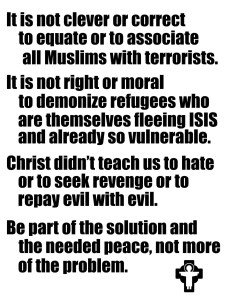
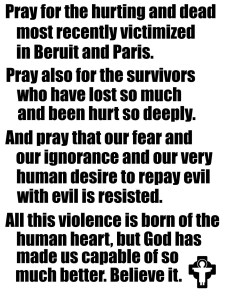
We face a moral challenge as a global people and a nation. Our species faces a moral challenge. It’s the question of turning on the most vulnerable and needful to vent our fear and rage. It’s the question of targeting the refugees of Syria as scapegoats for the sins of ISIS.
Even as State Governors embarassingly and proudly announce that they will not welcome refugees we need to be heard loud and clear as people of faith: attacking the most vulnerable is a moral outrage and wrong.
I cannot speak to the Muslim faith with authroity, nor to the scriptures and faith of Hinduism, Sikhism or Buddhism. These are neighbors and belief systems with which I am familiar and I respect, but am not an insider. I have spent a good bit of time with the Jewish and Christian scriptures, and there is a strong witness from both of our being a safe place for the hurting, a refuge for the vulnerable and peacemakers for the afflicted.
In the Jewish scriptures we find a beautiful image and phrase the heart of the stranger (Exodus 23:1-9, Laws of Justice) to describe the turning of one’s heart to the foreigner, the alien, the needful, because of our shared human experience. There are many ways that Israel was commanded to care for the stranger among them, but I have always felt that the reminder that we are all strangers was one of the most compelling.
Christians have a life and faith framed by what we call the Beatitudes (Matthew 5), an ordering of life based on the mutuality of human needs, experiencing life together and making peace. Those ideas frame the sermon in which Jesus says we are to love our enemies, refrain from striking back and to pray for those who hate us.
The West has been supposedly built on these Judeo-Christian faiths, ideas and teachings, but in fact many politicians today appeal to their faith in one moment and attack the most vulnerable of fellow human beings in the next. Perhaps we have lived too long with these teachings without an opportunity or the will to actually practice them?
We need to be loud and clear: Targeting the Syrian refugees in fear and anger, further compounding their pain and loss with our demonization of them and a denial of their basic human needs, is immoral and wrong on every level imaginable. Any political figure who does so is not worthy of your time or attention.
Instead, let us embrace the chance to live our faith in amazing ways, letting our hearts enlarge to surround and serve the most needful, and possibly to even be broken in service to the least. While together we pray…
35. For the Poor and the Neglected
Almighty and most merciful God, we remember before you
all poor and neglected persons whom it would be easy for us
to forget: the homeless and the destitute, the old and the sick,
and all who have none to care for them. Help us to heal those
who are broken in body or spirit, and to turn their sorrow
into joy. Grant this, Father, for the love of your Son, who for
our sake became poor, Jesus Christ our Lord. Amen.
36. For the Oppressed
Look with pity, O heavenly Father, upon the people in this
land who live with injustice, terror, disease, and death as
their constant companions. Have mercy upon us. Help us to
eliminate our cruelty to these our neighbors. Strengthen those
who spend their lives establishing equal protection of the law
and equal opportunities for all. And grant that every one of
us may enjoy a fair portion of the riches of this land; through
Jesus Christ our Lord. Amen.


 Our lives are often long and they are sometimes short. Our lives are marked by ups and downs, and our lives are often spent learning lessons and trying to remember the things we’ve been taught. Like the ashes which will wash away when you get home, or the next time you take a shower, our lives have a beginning and an end. The beginning is set for us, and is out of our hands. The end is also often provided for us without a lot of input from our wishes, desires or ideas of timing. But all those in-between days are the open fields in which we run, they are the canvases upon which we paint, and they are the paper upon which we have the opportunity to help write our stories.
 As we enter into February and the Lenten Season, let’s pray for a mutual love to deepen and expand among us, against all odds. Each week we’ll dig into a single biblical author’s thoughts or account of mutual love and we’ll re-affirm our own commitment to the love that should be growing between us.
 I rarely show anything I’m doodling until it’s completely done, but I realized this morning that I haven’t opened my sketch book in a week! This is a piece I started a couple of weeks ago that I need to finish.
 One of the uses or blessings of civility is it’s ability too turn things around, to take a bad situation and make it better, to help a person having a bad day begin to have a better day. An important part of civility is acting out of that civil impulse to positively engage and support one’s community.
 Civility begins within and then manifests in speech and action. This is true of everything, good and bad, better and worse. Out of our hearts we incubate ideas and expressions that take form in our words and responses. For this reason our God is not just standing around waiting to slap our wrist and cluck at us, but God is working to rehabilitate our heart and inmost being!
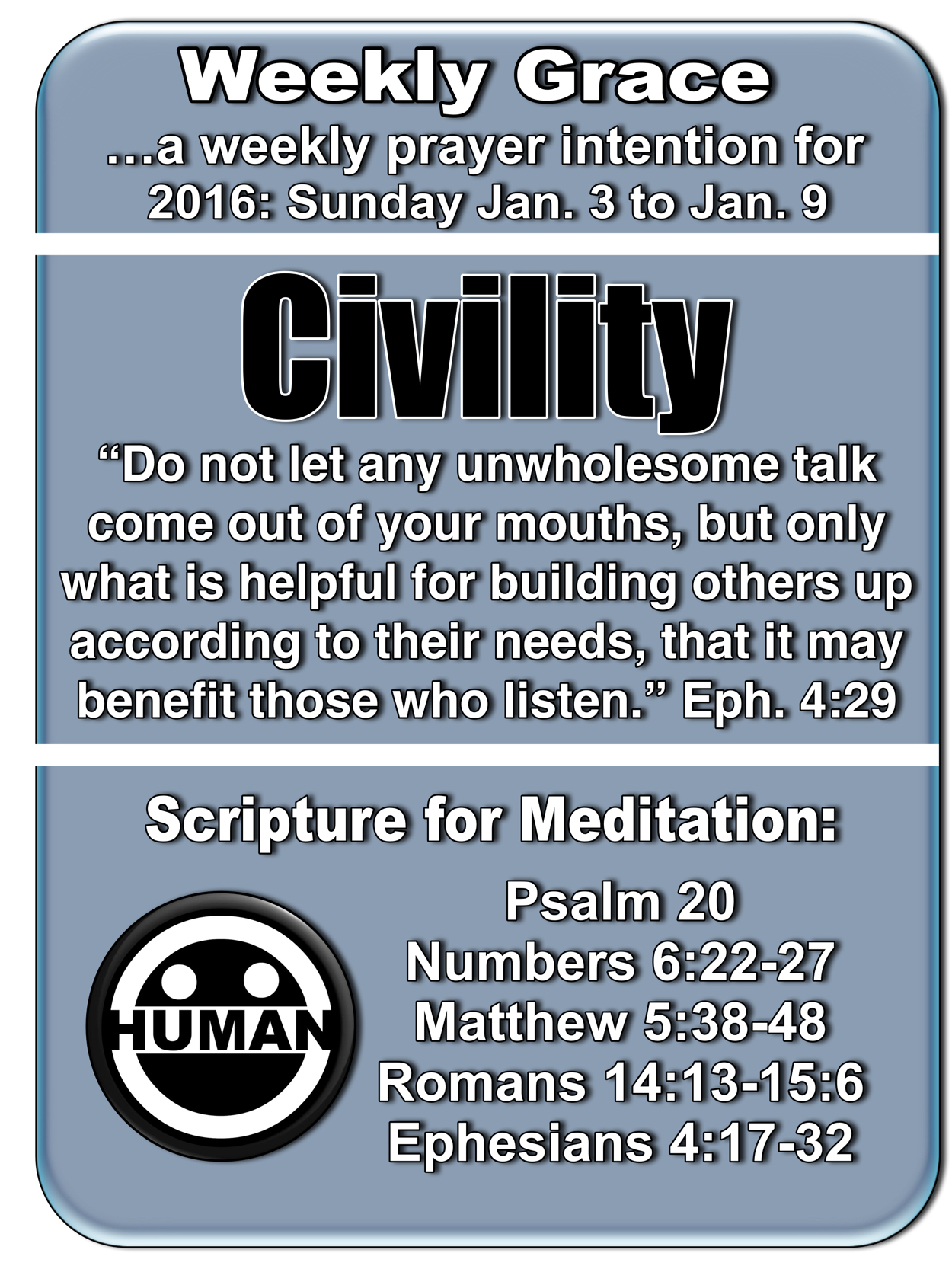 I’ve been making a weekly prayer intention for several years for our congregation at Church in Bethesda and for myself, but I’ve been wondering about continuing the practice now that I have left my pastoral duties with the congregation. After some thought and prayer I’ve decided to continue.
 My message this morning at Church in Bethesda for the Fourth Sunday of Advent, lighting out Peace Candle…
 Life is a journey and our spiritual life mirrors this with twists and turns and fun developments… a recent fun event in my journey was being confirmed in the Episcopal Church and the worldwide Anglican Communion on Saturday, November 14th, 2015 at the National Cathedral in Washington DC. In the picture with me is Reverend Sari and my new friend Anne, both from St. John’s Norwood Parish.
 Tribal Without Tribalism. Our family has been blessed to find a balance of openness and identity in the Episcopal Church that I describe as being tribal without the tribalism. We have an identity as a group, a faith family, without needing to judge or exclude others. We have a belonging system, which is important, without needing to also draw bold lines of division and keep others from our Table or our full welcome in worship. As a guest dropping in often over the last decade I was able to find solace in the Rites and share the Eucharist with this communion of faith long before my confirmation. I am so thankful for that gift through the years.
 We face a moral challenge as a global people and a nation. Our species faces a moral challenge. It’s the question of turning on the most vulnerable and needful to vent our fear and rage. It’s the question of targeting the refugees of Syria as scapegoats for the sins of ISIS.
 In the Jewish scriptures we find a beautiful image and phrase the heart of the stranger (Exodus 23:1-9, Laws of Justice) to describe the turning of one’s heart to the foreigner, the alien, the needful, because of our shared human experience. There are many ways that Israel was commanded to care for the stranger among them, but I have always felt that the reminder that we are all strangers was one of the most compelling.
 toddthomas.net