
Devotional Thoughts
Ignatius of Loyola, My Spiritual Friend
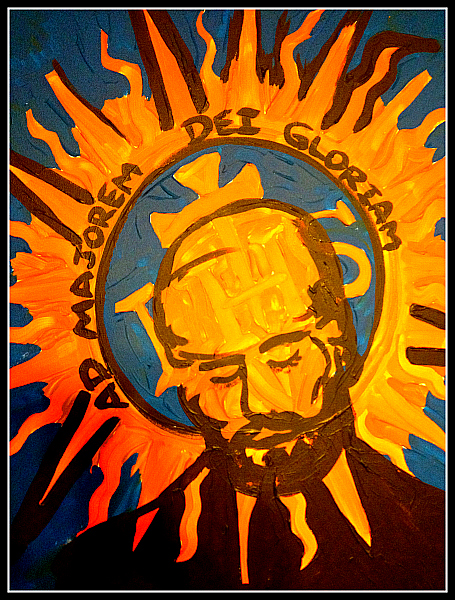 Sometimes God brings us the friends we need at just the right moment, and other times we meet someone and just hold on for dear life because we know we found a treasure. I believe St. Ignatius of Loyola entered my life in a combination of both those movements… I am so thankful that God brought me in touch with Ignatius’ lasting influence, and I’m determined not to let go of my connection to him.
I have a painting on my bedroom wall of Ignatius with his community’s catch phrase, “AD MAJOREM DEI GLORIAM,” to the greater glory of God. I meant this to be simply a study, a first expression of a painting I was carrying in my heart. As often happens, my attention span gave out and the study is all I ever painted.
Today is his feast day, July 31st! It’s one of the few feast days I will think about in any given year and I always look forward to it. Ignatius is my friend, a spiritual friend and mentor. I’m blessed to have become an heir of his contributions to the world.
Ignatius, as I have come to understand him, was a mystic who enjoyed laughing. He was not terribly well educated in theology, but had a passion and a zeal, sometimes tempered by wisdom and sometimes not so much. He was devoted at once to community and individually hearing God. He was an opposable mind.
I like Saints who shine in their humanity as much as their connection to the divine, who make us stand in wonder at the way the two are so often one in the same, as God intended the two to intertwine in us. I like the way that Ignatius was a person of vision and visions, though he sometimes didn’t know what a particular vision meant. Such an occurrence didn’t cause fear or anxiety for Ignatius, because “perfect love casts out fear.”
He was a soldier turned saint. He was a Don Quixote. He was a renaissance dreamer who took a canon ball to the leg and was forced to slow down long enough to see what would matter most to him in life.
He taught me to pray with the saints. I had grown up with many “s” saints, the wonderful people of faith all around me, but I hadn’t grown up with the “S” Saints. Ignatius’ life work, his Spiritual Exercises, welcomed me into the joyful practice of praying with, and even just sitting with, a community of comfort, love and support I had not previously known. Suddenly, I joined the generations who call Mary “blessed” and I prayed with Jesus instead of only to Jesus.
I will always be thankful for my spiritual friend Fr Leo Murray SJ in Georgetown who patiently led me in the Exercises for four years. Community and friendships come to us in many ways, and the lasting influence of Ignatius’ joy and devotion is a gift I will always carry.
A New Word for Prayer
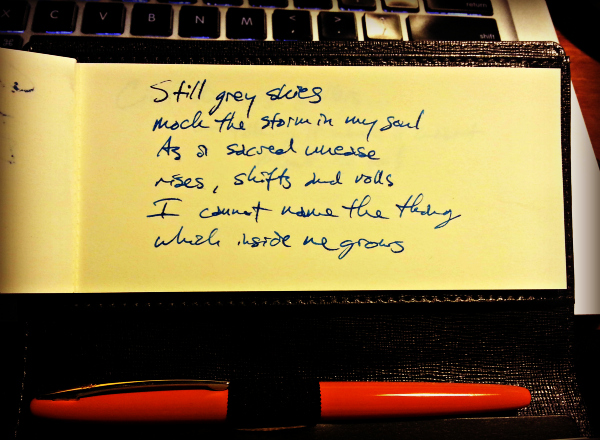 “Prayer” is just a word, and the word is not the reality of actually praying. I’m kinda tired of the word to be honest. In my own life it’s just accumulated too much baggage and confusing background noise. I want to pray, but I’m tired of trying to pray. I find myself wanting prayer, but what I need is to pray.
Back in the day, the New Testament most often used a handy compound Greek word for prayer that signified both intimacy and longing. In Hebrew we have the history of an even more amazing word that conveys attachment and self-evaluation. I’m not going to painstakingly link my readings in for you. I usually do, yes, but this time I’ll let you do some Googling and digging if you’re interested.
In English we have a nice latinized word we are all used to, “Pray.” Our good friends Merriam and Webster tell us that the word has two general meanings: 1) to ask for or entreat (the linguistic roots of the word), and 2) to address God (the general historic use of the word for the last bunch of centuries).
But I’m more interested these days in praying than in prayer. I picked up a quote some years ago from my reading of Thomas à Kempis in The Imitation of Christ, “I would rather feel compunction than know how to define it.” Let me to just say “Right freaking on!” to that sentiment. That statement can be made of many things, not just our bigger more complicated terms like compunction. It’s how I feel about prayer. I need to experience something bigger than the word.
So, thinking about the Hebrew roots and the Greek roots and thinking of the way Jesus taught and practiced praying, what is a word for what I’m looking to find and do? What word captures what prayer would be in my life if prayer becomes freed from some of the baggage it’s been carrying?
I think often of a lost word for most of us in the West: meditation. Years ago, as in like over 20 years ago, I heard of “soaking.” Soaking was the practice of laying in bed or sitting in a chair with the lights down and headphones on, letting music guide you into a meditative state for connecting with God. It’s good stuff. Worthy of a try or two.
In Mother Teresa’s “Simple Path” prayer is sandwiched between silence and faith. Hmmmmm. Mahatma Gandhi said, “Prayer is not asking. It is a longing of the soul. It is daily admission of one’s weakness. It is better in prayer to have a heart without words than words without a heart.”
Rumi has an amazing quote about passion, what I will call “passionate swimming“: “With passion pray.
With passion make love. With passion eat and drink and dance and play. Why look like a dead fish in this ocean of God?” But I’m not sure that replacing prayer with passionate swimming will be useful for me in a daily way. He does though capture in a beautiful style the desire to revel in the fully present and enlivening God.
A quick look around shows an affinity we have with linking dance and prayer, and not just among those who follow Christ. Like swimming, I think dancing embraces an immanence that I want to experience in prayer. But I’m not even a bad dancer. I just don’t dance.
I want to have a word like imagining. I want to have a word like creating. I want a prayer experience that is foundational to a constant becoming. I want a word that can include riding my scooter, painting, crying to God in anguish, singing a hymn and journaling. I want a word for the capture and crafting of a soul.
I need a word for at one moment losing and finding myself in God. I need a word for at moment experiencing and re-creating the reality in which I live. I already know that hugging one of my sons is praying. I know that every kiss I give my wife is a prayer.
I’m still looking, and still trying to find it, even if I can’t define it. I am hopeful and expectant, that even a simple blog post becomes prayer, an imagining and a rooting of myself in something unseen and yet present. And for a while, in a moment of time and place, my soul is remade a little closer to the image of God’s heart.
Some Afternoon Body Prayer
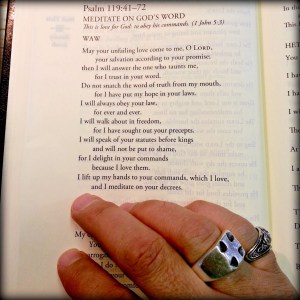
“I lift my hands to your commands, which I love,
and meditate on your decrees.” Psalm 119:48
I’m practicing some body prayer at my desk this afternoon as I read my Midday Psalms. You’re invited to do this with me. My prayer is: “Your kingdom come, your will be done, on earth as it is in heaven.”
Sitting at my desk I straighten my back (though it can be done standing) and cross my arms on my chest, hands open and flat against each shoulder. Throwing my head slowly back I look up and raise my hands into the air, gradually bringing them apart in a circular sweep outward until both rest at my sides. I do this several times praying, “Your kingdom come, your will be done, on earth as it is in heaven.”
And I am awakened.
So much better than drinking another cup of caffeine, my afternoon changes as my joints pop and I feel my back loosen a bit. My prayer is no longer just whispered or thought, but now it seeps into my body in newly opened places.
Un-Branded Truths
 I wrote the bulk of this blog a couple of weeks ago and promptly forgot to finish and post it. I wrote it just after the Mother’s Day parade gunfire in New Orleans, as we reeled as a nation from the Boston Marathon attack and the women rescued in Cleveland after a decade of imprisonment. But honestly, I started forming this post in my heart a little earlier than that after reading of the young woman in Canada, Rhetaeh Parsons, who ended her life after being raped and bullied by her classmates. You’ll have to excuse me if it offends anyone that I don’t refer to it as an “alleged” rape. It offends me that when a young woman is oppressed to the point of ending her life that someone might still doubt the veracity of the crime done to her.
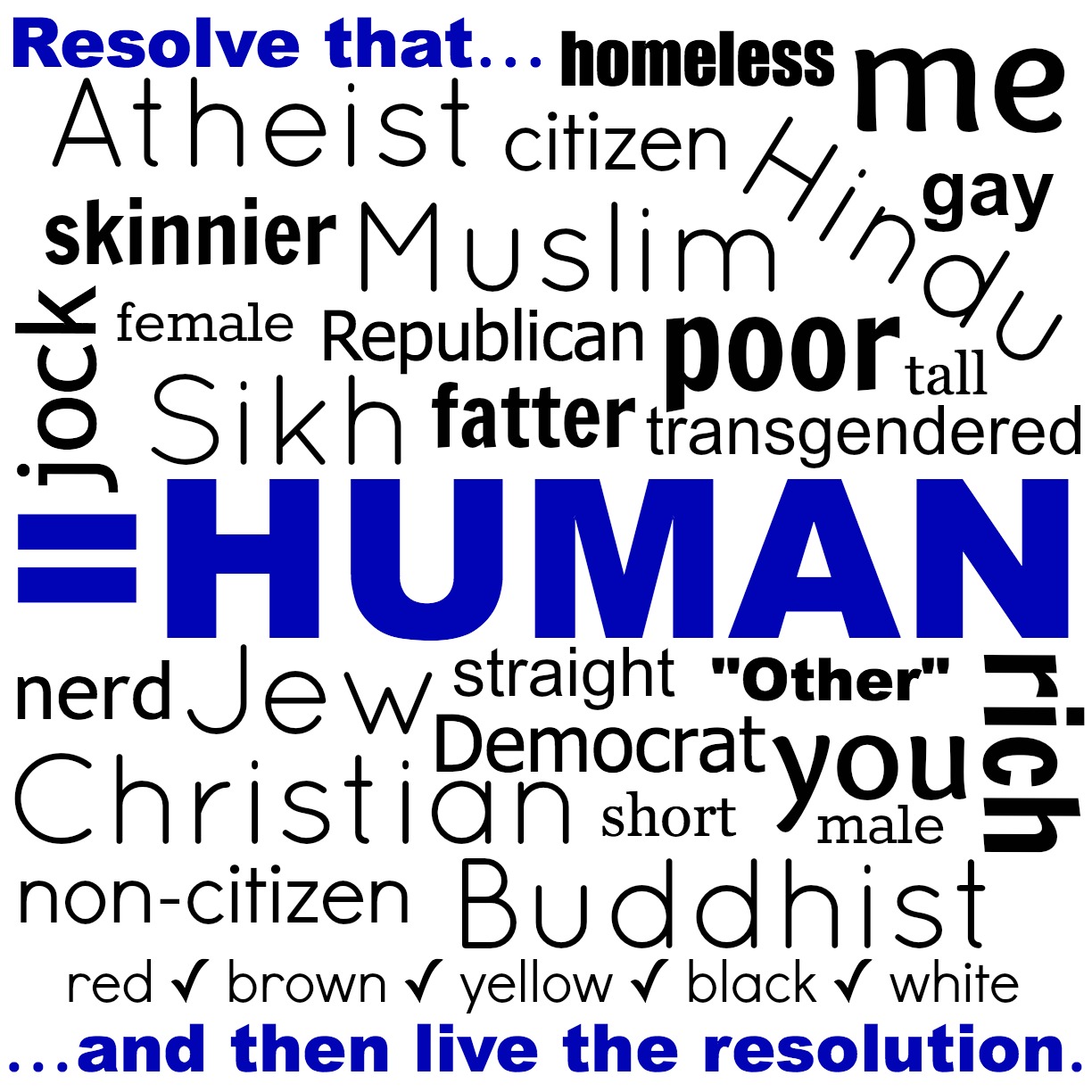
I am inured at heart by the violence we do against one another as human beings, the violence that our children have been taught to do against one another. I’m also at a place where I’m exploring what the truths of my faith are at their root, separated from the “branding” of Christianity, so that I can find even more ways to engage the problem of violence in our society without having to first deal with the “faith divide” presented by a pluralistic society such as ours.
I was reminded of this blog and encouraged to finish and post it today when I read about the homily given by Pope Francis in his morning mass. He vocalizes such a beautiful expression of meeting our neighbors, in our diversity, at the intersection of our common need of and duty to do “good.” I encourage you explore his statements, and I’ll only give this one amazing quote from the link embedded here: “We must meet one another doing good. ‘But I don’t believe, Father, I am an atheist!’ But do good: we will meet one another there.”
“We will meet one another there.” Wow. It’s time for Christians to un-brand some of our truths from being “Christian Truths” so we can share them fully with all our neighbors, many of whom already own and exemplify them better than we often manage to do ourselves.
Here Are Some Questions I’m Laying Out There
What is the “gospel” or the “good news” that people of faith have for a country that seems to be in a cultural tailspin of violence and the love of violence? What is my message? If I’m honest, then I believe I need to be real about having a message that is more than, “Hey, be like me!” In other words, converting my neighbors to Christianity is not the only answer I have to participating right now with my neighbors to make a more peaceful nation and world. Maybe sounds obvious, but it’s not the way many of us were raised to operate.
I need to make sense. I need to speak in ways that all people can understand and that communicate the core realities that exist within my faith, in actionable ways for all people. I’m switching now from single to plural pronouns because this is a shared need we have to make sense in our time and place. One of the biggest realities of our daily experience should be that we aren’t all going to suddenly adhere to the same religion: We won’t wake up tomorrow to find that we have all miraculously become Christians.
Our nation will wake up tomorrow with the amazing diversity in which we live today: Christian, Atheist, Muslim, Sikh, Hindu, Wiccan, Buddhist, Bahai, and all the faiths and philosophies I don’t have room to name or even know. Of course, that is all happening right alongside our incredible diversity of political ideologies, regional concerns, linguistic roots, ethnic richness, gender identities, sexual orientations, educational backgrounds and economic struggles. To name a few. We are a beautifully mixed bag of amazing variety.
This isn’t a repudiation of Christian on my part. I’m a disciple of Christ and have no intention to ever walk another path, but I am doing so in a diverse world, a diverse nation with a pluralistic society. This diversity isn’t bad, but it does make it much more difficult for people of our faith, or any faith, or lack of faith, to speak into the broader nation, culture and community in which we live. We won’t all have the same vocabulary. The shame is that often we won’t have the “tools” in language or common experience that are necessary to recognize shared values and hopes.
If everyone to whom we speak is not willing to become like us, to become a Christian (or a Jew, or a Muslim, or an Atheist), or more to point, our chosen brand of Christian (or brand of whichever tradition we have chosen), how then do we speak, share and participate in discourse? What do we do in a pluralistic time and space when we need to communicate with our neighbors in the absence of simply making them like us? The episodes of violence breaking into our daily national conscious demand that something be said! Something must be done!
But we people of faith, and not just Christians, have a huge disconnect when it comes to speaking to one another in a pluralist, diverse culture. This issue is most evident in my life when I hear my fellow Christians naming the problems we face as a nation and a culture being that we have “turned our back on God/Christ,” or “Satan’s power is the root of our troubles.” The same goes for when the answer to the most disturbing trends in our nation’s violence are simply stated as a need “to return to being a Christian nation” or that all would be well “if we would all simply embrace Christ.”
Having grown up in a place and time of the country where and when almost everyone was a Christian, I find it too laughable that a Christian would say the answer for our nation’s violent crimes is as simple as converting everyone to our faith. I’ve watched too many times as Christians turned on one another in the absence of any other common enemy. Maybe it would be more plausible if the statement were more along the lines of, “If only we could all follow the teaching of Christ” as in the parts about treating others as we wish to be treated ourselves and loving everyone even to the ridiculous extent of loving our enemy.
And I’m not repudiating a worldview that includes Satan. I believe that there is evil in the world. My own framework as a Christian names a particular force of evil in this world as Satan, though I prefer a more ancient tag “The Accuser.” The Accuser is an agent of evil and a personification of evil’s work in humanity and creation. But here’s my question about evil: Does my neighbor have to conform their frameworks and beliefs about evil to match my own before I can begin to speak and move together with my neighbor to stand against evil? I can only hope not.
One of our deepest yearnings as Christians may very well be that everyone on this good earth would proclaim and own our Christ as Lord, knowing and experiencing the goodness of knowing God in Christ. But there never seems to be any expectation in the teachings of Christ, or even the later apostolic witness, that we will find ourselves suddenly on such a planet.
Paul relates for us the vision that seems to be from an early Christian hymn of the moment when every knee bows and tongue confesses, and it is a vision of worship and unity that warms my soul. Really. But it’s hardly a reasonable expectation that such unity of faith is the foundation for how I will participate with my many diverse neighbors on these important societal issues in our shared life as a nation, right now. I can’t simply remain quiet or continue speaking in ways that don’t make sense to my neighbors “in the meanwhile” as I wait for all the bowing and confessing to start.
Here’s the Short Version of My Question
In the wake of our country’s past episodes of home grown violence and the more recent national tragedies at Sandy Hook, the Boston Marathon bombing, this past Mother’s Day parade shooting in New Orleans, the women and children held hostage in a Cleveland home for a decade, and the bullying and suicides happening across our continent every day: Do Christians have anything to say other than quoting John 3:16?
John 3:16 is good stuff, but in fact we do a lot to say to our home culture, and our neighbors! We have a lot of things to say that flow directly from our faith, but aren’t predicated on all our friends and neighbors accepting our faith before being blessed by our message or welcomed to participate with us in living and realizing this “Good News!”
In other words, I believe we have amazing truths through which we can participate in with our neighbors to bring about more of what our Lord taught us to pray for: Your kingdom come, your will be done, on earth as it is in heaven.
Here are three messages that I believe are core to our faith as followers of Christ that can be transformative in our nation when we live, proclaim and defend them, even when un-branded and allowed to simply be truths, instead of “Christian Truths”:
1. Love is preeminent.
2. We are intrinsically interdependent.
3. Tomorrow is ours to lose.
Three Heavy Truths
These three messages are truth. I believe they flow from the heart of God, have been illustrated in the life of Jesus Christ, and are commissioned to the followers of Christ by Jesus himself and the apostolic witness of the church. That last sentence sounded pretty heavy, yeah? I think these are heavy truths.
1. Love is preeminent. That word preeminent might look a little tricky at first, but it’s not as theological a word as you might think. It’s a good word. Mirriam Webster’s online dictionary defines preeminent as “having paramount rank, dignity, or importance.” That is how we need to be speaking about and living our love for all people. Preeminent love is pure gospel! Jesus famously summed up all the law and commands of his own Jewish religion in the two-fold flow of love 1) love God, and 2) love neighbor. He also taught stories to illustrate a love of neighbor that crosses lines of ethnic, geographic, national and religious diversity. When Jesus was asked “Who is my neighbor?” his answer broke down barriers that prevent us from loving people, even the people least like us or likable to us.
What is preeminent love in the context of our society? It is the answer to the hatred that is kindled and fanned to life by the things we have wrongly raised above love. We are talking about being real, so let’s be real. Our culture has lots of things happening emotionally and spiritually, economically and politically, besides love. Namely we have hate and anger, and they flow from a myriad of very real streams of lives: jealously, competing ideologies, inflation rates, diseases, immigration arguments, fear, pain, nationalism, racism, prejudices, bad drivers, dishonesty, workplace tensions, loneliness, food scarcity, environmental concerns and arguments, and much more. And if I’m really real, I can name and easily find preachers who have used all those streams to incite and divide us in recent years, all in the name of “truth.”
But as a people, Christians have a spiritual mandate to speak love above those things. How else is mercy possible? How else does forgiveness happen? We have a spiritual mandate to live out of love above and beyond the hatred, anger and fear. Fears are often well founded, and sometimes anger is justifiable, but neither should be placed above love in our words and actions. Love is neither restrained to only romantic arenas or to theological discussions. Love should be a daily reality. You don’t have to be a Christian to embrace this truth, and many in the world who strive to live this truth aren’t Christians. But every Christian should have learned along the way that if we are going to accept a scriptural definition of God being “God is love” and the basic drive of the heart of God being a robust and active love for this world (yes, John 3:16!), then we have the same basis, foundation and core for our heart and drive.
2. We are intrinsically interdependent. We need preeminent love for the simple reason that you and I are indelibly connected and interdependent. We exist together. Our freedoms and our rights are shared freedoms and rights. Our lives are connected and intertwined. As Christians we have this truth illustrated in matters of love, life and spirituality in many ways: 1) we cannot love God but refuse to love each other, 2) we cannot see the suffering of fellow humans around us and not act, and 3) we have been taught not to ever say to those not like us, “I don’t need you!” on the basis of our differences. Just to name a few.
We need one another. Our value and dignity are shared. Too often we end up bunkering into our various cells of culture, by religion or race or gender or any of the many ways we self segregate, and in doing so we disconnect from others, lessening their presence and contribution to us and ours to them. Once we have broken that connection we have broken our ability to love and hold love as preeminent. Once we break that vital connection we become more easily swayed by the rhetoric of division that places us in “us vs. them” systems and ultimately de-humanizes the other.
If this were not true, then why aren’t more Christians speaking out against hate crimes and prejudices against Muslims? Why aren’t more Muslims fighting to end discrimination against their gay neighbors on the basis of their sexual orientation? Why aren’t more Republicans fighting for the voting rights of Democrats? Because when we bunker down into our own self interests we have broken the vital connection which allows us to love and raise love above the fears, jealousies and frustrations that inhabit a pluralistic society. By the way, one of my favorite newest friends is a Jewish man who has devoted his life to stopping anti-Muslim prejudice. Ira is an amazing human and he encourages me with his grasp of these truths!
Our vital connection to one another is gospel and it’s not predicated on everyone being of the same faith. We can live and speak and engage with our neighbors within this vital connection to increase understanding, cooperation and peace in our nation and upon our beautiful little globe. In fact, we must. I must not allow anything to devalue my fellow human being in my heart or mind. Such a devaluing of another person is a disease and a cancer in my own soul and self. For me to break our human connection and lessen you is to suffer the same for myself.
3. Tomorrow is ours to lose. All my life I have loved the 131st Psalm, a song of humility and peaceful contentment against the restful greatness of God. Humility is core to the Christian faith and is central to living in the connectedness that we have been speaking about, but it is not an excuse to be idle or stupid about our power to make change in the world. It is not a denial of our humility to recognize that we are powerful and responsible in this world. We are gifted with everything we need to live and breathe and create greater peace, love and joy in this world. We have been crafted as agents of good, and we cannot live in denial of this amazing purpose in our daily lives.
One scriptural writer famously says that we are not given a spirit “of timidity, but of power, love and self-discipline.” (2 Timothy 1:6-10) And as I love the song of humility in the presence of God’s great sovereignty from Psalm 131, I also recognize the reality of the psalmist’s statement that God “has made [us] just a little lower than God.” (Some will translate this “yourself” or “angels.”) Whoa, we need humility because we are so powerful. We only have tomorrow to lose. God has already given it to us. God has equipped us, as little less than the gods, to be movers and makers of change on this earth! There is no adequate rationale for a person to faith to sit still and wait for God to do for us what we have been made to live and be ourselves.
It’s easy to forget, but neither of those psalms were originally written by, about or to Christians, regardless of how or by what reasoning I might lay claim to them today for my life. The ideas and truthes they carry cannot be branded as “Christian.” And even as we believe that Christ gives great and precious gifts to those in his church, we cannot deny the amazing gifts and abilities that God has wired into all our of species. We see those gifts every day. We cannot wait for all our neighbors to share our faith before we move humbly among and with them to not lose tomorrow’s promise and goodness.
Un-Branded Truths
I think these truths are for all people in all times and all places. The hard part for us swallow is that the three simple statements are unbranded truth. We have been taught to brand everything or own nothing. So we speak of Christian Love, Godly Justice, Christian Truth and God’s Mercy. And we have been taught to devalue all truths not so labeled. Have you ever noticed how rarely scripture addresses things that way? Paul simply says that God’s Spirit makes in us love, joy, peace, patience, gentleness, kindness and self-control. It’s the work of the Spirit in us, but the fruits are simply fruits. And so we lose the ability to see and value the many truths of God’s work and Spirit in the various people all around us every single day.
I grew up hearing preachers often say, “It’s not enough to be a good person, you have to be a Christian.” I suppose I know what they were saying about identifying with Christ and the church in a theological sense, but I always came away thinking more about what sounded like an inherent contrast they were making between good and Christian. Those two didn’t seem to be the same, but different. And even if I am able to step past inferring a contrast like that, the statement still devalued the good in a person if they weren’t enough like me. I’ve not had a very long life, but I have definitely learned that finding a good person can seem a rare enough event not to ever devalue or dismiss.
I am asking us, asking myself, to do better at engaging the world with these unbranded truths so that we move the truths forward without having to have the argument about what is dissimilar between us. I could easily stick to branding and say something like: 1) God wants Christians to live in preeminent love, 2) Christian altruism and Godly benevolence is a duty, and 3) with humble prayer we can defeat Satan and can claim tomorrow as the Lord’s Day returning our nation to global moral dominance and greatness! But I won’t.
But I believe it is no less true and vastly more engaging for many of my neighbors if I proclaim and live: 1) love is preeminent, 2) we are intrinsically interdependent, and 3) tomorrow is ours to lose. Though I do understand a little bit about the power and importance of branding in the commercial sense of moving products and services, I think that God’s truths should be handled a bit more on the open source model, freely shared and abundantly distributed.
Love My Enemy?
 The Question
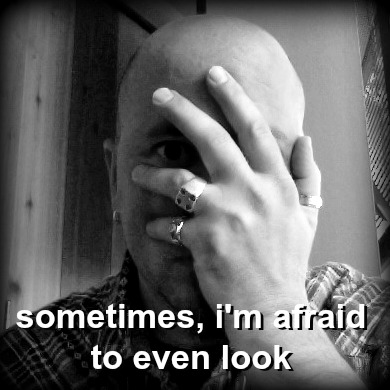
Jesus said, “Love your enemy.” (Matthew 5:43-48) What does it mean to love my enemy? I’ve been thinking about this a bit lately. It seems appropriate to talk about as our culture continues it’s “war” and daily divides along a myriad of lines, political, religious, racial and economic. And it’s not just the “culture,” it’s often me. I seem to have enemies. Some are pretty up front about it and tell me clearly of their disdain for me, but others seem to have more of a guerrilla tactic of sniping quietly from the trees and hills, little hits and nicks here and there that seem minor at the time, but become a real issue for me.
And of course there’s the third angle… there’s the people I don’t like. I figure that most of us know we all have people in our lives we don’t like. We may hope that we able to rise above such a thing, and we may exert a lot of energy to rise above viewing all people with anything over than love, but we fail. I fail.
That’s when the words of Jesus then come ringing in and oppress me. He commanded love for enemies. A part of my gut reaction to that is to feel as if “I am told to lose.” Most of our enemies are not just in conflict with us, but also in competition with us. I also feel a reaction deep inside that says, “He doesn’t know my enemy.” Surely, if Jesus knew how much hurt I was feeling from the malice of another, he’d be as peeved off as I am! And finally, I have to admit that often at my core, I’d rather beat my enemies. You know, I’d prefer to get a little Psalmy and smite the skulls of those who would encircle me, right on?
So……….. I’m trying to find some things that “love your enemies” might mean in my life. What does it really mean to love an enemy? For me? Can I do this? Do I want to do this? Will I do this? Each question just surfaces another one, or three, or fifty questions.
I have to start with myself. After all, the command to love enemies is mine to own. It’s not a command that necessarily alters the enemy, it changes me. Here’s where I’m starting:
Love Your Enemy = I Am Not A Victim (even if I was victimized)
I need to step off the stage every time I start to feel like singing my woes. I am not a victim and my enemies do not control me. Victimization is too often an experience that becomes an identity. Of course, there are victims among us every day, and we are victimized. I would never try to lessen the pain or impact of anyone who is a victim of a violent or horrible crime or hurt. In my own life some things have been more painful and less painful at times, but my response needs to be consistent that I am not defined by the hurt.
The recent theatrical incarnation of Les Misérables gets some pretty mixed reviews, but I totally enjoyed it. One of the most haunting lines for me is in Fantine’s song “I Dreamed A Dream” when she sings, “…but there are dreams that cannot be / and there are storms we cannot weather…” The sentiment is echoed again in the song “Empty Chairs at Empty Tables” when Marius sings, “…there’s a grief that can’t be spoken / there’s a pain goes on and on…” I can’t speak for anyone but myself here: I know what they mean. But even as these lines resonate with me in deep ways, I also recognize that I must turn away from darker, hopeless view, even when justified by my own pain.
I cannot be a victim, defined by the injury done by my enemy, if it I am to love her/him. Love is not denial. Love is going to require that I find my way out of the identity formed by my injury. If someone abuses or attacks me in a way that devalues me, I must re-find my value. If the attack cause me pain, I need to heal. If the attack demoralizes me, I need to regain strength and courage. I will do these things so that I can return to the task of loving. I cannot do this alone. If Jesus commands it, I need Jesus to help me do it, and I’ll probably need you, too.
Love Your Enemy = Forgiveness
Just as love is not denial, neither is forgiveness. Forgiveness begins as my own way of releasing the need to punish, to avenge, to hurt another, to attack, to rationalize my own violent needs. Forgiveness is hard because when I choose to forgive I am choosing to shoulder the burden of paying for another’s crime. At least if Jesus wanted to command something he was willing to demonstrate it. On the cross, he spoke what I think might be some of the most awesome words uttered in the gospel narrative, “Father, forgive them, for they don’t know what they are doing.”
What? Yes, they did! They knew what they were doing! Can I accidentally crucify someone? Could they have tortured and murdered so cruelly without intent and premeditation? What is Jesus saying? Is this the blindness and denial I fear that my own forgiveness might represent? Or is it a conscious decision on the part of Jesus to remake the world around him? Those words are a one-sentence-wake-up-call and alarm that something is happening here that breaks the ordinary into sharp little pieces.
Forgiveness is re-creation. When I can actively forgive I am re-creating things and myself. This is not a simple switch I throw or a decision I make. It’s a set of reflexes and intentional actions I take to make forgiveness real. And I’ll be the first to admit, I’m not the best at it. Forgiveness will look and feel a little different for each person, reflecting our intrinsic variety as individuals, but it will always need to have the hallmarks of active, authentic forgiveness. Jesus forgave, and still hung on the cross. He still died. I think the reality of his forgiveness is in the narrative of his resurrection. He didn’t come busting from the grave like one of our contemporary action heroes might, kicking butts and slapping bad guys. He came forth and said, “Everything I taught you is still in force, my own pain and hurt doesn’t change a thing… go love, love God, love one another, love enemies… go do it, go teach it, go live it… everywhere… every when… with everyone.” (Yes, that’s my paraphrase and interpretation of Jesus after his resurrection. I personally don’t want the “great commission” in my life and experience of it to ever be divorced from the power of Jesus’ humble, courageous grace.)
Love Your Enemy = I Don’t Have Enemies
Unfortunately, I am me enough to get sidetracked by the statement Paul makes about enemies, that seems so close to what Jesus says, but adds that in doing so I will be “heaping hot coals on the heads” of my enemies by my love. I am bent and base enough to chuckle that Paul seems to offer me such a slick way to get revenge on an enemy, simply by loving. Is that not a bonus and a half? I really can kill him/her with love!
One of favorite authors and speakers is Fr Richard Rohr, a Franciscan out in Albuquerque, New Mexico. I have heard him a couple of times mention what he calls “a low reading of scripture” and “a high reading of scripture.” I think it’s Fr Rohr’s very polite way of telling me how childish I am sometimes, lol. Whenever I read scripture in a way that gives me license to hate or attack or be mean/vengeful/negative, or in any way move against the actual fruits of God’s Spirit in my life… love, joy, peace, kindness, goodness, faithfulness, gentleness, self-control… in those moments I have misread scripture. So, for Paul and the Proverb he seems to be quoting, I will choose to focus on the summation of “Don’t let evil conquer you, but conquer evil by doing good.”
Whether my love for an enemy is a purifying fire or a painful fire for my enemy, or more accurately feels like hot coals on my own head… it’s still love and not my need to punish or avenge myself. And for my part, if I love someone, it’s hard to call them an enemy at all. We may still disagree on things, we might still need to work on the consequences of their actions, or mine… but in the act of loving I am re-creating their role and place in my life. One who is loved is the antithesis of an enemy… she/he is precious, cared for, sheltered, redeemed.
The Answer
I wish that writing a blog post about love made me love better. The only thing a blog post might actually signify is that somewhere along the way I have recently realized a deficit of love in myself. It’s too easy to blame my “enemies” for that lack of love… they are either too unlovable or too deserving of hate. It’s too easy to make some quick excuses for myself… I drank too much, I’m too tired… or I didn’t really mean it, I just knew it would get a lot of shares and likes from people on Facebook who are angry or biased like me!
And that’s the reality. I recently find myself withholding posts and shares because I know they don’t stem from love, but from the hate I’m harboring deep inside. I find myself sitting in the corner of the room rubbing my hands together and evilly chucking “bwahahahahah” over the attack posts I could launch if I wanted to… and then, baby, they’d know how stupid they really are! Quite an image, huh?
Withholding the attack posts is only part of the equation for me… facing the reality of my own anger and lack of love is the other half. Dang it, having enemies can really enliven me! And just as my cat would love to shred my favorite couch, it would feel too good to sharpen my claws on the idiocy of another.
“They don’t know what they are doing” is not denial, it is re-creating myself. It is the reality that whether they know anything or not about what they do, I am still to know myself, and I am to carry the responsibility to make myself. No one’s action or ignorance is license for me to abandon that call.
Holy Saturday Waiting, Resting, Loving
 This morning I noticed that our daffodils don’t realize it’s still Holy Saturday, they must think it’s already Easter morning! And it got me thinking about Holy Saturday, about waiting, and about the goodness of human beings.
I probably should have blogged about Good Friday yesterday, but it was a full day of work getting things prepared at Church in Bethesda for the evening pilgrimage, and we also ran the boys over to Baltimore for lunch at the nearest Sonic Drive-Through… mmmmm, a family favorite!
We did host the pilgrimage, and Jesus is still in the tomb in our sanctuary. The following is the passage we read at the tomb last night…
Luke 23:50-56
Now there was a man named Joseph, a member of the Council, a good and upright man, who had not consented to their decision and action. He came from the Judean town of Arimathea, and he himself was waiting for the kingdom of God. Going to Pilate, he asked for Jesus’ body. Then he took it down, wrapped it in linen cloth and placed it in a tomb cut in the rock, one in which no one had yet been laid. It was Preparation Day, and the Sabbath was about to begin.
The women who had come with Jesus from Galilee followed Joseph and saw the tomb and how his body was laid in it. Then they went home and prepared spices and perfumes. But they rested on the Sabbath in obedience to the commandment.
I didn’t grow up with Good Friday or Holy Saturday. In fact we didn’t have a Holy Week at all and I remember preachers making a clear point to us that Easter was not a “religious” holiday for us, but only a “secular” fun day. After all, we celebrated the death, burial and resurrection every Sunday! We didn’t need these kinds of holidays. So there.
But more than anything else, I think we feared death. We feared an impression of defeat. We feared a hint of weakness to our cause. I don’t think we were brave enough or strong enough to talk of the death of Jesus without immediately moving right to the resurrection. The church of my youth rejected things like crucifixes, because “Jesus is no longer on the cross!”
Really, I can’t recall hearing a sermon on the death without an exhortation to look to the resurrection. Without a Holy Week tradition that included a Good Friday service, I was never told that “Jesus has been killed, now go home and pray and wait.” Today, I struggle every year to place his “body” in our makeshift tomb in the corner of the Sanctuary. Kneeling beside a weeping pilgrim last night I had trouble praying the usual prayers.
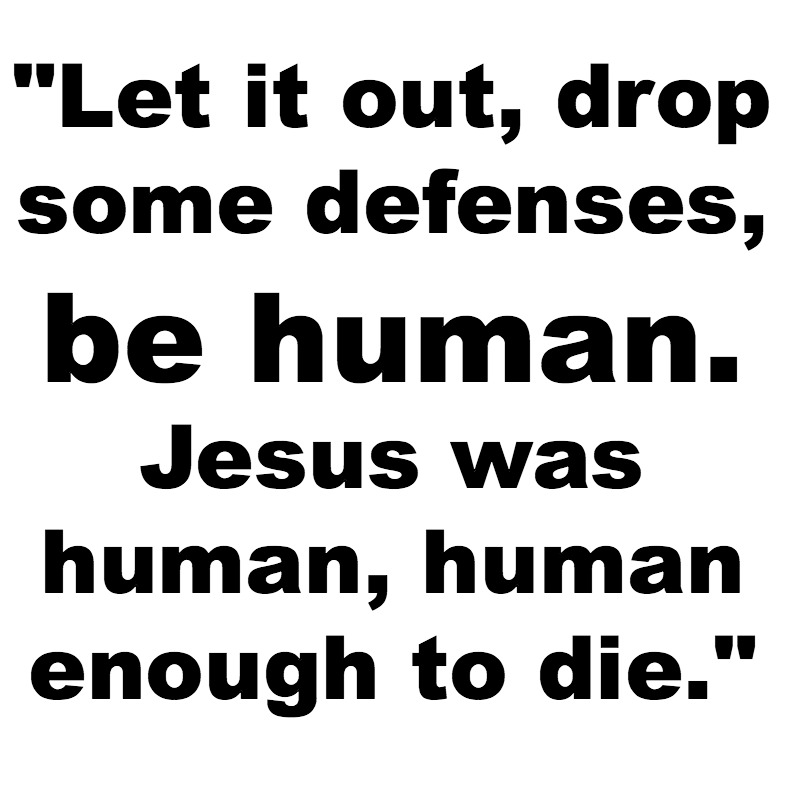 Good Friday is such a beautiful time to hit the pressure valve that has been wound so tight throughout the last year. Let it out, drop some defenses, be human. Jesus was human, human enough to die. The people standing at the cross were human, human enough to jeer and laugh, to weep and cry out, to be afraid, to be proud, and to be humbled. And Joseph was human enough to want Jesus’ body to be in a tomb, not disgracefully hanging in the open. The women were human enough to go home and prepare burial spices, working right up to the start of the Sabbath, then resting and waiting. Holy Saturday is a time to rest in that deflated, relaxed and waiting place.
Dang, have you ever thought how hard it was for those women to sit through Saturday looking at the spices they had prepared, imagining the body of their beloved languishing without the tender attention of their care? And yet God says, “Wait. Rest.”
Today, as I wait on Saturday for the coming morning, as I wait for the right time to get that “body” out of our Sanctuary and replace black cloth with bright white, as I rest from yesterday’s long day of work, I love that man and those women who cared for my Lord so long ago, so preciously.
I look around Starbucks where I’m writing, and I love the people I see all around me. They are diverse, loud and beautiful. They are precious. They are human like Jesus was human, human like the man and women were human, and human like I am human. Thank you, Lord, for reminding me, for making me stop and rest and wait and see.
Most days in my later life I have taken wearing a crucifix under my shirt, laying against my chest, or maybe carried in a pocket of my jeans or backpack. It’s usually near enough to touch and hold. Because Jesus is still on the cross? Of course not. Because he was human, and I am human, and I find some deep comfort and hope in that? You bet. I look at the pain, love, sacrifice and humanity of the crucifix and it helps me look with love on the people around me.
I’ve decided it’s ok for my daffodils to bloom and shine today. I look at these flowers and I think of the women watching their fragrant spices throughout the day. I will watch with them and wait with them. I will love them. And when the morning comes, I’ll go to the tomb to give what I can to Jesus.
Holy Week: A Repudiation of Violence
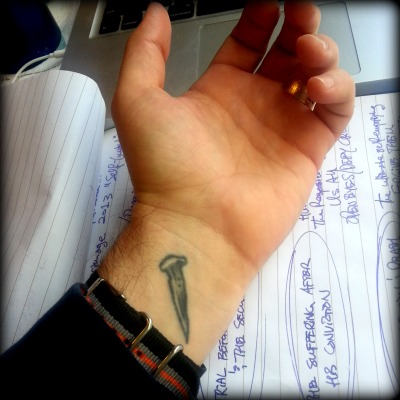 Seven or so years ago I stated my journey with tattoos. I had a nail tattooed on one wrist, and then my dear friend (and then boss as well as newly minted author) Suzanne Castle graciously gifted me with the other wrist nail. I wanted these tattoos to mark that Easter Season and the meaning that Christ has held in my pilgrimage through life.
This week as I work on Good Friday devotional ideas and prepare for Easter Sunday, I am stuck not by the violence of what was done to Jesus, but by what a repudiation of the violence the events represent for students of Jesus.
Beginning in the garden when Jesus heals the servant whose ear is struck off in his defense, our Lord lays the foundation for a different way to do life…
Luke 22:49-51 “When Jesus’ followers saw what was going to happen, they said, ‘Lord, should we strike with our swords?’ And one of them struck the servant of the high priest, cutting off his right ear. But Jesus answered, ‘No more of this!’ And he touched the man’s ear and healed him.”
Wow, can you see Jesus in your mind’s eye, hands raised and eyes wide, motioning his friends to a halt, “No more of this!” No more of this! Striking with the sword was not the answer. Striking back was not the way.
Later, on trial for his very life, Jesus will again repudiate violence as he speaks to Governor Pilate. His assures the Governor that his followers will not violently storm any chambers or raise weapons in his defense or to overthrow any authority, for that is not his kind of kingdom.
John 18:33-36 “Pilate then went back inside the palace, summoned Jesus and asked him, ‘Are you the king of the Jews?’ Is that your own idea,’ Jesus asked, ‘or did others talk to you about me?’ ‘Am I a Jew?’ Pilate replied. ‘Your own people and chief priests handed you over to me. What is it you have done?’ Jesus said, ‘My kingdom is not of this world. If it were, my servants would fight to prevent my arrest by the Jewish leaders. But now my kingdom is from another place.’”
These passages have caused me to stop and reflect on the exquisite repudiation of violence that exists in the violence to be done to Jesus. That God would enter into life to bear the burden of such violence to open our eyes, to soften our hearts, to change our way, gives me pause and humbles my “wisdom” I am tempted to think I have collected.
I look at the nails tattooed on my wrists and I think that I have tended to meditate selfishly on what they mean, that I am the recipient of such love. Today I am moved to meditate on the awesome burden of love that I am live, instead of the violence that so often inhabits my thoughts, my mind and my heart.
I’m not sure I will ever be worthy of such audacious marks as these inked nails; most days I know that I fall so painfully short. As I’ve been thinking of a new tattoo for this Easter Season, I feel the need to double down on what it’s all about… maybe I read too much news, but it seems that from battlefield torture to Middle America’s children raping children, to living in ignorance of the plight of my poorest neighbor, the world needs a change of pace, a new way.
A Not So Blind Faith

I don’t go to Catholic Mass all that much, not nearly as often as many of my Protestant friends think I do given my bromance with St. Ignatius of Loyola, so I was happy to have a surprise chance to drop in on a noon Mass one day this week with my good friend Greg and others down at St. Paul’s College in DC. We arrived five minutes fashionably late and I had to grab an empty chair that was of course up front near the altar and next to one of the presiding Fathers.
I’m not Catholic, though I love and appreciate my Catholic brothers and sisters. And I know a good bit about the Mass, though I don’t know the rhythms like a good Catholic. This means that when I go to Mass I have to bring my “A Game.” I have to work hard to listen and watch everything so that I’m not always the last one standing or sitting. I rarely make the sign of the cross in prayers or before the Gospel reading… my goal is not to pass myself off as a Catholic, but I do hope to worship and to at least not be a distraction for others.
In this particular noon Mass I was rocking along quite well when the wonderful old, probably retired, Father who was presiding over the Mass moved to deliver his homily. I had of course already noticed his quaking voice and shaking hands, a loss of muscle control I would usually associate with my own sweet grandmother’s Parkinsons Disease or other such aliments that afflict the mature among us. But he manfully strove with his body to grip the lectern and deliver the homily with a stronger voice and presence than he had previously shown us.
His text was from Daniel 3, the famous story of Shadrach, Meshach and Abednego and their fiery trial. As he worked to bring his body under greater control and speak quite eloquently on the passage my personal empathy went through the roof with this dear old man. I know the feeling… when I am especially tired or excited I will often have to work over-time to keep my stuttering under control.
His obvious effort served to focus me on the passage and his words. And so I was unprepared for the power of the words in verse 18, “But even if God doesn’t save us…” It’s a familiar passage, and one I have happily preached many times myself. But caught in the furnace of age, not himself delivered from the ravages of a failing body, this old priest drove those words to the center of my soul. From the lips of the three young men so long ago, to the lips of this venerable priest, to my own often too-hard heart, the words rang as they seldom have for me. Forget the fickleness of my faith, the faith that follows on good days and coasts on the bad days! Forget my faith that only responds to the gifts of God. Forget my faith that only survives on answered prayer! O God, give me a faith that stares into the trial and carries on regardless.
Some detractors might label this kind of faith that moves regardless of immediate evidences of God as “blind faith.” And certainly there are times when I could simply pantomime my religion instead of being a thinking, “seeing” person and an accountable soul. But that is not what I see happening in the story from Daniel. That is not what is happening in the life of a old priest who musters his strength to worship God and to serve his friends at the altar. It is not a blind faith, but a decisive faith. A faith that has chosen and does not have to continue choosing again and again. It is not a blind faith, but a very self-possessed faith that knows itself.
Even as I type the words I find my inner voice crying out in prayer, “Lord, help me know myself! Help me be so decisive! Help me be so self-possessed of faith and you!” And as we prayed together in Mass this week, “Lord, hear our prayer” I continue to pray, “Lord, hear my prayer!” For if I can bet on anything, it’s really two sure things: 1) another trial is eventually headed my way, and 2) I can either have decided my course, or be caught unprepared for the heat.
Praying, Todd
Nonjudgmental Christians, Part 2
We begin with the words of James 4:11-12…
11 Brothers and sisters, do not slander one another. Anyone who speaks against a brother or sister or judges them speaks against the law and judges it. When you judge the law, you are not keeping it, but sitting in judgment on it. 12 There is only one Lawgiver and Judge, the one who is able to save and destroy. But you—who are you to judge your neighbor?
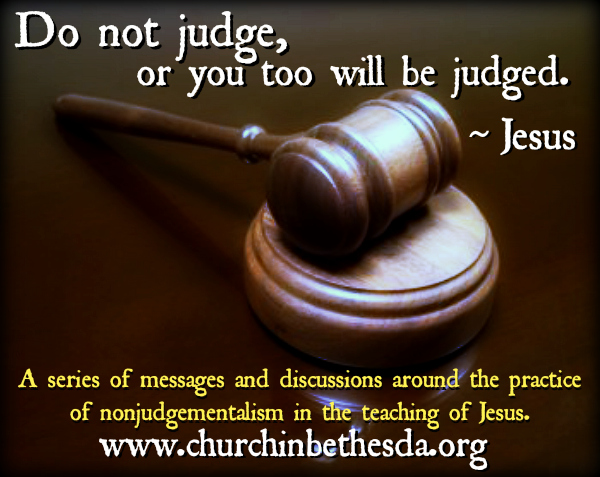 James makes a fundamental point about judging… when a person chooses to become a judge there is a usurping of the way things should be… a stepping out of place for the one who chooses to judge. Who am I to judge you? Who am I to act as if I am the judge and not simply a co-defendant, standing at the same level as you?
In the first week of this series we looked at the straightforward warning from Jesus that we should not judge others. It creates a reciprocal loop of judgment and easily becomes tangled our own blindness and hypocrisy. But at the same time we are told not to judge, we are also told by scripture to be involved in one another’s lives. And for that reason many Christians get really uncomfortable when we quote Jesus saying, “Do not judge.” They immediately begin qualifying the statement, basically creating loopholes for judgment.
I get the rub, I really do. When I speak of being nonjudgemental I often get a response somewhat like, “But if I see something sinful, I’m supposed to point it out!” or maybe “If I see someone in trouble, I can’t pretend that everyone is just ok and not help!” Some Christians like to speak of nonjudgementalism as being convictionless or “wishy washy.”
I see where the problem is and I do understand what is trying to be said: If I see someone hurting themselves or hurting others by their words and actions, I should not pretend that I don’t know anything is going on. I agree with that. It’s not being a very good friend or brother if someone I love is doing harm in their words and actions, but I simply stand by and watch.
Do I have to judge someone to correct them?
There are certain passages are often sited in support of actively judging the people around us: John 7:24, James 5:20, Ephesians 4:15, and 2 Thessalonians 3:11-15. These are passages I have seen and heard Christians quote as their “License to Judge.” If you want to look at those, you’re welcome to and encouraged to. But here’s deal on each… The John passage deals with people’s performance of the Law and how it is judged fulfilled or not, as Jesus is speaking to the religious pros, correcting their misjudgment. That hardly overrides his own warning not to judge. The James passage is about correcting someone “in sin,” but of course comes a chapter after James reminds us not to judge people. The Ephesians passage is the famous (and famously abused) “speaking the truth in love,” but is in a context of building people up, not tearing them down. And the 2 Thessalonians passage is crystal clear that the offending people are not to be viewed as enemies, but as fellow believers. So, let’s move on to the real issue…
We seem to have some problem premises, some destructive ideas that we need to root out and remove from our lives and habits. I identify and list them in the following way, but they are interrelated and can be see in almost any order. These are wrong ideas…
1. For me to have convictions about right & wrong, I must be judging you or correcting you.
2. Because for me to help you, I must first judge you.
3. Because help and correction only follow judgment.
4. Judging and correcting are one and the same.
When I think in ways based on these problem premises, I cannot distinguish judging from helping, judging from correcting, or even sometimes judging from encouraging. This idea is fairly self-evident when you quote Jesus, “Do not judge” and a nearby Christian immediately says, “Yeah but…”
The bottom line is that when I allow myself to distinguish between judging and correcting, I can correct without judging. Sounds simple, but I actually have to work on this to do it well. You may sin, but I do not have to judge you a sinner, fallen, evil or wrong, before I can show you a better way. And vice versa. When I am caught in a weakness, or a moment of poor choice or wisdom, you do not have to judge me a failure to lend a helping word or hand. Jesus modeled this so well!
Neither Do I Condemn You
Jesus models a way of helping, even correcting, without judging in John 8:1-11. He says, “Neither do I condemn you.” That’s right, even when a person is caught doing wrong and guilt is not in question in any way, Jesus still begins with “Neither do I condemn you.” But Jesus! It’s a slam-dunk! This person is totally guilty… but Jesus didn’t condemn. He didn’t say, “Well, you screwed that up! Here’s what you do to fix things…” He didn’t say, “You’re so guilty, and you suck at fidelity and all, but good thing I still love ya anyway. Shape up.” He says, “Neither do I condemn you.” And in saying that, he loses absolutely no authority to correct her behavior.
Think back on John 4, as Jesus speaks with another woman, whom he knows to be living with a man out of marriage, and he doesn’t condemn either one of them. Instead, he chats with her having one of the deepest theological discussions recorded in the gospel narratives.
Think again on every single time Jesus touches the “unclean” or eats, drinks and associates with the wrong kind of people. He’s amazing in the way he reaches into people’s lives and touches them, without judging. Why can’t I do this as easily? Is it simply my ego that demands they be judged first? Jesus makes it look easy, but I know I have to work hard to retrain my heart.
I will also say this, one more thing about the passage in John 8… by the time Jesus says “Leave your life of sin” he has that person’s attention. He has an audience with her, I believe in large part, because he did not feel the need to judge her first. How many times have I lost an audience because judgment rang through in my opening remarks, or it was painted across my face? The question makes my stomach hurt, just to be honest with you.
The real test of this thing, this amazing way that Jesus modeled for us to reject condemnation and judgment, was seen on the cross. He looked at a raving crowd that demanded his death, at the soldiers who nailed him to a piece of wood, and he said, “Father forgive them, they don’t know what they are doing.” What? Jesus? They do too know! They just did it! Guilt is once again crystal clear!
But for Jesus, the choice has been made to look on others without the need to judge and condemn. He doesn’t need to revel in their guilt before offering prayers for their benefit. The words from the cross need to haunt me, drive me, guide me. If I could only look at the people around me whose guilt is so certain, and begin with a love not rooted in what they’ve done or not done, then maybe I would receive the same.
I don’t judge the judgmental people. I’ve been there too many times myself. I feel the judgement sometimes rise up within me. My heart can sometimes judge, classify, label and dismiss a person faster than a super computer can process 2+2. But when I want to judge, I need to not judge. When you feel like judging, please stop it.
My heart has some growing to do. It so often feels like judgment has replaced love in my heart, by habit and experience. But didn’t someone once say, “Knowing is half the battle?”
Nonjudgemental Christians, Part 1

This past Sunday I started a discussion with our church family on the teaching of Jesus that we not be people who judge others. I am blogging along at our church website on our series and wanted to also place the entries here.
Nonjudgemental Christians, Part 1
Here’s our base text from Matthew 7:1-6…
1 “Do not judge, or you too will be judged. 2 For in the same way you judge others, you will be judged, and with the measure you use, it will be measured to you.
3 “Why do you look at the speck of sawdust in someone else’s eye and pay no attention to the plank in your own eye?4 How can you say, ‘Let me take the speck out of your eye,’ when all the time there is a plank in your own eye?5 You hypocrite, first take the plank out of your own eye, and then you will see clearly to remove the speck from the other person’s eye.
6 “Do not give dogs what is sacred; do not throw your pearls to pigs. If you do, they may trample them under their feet, and then turn and tear you to pieces.
Do Not Judge
We started with the recognition that the word “judge” here means exactly that, “to judge” or to give a verdict. It’s not just criticism, but it is delivering a verdict; a person is judged inadequate, worthless, wrong, or without value. A person is judged as not worth God’s time, not in God’s favor. It is the decision on a person’s worth and value, a full and complete judgement. Certainly among the audience on the day that Jesus spoke these words there were many of the religious professionals present who were well versed in judging, and many who had been judged.
As we read through the ministry and life Jesus we often see these religious professionals in action. They are the ones in the background whispering, “If he only knew.” When Jesus was eating or interacting with people they judged unworthy or undeserving of his attention, they assumed he simply didn’t know who they were. If he knew, surely he would have judged the person as they did. And yet Jesus did not judge as they did, and his words warn us of judging. Some examples of people judging others when Jesus did not: Luke 7:36-50, Mark 2:13-17, John 8:1-11, and Matthew 21:28-32 (premature judgement).
The first warning in this passage that Jesus gives is very clear… if we choose to indulge in bringing judgment, then we open ourselves up to the same standards and imposition of judgment. He says clearly, “Do not.” Then he unpacks the danger of judgement as it opens us up to the same treatment.
Do Not Judge, But Maybe Help
Jesus goes on to essentially make a joke of my hypocritical use of judgment, that I easily overlook the reasons in my own life to face judgement and turn to quickly judge another. He says that when judging others I overlook the “plank” which debilitates my own life to focus on the “speck” that trips you up. Jesus asks “Why do you do this?” Why do I do this blatantly hypocritical thing? Because your speck, your sins or mistakes, they make me an expert. My own plank, my own sins and mistakes, they just make me a failure. Why wouldn’t I choose to spend the day on your problems instead of my own?
And yet, Jesus puts a line of hope out there for me. I can work on on my own life, and maybe, just maybe, one day I’ll be able to help another person. Maybe, if I can do something about this plank in my eye, if I can find my way from the debilitation of my own sins and weakness, then I will be strong enough to help someone with a speck. Because no matter how hard I work on my life and no matter how much I achieve in purifying my life, the contrast is still overwhelmingly against me: my plank vs. your speck. My primary responsibility is always my own sin, no matter how well I ever manage to hide or tame it, or notice yours.
Some see these words as a chance to judge, a license to judge! You see, if I can simply tame a sin in my own life, then it’s fair game to judge in your life. But I will have to humbly disagree with that. This is still within the discussion on judgment which Jesus began with the words, “Do not judge.” We are still talking about why we don’t judge. Removing a plank from my eye does not give me license to judge, but an opportunity to help. St. Paul would later echo the same sentiment in Ephesians 4:28, “Those who have been stealing must steal no longer, but must work, doing something useful with their own hands, that they may have something to share with those in need.” I am not to judge, but I may be able to help. There’s a big difference.
Pigs and Pearls
And finally there’s the closing verse of the passage we used on Sunday, the one about pearls, pigs and dogs. I was surprised to find so many commentators who treated this verse as unattached to the fuller discussion. They simply made a comment on the common sense of not wasting precious resources on ventures or opportunities that are not precious.
Yet it is a beautiful restatement of verses 1 & 2! Verse 6 restates the devastating reciprocity of judgment that Jesus warns us of, that when I judge I open myself up to the same treatment. Think of verse 6 now, and in that imagery, the pearls and sacred things are the people around me, and the pigs and dogs are my judgements. If I throw those precious people to my judging (usually to feed my own ego and righteousness), the same judgments will eventually turn and destroy me. I will reap what I sow.
So Why Do We So Often Judge?
In the coming weeks we’ll be talking about the job of sharing life as nonjudgemental people, and yet we are involved in one another’s lives and have a responsibility to help each other when needed. Can we recognize opportunities to help without the prerequisite of judgment? Can we make sense of other things that New Testament writers say in light of the words of Jesus? Maybe I’m too much an optimist, but I believe we can, if we will be both thoughtful speakers and thoughtful listeners, bound in love.
Peace, Todd
 toddthomas.net