
Here’s my Dream I’ve rarely shared…
OK, friends and family. I’m going to share a dream with you that I’ve always felt is too big for me, and so I’ve not chased it or even started to make it a reality. But I feel the need to lay it out here and to know if I need to take some beginning steps with it…
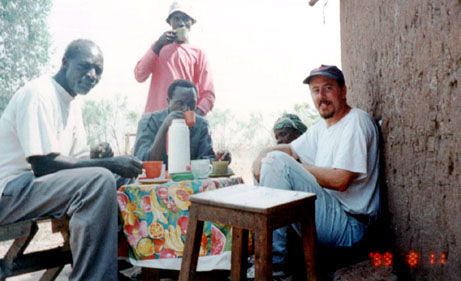
When I lived in Kenya back in 1989 and 1990 I was aware of the HIV/AIDS problem in Sub-Saharan Africa in an intellectual way, but not an intimate way. It was not something I saw among the Giryama people, but only caught glimpses of in the haunted eyes of coastal prostitutes who shuffled the streets of Malindi and Mombasa.
When my family lived and worked in Tanzania some years later I was introduced to the problem in far more personal ways. I was often asked to drive someone in from the rural areas to the urban hospital, usually to die. They would be suffering from the multiple, debilitating diseases that often afflict poor souls in the last stages of their body’s battle with AIDS. I was asked to drive for a couple of funerals, including the funeral of a good friend’s aunt who died from AIDS related diseases. She was first person with whom I sat holding hands and praying in those final, painful days.
It took some years to process these experiences. I have rarely spoken of them. Really, it was almost five years later when sitting in a coffee shop back Stateside (as I am at this moment) that I thought, “Why have I not talked more about this? Why have I not wept more for this? Why have I not done anything about this?” And a dream began taking shape in my heart and mind for a way to respond to the HIV/AIDS pandemic in Sub-Saharan Africa.
This thought also rolled into view about the same time something else really clicked for me for the first time… it’s this… Have you ever realized the untapped potential for global change buried in the wealth of Western Christianity? I know that money is not the blanket panacea for all our planet’s woes, but stop and think about it for a moment. I know we as Christians give a lot of money locally and globally… but also stop and think about how much we have left over after that giving! Do we have enough to really break into the cycle of disease and poverty in regions like Sub-Saharan Africa? I began to suspect that we do, especially as I took a look at the discretionary spending going on in the life at that time of this “poor” in-between-jobs-at-the-time pastor (me). And we won’t mention the discretionary spending I waste these days as a currently employed pastor, for the shame of it.
I started reading and looking around and discovered that it cost only about a $1 a day to supply the needed antiretroviral medicines to an infected person in Sub-Saharan Africa, and I’ve lately read that the cost has dropped to only $88 annual! My beloved people, that’s chump change to us, but an unreachable goal for the vast majority of these infected neighbors of ours who are trying to hold families together, maybe accomplish year-round subsistence farming, keep kids in school and often have to walk miles a day with their associated secondary diseases just to fetch clean water.
It’s time for a longer story made shorter… here’s my vision: “I dream of making a nonprofit that is built on a model being a hybrid of the very successful and productive models of Heifer International and Compassion International which will inform and organize individuals and other organizations into a purchasing power for cheaply made antiretroviral medicines from India, and then will oversee the delivery and distribution of those needed medicines on the ground in clinical sites across the hardest hit and neediest parts of Sub-Saharan Africa. We select the sites on the African Continent, purchase the drugs, and then insure their delivery and distribution to the people.”
And here’s the big “Why?” Why do this? We should know that HIV/AIDS is not just a health issue, but also a social issue and a family issue, a parental issue, child issue and a poverty issue. A steady available supply of antiretroviral medicine will keep countless individuals alive, and saving lives is result enough. But it gets better! When we help save a mother or a father from from an early AIDS related death, we can help keep a family intact. We can give the gift of having parents back to a potential orphan! We enable a mother and/or a father to keep working and thereby support their family. This serves a family unit and helps keep a local economy moving! And whole family units are better equipped to survive and thrive in ways like sending their children to school instead of needing them in the fields all day. We can have an educational impact! And when an infected mother is on a regimen of antiretroviral medicine the rate of transmission of the HIV virus to her child at birth is drastically reduced. We can have an impact on transmission rates!
Did you follow all that? Potentially, for $88 dollars a year per God-created-and-loved, precious human soul, any one of us or all of us can help keep people stay alive, help keep families together, help have a positive impact on poverty and local economies, and help cut HIV transmission rates! This is a response with a near total impact on the spectrum of problems connected to HIV/AIDS in Sub-Saharan Africa!
I have to stop now and let my heart rate return to normal…
I believe that the heart of God beats in this kind of vision, but I’m terrified, excited and overwhelmed every time I speak it. I am weak, and I am an individual. There are other issues surrounding HIV/AIDS in Africa, and I not ignorant of them. I have first-hand seen and know how a lack of education contributes to the spread of HIV. I have seen first-hand and know how rampant sexually activity, sometimes even aided by cultural or religious norms, has contributed to the spread of HIV. I don’t dismiss those issues, but countless programs are addressing them, and neither issue causes me a moment’s pause in wanting to help people stay alive, to keep families together, to help parents keep working, to enable children to get an education, or to help cut HIV transmission rates to children at birth.
As thrilled and humbled as I am each time I stop my usual business and think on these things, I am equally baffled at what to do next or if to do anything at all. So I sincerely ask you for help. What should I do? What are your thoughts? You who know me… Where should I turn or go, or what should I do next? Do I give our God a vow and a plea to make this happen and then start working on the realities of it? Thank you, for any thoughts, prayers and consideration you can give me with these questions.
Want to read some stuff or pick up some info on the issues of HIV/AIDS in Africa and beyond? Here’s a short list of some great sites and places where you might start… and I’ll just especially plug the AVERT site, it’s amazing…
AVERT
http://www.avert.org/
A good paper I found one day…
http://www.undp.org/hiv/publications/issues/english/issue27e.html
UN Stuff…
http://www.unaids.org/en/CountryResponses/Regions/SubSaharanAfrica.asp
Again, thanks for your time with this… and with all peace,
~Todd
Dreaming dreams… I’ve often not dared to share…
Within the next few days I am going to share one my dreams with you. It might border on being a vision, I’m honestly not sure. But what I do know is that it has been with me now for about five years, a constant companion and sometime topic of conversation. I’m going to throw it out here in the next few days, and ask you to help me make some decisions which I have avoided making about it.
Before I do that, I thought it might be a good idea to tell you a little bit about the way I think. As I have moved through different ministry potions and jobs I have often struggled with the nature of my work. A pastor’s work is varied to a ridiculous degree… I am an amateur website builder, public speaker, office manager, vision caster, attendance taker, janitor, spiritual guide and the guy who fixes toilets. Since coming to Bethesda I’ve also sometimes been a landlord, cut the grass and played the ukulele in worship.
I’ve struggled to build a framework for myself as a person and a professional that allowed me to do much needed and healthy self-reflection. Really, if I am slipping in one area or catch criticism in one aspect of my work, I can always point to numerous other areas in which I’m doing great work! “I really busted a move on that downstairs toilet!” A helpful model of self-evaluation is critical for self-qualifying and quantifying my work.
What I have landed on is nothing new, and certainly not a magic recipe for anything. It’s just my little framing, and you’ll probably find it both obvious and simple. I think of three things when I self-reflect, three questions: Am I… 1) doing what I ought to be doing in this time, 2) being what ought to be in this time, and 3) leaving anything good in my passing through these days and this life? You might think of it as Do, Be and Gift (“gift” being a way of saying “produce” that has some beauty to it).
The subject and substance of my next blog entry, when I open up a dream of mine to you, is more about the gifting part of all that fluff I just unloaded on you. More than my legacy, but my gifting to my species and planet, to my God’s Kingdom and Will. Some of you’ve heard me speak of it, but most haven’t. I have been afraid to share it often or well. I feel it’s bigger than I am, and that scares me. And honestly, I usually answer the doing and being questions more quickly and easily than the gifting question. So I’m going public with it… and I wonder if there will be people willing to hold me accountable for having had this dream.
Oh, and I’m not being dramatic with you. I just know myself. Sloth is a deadly sin for a reason. And I have battled slothfulness my whole life, and still do today. Bringing my dream out in the open might force my hand to deal with it, and either put it to the test or to bed.
So, long story short… I’m throwing you a piece of my dreaming real soon… watch out!
Praying for the Gulf Coast…

Well, it’s been a while since I shared anything here; life’s been a little busy. But this week the oil spilling into the Gulf Coast has been heavy on my heart. So, I thought I’d try to unpack a little.
I’m going to ask you to suspend your political sensibilities for a short season. As I’ve listened and reflected on the oil spill, I’ve found the political dynamics to be distracting. Truth is, this is moral issue and an issue of empathy for our friends most impacted and for God’s good creation.
My mother-in-law’s family hails from Southern Louisiana, and so my heart is tied to a region that has partly existed for so many millennium just to bring me my wonderful wife. I and my kin hail from the great state of Texas which shares that same gulf with our neighbors in Louisiana, Mississippi, Alabama, Florida, Mexico and Cuba. Though not all the gulf is like the pristine waters I have relished along the coast of East Africa, it’s still part of my home.
We really need to be praying for and listening to our neighbors in the killing, thieving path of this spill. We need to be broken for the destruction that this spill is creating within the coastal animal, bird, fish and vegetative communities. We humans are a species of risk takers, often to our gain and sometimes at great cost. I get it; I’m not immune to the thrill of taking a chance and doing what seems impossible. I marvel at the complexity and seemingly preternatural audacity that makes deep sea drilling a reality. But I’m starting to really hurt that the same energies are not given to a love of our God’s good earth and to being present with our neighbors. Did you mark the 45th day of the oil this week? The forty-fifth day! And now BP finally manages to be able to catch a small percentage of the escaping oil… and I can’t muster much joy at the news.
I’m sick and angry as the stories of the ruined lives and livelihoods begin to seep out of LA as the oil seeps into it. I’m embarrassed by a culture of consumption that creates the need for such risky drilling. And I’m so dependent on and appreciative of the mini van and it’s petroleum munching, combustion engine that will soon carry us around on a road-trip to see our family in other states. *sighs* What shall we say to our neighbors in the Gulf Coast in the coming months and years? What will they say to us?
Have I ever mentioned how much I love alligators? I visited an alligator farm in LA some years ago, and have played with the idea of having my own such farm ever since. Fascinating creatures. I’m incredibly angry that their marshes are in danger.
And I’m having a hard time praying for BP. I know. Just typing the words made my fingers itch.
God has made a good world, and it’s wonderfully resilient in the face of such catastrophes. But it pains me to say that I’ve heard people, people self-identifying as followers of Christ, use this truth as a license for apathy about the oil spill. As if in making such a wonderful creation our God abdicated the right of wrath and disgust at the carelessness of any one species within it. Let us not be tempted by such a foolish notion.
This may be an unwelcome observation to you (honestly, it is for me, too), but I’m thinking God’s people need to do some soul searching right about now. Dare we toy with the word? Let’s. Change. It’s time to have a discussion about changing some things. I have an overwhelming feeling of need to do some hard penance for the mess we have made… and I’m not sue what to do about it. Any ideas?
“Saving God… I’m sorry. I’m sorry for unthinkingly embracing a life of no limits on my consumption except those imposed on me by my salary and earthly creditors. I repent of it, and ask for wisdom in the coming days as I try to see a better path, a faithful path. Amen.”
The Checklist Manifesto, a Book Review

One of my joys in life is finding good material for cross-discipline reading, and I found a lot of great stuff to digest in Dr. Atul Gawande’s work entitled “The Checklist Manifesto: How to Get Things Right.”
Dr. Gawande is a surgeon who has worked with the World Health Organization to study, craft and implement simple checklists as a precaution against surgical mistakes, complications, infections and deaths. This is a fascinating book written with humor and style. I owe a lot of thanks to the venerable Diane Rehm for having the author on her show recently and introducing me to the book. Diane rocks!
The book introduces some solid ideas for those of us in spiritual vocations to consider. I’ve made a short list of four big ideas and will add in a few quotes from the book. The ideas aren’t necessarily new, but definitely under-enacted in many of our professional lives and faith communities.
1. The Burden of Knowledge. Dr. Gawande touches on a huge problem facing many fields of science these days, not that we are ignorant, but that we actually know so much. He does not say we know too much, but points out that as our knowledge base has grown so much that we have begun to face more difficulty in assimilating the knowledge into consistent, accurate and dependable practice. He says it this way on page thirteen, “…the volume and complexity of what we know has exceeded our individual ability to deliver it’s benefits correctly, safely or reliably. Knowledge has both saved us and burdened us.”
If you’ve delved into the realm of theological studies then maybe you’ve also faced a frustration that has haunted me through the years: I can’t process all this stuff! I find that I cannot hold, in my sorry excuse for a brain, everything I need to know and remember about 2,000 years of Christian thought, much less what I add from thousands of more years of Jewish thought and all the other spiritual traditions of the world around me. So, can I create a model, even a checklist of sorts, to help me anchor a point from which I can operate in a daily way but also take deeper forays into the deeper realm of theology when needed activities and tasks arise? I’m both afraid and intrigued by such an idea, and to date I haven’t even tried to make such a list/process. The question may sound stupid and even primitive to you smarter folks, but the second point I’m pulling from the book may help you see how such a checklist would function.
2. The Cognitive Net. Dr. Gawande describes the checklist, not as a robotic brain-sucking, inanimate object that tells us what to do or what to think, but as a “cognitive net” that frees us to concentrate on the important, immediate stuff while not risking the important, yet peripheral things. He says on page 48 that such a checklist would “…catch mental flaws inherent in all of us – flaws of memory and attention and thoroughness. And because they do, they raise wide, unexpected possibilities.”
OK, that quote gets me a little excited. Not just in theological studies, but also in the weekly activities of a church family. In our daily tasks within the religious vocation we face a myriad of activities and responsibilities that present us with a combination of complexity, mind-numbing detail and often repetitiveness. What would a cognitive net for the full-time or part-time pastoral staff look like? Would we develop a set of checklists to get the main tasks of a week finished and to track the Sunday AM preparations? If so, what would such lists look like, and how would they be made accessible and function with us?
3. Team. One of the strongest points made by Dr. Gawande is the power of a team versus the strength of the single hero whom he calls the “audacious expert.” This is something that many disciplines have struggled to understand and implement. At Church in Bethesda we work toward valuing the team effort over the single expert’s audacity by creating a flat and participatory organizational structure and then implementing a visionary-consensus model of making decisions (no voting, only group think). We assume that the group can be more creative, wise and better equipped than any individual, no matter how trained and competent that individual might be. Such individuals are still important and needed, but are helped and made better by the group.
Dr. Gawande mixes this in with the concept of decentralizing power to better enable and empower the many members of a team (or community) to carry shared responsibility for solutions and outcomes. I like that idea, and I like what he says about building team in easy ways on page 108, in discussing the simple yet powerful idea of everyone speaking and being heard, even if just in giving their names: “The researchers called it an ‘activation phenomenon.’ Giving people a chance to say something at the start seemed to activate their sense of participation and responsibility and heir willingness to speak up.”
Really. How many times have we failed to emphasize the voice of every member of our faith communities? And I don’t just mean in business or ministry meetings.
4. Failure and Discipline. Dr. Gawande raises some very cool points to conclude the book. He begins by talking about a professional’s lack of discipline. I think I agree when he says that most helping/serving professions have a code of conduct, implicit or explicit, which emphasize the importance of selflessness, skill, and trust. He then adds a fourth that is often over-looked: discipline. He believes discipline to be much more difficult than the first three. Discipline is the commitment to process and procedure, the bane of any talented, driven, audacious and heroic leader, right? We want our heroes to be improvisational and amazing, not team players who can recognize and implement procedure and process to solve complex problems! Boring! But a new kind of hero is what many situations and problems most need.
Wow. This really frames a lot of angst in the church. We have and cherish the mythos of the charismatic, inventive, talented and unique pastor/leader/thinker/writer who stands alone, without peer, to break the path for us into new and exciting territory. We love and value the pastor/author/guru who can catapult us to the next level of coolness. St. John of the Cross, the Spanish mystic and poet of a bunch of hundreds of years ago, chastised this kind of thinking, a fevered dependence on the latest and greatest spiritual sermonizing and writing, as a pitfall for the spiritual adolescent. Dr. Gawande says on page 173: “Maybe our idea of heroism needs updating.”
Valuing both the audacious expert and the wisdom and power of the group can be a tough balance, but one that empowers a team/community to accomplish more and better action. He says succinctly on page 162 that “…good clinicians will not be able to dispense with expert audacity. Yet we should also be ready to accept the virtues of regimentation.” I think that it’s often either the over-regimentation or the lack of regimentation, a crucial imbalance, that holds some of our faith communities back from realizing their greatest impact in the world, locally and globally. What do you think? I’m intrigued and challenged by the question and it’s possible impact on how I do my job.
And finally, most of us aren’t too enthusiastic about really digging into our failures and the possible patterns that might be discovered, studied and changed. How many of us serving church congregations have reeled from job to job thinking, “Oh well, these folks just weren’t ready for me. One day I’m going to find a bunch of people who appreciate the greatness I bring to my profession!” Dr. Gawande points to the amazing process of and value placed upon investigating failures in the airline industry. No one else seems to come close to the kind of scrutiny they bring to bear on failures. Who would want to?
Still, if we are serious about the selflessness, skill, trust and discipline that come along with our professional and spiritual responsibilities, we must stop and do the scary work of poking around in our painful pile of failures. The hero, the audacious expert doesn’t often do this… that individual is expected to be above failures. To have a failure, it is thought, is to be a failure. Seriously, look at the professionals around us in just the field of politics. If someone makes a mistake they must resign, be fired and never grace our TV screens or webpages again.
Our author laments the situation on page 185, “We don’t study routine failures in teaching, in Law, in government programs, in the financial industry, or elsewhere. We don’t look for the patterns of our recurrent mistakes or devise and refine potential solutions for them.” And it’s exactly those potential solutions that we so badly need! So avoid our failures and continue to perpetuate them.
I think, in general, he’s right. We’re very aware of the failures in all those fields, as we are often aware of the failures of people within the spiritual vocations. Our problem is that we generally treat such failures only in the realms of figuring blame and enacting punishment. When I’ve tried to reflect and process on my own failures in my chosen vocation the typical response from friends and other church leaders has been one of “Well, just don’t worry about it. You’re a good guy and we know that.” Hey, I know that, too! Few, myself included, have been ready to sit and really hash into possible patterns of failure and the potential solutions to which Dr. Gawande alludes.
Conclusion: This is a good read! The author made me laugh out loud several times and consistently challenged my thinking on systems and process. I’m still working through the ways his ideas and thoughts might impact me as a professional. I’m not sure what I might end up doing with the experience of his little book, but do know that I’ll be changed by it, my work will be changed by it, and all that change will be for the better.
Stop, Drop and Paint…
I’ve been working on “Thoughts on Preaching: Part 2,” but this afternoon I just had to stop thinking for a while and do some painting. Painting is prayer, a form of meditation for me. I make no claims to be good at it or have a style I can all my own, but it is one of the most freeing times for me.
I’ve been reading and thinking about St. Francis of Assisi for a few days and I was thinking of doing a self-portrait, so I combined the two and came up with this painting, today… an acrylic meditation on the first line of St. Francis’ formative prayer,
“Lord, make me an instrument of thy peace.”
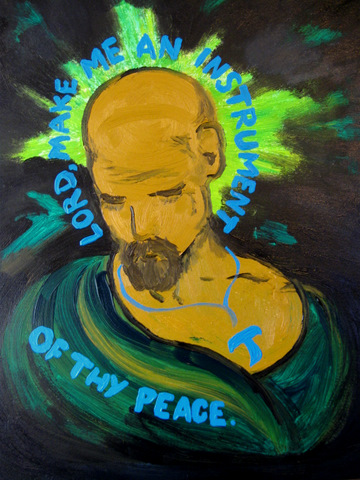
I worked two hours straight on it from the beginning to completion, and it’s drying now in our bedroom. I have a spot on the wall all picked our for it. Don’t worry, I am under no delusions about the difference between myself and the great saint. I just used a little artistic liberty to focus my efforts.
Our congregational email on Praying for & Helping Haiti… 01-14-10
Good morning, folks…
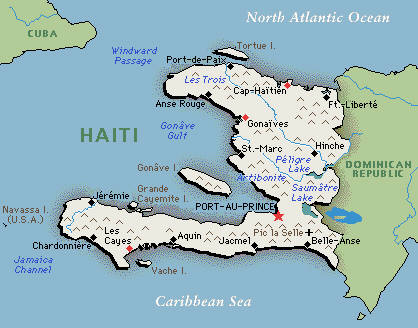
It’s been a horrific few days watching the images and scenes coming from the devastated streets and lives of our neighbors in Haiti. Time and time again we’ve seen the prayers being lifted for the suffering in Haiti and we’ve lifted our own. Many efforts have begun to get aid to the people who need it most, and to get it to them in ways that will be effective and handled with the greatest care and stewardship. I wanted to drop a note today to share a few thoughts on praying for Haiti and an opportunity to help with the needs brought by this disaster.
First, I did not know until this week that our own Luke Campbell has a sister (Deborah Baker) living outside of Port Au Prince, living and working with her husband (Kyrk Baker) and children, for Baptist Haiti Mission, assisting churches and operating hospitals and school programs. They are weathering the storm as best as possible with no loses of life within their family, but now the huge stresses of being first responders and completely overwhelmed. Fortunately, they have medical facilities still standing and are receiving people coming from the city. They have a blog about their life and work in Haiti, and I’m listing it along with a link to Baptist Haiti Mission:
http://www.ourlifeinhaiti.blogspot.com/
http://www.bhm.org/bhm/index.php
With the myriad of ways offered to us to contribute and send aid as individuals to the hurting people of Haiti, I was glad to know that we have a connection with people there working and serving in such an immediate way. We will have a prayer station set up this Sunday to offer not only prayers but also contributions as a church family that will be sent to help the Bakers as they respond to the crisis as God’s hands and feet in the midst of such pain.
Praying for the People of Haiti…
It’s going to be a given that we are offering prayers for the hurting souls of this devastation. Some of the poorest and most disenfranchised people are suffering through a situation that no one is ever prepared to face. So, we pray for the people of Haiti, for the hurting and the for the dead. Your prayers are so important in the coming days as victims and responders deal with the loss and pain they face. I’m including a link to Gratefulness.org where you can light a virtual candle in prayer for Haiti. We also used to have the “Prayer Lava Lamp” set up in our Sanctuary, though it’s been a while. If you’d like to open it and have it on your desktop to remind you and facilitate prayers, I’m linking it in as well.
http://www.gratefulness.org/
http://www.emergingchurch.info/prayer/lamp.html
Praying for the First Responders…
I’d also like to ask you to pray for the first responders, the folks like Luke’s family and many other aid workers, working for different types of church missions and for the many governmental agencies, who are on the ground in the midst of the situation. Some of them have lost a lot in the last couple of days, and still will be looked to for help. I’ve also been touched by the stories of Haitians tearing through rubble with bare hands to affect rescues and recoveries of people trapped in collapsed buildings or giving what medical and rescue assistance they could, even with no training. We pray for the people who are saving and serving their neighbors, right now. They will have a long road of healing of their own. There’s a good list of prayer points on the National Prayer Center’s website, and I’m linking it in (shortened by Tiny URL).
http://tiny.cc/haiti812
And we pray for the US Military and US Rescue Personnel…
I’m including a link about our mobilization of military medical personnel, supplies and ships, and many other responders who are on their way to Haiti to serve. These folks will face some very harrowing days ahead, and they need our prayers of support. I am always so proud when our military’s medical fleet is prepped and sent to respond to disasters around the globe, providing supplies, help and security.
http://www.msnbc.msn.com/id/34832613/ns/world_news-haiti_earthquake/
So, I hope to see you on Sunday. I know that there are many ways to send aid and support to the people of Haiti, and I would never expect you to neglect the other connections you might have to directly serve with friends and family who are there helping in the aftermath. However, I’d also ask you to think about the amount which you would be able to bring on Sunday to help with the needed supplies and materials for helping stabilize and heal our hurting neighbors in Haiti. We’ll pray and do what we can as a church family to be the neighbors they need in us, now. And I’d invite you in your prayers to even consider what the future may hold for our church family as global neighbors with Haiti. Just a few weeks ago I shared with you that I’ve had it on my heart to find the way in which we might engage the world this year in missions, and from our previous support of Brooke in Haiti, to the connections we find developing now, I wonder if we’re not being asked to consider a longer-term commitment of prayer and service to the people of Haiti? Let’s lift that question to God as well. Thanks.
With All Peace,
Todd Thomas
Church in Bethesda
I have a verse for Mr. Pat Robertson…

Wise words from Romans 14:22
“So whatever you believe about these things
keep between yourself and God.”
Why don’t we ever hear more sermons on such a great idea? Why don’t I preach on it more? There’s a truth loose in the world and it goes something like this… “You don’t need to hear my views on everything, or vice versa.” Please, Mr. Robertson, enough.
Paul has struggled through a very sticky situation in his Roman letter. It’s a moral, ethical and spiritual question with huge impact on the civil, secular, communal and daily lives of believers. Should a believer eat food that is consecrated to another god? And if so, or if not, to what lengths do they go to discover if it has been consecrated or not? The whole thing has very little meaning to many Christians today, but we do have our own big questions, moral questions, ethical questions, questions that impact our daily lives. And we spend a lot of time expressing opinions, many of which are hurtful and uncharitable.
Paul’s solution? In part, silence. Respectful. Silence. Quiet time with God.
I don’t question Mr. Robertson’s right to hold views on the causality of earthquakes or the relationship between what we call natural disasters and the impact of spiritual powers in the world. I just wish he’d keep most them to himself. Instead, he heaps blame and shame on an already suffering, impoverished and destitute population. Not what I define as a “Charitable Act.”
I could go on, but that’s pretty much it.
Lord God, in your mercy,
hear our prayers and pour out your peace,
hope and blessing on the people of Haiti.
Amen.
Some thoughts on Emergent Church…

I’m planning to come back to some more thoughts on preaching, but since my brain tends to bump and jive between multiple threads (not necessarily a good thing), I’m going to share some thoughts on the whole “emergent” church stuff first, or “emerging,” or “emergence,” whatever.
Honestly, too, I’ve lately not only had some questions put to me about it, but I’ve also read a few things that I only marginally thought had merit. Also, I’m surrounded by a church family, many of whom are new to the vocabulary of emergent and find themselves where most of us find ourselves, when painfully honest… that’s an exercise of defining emergent for myself, because we each have had a varied introduction to, experience of, and history with emergent church friendship/conversation/aspiration.
Here’s a couple of things you should know about me, in case you’ve never heard me say them out loud: 1) I self-identify as a pastor of an emergent church, 2) most of the folks in my church family are versed or becoming versed with things “emergent,” and 3) I in no way consider “emergent” to be a denomination, affiliation or even much of a genuine modifier past my own set of thoughts and definitions.
I was at a little conference hosted by our Disciples of Christ sisters and brothers in DC back in 2007 and heard Tony Jones try to share a metaphor with folks about why emergent is not a denomination, or even a reformation movement, but simply a survival move that has resonated with a lot of people. He said that he and his friends who kick started what we now call “emergent church” simply jumped ship from their Christian traditions into spiritual life-rafts in an effort to save their own faith. But amazingly, as they paddled away in their life-rafts they heard the splashing and calls of all the folks jumping ship after them and hoping to also salvage their own faiths.
That resonates with me. I was at a place where my own faith had become sullen, caged and dry. Because my church tradition was wrong? No. Because my church tradition was stupid or bad? Nope. My faith was in jeopardy because my church tradition simply didn’t have the built in receptors for a person like me. (I mean “receptors” like when certain proteins or viruses are made to connect and join together.) There were no places of safety for me to ask my questions. There was no value placed on diversity of thought or expression. So, as an individual human and as a follower of Christ, as I began trying to unpack certain parts of my life and faith, I found mostly only confusion and hostility.
Was it because I’m a “post-modern?” I suppose partly. Was it because I’m a “rebel?” At one point, yes. Today? Not so much. Could I have stayed in my tradition and made a place for folks on a spiritual journey like mine? I could not have stayed. Some of my friends who are kindred spirits have stayed, and I respect that. For me, survival meant moving on.
So, back in about 2003 I read a little book by Eddie Gibbs called ChurchNext about why we needed missionaries in America again, folks who are tooled to re-deliver the gospel in new terms and models. As a trained cross-cultural missionary, this woke me up and put words to many of the thoughts and questions with which I had previously wrestled. It also laid the ground work for me to pick up my first Brian McLaren book, More Ready Than You Realize. Brian started filling in some the terms and frameworks that I needed to find my new way of faithing. That help ultimately culminated in his Generous Orthodoxy.
More authors followed: Darrell Guder, Doug Pagitt, GK Chesterton, Richard Pascale and more. Ultimately, I found ways to express my yearnings and fill in some of the blanks… and that is the foundation for our church family in Bethesda right now… and so we are arriving at a few of my thoughts on what emergent church means to me…
Emergent gives faith a fighting chance against certainty.
That’s right, I don’t think faith is simply holding a certain set of theological definitions or affirming certain doctrinal statements. Faith is something other than certainty. I can’t believe that with all the scriptural witness to what faith is, we have so often made it an answer instead of a question. Faith is hope. Faith is yearning. Faith is trust. Faith is appetite. Faith needs to move and live and breathe. We try to make faith into the acceptance of a method and form like the four spiritual laws (easily distilled to a tract, pamphlet or sermon). We try to make the scriptures answer all our questions so that we can construct a base of certainty. We try to make a hermeneutic that can help us navigate and subdue the Holy Scriptures of our “faith” and leave no questions in doubt. Can we have faith without doubt? Really? With certainty in place, we’ve no need of faith.
Well, I found my certainty system to be severely lacking. I’ve probably investigated and found yours to be lacking, too. What I love to read about these days is your faith. I want to know how you hear God and touch the divine. Without the certainty crutch you can become frighteningly mystical, and that is necessarily a good thing. I want to hear your doubts, and how you grapple with a God who is wrapped in the deepest mystery and yet also is claimed to have walked in human flesh. That’s a God worth my time. That’s a God who defies my pamphlets and snorts when I talk about my awesome theologies. That’s a God who calls all people, for that’s a God able to wrap around all kinds of people, I hope, I trust, I faith.
Emergent gives diversity a fighting chance against conformity.
So, did I run into trouble in church because I’m a “postmodern?” Yes, I have to admit that I did. My value system just can’t support a communal structure that enforces conformity. I also can’t abide in myself an inauthentic acquiescence that screams hypocrisy from the depths of my soul. Sweet grief, I can’t even abide the idea that you’d agree with everything I’m writing and be thinking just like me! What kind of screwed up world would we have if we all thought alike? Diversity is the core of imagination. Diversity is the foundation of innovation. Diversity is flavor and color. Diversity is needed for mental, intellectual, emotional and spiritual health. When a faith system or church tradition loses diversity or moves to quell diversity, it becomes inert, that is without internal and vital motion. The same is true, I believe, for a single human soul.
Members of our church family in Bethesda claim many church traditions and often still self-identify with those traditions. And that’s awesome! We’re not post-denominational, we’re pan-denominational, or I usually say “multi-denominational.” So, my messages on Sunday mornings often have more to do with what someone might go make of my sermon ideas than what they’re supposed to agree with me about. Ergo… sermonizing as “Here’s an idea/image in scripture that I think we need to fashion a response to; Now what might that response be in your life, or our life as a worshipping community?” Diversity is fertile soil for growth.
Emergent gives a relational, gracious community a fighting chance against earned acceptance.
Let’s face the facts. If I am to be me, I’m not really welcome in very many congregations. One of the hardest things for me in my earlier years of ministry was the recurring fights and arguments with church leadership. Often, I would have taken so much time to tailor my words and finesse my communication to be non-threatening, but still end up with horrible things being said to me. I would think I had come up with the most innocuous way to say something, and then BOOM, I’d blow someone’s world apart and off we’d go down the rabbit’s hole. It took a few years, but I finally figured out that it was me, ME, who I was and how I thought was the problem. And I couldn’t just stop being me. I have tried that, by the way, and seen others choose that path, and it leads to spiritual death.
We have to relearn how to practice a very authentic and whole-hearted welcome. We have to relearn how to love each other whether we agree on some things or not. People, including ourselves, must be able to walk into the life of a faith community with a full, intact and immediate worth and dignity. If we withhold that on any basis of merit, we have sinned, and sinned mightily.
We’ve spent to much time deciding and communicating who wasn’t welcome. We’ve spent too much time “protecting” the church to let it be porous enough to admit some of the most needful folks in our society and some of the folks we’ve most needed among us. In our rush to certainty we’ve forgotten to trust God. In our unreasonable fear of God and of messing up that solid base of certainty, we’ve not allowed ourselves to love as God loves or risk ourselves as God so amazingly risked personhood in the life and death of Jesus who was the Christ. Walled-in communities and souls risk a death of stale inertness.
I never thought I would say this and really mean it, but I would so attend worship with my church family, even if I weren’t their pastor! I love those folks! Man, some of them are screwed up, almost as bad as I am! Some hold political opinions or theological ideas that scare me, really. Some can’t sing on key and some truly share nothing in common with me. I love them all! They love each other. It sounds stupid and fake, but we have to love each other. You don’t come to us to have your belief/certainty system validated! Truth is, it’s our love for one another and for God that allows transformation among us. It’s the tension of our diversity that fires the kinetic joy, peace and imagination among us. We practice an authentic welcome because we each depend on it and need it so much.
Wow. This is a long post. And it only has three thoughts in it so far. But I have to lay just one more out here, before I chicken out totally…
Emergent gives dynamic, “becoming” faith a chance against a completed, static system.
I was once asked if I didn’t think the scriptures provided a complete “Christian Worldview.” My answer then, as it is now, was no. What I felt I was really being asked was if I couldn’t see that the Bible gives us a single answer to every moral and ethical, methodological and theological question which confronts humanity in each epoch, place, generation and situation. My answer reflected my belief that we are not ultimately called to parrot doctrinal and moralized statements generation after generation, but called to be thinking, processing, growing agents of eternal life. If calling faith “appetite” didn’t make you grimace then the implications for church of that last little ditty should have. My humble opinion is that our loss of becoming, our loss of identity as contemporary agents of eternal life, is why so many church buildings stand empty today and why so many congregations devour books on how to keep a dying congregation alive. We’ve traded off an amazing invitation to become something for the consolation prize of belonging to something.
If we aren’t allowed to “become” church just like the lucky folks living in 70A.D. or 325A.D. or 1500A.D., then we become the simplest minded, however clever, copy-cats the cosmos has ever created, and most of the unbelieving world’s criticisms of us become well-earned. For some of you, I just stopped being a “Bible Believing Christian” because I thoroughly undermined the authority of scripture. All I can say is this: I love, cherish and cling to our scriptures. They guide me, admonish me and uphold me. I love our scriptures and the community of souls whose story they share and invite us to be a part of… but I don’t worship the scriptures or follow them in place of a living God. Fact is, it’s in the scriptures that I see the call to become.
Now, if we are allowed to become, then it’s an imperative that we hold to faith and love, without which we fracture in our diversity and lose touch with one another in a hurry. BEWARE: What I become may not be what you need to become! The scariest things for me to hear is someone saying, “We’re the only true emergent blah, blah…” or something like that. Go catch the wind and put it in your pocket, my friend. “Emergent” is not what we are becoming. “Emergent” is not just a new way of conforming and belonging. What I am becoming, what you are becoming, that’s all God’s business. And the day that “emergent” stops facilitating that becoming, I’m moving on, I promise.
Emergent stuff is a dangerous game we play, as dangerous and threatening as any relationship we’ve ever pursued with another person, but the rewards! The joy of the kind of community and running with God that this emergent conversation, friendship, and aspiration has afforded me! It’s been well worth every momoment.
Some Thoughts on Preaching, Part One
Several conversations this past year have had me thinking about writing something about the practice of preaching. I’ve sat with several folks from my church family and responded to questions about my preaching style and habits, and I suppose that what I want to do here is share some of that with you. This is part one of that effort.
Why share thus stuff?
Am I tooting my own horn or flexing my pretentious muscles? I really hope not. But, I think it’s important to talk about things from individual perspectives and experiences. When we do that we find out that we’re not nearly as unique or alone as we tend to think. So, I guess I’m trolling for kindred spirits as I do this, friends trying to make a similar path. I wasn’t trained to preach as I do, so it’s been an odd journey for me to do different things and attempt new methods. Sometimes it has soared with eagles and other times hidden in the mud with worms, but I find that experience far more authentic and life-like than the many idealized preachers of my youth who became more and more distanced from us and God because of a rigid preaching practice until they fell into the worst sins against which they weekly railed. As is probably the case for most church leaders, I am deeply concerned with the lives and souls of the people who look to me for leadership, but I’m also hoping to live the life eternal now and always for myself.
Here are a few things I don’t tend to do…
I don’t ever read a prepared sermon.
If you are trained to do this, and you enjoy it, and you minister with a church family that appreciates it, don’t change a thing! I found that I could not engage my listeners when I engaged the paper. My experience has been that younger generations, unless trained otherwise by seminary or church experience, tend not to respond positively to the sermons being read to them. I think it has to do with the way the younger gens interpret and recognize a couple of crucial things: authenticity and relationship.
Did I just say that written sermons aren’t sincere and authentic? Nope. I said that I’ve found the younger gens, and many from the older ones, are finding a prepared and read sermon to feel less engaging, and therefore not seeming authentic to the life of the speaker. That’s my experience when trying to encode messages for my listeners… and it resonates with me as well.
The idea of relationship is probably even more important and really impacts the idea of a speaker’s authenticity. Younger gens are way more relational these days, and they often hear you or don’t hear you based on their relationship or perceived relationship to you. I believe that to be a fairly true generalization. Many younger folks just aren’t looking for the “power” image in preachers, but instead want someone who can relate to and connect with them at empathetic levels.
Of course the kingdom still has plenty of room it seems for the styled hair, capped teeth and prosperity models who build some of our mega-churches. Cool. That’s no skin of my bald head, not so pristine teeth and jeans. I don’t go into Sunday mornings looking like a slob, nor a poster child, but just me. I’ve found the effort worth the dividends of trust and grace that my church family folks are willing to extend to me.
I don’t like to draw a closed circuit of conclusions.
I don’t think that what I have to say should ever be the final word on something, or that my conclusions are the necessary conclusions for each of my listeners. What? But aren’t preachers paid to think for us, study for us and tell us what the coolest theological trends might be for the day? Aren’t we actually saved by our rightness regardless of our lip service to grace and faith?
I don’t try to complete some of the ideas I’m preaching because I intend for them to be germinal in my listeners. My applications tend to be exploratory. I genuinely invite folks to chew on what I’m saying and give me alternative conclusions or ideas. I’ve been broadened many times by my church folks coming to me with alternatives and additions to what I’m talking about, and I often include those points or reference their thoughts on a following Sunday. The classical form of a sermon that has an introduction, three points and a conclusion is more of “take it or leave it” situation than one in which a person in invited to grow and take their time. Simply put, I don’t expect my listeners to accept everything I say in a message at face value or in the moment of hearing my words… I’ve had a while to play with my ideas and conclusions, digest them and throw them through some tests before any given Sunday morning. It would be un-neighborly not to allow my listeners some time to digest and incorporate the ideas, and improve on them in the effort.
Humility seems to call for a bit of openness and invitation to many of a preacher’s conclusions. After all, I am one person, and God’s Spirit lives in the many persons surrounding me. If I have faith that God’s Spirit is a present, convicting agent in peoples’ lives, then I carry no less of a burden as preacher, but a little different of a burden, one shared with my church folks, not imposed on them.
At the risk of making any comparison between myself and Jesus, which would be a huge mistake for me, I’d ask you to consider how many times Jesus threw some teaching out and then walked off leaving people scratching their heads, frustrated or confused, but also processing and deeply involved in what he had said, though maybe not what he concluded.
I try not to move in a linear fashion through points A to D, 1 to 5, etc.
Mostly, linear communication leads to two great evils: 1) alliteration, and 2) lazy listening. I’m doing my part to kill both practices in the world. Seriously, I can remember in one of my earliest preaching class experiences when the teacher was trying to help us grasp the finer points of outlining our messages and ended up with sub-points A) thru Q) on the board under his second main point. No kidding. It forever altered my perception of the job of a preacher.
Of course, I don’t think that everyone who practices alliteration is evil or dumb, I’m just wore out on the five P’s of this and sixteen J’s of that. Alliteration takes valuable energies that could be much better spent in service to the church and the world. I involuntarily tune out the moment I see sermon notes that have five blank lines all beginning with a capital “U:” because we’re getting the five great U’s of uber discipleship. OK, I don’t just tune out, my mind changes channels and rips off the tuner knob. And, though maybe not all preachers are crass enough to say it out loud, I simply preach the way I want to listen. That’s why not every preacher is right for every listener. I usually say it another way… if I’m not comfortable and enjoying myself, then I bet my listeners aren’t either.
And I think linear messages can lead directly to lazy listening. You know what lazy listening is right? That’s like when someone listens through a whole sermon, shakes hands afterward and compliments the preacher, and immediately moves on with life with nothing better than hopefully a subconscious plant to later haunt them. Lazy listening engenders no questioning of what the speaker just said, it engenders no curiosity or creativity, and it certainly never leads to interrupting the speaker during the message.
I think that classical American preaching set out to do two things, to inform and to convict. So my grandparents were trained to sit and receive information during a sermon and maybe be convicted to do something. These two movements were the meat and bread of persuasion. My grandparents’ generation really believed that they should listen to a sermon because it was good for them to do so, sort of like eating broccoli was supposed to be a good thing.
Later, some preacher with too much time on his/her hands decided to plant a joke in their sermon, and the modern preacher was born… now we’re going to inform, convict and make them like us, too! How liberating and exciting for a tired preacher! Critics of this new paradigm shift invariably call this the “entertainment” model of sermonizing. The more jealous they are of a preacher’s ability to be liked is directly related to their time spent calling it entertainment, even though that preacher is usually still playing the same old game of informing and trying to convict his/her audience. So, my parents were trained to sit and listen, but they really lived for the next humorous story or tear-jerking anicdote. They were willing eat their broccoli, but now demanded some melted cheese on top, because really!
Listen, I’ve done all that! I’ve laid out my points, I’ve brought the Reader’s Digest to bear on important topics, and I’ve tried to bring folks down front during fifteen verses of Just As I Am with tearful pleas between each verse. But these days I’m more interested in getting people engaged than persuaded. I would be just as happy if one of my sermons made someone go be a student of the Bible in an attempt to prove me wrong then because I was so eloquent. I’d love to think that our circular weave through paintings, scripture and life one Sunday morning caused an artist to think about writing a new song or putting brush to canvas. I would often rather one of my sermons leave you with a big question than a big answer. Why? Because I don’t fear God blasting you for something you don’t know more than I hope for you to seek God in a new way, a new question or a renewed period of reflection.
Then again, someone might do what I usually do when listening to a sermon… often I hear a word or phrase early on and disconnect because it’s sent me off on a grand chase down some rabbit hole of scripture or reflection. I’m always grateful to the preacher for kicking off that journey for me, though I probably didn’t hear their message’s conclusion, much less was I persuaded by it. But I did engage. Folks are welcome to do the same during my sermons.
Really… look again at Jeremiah 31:33-34, especially the second part: “This is the covenant I will make with the house of Israel after that time,” declares the LORD. “I will put my law in their minds and write it on their hearts. I will be their God, and they will be my people. No longer will they teach their neighbors, or say to one another, ‘Know the LORD,’ because they will all know me, from the least of them to the greatest,” declares the LORD. “For I will forgive their wickedness and will remember their sins no more.” Sounds like the end of preaching as a profession, huh? Maybe it is, or maybe it is a reminder that God wants a lot more engendered in the hearts of all the people than in the pulpits and sermons of the churches. Maybe this new covenant hope has been stalled because we keep wanting folks more focussed on what we’re saying than what we’re releasing them to experience.
I’ll stop here. I’m almost ranting, and that’s not always constructive. Peace!
 toddthomas.net