
Scriptures
Isaiah 59 Feeling Days

For sometime I’ve had the blessing of being part of a poetry writing group hosted by Q Christian Fellowship. We meet weekly to check in with each other and to write poetry together. I don’t always manage to write something myself, but when I do the group gives me wonderful feedback and support, and I am so often amazed at what my friends in that group compose.
Of course, right now we’re processing together the results of the 2024 general election, and sharing with one another our feelings of anxiety, fear, disbelief, and confusion that so many in this country could elect a convicted felon who bragged of sexually assaulting women. We share an unease and anxiety at being asked to follow the lead of and to respect the office now held by a predator. Last night our poetry expressed where we were in our hearts and minds, and I have to say that my friends did such a better job than me.
Two times last night someone shared poetry which cast me into scripture, recalling to mind important words of faith and aspiration.
The first instance was in a poem written about gentleness, that was in fact a prayer for gentleness. That’s an amazing aspiration and it threw me into the words of St. Paul to the Philippians, “Let your gentleness be known to everyone.” (Philippians 4:5) That verse has always resonated with me, especially living in a time in Western Christianity which more often values the opposite, which values winning fights, winning arguments, and just shouting louder if that’s all we got.
One of the hallmark teachings of Jesus is about breaking cycles of violence, I believe in both speech and action. He said to love one’s enemies, and he taught us an extremely difficult way of giving forgiveness again and again while turning from personal vengefulness. (Matthew 5:38-48 & 18:21-35) I’m not sure about you, but I know that my heart too quickly and too easily reacts to anger with anger and to hatred with hatred. Those statements are not meant to embolden or excuse an abuser, but to keep the abused and injured from joining in the violence. When the time comes for our strength and conviction to be acted upon, gentleness allows us to be just and to know and to share healing.
The second instance of being thrown back on scripture was when another poem’s lament landed me mentally in Isaiah 59. You may be familiar with that chapter, but let me give a quick synopsis. In that chapter we hear first that God can save, “Surely the arm of the Lord is not too short to save nor his ear to dull to hear.” But there’s a problem, and that problem is the mess that we make. Humanity’s messiness can be huge and egregious, staining our hands with blood and destroying justice among us. In fact, the chapter laments that justice cannot be found, it can no longer be heard and is now far from those most needing it. The lament is that we look for justice, but cannot find it, because we killed it. We look for light but only find shadows. By verse 14 we hear the haunting words, “So justice is driven back, and righteousness stands at a distance; truth has stumbled in the streets, honesty cannot enter. Truth is nowhere to be found, and whoever shines evil becomes a prey.” Wow, that really sums up the gut-punch of this past week’s election.
Having had a week to process the general election, and to think about this felon, this abusive predator, again sitting in our highest office, and the damage he will do through those with whom he will surround himself and a Congress which will not oppose him, these truly feel like Isaiah 59 kind of days.
I have no hope that this incoming felon will value truth, uphold justice or shine any light by which we might find a good path. But I do have hope. In the next movement of Isaiah 59 God looks upon the earth and sees the mess people have made, and God is not happy. It says that God looked and saw that there was no justice and no one working for justice, and so God goes on the move. God puts on some familiar sounding armor to those of us who read the Christian scriptures (Ephesians 6:10-18)… God puts on the armor of righteousness, salvation, zeal, and the intention to bring justice against those who have oppressed the people, and moves coast to coast to clean things up!
By the beginning of the next chapter, the people are called to “Arise, shine, for your light has come!” (Isaiah 60) The light of God has broken through the shadows and that light will shine on the people and will reflect from the people to every part of the world. A promise is given that “I will appoint Peace as your overseer and Righteousness as your taskmaster. Violence shall no more be heard in your land, devastation or destruction within your borders; you shall call your walls Salvation and your gates Praise.” (Isaiah 60:17-18) I want to be there in an Isaiah 60 world, but we have to go through these Isaiah 59 days first.
Another blessing for me in these days has been the rhythm of Celtic Daily Prayer, sacred words for the morning, midday and for the evening. Each evening includes an expression of faith, words spoken from Isaiah 59 days in trust of the coming Isaiah 60 morning…
Lord, You have always given
bread for the coming day;
and though I am poor,
today I believe.Lord, You have always given
strength for the coming day;
and though I am weak,
today I believe.Lord, You have always given
peace for the coming day;
and though of anxious heart,
today I believe.Lord, You have always kept
me safe in trials;
and now, tried as I am,
today I believe.Lord, You have always marked
the road for the coming day;
and though it may be hidden,
today I believe.Lord, You have always lightened
this darkness of mine;
and though the night is here,
today I believe.Lord, You have always spoken
when time was ripe;
and though you be silent now,
today I believe.
Walking through a difficult and hurtful chapter can make the next chapter seem less real and too far off. It especially pains us that this terrible chapter has just begun and has years yet to be written. But it will end, and a new chapter will begin.
I will watch out for you, and I know you’ll be watching out for me. Though I wait for so much which I can only hope to see tomorrow, today I believe.
AMDG, Todd

Psalm 1: On Trees and Paths
This past week was spent with Psalm 1 each morning, for at least five minutes with a fresh cup of coffee. I found the most impactful translation of the Psalm to be the Inclusive Bible:
Happiness comes to those who reject the path of violence,
who refuse to associate with criminals
or even to sit with people who belittle others.Happiness comes to those who delight in the Law of YHWH
and meditate on it day and night.
They’re like trees planted by flowing water —
they bear fruit in every season, and their leaves never wither:
everything they do will prosper.
But not wrongdoers! They’re like chaff that the wind blows away.They won’t have a taproot to anchor them when judgment comes,
nor will corrupt individuals be given a place at the Gathering of the Just.YHWH watches over the steps of those who do justice;
but those on a path of violence and injustice will find themselves irretrievably lost.Priests for Equality. The Inclusive Bible (pp. 1157-1158). Sheed & Ward. Kindle Edition.
The image of the tree as been a central part of my faith journey since I was a young boy in church doodling fruit laden branches on worship bulletins and in Bible page margins to visualize the Fruit of the Spirit. I would doodle the tree from Jeremiah 17 that has roots down to the flowing waters… in fact there’s an acrylic canvas of that tree on my dining room wall I painted some years ago. I’ve done my best to follow St. Paul’s admonition to be rooted to Christ. And of course, we have our tree planted by the flowing water in Psalm 1.
The tree is the image of robust strength, stability and growth even in the most difficult times, and it’s providing for others by bearing fruit. It’s a good image and good analogy for us in our intentional choices of where and how we’ll put down our roots. We want to choose, as the psalmist encourages, the path of righteousness, which is justice and goodness. We want to reach into those life giving waters, and for Christians that has always meant spending time with Jesus, soaking up his teaching and examining his Way for emulation in our own lives, this Jesus who promised to be in us a wellspring of living water.
Speaking of choices we make and the Way of Christ, the other image in the psalm is that of the path, the system of choices by which we navigate our days. If the tree image doesn’t resonate at the moment, perhaps the path will… we have images of both standing still and strong, and moving on in confidence and blessing. Life is often like that, huh? We have times of standing fast and times of moving fast. I know that life rarely feels so straight forward or as simple as wisdom literature usually presents, just two paths of right and wrong. It seems that in life we find ourselves more often at a twelve way intersection of choices than at a simple fork in the road, but the idea still works… trying to keep on the good path, the way of life and wholeness. It truly can be a daily effort to leave aside the opportunities and inclinations to be apathetic toward, verbally abusive, dismissive, cruel or even criminal toward the people around us, but that effort is crucial to both our dignity and joy and that of others.
It’s easy to read passages like Psalm 1 as an us vs. them arrangement, winners and losers, and dividing us to those who are good and those who are bad. But by spending time with roots down into those flowing waters, and meditating on the paths that bring life, you come realize that this isn’t us vs. them, but in fact it’s about living as though there is no them; there is only us. Whether we’re talking about a tree growing strong and providing fruit and shade in the midst of a life’s droughts, or we’re talking about paths of hope and goodness that help us all navigate our way through life, we’re in this together. We should act like it.
Peace to you,
Rev. Todd

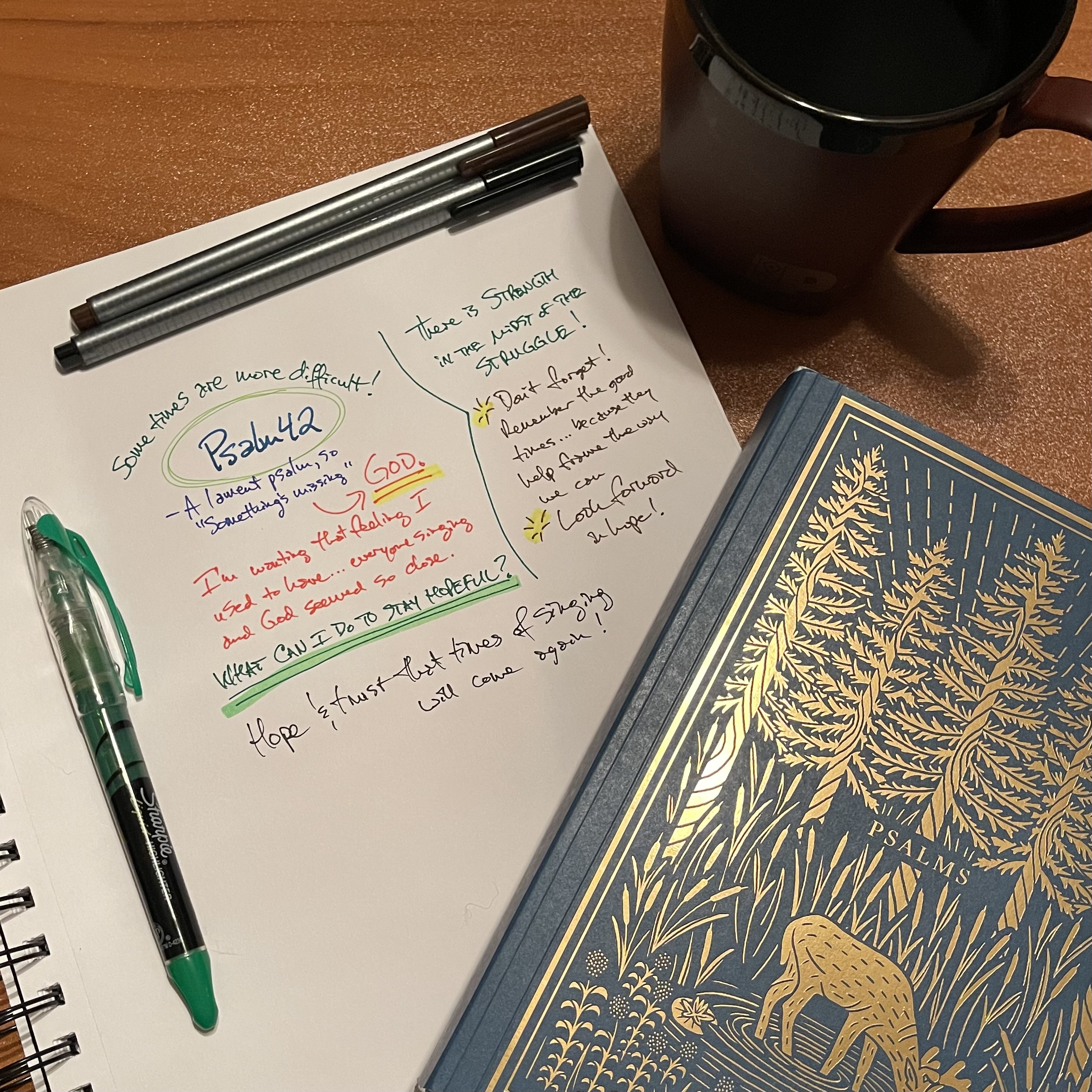
A Week With Psalm 42
In my post last weekend I chose to spend five minutes each morning last week with a cup of coffee and Psalm 42. Since I’m not preaching today and don’t have a sermon to share, I thought I might reflect on the week’s intention with scripture. Whatever else I was doing in practicing morning prayer or starting up each day, I was sure to refresh my coffee, set a five minute timer on my watch and open up to Psalm 42 to read and meditate a bit. It’s a familiar and beloved Psalm, especially if you grew up as I did in church circles singing some version of As The Deer.
Psalm 42 is a song of lament, that means it’s essentially a song about being upset that something is missing. In Psalm 42 the singer is missing their past closeness to God and the peace that comes with God’s presence. I’ve used and enjoyed several different translations during the week, but by far I’ve most loved the wording from the New Living Translation. It renders the opening line of verse 4 as “My heart is breaking as I remember how it used to be…” That line has really resonated with me, the sentiment of remembering better, or at least good, times.
Looking Back
We can all relate with that sentiment in some way, can’t we? Whether remembering all that we took for granted before the COVID pandemic, or times when our younger bodies had more energy and fewer aches and pains, or a time gone by when our spirituality was easier, richer and more satisfying: we get it. When today gets difficult, memories of yesterday can be a comfort. The psalmist has obviously fallen into some hard times, but there’s some peace and comfort in looking backward and remembering the good days of joy and praise.
Looking Forward
The psalmist also looks forward using a refrain which occurs twice in Psalm 42, in verses 5 and 11, and even again in Psalm 43, verse 5: “Why am I discouraged? Why is my heart so sad? I will put my hope in God! I will praise him again – my Savior and my God!” The NRSVue translation reads this way: “Why are you cast down, O my soul, and why are you disquieted within me? Hope in God, for I shall again praise him, my help and my God.”
Strength in the Struggle
The sentiment is clear, we have strength in the struggle remembering what we have experienced of God to be true and looking ahead in faith and hope. Our faith and our scriptures don’t deny that we will have struggles or ever promise to eliminate all the struggles. Our faith doesn’t judge us for struggling. We all have times when our souls are heavy with grief, anxiety or fatigue, times even when breathing seems a chore. Looking back to remember the good times can be a source of strength for the moment and a way to frame the way we look forward, hopefully looking to the day when the good times will return and we will again hear the music and sing the songs.
Are we in a time of lament, today? What was a good time? What was it like and how did it feel? Those times will come again, and God has never left. We can rest in the memories and faithfully hope that good times are coming again. God’s love has never ended, faded or been stolen; God’s love is our anchor in the storm and energy when it’s time again to dance.
Be blessed, Rev. Todd
Holy Spirit Novena in 2019
To start off the new year of 2019, and in recognition that I need this so badly right now, I’ve worked on a simple novena with the Holy Spirit. I welcome anyone who would like to join me for the next nine days and I’d love to hear about your experience!
 What is a Novena? The short answer is that a novena is a nine day stretch of special prayer emphasis. This is an ancient Christian practice which is connected to many things including a traditional count of nine days between Christ’s Ascension and the day of Pentecost in the lives of the Apostles, and even a pre-Christian period of mourning and prayer in Roman culture. There’s nothing magical about a novena, or the number nine, and it surely cannot put any obligation on God. It is prayer, and as such God hears us and loves us. Prayer changes us by helping us stay focused and in tune with God, and this novena practice is simply a method of prayer.
With this novena we’ll look into some scriptures, a new passage each day, but we aren’t doing scholarly theological work. We’ll look into these holy words for inspiration and encouragement. We’ll see how these scriptures illuminate the work of God’s Spirit to bind us together into a whole, with one another and with the Divine.
Here’s the plan, in two easy pieces, 1) Morning & 2) The Rest of the Day:
MORNING: (or morning’ish if you get busy) Begin each day by reading its passage and the very short reflection, and then use the following prayer, changing it to reflect your own faith and experiences if you’d like, to begin a time of prayer. The whole morning exercise might be ten minutes long.
Morning Prayer:
“Holy Spirit, here I am. I would draw nearer to you,
nearer to my God and nearer to my Savior Christ.
I would be more fully present with my family, friends and neighbors.
Help me be the person you would make of me.
Through Christ. Amen.”
DAY-NIGHT: Throughout the rest of the day, let the passage and your prayers go with you. Reflect on them when you can. If anything comes to your mind or heart, you can journal those notes to keep them. If you’d like, feel free to read the passage again and pray as often as you like. As you go to bed, give a few minutes of prayer to reconnect with God in gratitude for the day and hope for tomorrow.
Easy peazy, right? I’ll be doing this for the next nine days, January 1-9, and I invite you along for the ride. Again, I’d love to hear about your experience with this novena practice. Be well, beloved, and Happy New Year!
January One
Spirit of Life – Galatians 5:22-26 “By contrast, the fruit of the Spirit is love, joy, peace, patience, kindness, generosity, faithfulness, gentleness, and self-control. There is no law against such things. And those who belong to Christ Jesus have crucified the flesh with its passions and desires. If we live by the Spirit, let us also be guided by the Spirit. Let us not become conceited, competing against one another, envying one another.”
We begin with this beautiful metaphor of the way that opening ourselves up to the Spirit of God can change us. The best things are grown from our hearts and minds when we allow the Spirit to change our hearts and minds. Can I imagine God transforming me to show and to share more love, joy, peace, patience, kindness, generosity, faithfulness, gentleness, and self-control in an often hurting world?
January Two
Spirit of Community – Ephesians 2:13-22 “But now in Christ Jesus you who once were far off have been brought near by the blood of Christ. For he is our peace; in his flesh he has made both groups into one and has broken down the dividing wall, that is, the hostility between us. He has abolished the law with its commandments and ordinances, that he might create in himself one new humanity in place of the two, thus making peace, and might reconcile both groups to God in one body through the cross, thus putting to death that hostility through it. So he came and proclaimed peace to you who were far off and peace to those who were near; for through him both of us have access in one Spirit to the Father. So then you are no longer strangers and aliens, but you are citizens with the saints and also members of the household of God, built upon the foundation of the apostles and prophets, with Christ Jesus himself as the cornerstone. In him the whole structure is joined together and grows into a holy temple in the Lord; in whom you also are built together spiritually into a dwelling place for God.”
In Christ our racial and national divisions are made inconsequential. God’s Spirit would grow us together, removing barriers and binding us to one another. Am I open to less hostility in my life, open to more peace between myself and all my neighbors, and open to being together with people not like me?
January Three
Spirit of Service – Romans 12:1-8 “I appeal to you therefore, brothers and sisters, by the mercies of God, to present your bodies as a living sacrifice, holy and acceptable to God, which is your spiritual worship. Do not be conformed to this world, but be transformed by the renewing of your minds, so that you may discern what is the will of God—what is good and acceptable and perfect. For by the grace given to me I say to everyone among you not to think of yourself more highly than you ought to think, but to think with sober judgment, each according to the measure of faith that God has assigned. For as in one body we have many members, and not all the members have the same function, so we, who are many, are one body in Christ, and individually we are members one of another. We have gifts that differ according to the grace given to us: prophecy, in proportion to faith; ministry, in ministering; the teacher, in teaching; the exhorter, in exhortation; the giver, in generosity; the leader, in diligence; the compassionate, in cheerfulness.”
Has the Spirit called me to ministry? To service? Have I felt at times that I have a gift? This is all for the building up of our community of faith. Have I worked to move my ego aside and desired to be put to service for others around me?
January Four
Spirit of Diversity & Unity – 1 Corinthians 12:4-12 “Now there are varieties of gifts, but the same Spirit; and there are varieties of services, but the same Lord; and there are varieties of activities, but it is the same God who activates all of them in everyone. To each is given the manifestation of the Spirit for the common good. To one is given through the Spirit the utterance of wisdom, and to another the utterance of knowledge according to the same Spirit, to another faith by the same Spirit, to another gifts of healing by the one Spirit, to another the working of miracles, to another prophecy, to another the discernment of spirits, to another various kinds of tongues, to another the interpretation of tongues. All these are activated by one and the same Spirit, who allots to each one individually just as the Spirit chooses. For just as the body is one and has many members, and all the members of the body, though many, are one body, so it is with Christ. For in the one Spirit we were all baptized into one body—Jews or Greeks, slaves or free—and we were all made to drink of one Spirit.”
The Spirit seems to be a powerful player among us, enabling us for ministry and communal service. We aren’t all made to be alike, but in diversity we are made to be one whole. Have I appreciated all the people around me who are not gifted as I am or talented in the things I enjoy and have pursued? Have I told them?
January Five
Spirit of Hope – John 14:25-27 “I have said these things to you while I am still with you. But the Advocate, the Holy Spirit, whom the Father will send in my name, will teach you everything, and remind you of all that I have said to you. Peace I leave with you; my peace I give to you. I do not give to you as the world gives. Do not let your hearts be troubled, and do not let them be afraid.”
Jesus spoke these words to the apostles about the coming of The Spirit. Have I sought The Spirit’s presence for wisdom, truth and peace? Am I more focused these days on things which blind my wisdom, hide the truth and steal my peace?
January Six
Spirit of Strength – Romans 8:24-27 “For in hope we were saved. Now hope that is seen is not hope. For who hopes for what is seen? But if we hope for what we do not see, we wait for it with patience. Likewise the Spirit helps us in our weakness; for we do not know how to pray as we ought, but that very Spirit intercedes with sighs too deep for words. And God, who searches the heart, knows what is the mind of the Spirit, because the Spirit intercedes for the saints according to the will of God.”
Does it help to know that The Spirit is praying with us, even when we can’t hear those prayers? Does it help to know that our weakness is not a sign of or cause of God’s absence, but our weakness is actually an open door for God’s Spirit and presence in our lives and struggles?
January Seven
Spirit of Renewal – Titus 3:3-5 “For we ourselves were once foolish, disobedient, led astray, slaves to various passions and pleasures, passing our days in malice and envy, despicable, hating one another. But when the goodness and loving kindness of God our Savior appeared, he saved us, not because of any works of righteousness that we had done, but according to his mercy, through the water of rebirth and renewal by the Holy Spirit.”
I have to admit that I often feel like I am still quite stuck in life dominated by thoughts and habits very foolish, disobedient, led astray, slaves to various passions and pleasures, passing our days in malice and envy, despicable, hating… So, can I pray with an extra depth, “O Spirit of God, renew me!”
January Eight
Spirit of Freedom – 2 Corinthians 3:17-18 “Now the Lord is the Spirit, and where the Spirit of the Lord is, there is freedom.And all of us, with unveiled faces, seeing the glory of the Lord as though reflected in a mirror, are being transformed into the same image from one degree of glory to another; for this comes from the Lord, the Spirit.”
In a time when organized religion is not always associated with freedom, but sometimes with oppression and captivity, can I revel in the freedom of the Spirit? Can I gift that freedom to others around me, loving them and serving them with a whole heart?
January Nine
Spirit of Presence – Acts 2:1-4 & 14-18 “When the day of Pentecost had come, they were all together in one place. And suddenly from heaven there came a sound like the rush of a violent wind, and it filled the entire house where they were sitting. Divided tongues, as of fire, appeared among them, and a tongue rested on each of them. All of them were filled with the Holy Spirit and began to speak in other languages, as the Spirit gave them ability… But Peter, standing with the eleven, raised his voice and addressed them, “Men of Judea and all who live in Jerusalem, let this be known to you, and listen to what I say. Indeed, these are not drunk, as you suppose, for it is only nine o’clock in the morning. No, this is what was spoken through the prophet Joel: ‘In the last days it will be, God declares, that I will pour out my Spirit upon all flesh, and your sons and your daughters shall prophesy, and your young men shall see visions, and your old men shall dream dreams. Even upon my slaves, both men and women, in those days I will pour out my Spirit; and they shall prophesy.”
Have I had any dreams or visions in this novena time? Have I heard God? Have I felt the Spirit? Have I grown in my desire to know God’s Spirit? It’s not always like we think it should be, and the apostles were even considered drunk when the Spirit was poured out on the world and they spoke in all those languages. Maybe I’m expecting one thing and God is doing something else?
After the Novena:
Is there an insight you want to carry forward? Write it down, pray over it and share it with others in your faith community. And I’d love to hear about your experience! All to God’s glory and the benefit of the earth. Amen.
AMDG, Todd
Why Am I Still A Christian?
 I’d like to start with a confession, and then an admission. First, I’d like to confess that 2017 was a tough year for me, and I often vacillated between feeling neglected by God and neglectful of God. I was riding the struggle bus, front row. In a tough year like that it’s hard to pray, and I didn’t pray like I wish I had. In a tough year like that it’s easy to let one’s emotional desolation color all things, even the blessings, in a shadowed undervalued light. My admission is that I am still devoted to my Christ, to the call that God placed upon me so many years ago to be a servant of the world and the church. I’m ready to get off that struggle bus and begin again to serve and share life in a close-knit community of faith. But as I started this new year a question occurred to me and continued to feel very relevant for this time in my life: Why am I still a Christian?
It’s not a bad question. I’ve been a follower of Jesus Christ, by conscious choice, since my baptism when I was fifteen years old. That’s almost 33 years… my 48th birthday is next month. For the vast majority of my adult life I have been employed by churches in different positions of ministry and service. I’ve studied Christianity and other religions, and I have had many deep and wonderful relationships in and outside of the church. I have left the church tradition of my youth, pastored outside of all the established denominations, and eventually landed a few years ago in the Episcopal Church. For the last three years I’ve worked for Apple (full-time for the last two years) as a retail store technician, salesperson, trainer and most recently in store leadership. Two years out of ministry and after a rough year in 2017, I’ve been feeling very unemployable in ministry. At this moment I don’t have any firm path or prospect back into the religious vocational calling of my life.
Maybe we should start with a couple of reasons I don’t accept for why I’m still a Christian, after all these years and after so many recent disappointments. Reasons which are not accurate for why I’m still a Christian: 1) “I’m paid to be a Christian.” Nope. No one has paid me to be a professional religious person for over two years. I don’t think that was ever a reason why I was a Christian, but it’s worth mentioning that my paycheck does not depend on my faith. 2) “I have to be a Christian because all other religions are so wrong.” Nope. I’ve been leaning over the years toward something that many would call a form of universalism, though I would not say I’m a universalist. I’m not a Christian because I think that Jesus wins the grand cosmic religious competition, because I don’t think religions are intrinsically in competition.
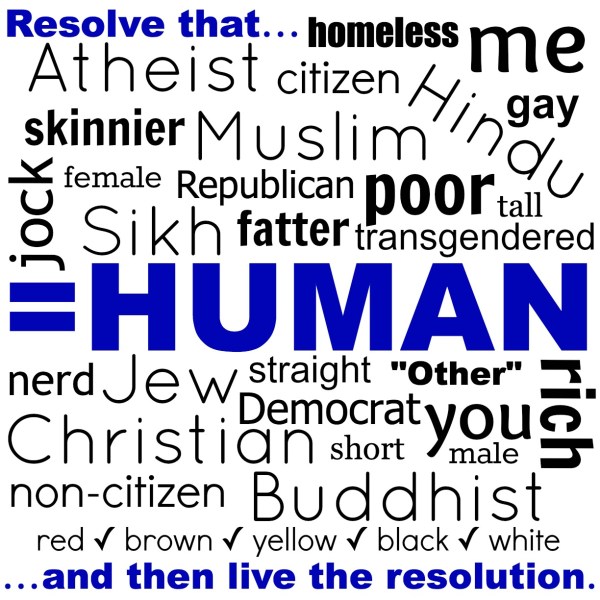
Why still be a Christian? I’m going to be breaking this into several blogs for while, sort of a Lenten expedition for myself. Yes, next Wednesday is Ash Wednesday and Valentine’s Day! In short I have been looking at a few ideas, answers to my question: journey, experience, meaning and witness. We won’t necessarily take them in that order or hesitate to add to the list. On April 8th I’ve been invited back to the pulpit at St. John’s Norwood to preach, and the Gospel passage that day is from John 20 when the Apostle Thomas touches the wounds of his resurrected Lord. He previously rejected the witness of the women and men who had seen Jesus and demanded his own evidence. In our passage Jesus graciously allows Thomas to feel his wounds and then gives a blessing for all who accept the witness in faith without demanding a touch of their own. Today, we have the question of what to do with this amazing witness. The graphic I chose to include with this blog post is an example of meaning, the meaning that faith can give to words and decisions, to life.
Why I’m still a Christian is also a great question in view of my coming pilgrimage to Israel and Palestine in April, just 65 days away! I will be walking where Jesus walked, and seeing places and landscapes central to the lives of those early witnesses who still speak to us, today. I’m going to blog my exploration of this question to help myself hear my own thoughts, to gain clarity and hopefully to hear from you as well. May God bless your 2018, and may all our efforts to be faithful and authentic be pleasing to God and enriching for us and the world around us.
AMDG, Todd
Choosing Wholeness – Sermon Transcript
It was a deep blessing to be invited back to Church in Bethesda this past Sunday morning to bring a message during worship. I’m dropping the transcript of the sermon, below. I share this realizing that choosing wholeness and achieving wholeness are often two very different things, but I do believe we begin with the choice. Cheers!
Choosing Wholeness
Our text is Matthew 6:26-34 from The Inclusive Bible:
26 “Look at the birds in the sky. They don’t sow or reap, they gather nothing into barns, yet our God in heaven feeds them. Aren’t you more important than they?27 Which of you by worrying can add a moment to your lifespan? 28 And why be anxious about clothing? Learn a lesson from the way the wildflowers grow. They don’t work; they don’t spin. 29 Yet I tell you, not even Solomon in full splendor was arrayed like one of these.
30 If God can clothe in such splendor the grasses of the field, which bloom today and are thrown on the fire tomorrow, won’t God do so much more for you—you who have so little faith? 31 “Stop worrying, then, over questions such as, ‘What are we to eat,’ or ‘what are we to drink,’ or ‘what are we to wear?’ 32 Those without faith are always running after these things. God knows everything you need. 33 Seek first God’s reign, and God’s justice, and all these things will be given to you besides.
34 Enough of worrying about tomorrow! Let tomorrow take care of itself. Today has troubles enough of its own.
Good morning, everyone. I come to you in the name of the God who dresses wildflowers in their bold colors and striking style, who sees each individual in the vast clouds of birds which crisscross our skies, and who sends us to seek and make justice in our world. Let us pray…
“Saving God, may we seek you and your justice, trust you deeply and move into this world as your agents of peace, and kindness, trendsetting only when showing the great glory of your mercy and grace. May the words of our mouths and the mediations of our hearts be acceptable to you, our Rock and our Redeemer. Amen.”
It was an interesting experience to put our passage from Matthew 6 out on Facebook this week as our text for today, and immediately hear from multiple people something like, “Oh that’s my favorite text!” The longer I live, the more I fall in love with our diversity as human beings and people of faith. I did not choose the text for today because it’s one of my favorites, in fact, I chose it because it holds a message with which I struggle. An opportunity to speak to you is a chance, perhaps selfishly, for me to dig into a passage and grow.
You see, I’m good at worrying, it’s always been one of my special gifts. I’m not only kinda good at worrying, I’m also good to planning what I’m going to wear and especially what I’d like to eat. Just to illuminate that: When we lived Africa we had a professor from our seminary come and visit us, and I was so excited for us take him out and show him some the places where we were planting churches. As we drove through the rural areas I would often point to places along the road and say, “That’s a nice place to stop on the way home for some beans and rice. Oh, sometimes I like to stop over there because they have really good chicken. Sometimes I’ll go down here to the edge lake because companies bring ice to pack the day’s catch of fish in, and they use the ice to have cold Cokes!” He finally laughs and asks me, “Todd, are all your landmarks in life places to eat?” Yeah. They kinda were. Anyone with me on that way of mapping life?
I’m also paradoxically really good at procrastinating, even though my whole life I’ve tried not to procrastinate as much. Anyone else good at putting things off and feeling bad while doing it? Anyone else with me in wishing they didn’t put things off as much as we do? I’m a conflicted guy sometimes, making all these great plans and worrying, just to put off following the plans.
And in one little passage Jesus comes in and threatens my whole house of cards, to topple both my comfortable worrying and my comfortable guilt over procrastination: he says, “Don’t worry about anything, just put it off until tomorrow.”
What? Am I to really do that? Doesn’t Jesus know we’ve invented some of our own proverbs over the years, proverbs about doing. “Cleanliness is next to Godliness.” Anyone ever try to find that one in scripture? It’s not there, but it does very aptly capture one of our societal and religious preoccupations, huh? And more to the point, we have often quoted and canonized a “verse” that’s not even in scripture: “God helps those who help themselves.” That is exactly opposite of what Jesus just said!
I remember hearing this passage as a young Christian and being mortified… Jesus just told me to goof off. Every other teacher I’ve ever had has told me the opposite. Because at a glance, in English, this looks to be a debate about goofing off, when it really it’s more a text about wholeness.
The Greek word for anxious here is merimnaó, “a piece instead of a whole.” Jesus says not to let ourselves get pulled to pieces by life, taken apart by cares and concerns over small stuff, but as whole people seek the greatest things, and remain whole people by focusing on the greatest things: God’s reign, God’s justice. Hear the passage again, but paraphrased a bit with this drive for wholeness woven into the text…
Look at the birds in the sky. They don’t work like we do to buy the stuff we buy, yet God’s birds have all they need. Aren’t you smarter than birds, who just go be the birds they were made to be without worrying if they’re bird enough? Which of you by falling apart over the small stuff can add a moment of meaning to your life? Why lose your bearings in life over clothing and fashion? Really? Learn a lesson from the way the wildest flowers of the field grow. They don’t work. They don’t shop. Yet not even King Solomon in his fullest splendor was as amazing a sight as one of these delicate marvels. In God’s world outward adornment is casually lavished on the unplanned growth of the fields, which measure so small against your value – you have been made even more wonderfully. You don’t need a bunch of other adornment to be the beautiful creation God intended you to be.
So, decide today that you’re not going to keep falling apart and losing yourself in addictions to food and fashion. You are so much more those things, made to be so much more. Anyone can dress, and anyone can eat, and everyone does. God knows you. God loves you. So, live to see God’s glorious peace in this world, first in your own life and then multiplied around you. Live to see God’s justice made real in this world, first in you, and then multiplying in the world around you. Enough falling apart over the junk that doesn’t really make us happy or fulfilled… that stuff steals from us our today and promises us a false tomorrow! There’s enough need for justice today to keep us busy. Tomorrow will present opportunities for action and justice all its own.
Folks, I’m still going to do my laundry. Jesus wasn’t saying I have permission to stop doing my chores. I’m still going to eat, and Asian foods like Phó and Bulgogi will still be some of my most favorites. I plan to eat them some more. But I’m also going to hold extra tight to the truth that no matter how well I dress, someone, honestly a bunch of someones, will be dressed better. No matter how well I wear my clothes, there’s always some who will wear them better. And no matter what I eat, my favorite foods or not, it is still fuel for the meaning, it is the energy for what matters: God’s will and God’s reign in me and God’s justice for those who most need it.
May we never lose sight, that after the food is done, the clothes have faded, and all that we thought was so important has vanished from memory like last year’s whithered flowers, God’s justice and the hope that God’s justice engenders in us and the world, that is our tomorrow.
It’s no wonder that this passage drops into it’s context as it does, caught between the discussions of heavenly treasures and not judging. This passage is a natural extension of putting our focus on heavenly values, the things worth treasuring, and it’s a perfect prelude to a warning about judging people around us or succumbing to that judgement.
Wholeness is the opposite of judgment. Wholeness is a refutation of life lived as critical competitors focused on the flaws of others. Wholeness is freeing for us and the world around us.
No, Jesus isn’t writing us a life-long hall pass to skip class and goof off from our responsibilities. Jesus is reminding us that God is involved here, and even if the clothes fade and the flowers whither, there is justice, there is peace, and there is life infused with meaning, the kind of meaning that lasts.
So, fly. The God of the Birds has also given you wings. And smile. Enrich this world, for the God of Flowers has also made you beautiful and amazing. This is our gospel, our Good News. Amen.
Thanks, everyone at CiB, for a blessed morning together!
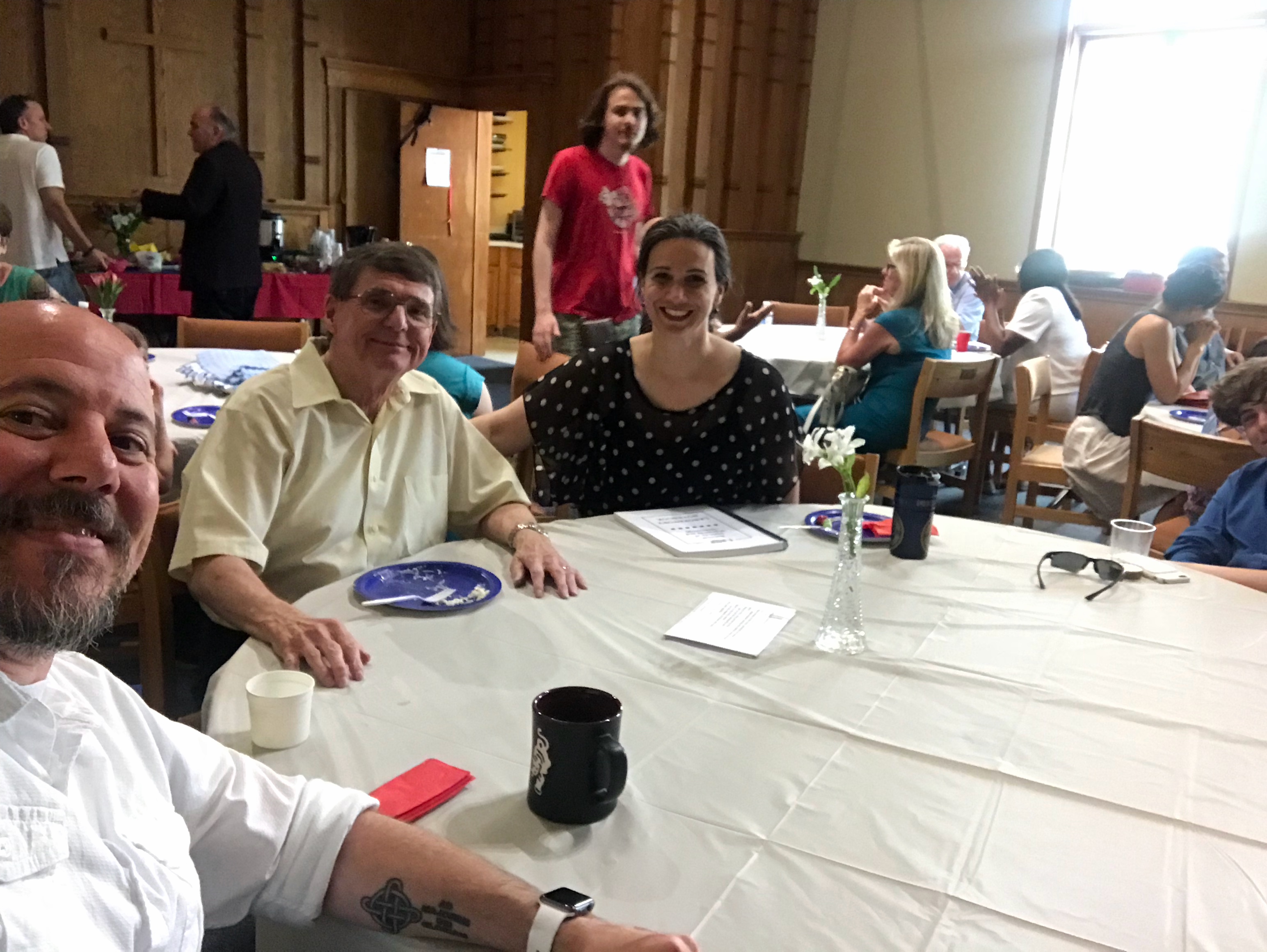


Here’s a link to CIB’s post about our visit with a few more pictures: https://www.churchinbethesda.com/single-post/2017/07/06/Thank-you-Todd-and-Teresa-Thomas
Blind Piety
 President Trump’s America is looking less and less American, and totally un-Christian. With the flurry of controversial executive orders our new President has shown the effects of something with which many Christians in the West seem to suffer: blind piety. All in the name of morals and American values, with a strong dash of dishonesty and fear-mongering, our new President shreds the image of America around the world and moves us farther from the Christian values of justice, mercy and love for our neighbors. President Trump road a wave of this blind self-centered piety and unreasoning fear all the way to the White House. Now some of the most vulnerable people on the planet are beginning to pay the price.
What is blind piety? Piety is defined as a quality of being religious or reverent. Blind piety is a religiosity that ignores its negative and hurtful impact on the people around it. Jesus actually condemned it in his own day, and an apt name would also be shallow piety or even mean piety. Jesus condemned the religious leaders of his day who acted piously in vowing their income to the support of the Temple, but in doing so actually neglected their own aging parents who were in need. (Matthew 15) Now, I always wondered at that passage thinking, “How will something like that ever find a dynamic equivalent, today?” Well, ask and receive. It’s been played out on our national stage just this week. With an executive order that piously calls on abortion as a reason to cut our nation’s international help to some of the most needful and most defenseless women and families around the world our President has endangered lives, and many religious people are applauding and smiling. Blind piety. Mean religion. Just as in the day of Jesus, religion used to deny people our assistance is an affront to God.
 At another time (Luke 14) Jesus chastises the hypocrisy of the religious thinkers who would refuse to help a fellow human being because of the religious obligations of not working on the Sabbath, but of course they would rescue a child or an animal in sudden distress. The hypocrisy is staggering, and it’s playing out before our eyes in this day and age. Our leaders are turning away from the most needful and endangered children on the planet, and mantling themselves in faith and patriotism while doing it! The President continues to narrate his actions with the familiar and completely dishonest alternative facts about a lack of vetting and the danger represented by refugees. He targets Muslim nations and vilifies and criminalizes the most vulnerable people on the planet. He speaks of walling us off from others, as though we are not all connected human beings with a shared and mutual life on this planet. These actions are not Christian, American or moral.
Why did Jesus condemn those religious leaders of his day? It was for what they had neglected: people. People are at the core of religious law, as he named that core: justice and mercy and faith. (Matthew 23) Jesus will later sum up the Law in two expressions of love: love for God and love for neighbor. (Matthew 25) The problem is not that religion is against people, but these people were misunderstanding their religion. We are guilty in the same way today when we turn from justice, mercy and faith to hide behind fear, exclusion and dishonesty. Some have chosen a blind piety that neglects people.
 The sad truth is that these Christians in the West are turning from one of our oldest and deepest religious values: the heart of a stranger. Far back in our oldest Jewish religious roots as Christians is this amazing idea of identifying with the endangered. God gave Israel strict rules for protecting the alien and stranger among them, for blessing them and for serving them. The people of Israel were reminded of their own time as strangers in a strange land, and therefore they should hold to the heart of a stranger. (Exodus 22 & 23, Deuteronomy 24) That is an amazing statement and command of empathy and service. Until the incarnation of Christ into human flesh I cannot think of a more identificational statement in scripture.
These current events call for our silence to be broken and our voices raised. This political landscape suddenly shifts to assault our deepest religious values and we cannot withhold our condemnation of these executive actions. Let us be courageous and true. Let us be vocal and honest. Let us speak against these executive actions and their false religiouslity, blind piety and alternative facts. Let us be as courageous as Jesus to speak for justice, mercy and faith. That courage got him ridiculed, cast out and killed, but most of us face far less danger in our privileged status here in our own country. Privilege is never a license to ignore injustice, forget mercy or live faithlessly in our own time.
Ad Majorem Dei Gloriam, Todd
(to the greater glory of God)
More Grace in 2017
 If you’ve been around me much you may know of my affection for the Book of Sirach, sometimes called Ecclesiasticus, an apocryphal book not always included in English translations of the Hebrew and Christian scriptures. It’s a very practical book of wisdom, one ancient mind’s interpretation of Hebrew Law and faith for those outside of Israel or those within who wish to study deeper into God’s instruction.
As an ancient book and being set entirely in an ancient worldview and mindset, there are many things which do not immediately resonate with us. But even across the thousands of years, there is so much to learn from these words. In the passage we’re reading today the writer of Sirach prepares us to gossip less, be more forgiving and less judgmental, and to seek truth in our relationships, to give the benefit of the doubt and to extend grace to others. Check it out…
Sirach 19:4-17
4 One who trusts others too quickly has a shallow mind,
and one who sins does wrong to himself.
5 One who rejoices in wickedness will be condemned,
6 but one who hates gossip has less evil.
7 Never repeat a conversation,
and you will lose nothing at all.
8 With friend or foe do not report it,
and unless it would be a sin for you, do not reveal it;
9 for someone may have heard you and watched you,
and in time will hate you.
10 Have you heard something? Let it die with you.
Be brave, it will not make you burst!
11 Having heard something, the fool suffers birth pangs
like a woman in labor with a child.
12 Like an arrow stuck in a person’s thigh,
so is gossip inside a fool.
13 Question a friend; perhaps he did not do it;
or if he did, so that he may not do it again.
14 Question a neighbor; perhaps he did not say it;
or if he said it, so that he may not repeat it.
15 Question a friend, for often it is slander;
so do not believe everything you hear.
16 A person may make a slip without intending it.
Who has not sinned with his tongue?
17 Question your neighbor before you threaten him;
and let the law of the Most High take its course.
As we move into 2017 this can become a worthy intention for us all, especially in this day of social media and internet driven false-news. When inflammatory things are said of anyone, give the benefit of the doubt. This is a faithful and graceful practice for our immediate neighbors as well as those in public office and service. Can you relate to the metaphor of a fool hearing some juicy gossip and suffering birth pangs until it’s repeated? I can.
I believe 2017 needs just a bit more chilling out and listening and a lot less freaking out and screaming from me and from you, from all of us. Because, as this ancient writer reminds us, we can all make mistakes, often without even realizing it.
AMDG, Todd
Treat People Like People
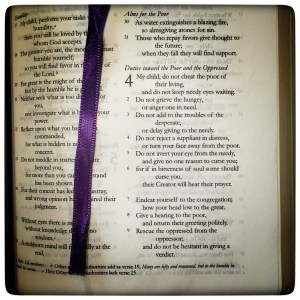 I’m on a Sirach kick again, as happens every couple of years. I have a deep affinity with the Wisdom of Jesus Son of Sirach, or Ecclesiasticus. It might also be called Ben Sira. Fun, huh? It’s a unique kind of book among the Apocrypha and scripture in general as the work of a proud grandson, an interpretation out of Hebrew of his grandfather’s acquired knowledge and wisdom.
Pressing Down. As a young Christian I was taught to primarily read scripture in a transactional way: do this and get this, don’t do this and don’t get this. Life was a cosmic vending machine and God was the correct change. Most things in life were a linear transaction of cause and effect, and the scriptures were a guidebook for making the best transactions. While many passages seem to support this way of reading scripture, there’s much more to be experienced. Pressing down into the way of a passage can remake us into new people, whole new communities.
Ecclesiasticus looks very much like the guidebook to end all guidebooks. However, like shifting one’s focus from the nearest trees to the farthest, we can press deeper and farther. Rather than take the transactional sounding statements as the product, let’s view them as the tools to create something bigger: a more just and blessed world.
and do not keep needy eyes waiting.
or delay giving to the needy.
or turn your face away from the poor.
and give no one reason to curse you;
their Creator will hear their prayer.
bow your head low to the great.
and return their greeting politely.
and do not be hesitant in giving a verdict.
and be like a husband to their mother;
you will then be like a son of the Most High,
and he will love you more than does your mother.
Knowing When Not to Quote
 Sunday afternoon Teresa and I asked Isaac what they had studied in youth group class that morning. He said they had talked about “rules” and done some reading in Leviticus. If I recall correctly he said something along the lines of “Man, there’s some crazy stuff in Leviticus.”
First, let me simply concur. There are many things in the scriptural book of Leviticus that seem quite crazy to us, today. As a few examples, we have to stop enjoying our bacon, but even more than just bacon, no fat! (Leviticus 11 & 3). We also find ourselves in a Hipster paradise with no rounded beards… all squares and angles, baby. (Leviticus 19) And sorry, Maryland, no more of the planet’s best crabcakes! (Leviticus 11)
On a far less humorous note, verses from Leviticus that proscribed certain sexual activities are used today to condemn and promote hatred toward our valuable LGBTQ neighbors, friends and family. (Leviticus 18 & 20) Not awesome.
It was a great conversation starter with our son to share an important principle: I love and revere our scriptures, and showing them the utmost respect often means knowing when not to quote them. Those verses from Leviticus seem crazy to us mostly because they are from a far away place, far away time and for a far away audience. As a white, GenX, Texas raised Evangelical turned Episcopalian, I could hardly be further from the context and time of the Levitical audience. We’re separated by time, geography, culture and we’re even different religions.
There’s nothing respectful about quoting and handling scripture as though we aren’t in a different time and place. In fact, for scriptures to be most understood and beneficial to us today, we have to be aware and accepting of our own time and place. This way we let the message for that time be what it was, and we trust in God to help us understand the message for this day and time. Some of those messages may be the same. Some will not.
When it comes time to quote something, let’s hold tight to the timeless values and ideas that transcend and permeate our scriptures from beginning to end, as summarized by our Sovereign: 37 He said to him, “‘You shall love the Lord your God with all your heart, and with all your soul, and with all your mind.’ 38 This is the greatest and first commandment. 39 And a second is like it: ‘You shall love your neighbor as yourself.’ 40 On these two commandments hang all the law and the prophets.” Jesus in Matthew 22:37-40 If we’re serious about finding an application for the verses from Leviticus in life today, we’ll do so within the love Jesus points us toward. Any application or understanding of the Law will be upheld by or be removed by that love.
AMDG, Todd
 toddthomas.net