
LGBTQ
Grateful for Justin Lee
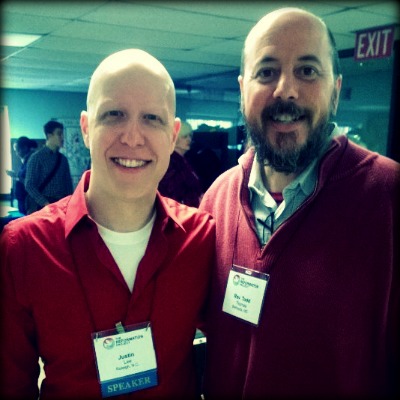 Today, I’m feeling really grateful for an acquaintance of mine, Justin Lee. He’s the kind of guy I want to say is my buddy, but we haven’t hung out all that much. We did have a chance to sit a few years ago at the Wild Goose Festival and enjoy some beer and pizza one afternoon… and to offset the anemic feel of our just being acquaintances, I’m throwing in a pic of he and I together last year in DC! =)
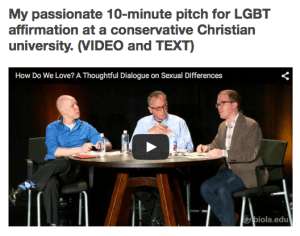
Justin wrote the book, Torn, and it’s great. He’s the founder of the Gay Christian Network, and he also recently gave an excellent ten minute snapshot of both the predicament in which LGBTQ Christians often find themselves, and the wrong hurtful ways that straight Christians are responding to that predicament. It’s worth so much more than ten minutes of your time! Here’s the link, and Justin’s ten minute remarks begin at the 41 minute mark of the video. Enjoy!
AMDG, Todd
Click below to jump to Justin’s site with the video, and go to minute 41 for his remarks!
SLGBTQ: Human
 I was just sitting there yesterday and wishing that we didn’t have to have the LGBTQ label set for talking about our many friends, family and cherished neighbors who identify outside the heterosexual majority or the rigid gender norms of our society. I was thinking, “What if I start putting as S along with the LGBTQ to include those of us who are straight: SLGBTQ? Would it be an understandable way to assert that we are all human and more connected in our similarity than disconnected in our differences? Does it convey our oneness?”
We use labels for some fairly justifiable reasons. Labels help us avoid confusion. Labels help us delineate between people, groups and things at times when it most matters to make useful distinctions. But we also know that labels can harm, bully and de-humanize. We have to handle labels with extreme care. As an overly privileged American white, male, Christian, clergy person, I have to be very careful and aware that my use of labels has the potential to disenfranchise people and to show gross paternalism and condescension.
I’ll still be using the LGBTQ label, and I don’t have plans at this time to try to mainstream the use of SLGBTQ. But I also want to take a moment and remind myself, out loud, that we are all humans with God-endowed dignity, value and beauty. Even as I use the LGBTQ label I reject it as a replacement for the beautiful persons, the women and men I know and love who happen to be lesbian, gay, bisexual, transgender or queer. I suppose I’m also a little selfish in hoping that my own value and gifts shine brighter than the S and the other labels I carry myself.
Can I ask that we all take a moment to wrap a little extra padding around our words and attitudes, a bit more of a protective coating for our neighbors and ourselves? We all have ideas, beliefs, arguments and propositions which we hope to advance in conversation and action… can we make sure that a mutuality of love and concern prefaces all of those and takes precedent over all else? Jesus connected love of neighbor with love of self, a mutuality of dignity and concern, “Love your neighbor as yourself.” (Matthew 22:34-40) Try not to see an S or an L or a G or a B or a T or a Q in front of you… see a human being, a neighbor, and love them intensely with purity and sincerity.
Day to day I need both to love and to be loved. I can’t know today if you need a reminder to love others or to love yourself. I can’t know if you need more to be reminded that you’re loved or to grow in love for others. I only know that we’re all in the same boat. I love you. Please love me. We all need love and we all need to love. Let’s not allow anything to stand in the way of either movement in our lives. Such is the work of Christ.
AMDG, Todd
Be Counter-Cultural Jesus Style
No. No. No.
TACOMA, Wash. — A woman was choked and stabbed and had homophobic slurs written on her body with a marker in an attack early Sunday in Tacoma…
The 45-year-old woman was attacked while looking for her dog that had slipped out of her house about 3 a.m. She was followed into an alley by the man who made homophobic slurs during the assault…
The News Tribune of Tacoma reported that the man kept saying to her, “Are you a dyke? God hates fags.”
 What God actually hates: the injustice and abuse of the attacker’s actions and hate. There is no room in our world for this kind of thing. And there is no excuse for hate engendering language which fuels this kind of an attack. Before spouting off more on the alleged culture war in our country and the problem of those people, please know that it’s not just a battle of words and many LGBTQ people suffer daily from the rhetoric.
Want to be on God’s side? Love more, love all, love stupidly until people think you’re a raving lunatic for your inexplicable tirades on justice, liberty, dignity and the value of ALL people. Be counter-cultural as Jesus taught us: Love those who may not love you or be like you at all, and serve them, and sacrifice for them, and do not fight with any weapon but love, turning “the other cheek” and giving more than you’re asked to give, and not only rejecting murder and violence but also rejecting hatred and disdain. That’s basic, fundamental Sermon-on-the-Mount Christianity 101 stuff!
Stop the rhetoric which fuels this mess. Stop the us vs. them talk. Stop the “God hates {people you don’t like}” talk. Stop the “that just makes me sick” talk. Stop labeling people with agendas, bad intentions and criminalizing assumptions. Stop making anyone the butt of your jokes. Speak up for people’s dignity, freedom and value. Serve those least like you. See people through the lens of God’s raging love and the servant heart of Christ.
Be a peacemaker. Be prayerful. Be holy.
AMDG, Todd
Dreaming With Peter
 As I’m working on message notes for this coming Sunday, and I’m thinking that I haven’t done much on my blog in 2015 as of yet, I thought I’d share something I’ve been thinking of, along the lines of my post last year looking for an Acts 15 Council Redux on LGBTQ Inclusion.
Today’s post is similar in that I’ve been dreaming with another passage from the book of Acts, Acts 10 and the story of Peter and Cornelius. Today, I’m praying for more and more followers of Christ to dream with Peter. I want them to have visions of God’s grace and love enveloping people who maybe aren’t like them, people of whom they have have been taught are outside of God’s presence and present work.
I invite you to read that chapter, even if it is very familiar to you already. This post may feel a bit like a defense of my affirming beliefs, but believe me, I’m not feeling too stressed about defending myself. What little negativity I have experienced in being a straight ally is no comparison to the hurt and pain that some of my LGBTQ brothers and sisters have experienced in and outside of the church. These are just some of my thoughts right now…
I Relate to Peter’s Experience
I feel as though I have gone through something very similar to Peter’s vision and the events at the home of Cornelius. Like Peter, I was also raised not to associate with certain people and certain things, and I was taught that they were unclean. But as I opened my eyes and desired to see clearly for myself, I began to see things in a different light, and people that I had been taught to see as so wrong no longer seemed so wrong at all, but more wrongly understood. Then as my thinking begin to change I experienced something even more powerful; I began witnessing their faith and I saw God’s Spirit moving among them. More than my mind changed along the way; my heart changed as well.
And so I have moved in my life from just not wanting to condemn my LGBTQ sisters and brothers, to vocally advocating for the affirmation of their sexual identities and their inclusion as full members of Christ’s kingdom and fellow human beings endowed with all the dignity and value God bestows on us. I’ve written about my understanding of many scriptures that are often related to this topic of conversation, but it’s passages like Acts 10 and 15 where my hope truly waits for us to move. I do believe that this is something a bit new that God is doing in the church and it’s not a question to be answered by only by digging in ancient texts and arguing over Greek words… this is movement of the Spirit in us all.
God initiates all the action in Acts 10. God sends an angel to answer the prayer of Cornelius, a Roman soldier outside of God’s people by birth, ethnicity and religion. But this soldier has faith and is called devout and God-fearing, and in answer to that faith God instructs him to send for Peter. Meanwhile, God is also moving in Peter’s life in a surprising way; Peter has a vision of God tempting him to act against his religiosity and spiritual upbringing! Whoa. The vision presents Peter with animals to eat which have been forbidden to him by religious law and practice, and Peter refuses on religious grounds to do as the voice from heaven instructs him. But the voice answers Peter, “Do not call anything impure that God has made clean.” This happens with Peter three times until he hears the voices of the men sent by Cornelius.
Peter is a quick guy, pretty smart. He puts it all together and goes to the home of Cornelius. He goes and begins speaking with everyone gathered in the house and explains that though he would never have come there before, now “God has shown me that I should not call anyone impure or unclean.”
If you know the story, or if you just read it earlier, then you know how the narrative goes. Peter hardly gets through his explanation about Jesus before the Spirit is seen moving in the audience in an amazing way, and Peter and the others from Joppa are astonished. Peter calls for their baptism because, “They have received the Spirit just as we have.”
Do you feel the connection that I feel with this passage? Just as the Spirit moved to manifestly convince Peter that he should affirm and accept the faith of those Gentiles who were so unlike him, I believe that we heterosexuals, who constitute the majority, in and outside of faith, are being called to witness God moving outside our expectations. Some of us are so sure, after years of religious life and years of religious practice, that we know exactly all that God has done, is doing and will do. I’m encouraged by Peter’s example of following the Spirit, even into some new places and some new understandings.
Peter surely had to do some rethinking with his scriptures after this experience. He surely had to do some restructuring of his religious thought and practice. And in fact we know that this is not only difficult to do but we make mistakes and stumble along the way. Later on Paul will recount his public chastising of Peter for refusing to eat with Gentile converts, even after Peter has had this incredible experience (Galatians 2:11-21). Change is tough, scary and requires an on going commitment to making it last in meaningful ways.
I Was Already Re-Reading My Texts
Since I made a public statement of my affirming and inclusive interpretations of scripture and religious life, I’ve had some emails and messages to me asking in various ways, “How can you?” How can I deny what I was taught in my youth? How can I deny what is so plainly written (in English at least) in our scriptures? How can I break with tradition? How can I risk alienating people from God by teaching them falsely? Though I will try to answer those emails when I have time, the answer is simple and kinda like the story of Peter in Acts 10: You see, I went and found God there already. I didn’t need to necessarily save anyone.
I Found God With Them Already
As I came to understand many of our scriptural passages differently than I had been taught, I also began to know LGBTQ Christians, people of deep and authentic faith. I experienced the real disconnect between the criminalizing speech of many straight Christians about “the gay lifestyle” or “the gay agenda” and the reality of their beauty, faith and struggle. Indeed, I found that we are far more united in our similarity and faith than we are divided in our dissimilarity and sexual orientations.
I Believe I’m Simply Following God’s Lead
Some keep asking me about a presumed arrogance on my part, that I have in someway chosen to reject God’s authority and wisdom to rely on my own. Really, I don’t claim a single new thought here, folks. Yes, my thinking has changed a lot over the last ten years on this, and even more in the last few years, but I don’t claim for a moment that I have received any kind of a special vision or message from God… I’m using Peter’s story in Acts 10 as a metaphor. I think it’s an exciting metaphor for the way we can see and follow God moving through the world and through people. As the Gospel crushes ethnic and national barriers, so can it remove the barrier of our differing sexual orientations.
If you’re a traditionally non-affirming pastor, preacher, teacher, parent or average Jolene on the street, it can be scary to entertain the option of changing your mind. It can be isolating, endangering of your friendships, and even threatening to your job security if you are engaged vocationally with a non-affirming congregation, school or religious entity. Just to risk asking the question if there’s room for changing the way you’re currently interpreting scripture and taking certain stances on human sexuality can put you in jeopardy and make you feel as thought you are losing firm footing in your faith. I want to assure you that in my experience, God has been waiting for me catch up far more often than trying to hold me back and keep me reigned in. If you need a safe person to ask your questions with and discuss a new way forward, please just let me know!
Worshiping with my LGBTQ sisters and brothers, and hearing their stories and expressions of faith, I’m left with Peter joyfully proclaiming, “God has shown me that I should not call anyone impure or unclean.”
AMDG, Todd
A Civil Repudiation of a Judgmental Viewpoint
 Things like this pop up in the news every now and again, and I took a hit for the team today and actually listened to Pastor Steven Anderson’s full sermon entitled: “AIDS: The Judgement of God.” It came as no surprise that he generalizes people, uses stereotypes and exaggerates, and does some pretty horrible handling of scripture.
This preacher is not mainstream Christianity. He’s not even mainstream for Baptists, even non-affirming Baptists. He’s not doing good exegesis of scripture. He abuses his concordance by picking and choosing uses of English words across the breadth and width of scripture. And I have to take a moment to repudiate his message and proclamation. I won’t join him in name calling and I won’t join him in screaming. But I won’t sit by and let this be done in the name of Christ, with the accompanying laughter of his congregation, without a strident denial of the message of vilification, violence and anger.
I had hoped to just mention a few things he did wrong, but it’s a long sermon. I ended up with at least 14 things he did that were disrespectful of people and/or disrespectful of our scriptures.
1. Jokes about HIV/AIDS and people’s health and suffering. Really, he laughs about AIDS rates and people having AIDS. He repeatedly jokes about their suffering and about efforts to help them. HIV is a laughing matter to him.
2. Backward reading of Romans 1 and dismissal of Romans 2. He ignores Paul’s point to the verses in chapter 1 which is made in chapter 2: Don’t judge. Since he ignores Paul’s point of not judging, he is then free to read the verses in chapter 1 any way he wants. I outline in depth this kind of problematic reading of Romans 1 in another post here at the blog.
3. Associating HIV/AIDS with Romans 1:27. I didn’t think people still did this, but he actually makes it the sermon title that he believes HIV/AIDS is the penalty mentioned in Romans 1:27. Do we have to go into the problem of reading a disease in our current time backward into scripture from 2,000 years ago? This is so disrespectful of scripture that it defies explanation when coming from someone so stridently claiming “biblical authority” for his message.
4. Use of the word “sodomite.” If we are honest about the destruction of Sodom as biblical writers spoke of it, then we have to know that using the word (which was created long after the scriptures were written) to reference a specific sexual activity is a warning sign that we’re listening to a severe lack of education on biblical topics and a lack of respectful interpretation. Again, I wrote on this in a previous post. Using sodomite as an adjective would more correctly denote gluttony, pride or a neglect of poor people as scriptural writers spoke of Sodom’s destruction.
5. Defining words with a concordance. He jumps around an English translation of the Bible to define biblical terms in one instance by the use of that term in another instance, as if it were all originally written in English, yesterday.
6. Setting up straw arguments which he of course wins. He says, “They said *blah blah” to which I say “blah blah*” and wins the argument… of course. He makes everyone who disagrees with him sound stupid both in their intention, content and inflection.
7. Advocating the execution of homosexuals. He claims that we can have an AIDS free world in short order by killing all LGBTQ people, as we were told to do in Leviticus. His words normalize and justify violence against sexual minorities.
8. Name calling. Psycho. Homo. Satanist. Freak. Hypocrites. Bastard (speaking of President Obama). Twinkie.
9. Vilification and criminalization of homosexuals in every possible sense. He says, “Homos are gross.” “Homos go both ways.” “No queers allowed in this church.” “All homos are pedophiles.” He actually asserts that all gay men are pedophiles. He asserts that all gay men are trying to spread AIDS to straight men and women. He says that gay men are to blame for any straight person who has AIDS, which of course he can assert by believing that God gave gay men AIDS in Romans 1:27. He claims that gay people only want to be married to be insulting to straight people. *Sigh*
10. Believing the gospel means that a person cannot become gay. He asserts that becoming a Christian means that a person cannot be then tempted to explore gay sex and negates any previous leaning toward gay sexuality. Since when does faith work that way with anything we might consider a sin? And of course, since I don’t believe that being gay is a sin, then I’m left further befuddled.
11. Misuse of a verse from Jude to link homosexuals with the destruction of Sodom. He misuses a phrase “strange flesh” from Jude’s short letter, almost as an afterthought, to link homosexuality with Sodom. The phrase is sarkos heteros in the Greek… very hard to link homo-sexuality with hetro-flesh, but it doesn’t stop our preacher in this instance. I hope we all know that hetro- means different not male. Therefore heterosexuality is attraction to the opposite sex.
12. He doesn’t know any gay Christians. Not just to repeat points 9 & 10, but it’s so sad that he doesn’t know any gay Christians, whose faith has at times put my own to shame. His narrowed and incorrect view of sexuality limits him from a fellowship which would do him such good.
13. “I’m not going to stone them with stones… this is not a violent sermon about harming anyone.” After asserting that we would have an AIDS free world if we’d only execute homosexuals, he then claims that he won’t himself use stones to kill anyone and isn’t meaning to advocate violence. Too late.
14. He engenders fear, “Don’t just put your kid on a school bus.” …because gay people are waiting everywhere to devour your children, with government support. He speaks with the language of fear and abuse. He himself is fairly stereotypical in his language when not only vilifying gay people but also the public educational system and politicians.
Now I have to pray and find a way to detox from this sermon. His anger, his venom and his excited joy in condemning and ridiculing people is injuring to the soul. Please, my LGBTQ sisters and brothers, don’t listen to this man. No one should be swayed by his screaming tirade and twist of scriptural passages and words. Don’t believe that he in any way speaks for our Christ, our God or our Church.
I can’t muster the spirit at this point to listen a second time, but I’m fairly sure he never once quotes Christ in this sermon. I can’t even recall that he mentions Christ. I do know he at one point makes fun of Christians who emphasize love. Hmmmmm. Let that sink in and be a warning flag for the future. If he did mention Jesus, then it was so passing as to not even register in my memory. Know that you cannot preach as this man preaches if you are tuned into the heart of Christ, a heart that breaks with every ridiculing joke and sneering dismissal of a human being from this man’s mouth.
AMDG, Todd
Hearing that Jesus had silenced the Sadducees, the Pharisees got together. One of them, an expert in the law, tested him with this question: “Teacher, which is the greatest commandment in the Law?” Jesus replied: ” ‘Love the Lord your God with all your heart and with all your soul and with all your mind.’ This is the first and greatest commandment. And the second is like it: ‘Love your neighbor as yourself.’ All the Law and the Prophets hang on these two commandments.” Matthew 22:34-40
Sexuality and Violence
 I took a bit of time off from blogging to get thru Thanksgiving, and it was a great time! I hope your holiday was blessed, happy and safe. I have the same prayer for your Advent Season and celebration of Hanukkah: safety, joy and good times with friends & family!
Sexuality and Violence
I was captivated by the story this morning of two sisters in India who courageously fought back against some young men harassing them on a public bus. But, it stands in stark contrast to the tragic story of Tugce Albayrak who was murdered in Germany for standing up for two other women who were being harassed. Sexuality and it’s tragic link to violence is a conversation that we must all engage, in our homes, within our local communities, across our nation and around our world.
Women’s Sexuality and Violence
Women are whole sexual beings of value and beauty, not sexual commodities to be handled, traded, devalued or owned. I’m glad that in an increasingly post-patriarchal world we can see women’s value on the rise, but we still have a journey ahead of us. I encourage you to support campaigns like It’s On Us and Hollaback! I just started looking through the website of Stop Street Harassment, a group working to equip male allies in the struggle to end this type of sexual violence. Honestly, I’ve been a bit discouraged by the number of men I see on Facebook justifying or laughing about the problem of street harassment. We can do better.
Something that I believe men often miss is the physical and emotional stress caused by verbal violence and actions (proximity and following) which engender fear for women in public places. We’ve probably all seen the recent video highlight the problem of street harassment in NYC, but many men are missing the point. Take for instance this interview with a man who clearly has no clue what kind of violence lurks behind street harassment and defends it as something women secretly desire. Then there’s a video of a muscular man walking in NYC and receiving some similar catcalls and harassment. The creators of that video believe there’s a dynamic equivalent between the experience of the woman and the man in a similar situation. The sad truth is that women are sometimes beaten and killed for rejecting those street harassments whereas the muscular guy has a bit less of a chance of the verbal assault becoming physically violent. Let’s get real.
Here’s a quick look at the global problem of violence against women, courtesy of the World Health Organization.
LGBTQ Sexuality and Violence
One of the saddest parts of engaging the current conversations about our valuable LGBTQ sisters, brothers and neighbors is the prevalence of violence linked with their sexual identity. LGBTQ youth have a high rate of homelessness which leads to vulnerability to crime, exploitation and drug abuse. They are often rejected at home and either driven out by the stresses of nonacceptance or simply told to leave. This is sexual violence. One of the saddest parts of this picture is that religion is often cited as a basis for both the nonacceptance and for kicking these teens out of their homes.
Sadly, we’re all familiar with stories like this one from Philadelphia just a couple months ago when two gay men were harassed and beaten. These stories are all too familiar and they highlight the problem of sexuality and violence. I recently shared the video of Laverne Cox speaking on street harassment and the ugly verbal violence she has faced and the physical violence which sometimes faces transgendered women on the street.
And who can forget the preachers who have used their pulpits to incite violence, both verbal and physical, against our neighbors based on their sexuality? Some of us may want to forget them, but we should face the truth that this is our issue in the church and we still have work to do to address it and move forward.
Here’s a downloadable report on hate crimes and violence against our LGBTQ friends, neighbors and family, courtesy of the Human Rights Campaign.
Speaking Up on Sexuality and Violence
What I ask is that we learn to speak up on behalf of anyone and everyone who faces verbal and/or physical violence because of their sexuality. We’re talking about gender and sexual orientation. We need to develop reflexes as a culture and a species which react to this violence with justice and mercy. We need to be heard from our homes, phones, Facebook streams, blogs and pulpits clearly saying that this kind of violence predicated on issues of sexuality is unacceptable, not funny and unwelcome on our big blue spinning globe.
I’m mediating this week with the beginning of Advent on John’s introduction to who Jesus is as he arrives in the world, from John 1:1-4…
1 In the beginning was the Word, and the Word was with God, and the Word was God. 2 He was with God in the beginning. 3 Through him all things were made; without him nothing was made that has been made. 4 In him was life, and that life was the light of all people. 5 The light shines in the darkness, and the darkness has not overcome it.
Word. Powerful Word. Creative Word. We know this truth: that our words have meaning and power. As the Word was a shaping and creative force in God’s founding of creation, we have similar words to shape and make this a world of justice, peace and hope. We know the words of Jesus, who is himself the light and life, claiming that we similarly are “the light of the world.”
Are we ready to speak up? Are we ready to stand up and use our words to shape the world with God’s peace and grace? The world, every woman and man, every LGBTQ neighbor, awaits our decision. Let the light shine.
Let the light shine.
AMDG, Todd
Transgendered Day of Remembrance and Awareness
Two Videos for Transgender Day of Remembrance 2014
It’s November 2oth and I just learned this year that Nov. 20th is the Transgender Day of Remembrance. It’s a day to remember those murdered for their gender expression. This is also a day to face the violence and hate that is perpetrated against transgendered people, and to oppose it. I’m going to dedicate today’s blog post to our trans neighbors who have faced violence and hatred, those youth who have been rejected by families and made homeless, those who have been bullied and those who have been murdered for trying to live as they most authentically understood themselves.
On this day of remembrance I ask that we all make a communal effort to replace any anger, any fear, any confusion, any hurt or lack of empathy, with love and a renewed desire to oppose all violence, verbal and physical, against our transgendered neighbors.
I was blessed recently to stumble on a short snip of Laverne Cox’s speech on the violence and bullying that the trans community often face in daily life. I shared it on Facebook and I offer it again as a place to begin listening and empathizing. Whoa, I just learned how to insert a YouTube video instead of just linking! Sweet!
I’m also happy to share another video, the Thursday Night Keynote from Rev. Allyson Robinson at The Reformation Project conference in DC a couple weekends back. She’s transgendered and a great preacher! Her message was deep and inspiriting.
I do realize that many (LGBTQ and straight) may not share the optimism she expresses on where we are at with LGBTQ acceptance and inclusion, either in churches or civil society. However, this lady can preach! I was blessed to be present hearing her message that evening, and blessed by her humility and gifting.
Talk to ya soon, beloved!
AMDG, Todd
Acts 15 Council Redux on LGBTQ Inclusion
 There’s an undercurrent of non-affirming Christianity that is sincerely seeking a way to welcome gay Christians without having to deal with gay marriage or the thought of gay people having sex, and it boils down to the idea of enforced celibacy. This means that gay folks are welcome to be gay, but not as whole sexual human beings. What I find most interesting in this proposal is what it indicates about the thinking on homosexuality among straight Christians, namely that more and more are finding it hard to assert that gay is a choice.
If you’d like to read the most civil and gentle assertion of enforced celibacy, you can read Mr. Ronald J. Sider here at Christianity Today. His article is the reason I’m writing this post. I would have eventually gotten around to writing about celibacy in our discussions of LGBTQ concerns, but his writing got me thinking, and thinking leads to pacing, and pacing leads to more writing… reminds me of a proverb I heard once, Proverbs 10:19 (NLT), “Don’t talk too much, for it fosters sin. Be sensible and turn off the flow!” Hehehehe, I can’t turn off the flow…
What is celibacy?
Celibacy is the absence of sexually gratifying physical activities. We don’t find much in the Old Testament about celibacy as the people of Israel didn’t think very highly of it. They had other concerns in mind, mainly procreation. Poor Prophet Jeremiah was commanded to be celibate as a graphic image of coming suffering. Ouch. That’s about it for the Old Testament where the idea of celibacy is not so highly celebrated. Of course, neither was same-sex relations, again as the focus was on making babies. All sexual minorities had a difficult time in those days: any LGBTQ people, eunuchs, celibates and barren women. They simply didn’t have a way to plug into the overall drive to populate the earth.
One of my favorite scenes in all the Old Testament is between Hannah and her husband Elkanah in 1 Samuel 1 (NRSV). She is barren, and her husband’s other wife ridicules her for her barrenness, but her husband loves her and says, “Hannah, why do you weep? Why do you not eat? Why is your heart sad? Am I not more to you than ten sons?” He loved his wife and celebrated their love without the need for her to bear children. Awesome.
And on a side note, Elkanah’s other wife? Yes, he was married to both Hannah and Peninnah. And God heard their prayers and Hannah’s son was the great prophet Samuel. But I thought God “ordained” marriage as one man and one woman? I would swear I’ve seen someone holding a sign that said that. So much of what we have in the biblical narrative lays outside the simplistic models we bandy around in our own day and age.
Sorry, back to celibacy. We have to move into the New Testament where the active redeeming of sexual minorities and marginalized begins to take place in its fullness. Jesus begins this by having women prominently placed around himself and his ministry and they are often the focus of his attention and conversation, to the befuddlement of his male disciples. And who is among the first Gentile converts in the book of Acts but an Ethiopian eunuch!
Jesus also affirms celibacy in a discussion of fidelity and eunuchs in the first half of Matthew 19 (NRSV). It’s a fascinating discussion in which Christ affirms fidelity in marriage by chastising the religious for casually breaking the kinship bonds (bone of bone and flesh of flesh) of marriage. He then mentions some outside the kinship/marriage bonds, those who do not marry, what seems to be three types of eunuchs:
1) natural eunuchs (asexuals? hermaphrodites?),
2) physically altered males (eunuchs made eunuchs by removal of the testicles), and
3) spiritual eunuchs (those choosing a celibate life for the work and glory of God).
There’s room to quibble on the descriptions of the types of eunuchs here, but what cannot be quibbled over is that the option to become a eunuch (presumed to be celibacy) is a choice made by one who can accept celibacy as a calling.
Matthew 19:12
“For there are eunuchs who have been so from birth, and there are eunuchs who have been made eunuchs by others, and there are eunuchs who have made themselves eunuchs for the sake of the kingdom of heaven. Let anyone accept this who can.”
Paul celebrates his celibate lifestyle. He’s happy to be celibate himself, and he encourages anyone who has the gift of celibacy to exercise it…
1 Corinthians 7:7-9
“7 I wish that all were as I myself am. But each has a particular gift from God, one having one kind and another a different kind. 8 To the unmarried and the widows I say that it is well for them to remain unmarried as I am. 9 But if they are not practicing self-control, they should marry. For it is better to marry than to be aflame with passion.”
Let’s make special note of two things here from Paul…
1) celibacy is a gift for one called to it, and
2) Paul is substantially challenging many millennia of religious focus on marriage and procreation. Whoa.
I think the worst thing that happens when we engage this text is to give people the idea that they should just get married if they can’t contain their sexual desires. Marriage is much, much more than that. We shouldn’t read Paul saying there is only denied lust in celibacy and fulfilled lust in marriage. But we also make a big mistake when we don’t engage this text and slip into thinking that celibacy might be something that we may impose on someone not otherwise gifted or called to celibacy.
And how about Paul going up against all the millennia of religious preoccupation with procreation? I’m not sure I’ve ever heard a sermon about the way Paul challenged procreation as the basic reason or function for human sexuality and marriage, but there he goes. I know, the chapter goes into more than marriage and celibacy in the sense of calling. It’s a deep and unique discussion on calling as a Christian. But hey, 1 Corinthians 7:1-5 (NRSV) is actually an amazingly beautiful exposition of equality between marriage partners. It’s very not-at-all-patriarchal. I like it a lot.
Celibacy in scripture is a choice, a gift and a calling. It is not a consolation prize or a requirement that one Christian might decide to enforce upon another.
An Acts 15 Redux, please!
Ok, let’s get to the good stuff… I am calling for a repeat of the church council in Acts 15! LGBTQ folks want a place at the table with us, the table where we all sup equally of the joys of marriage, acceptance and full citizenship in our churches and civil communities. And so far the straight Christians are not all sure what to do about this insistent desire.
Let’s remind everyone what happened in Acts 15. Gentiles had begun converting to Christianity and some of the Jewish Christians felt that those new Gentile converts should be circumcised and made to adhere to the Law of Moses as a prerequisite for being in the church. Paul and Barnabas didn’t want that to happen and in the interest of settling the debate they go to Jerusalem to put the matter before the church elders and apostles. They go and tell the story of the Gentiles’ faith, and Simon Peter steps in with a great idea… don’t put rules on them that even we can’t tolerate.
Acts 15:6-11
6 The apostles and the elders met together to consider this matter. 7 After there had been much debate, Peter stood up and said to them, “My brothers, you know that in the early days God made a choice among you, that I should be the one through whom the Gentiles would hear the message of the good news and become believers. 8 And God, who knows the human heart, testified to them by giving them the Holy Spirit, just as he did to us; 9 and in cleansing their hearts by faith he has made no distinction between them and us. 10 Now therefore why are you putting God to the test by placing on the neck of the disciples a yoke that neither our ancestors nor we have been able to bear? 11 On the contrary, we believe that we will be saved through the grace of the Lord Jesus, just as they will.”
Others agree, and James steps forward to outline a simple down-to-bases list of things to ask the Gentile Christians to avoid: idolatry, fornication, meat from strangled animals & blood. It seems totally sensible that they are asked to avoid association with idols, though it was probably a bit difficult as the new converts would be confronted with civic gods and household gods at every turn in daily life. The fornication they are asked to avoid is porneias, or a general sexual infidelity. Sounds legit, as we are called to be a people of covenant, both with God and one another. The meat of strangled animals and blood part seems weird to us today, but would have made much more sense to people steeped in purity rituals than we are.
We need a Simon Peter to stand in our midst, a rock, a voice of wisdom and liberating courage to say, “Enough with our reticence. Enough with our burdensome ideas and rules. We need to celebrate the faith of our sisters and brothers and not do anything more that causes them to stumble or lose hope.” And then we need a James who can help us chart a course of grace. Our Peter and James don’t have to be males, we just have to listen and make a move in faith.
What if we straight Christians would look and see God moving in the faith and lives of our amazing LGBTQ brothers and sisters, and would celebrate? What if we chose not to try to bind impossible conditions on these sisters and brothers, something as horrible and as unscriptural as enforced celibacy, but instead decided to welcome them into our shared down-to-bases understanding of God’s will for sacramental and covenantal relationships and life?
We would be faithful to ask for things like…
- Purity. We’re all called to live lives of purity, avoiding unrestrained sexual activities and lusts that can overwhelm us.
- Fidelity in Marriage. We’re all called to be faithful and committed life in the covenant of marriage.
- Full Offering of Gifts. Our LGBTQ brothers and sisters should be sharing their full gifting with the church to help us grow and mature in faith, just as we are each dependent and in need of the other, and we all share this responsibility to one another.
- Grace & Hope. And finally, as we recognize that we really aren’t two separate people at all, but one family in Christ, we would ask that our LGBTQ sisters and brothers would extend us a healthy dose of grace to overlook our delay in celebrating their faith and to join us in a deeper and more faithful hope that better days are coming for us all.
I’m going to go sit in the corner of my living room now and savor the dream. I’m going to revel in my belief that our God will be found to be much bigger than our divisions and worries. I’m going to be watching and listening for the Peter and James that God will raise up among us. And then she speaks, I’m going to be there to sing a hymn of the purest praise to our awesome God.
O my God! My God of impossible dreams and limitless peace! May your people of every nation, tribe and tongue, every color and continent and island, every gender, every sexual orientation and every corner of your amazing world call on you in joy and hope! May all of us join together in praise of you and love of one another! Speak and make us listen! Amen!
AMDG, Todd
Romans 1 and LGBTQ Christians
 I promised we’d come around to Romans chapter one, and here we are. This will be a long post, and up front I want to mention how we’ll do this… we are going to try to look at Romans 1 with fresh eyes, if that’s possible. We’ll also spend some time talking about the nature of sin and an individual’s conscience. Our third stream of thought will have to do with identifying and relinquishing certain presumptions which stigmatize and hurt LGBTQ Christians.
I want to say at the beginning that even in the years before I came to hold views of faith and scripture which affirmed my LGBTQ sisters and brothers, I had a hard time relying on Romans 1:18-32 as a key non-affirming passage. Most of my reticence was due to my not understanding from WHERE IN THE WORLD the section in verses 18-32 even came. The passage just didn’t seem to fit the letter to Rome at all. Paul’s all happy and flowers and gospel joy, and then boom, people are crazy horrible. When I was young I often heard the saying, “If a man gets Romans, God gets the man.” Considering the overall themes of grace, God’s power over condemnation, and a robust spiritual rebirth, I was confused by this passage in chapter one. Let’s take a quick look at the verses in question, Romans 1:18-32 NRSV…
18 For the wrath of God is revealed from heaven against all ungodliness and wickedness of those who by their wickedness suppress the truth. 19 For what can be known about God is plain to them, because God has shown it to them. 20 Ever since the creation of the world his eternal power and divine nature, invisible though they are, have been understood and seen through the things he has made. So they are without excuse; 21 for though they knew God, they did not honor him as God or give thanks to him, but they became futile in their thinking, and their senseless minds were darkened. 22 Claiming to be wise, they became fools; 23 and they exchanged the glory of the immortal God for images resembling a mortal human being or birds or four-footed animals or reptiles. 24 Therefore God gave them up in the lusts of their hearts to impurity, to the degrading of their bodies among themselves, 25 because they exchanged the truth about God for a lie and worshiped and served the creature rather than the Creator, who is blessed forever! Amen. 26 For this reason God gave them up to degrading passions. Their women exchanged natural intercourse for unnatural, 27 and in the same way also the men, giving up natural intercourse with women, were consumed with passion for one another. Men committed shameless acts with men and received in their own persons the due penalty for their error. 28 And since they did not see fit to acknowledge God, God gave them up to a debased mind and to things that should not be done. 29 They were filled with every kind of wickedness, evil, covetousness, malice. Full of envy, murder, strife, deceit, craftiness, they are gossips, 30 slanderers, God-haters, insolent, haughty, boastful, inventors of evil, rebellious toward parents, 31 foolish, faithless, heartless, ruthless. 32 They know God’s decree, that those who practice such things deserve to die—yet they not only do them but even applaud others who practice them.
Alright, Paul seems to be talking about some really bad folks. Verses 18-23 introduce us to these people… they have known God, at least by virtue of creation’s witness, but it seems they knew much more of God. They had truth, but they chose to consciously suppress that truth. Verse 32 affirms this idea, saying that they understood the gravity of rebellion, but still chose to rebel and reveled in other people’s defiance of God.
They became idolaters, worshipping images of humanity and animals, and this seems to be the point of pivot for them. Becoming idolaters precipitated God’s response; God gave them up. In the Greek Paul uses a term of resignation, the same word used when Pilate gave Jesus over to an angry crowd to be crucified (John 19:16), and the same word describing the moment Jesus gave up his spirit on the cross (John 19:30). Total resignation.
God’s response to their conscious choice to rebel is to let them go and to experience the depths of their rebellion. With total resignation God let’s them go into extremes of their desires. There is a statement and restatement with verses 24-26. God gave them up to degrading lusts because of their idolatry, because of which God gave them up to degrading lusts. If there’s a clear message here it’s that God is resigned to these people’s rebellion.
Now we get into the nitty gritty. Paul begins to elaborate on what these people do in their lusts after God has given them up…
- Women begin to engage in “unnatural” sex. The word unnatural is the same word that Paul will later use to describe the difference between natural branches upon an olive tree and those grafted to the tree in Romans 11. Paul doesn’t give specifics about what is unnatural about the sex in which these women are engaging.
- Men had sex with one another. Paul is clear in his language that these men are having sex with one another. When he shifts to speaking of the men he says that the men are “likewise” or “in the same manner” moving away from what is natural. Also, as a direct result, these men received some type of recompense, one matching their behavior.
Now again, in verse 28, God is resigning them to their trajectory of rebellion and enmity. Paul goes on with a list of further behaviors which marked their rebellion, and we’ll list those as enumerated in the NRSV:
- They were filled with every kind of wickedness, evil, covetousness, malice.
- Full of envy
- murder
- strife
- deceit
- craftiness
- they are gossips
- slanderers
- God-haters
- insolent
- haughty
- boastful
- inventors of evil
- rebellious toward parents
- foolish
- faithless
- heartless
- ruthless
It seems safe to agree that Paul can’t say enough about how badly these people want to reject and rebel against God. The first question we now must ask is whether Paul is speaking rhetorically or if he is speaking about an actual group of people. The reason we ask this question is because of the next few verses, Romans 2:1-3…
1 Therefore you have no excuse, whoever you are, when you judge others; for in passing judgment on another you condemn yourself, because you, the judge, are doing the very same things. 2 You say, “We know that God’s judgment on those who do such things is in accordance with truth.” 3 Do you imagine, whoever you are, that when you judge those who do such things and yet do them yourself, you will escape the judgment of God?
Paul has used all that extremely graphic language and the laundry list of accusations to make a point about his audience’s own culpability and the absurdity of their judging others. Wow. Paul paints a word picture of the people his audience would most recognize as enemies and outsiders to God’s grace, and then says they are the same, they do the same, and they are in the same place of judgement. The rest of chapter two continues this discussion by contrasting what makes a person righteous before God or simply a religious hypocrite.
But I thought Romans 1 was about gay people?
We do some interesting (as in mistaken) things with this passage. First, we don’t read it in the context of Paul’s point about not judging others, and so we use it to judge. Oooops. Second, we selectively read certain of the behaviors backward through the passage to identify people today with rebelliousness, in contrast to Paul’s first presenting their rebellion as the reason for the behavior. Third, we don’t engage the use of the word unnatural, but simply read it as sinful.
Context & Message
To the first point, I think we’d be hard pressed to find a person who fits this list of naughtiness in Romans 1:18-32. I know I’ve been guilty of gossip, envy and even some ruthlessness on occasion. But the point of this passage from Paul seems to be a lesson on humility: think of the person you most believe to be the epitome of living in rebellion to God, then put yourself in their shoes, because you’re in their shoes. The sexuality of the passage is unrestrained, excessive and driven by lust. It’s also heavily associated with the idolatry of worshipping the creation instead of the Creator. And, though the women are having some type of sex which qualifies as unnatural, we again see the habit of ancient writers to dwell on the same-sex activities between males. Go and spend some time with Leviticus 18 & 20 to get a feel for the way a woman’s sexuality is treated differently than a man’s. Her role is passive; she “presents herself to an animal for sex” while a male is in the active role of having sex with someone or something. And an honest reading of Romans 1, without backward implying same-sex relations as described for the men, leaves us in the predicament of not having a single scriptural passage about a woman having sexual relations with another woman, from Leviticus on to all of Paul’s passages. Are women exempt from the scriptural same-sex debate?
This is again all about reading and handling scripture with respect and honesty. It’s the same as in our discussion on Sodom when we showed how overlaying our obsession with the attempted rape in Genesis 19 obscures what all later biblical writers are actually teaching us about the city’s destruction. When we obsess over the sexuality in the verses in Romans 1 we completely miss the lessons of judging, hypocrisy and humility that Paul is trying to communicate to the Christians in Rome.
Backward Reading
To the second point, we have had the tendency to read this passage backwards, choosing something from the listed behaviors that we see or imply into the lives of someone around us, and then label them as rebellious and in defiance to God. Some have taken same-sex orientation as a sign of rejecting God because the rebellious male idolaters in Romans 1 engage in same-sex activities. Therefore many straight Christians have been taught that any and all same-sex activity is a sign of rejecting God.
Our assumptions and backward readings have led us to say extremely hurtful things to our LGBTQ sisters and brothers. Because of our backward reading of texts like this one, we assume that a person is only LGBTQ by a conscious choice to rebel against God. We make assumptions that all LGBTQ people live in an excess of lust and unrestrained unprincipled sex. By the way, when Paul revisits questionable behavior later on in chapter two, the only sexual reference is to adultery, that is sexual infidelity.
A major problem with our assumption of other people’s rebellion is that we are making implications about their conscience that we have no right to do. As people of faith and readers of the scriptures we know that a person’s conscience is often the basis for whether something is right or wrong for an individual to do, such as eating or fasting (1 Corinthians 8) or doing or avoiding the doing of good (James 4). We have been taught to rely on our conscience. Why would be deny other’s the same ability?
Assuming that our LGBTQ sisters and brothers have made a conscious decision to rebel against God and need only repent of that decision is problematic in the extreme. Too many of our precious LGBTQ brothers and sisters have shared their stories of the long years yearning not to be gay for us to continue ignoring or marginalizing their experience and faith. We need only listen.
I was sitting at lunch a week or so ago with two gay brothers in Christ who were lamenting how hard it can be to date and fall in love, as Christians. They were frustrated with the sexual promiscuity in many men in the gay dating scene where they lived. They yearned for a committed relationship of trust, monogamy and lasting mutual care. I had to chuckle a few times because their desires and frustrations so perfectly aligned with the desires and frustrations of any two straight Christians with whom I’ve ever had the same conversation. We are the same, but with different sexual orientations. Our shared faith calls us to the same desires of fidelity and commitment. Straight Christians often use the phrase “Gay Lifestyle” to condemn all gay people as sexually promiscuous. That is sinfully unfair and untrue. LGBTQ Christians could just as easily refer to the “Straight Lifestyle” to condemn all us straight folks for the sexual infidelity and excesses in straight dating and relationships. 50 Shades of Grey, anyone?
Unnatural
And on the third point, we read the word unnatural as though it were a synonym for sinful. While something may in fact be both unnatural and sinful, that remains a dangerous way to read scripture. The use of the word unnatural should clue us in that Paul is speaking out of a combination of his religious mind and cultural mind: his worldview. In 1 Corinthians 11 Paul has a similar discussion on how it’s unnatural for a man to pray his head covered, or for a woman to pray with her head not covered. Paul assumes his audience, holding a similar worldview, will easily see that nature underscores his point. Huh? Doesn’t work as well for me… every SINGLE rendering of Jesus I saw while growing up had him in long hair, and yet if I didn’t doff my cap at a high school football game during the prayer someone was going to slap me on the back of my head. How many non-affirming straight Christian women routinely condemn LGBTQ people on the basis of “nature” and yet never cover their heads to pray?
In point of fact, the “nature” language points us to patriarchy and it’s prevailing hold on the ancient worldview. Today, we live with an increasingly post-patriarchal worldview. Some Christians understand this and will intentionally fight for maintaing a patriarchal worldview (even though they support things like women voting or having careers, etc). Many only use the patriarchal assumptions when handy for undergirding religious arguments, while they go on living for the most part free of patriarchal restraints. There’s a big problem with patriarchy, today. We need to talk deeply and honestly about how and why we speak and act out of some patriarchal norms while ignoring others. If we don’t dig in with patriarchy then we’ll continue to use it to selectively attack and vilify our LGBTQ sisters and brothers. That’s a bit of foreshadowing for the other coming blog posts. =)
So, where are we with Romans 1?
It’s fair at this point to stop and get some coffee and let our heads clear. We’ve covered a lot of ground and talked a lot of talk, but where have we arrived? As I tried to conclude my blog on 1 Timothy 1:10 on common ground, I believe we can do the same with Romans 1 & 2.
Let’s agree that Paul’s point about judging others is a fair one and the one he intended to make. Is it really probable that his audience were all doing exactly what he was outlining as rebellious behavior in chapter one? Probably not, but his point was that none of us should be playing the “look at how bad they are” game with the people around us. I will never be able to justify myself by condemning others.
Paul did in fact speak of an excessive unrestrained sexuality in Romans 1, and it included same-sex activities for the men. But the list in Romans 1 is a different kind of list compared with 1 Timothy 1 or 1 Corinthians 6 or even a familiar passage like Galatians 5:13-26. In other lists Paul is casting a wide net of behaviors that are problematic for a Christian. In Romans 1 he is making a laundry list of what a particular group of rebellious God-hating people are doing. Because we don’t differentiate in the kind of list he’s making we have no qualms about pointing to Romans 1 as a passage about all same-sex activities without ever mentioning it is a specific group of rebellious people also involved in gossip, foolishness, envy and much more. Paul is not casting a net to catch a group of various people here, but instead outlining all that a particular group is doing.
Here’s the deal: I cannot with a clean conscience associate ANY of the LGBTQ Christians I know with that group of rebellious truth-haters and God-haters in Romans 1. It’s an impossibility. Their faith and their lives cry out against that association, even if they have a same-sex or bisexual orientation, or they identify as transgender. In truth, I can’t find many LBGTQ non-Christians I can associate with that group, if I’m honest in observing their attitudes and behaviors compared to Romans 1.
I think our common ground is found in Paul’s intention to teach humility, and that’s where we need to remain as faithful readers and interpreters of scripture. To stray from Paul’s intent and begin building secondary or tertiary teachings on broad same-sex generalizations, to the exclusion of all the other problematic behaviors in the passage, leaves us on very shaky ground exegetically and theologically.
Thanks for hanging with me through this long post. I know that we’re going to be in new territory here for a lot of faithful folks. We all have a lot of unlearning to do with these passages and the ways we’ve been taught to read them. I hope this is enlivening for all of us! I love to spend time with scripture. I love to realize that I’ve brought things to Paul and forced them onto his words, and then get to break him free to speak as he wanted to speak. I find it thrilling and chilling. May God bless the reading of the scriptures in our lives and give us the courage to stride faithfully and joyfully into scripture’s liberating warmth. So be it, world never ending!
AMDG, Todd
21 Therefore rid yourselves of all sordidness and rank growth of wickedness, and welcome with meekness the implanted word that has the power to save your souls. 22 But be doers of the word, and not merely hearers who deceive themselves. 23 For if any are hearers of the word and not doers, they are like those who look at themselves in a mirror; 24 for they look at themselves and, on going away, immediately forget what they were like. 25 But those who look into the perfect law, the law of liberty, and persevere, being not hearers who forget but doers who act—they will be blessed in their doing. 26 If any think they are religious, and do not bridle their tongues but deceive their hearts, their religion is worthless. 27 Religion that is pure and undefiled before God, the Father, is this: to care for orphans and widows in their distress, and to keep oneself unstained by the world.
Dr. David Gushee’s Keynote Address on Sexual Minorities
 In the last blog I emphasized the need to hear LGBTQ Christians tell their own stories and to let them have a voice of their own. We learn a lot when we listen and allow our brothers and sisters to share their journey. A sentiment I’ve heard many times from straight friends who get to know an LGBTQ Christian, or even have a chance to worship with our LGBTQ sisters and brothers, is something like “Hey, they’re just like us!”
Yes, they are. Their faith is built on the same hope and trust in God’s grace and God’s love. They wrestle with similar doubts and fight similar temptations and trials. They are people. They are Christians. They are us. We are they.
Today, I’d like to share something that many allies and LGBTQ Christians are excited to share across their Facebook, Twitter and blog feeds, the keynote address from Dr. David Gushee at The Reformation Project conference in DC last weekend: “Ending the Teaching of Contempt against the Church’s Sexual Minorities”
Dr. Gushee shows us a path for change. He uses a powerful analogy and an historical precedent for how the church can intentionally change our views and our interpretations of certain passages. He shows us that when faced with damaging and problematic teachings and interpretations, “We have repented before. We have changed before. We can do it again.”
This is a powerful address, and not a short one. Yes, it is an hour long, but very worth the time. Grab a comfy seat and your beverage of choice, settle in and soak it in. And see if you catch a glimpse of me in the audience in the opening few moments (red sweater, bald head)! =)
And have a blessed, amazing Sunday!
AMDG, Todd
- ← Previous
- 1
- 2
- 3
- Next →
 toddthomas.net