
Civility
Nov. 25, 2013 Civility in Xian Scripture
 November 25: Civility is raising the expectations.
Galatians 5:22 & 23, “But the fruit of the Spirit is love, joy, peace, patience, kindness, goodness, faithfulness, gentleness and self-control. Against such things there is no law.”
I have to admit that this passage from St. Paul has been a favorite of mine my whole life. It’s not that I have in some way mastered it or think that I’m a great example of it, but it reminds me to raise my expectations for myself, and even for you. I’ve been accused of having a “thin skin” when someone’s rudeness or naughty behavior will be hurt or disappoint me, but I don’t want to let my expectations slip! I’m a textbook Gen-X in some respects, and I always struggle to keep a high level of pessimism and cynicism at bay.
If you want to go and see the list that St. Paul has of the “sinful fruits” (Galatians 6:13-26) you’ll find many of the things we’ve identified and renounced as incivility throughout our exploration of scripture: rage, discord, selfishness, divisiveness. But I’ve never spent a lot of time on the sinful fruits; I know them too well. My imagination is better fed on the fruit of expecting and identifying God in action in me or in you. I want to dwell on those moments when our goodness shines. I like seeing our patience surprise someone, our kindness meet a need, our self-control end a conflict, our love warm a soul, our joy become infectious, and our peace break down barriers and make us a family.
The fruit are a strong reminder that civility is not just what we don’t say, but what we do say. Our faith and spirituality are the same in respect to renouncing some things and embracing some things. Renouncing and letting go of some things can be seen as a bit passive, simply making sure that some things are absent from our lives. Choosing to embrace other things that we wish to manifest in our lives can be a bit more active, even aggressive.
This morning I’m meditating on these on these things that I can embrace, things against which I will never find a law or an obstacle outside of my own heart. I’m going to include a photo with this blog, a six foot goose that my wife and I hand-made and painted for an arts festival a few summers ago. In Celtic spirituality the Holy Spirit is sometimes pictured as a wild goose, and I want God’s presence today in my life to be a goose, to be flamboyant and noisy, aggressive and loud. I want God’s presence in me to take flight.
AMDG, Todd
Nov. 24, 2013 Civility in Xian Scripture
 November 24, Incivility can truly be the end of us.
Galatians 5:15, “If you keep on biting and devouring each other, watch out or you will be destroyed by each other.”
By the way, please excuse my silly graphic, today.
When I was growing up in church, in my little slice of the world, there was definitely a lot more emphasis placed on being right than on love. In fact, unfortunately, love could be withheld on grounds of someone’s doctrinal correctness. It’s not that there weren’t mavericks who did dare to love, even to love the people with questions and shaky doctrines, because there were! Thank goodness for me!
I’m going to always agree that we should strive to have a good understanding of doctrines and treat right knowledge and thinking with it’s due respect, but correct doctrine is never lauded as the sum of the entire Law. Love, and it’s consistent expression, is. Here with the Galatians St. Paul echoes the summary of religious Law similar to the way Jesus summed it up (Matthew 22:34-40) a few years before him, and it’s worth seeing that passage expanded a bit:
Galatians 5:13-15 “You, my brothers and sisters, were called to be free. But do not use your freedom to indulge the sinful nature; rather, serve one another humbly in love. For the entire law is fulfilled in keeping this one command: ‘Love your neighbor as yourself.’ If you keep on biting and devouring each other, watch out or you will be destroyed by each other.”
We are called to be free agents, but with a choice. Our free will can be used to serve ourselves and our own wants and needs, or we can use our own free agency in humble service to one another, choosing paths that could mean the life or death of our communities and relationships. It sounds rather dramatic, but I have found it to be true. Biting and devouring the people around you is a sure fire way to be the last one standing. Call that a win if you’d like, but it sounds lonely and defeated to me.
Civility calls us to building others up and meeting their needs by word and action, as does our love and freedom. So maybe civility is the responsible expression of freedom? I think that when we choose an uncivil path, one of judging and not loving, or as Paul so poetically puts it, as one of biting and devouring one another, we can expect to be consumed in the end. We may be free while tearing and biting, and having a bit fun and filling our bellies, but that freedom is being squandered, and it’s ultimately lost in the demise of our relationships and connections.
AMDG, Todd
Nov. 23, 2013 Civility in Xian Scripture
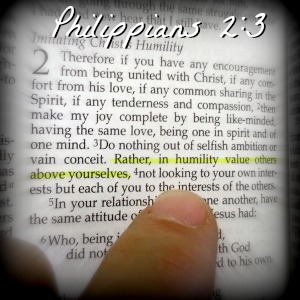 November 23, Civility is a reflection of humility.
Proverbs 3:34, “He mocks proud mockers but shows favor to the humble and oppressed.”
There is an undeniable stream of thought in scripture that highlights the thrill God feels in elevating the poor and disenfranchised, often at the cost of the rich and un-empathetic who have prospered while their neighbors suffer. It’s not a stream of thought that supports a hatred of rich people or a disdain for wealth, but certainly does remind us that God doesn’t judge our value based on our financial bottom lines. In contrasting generosity and greed Jesus famously said, “The first shall be last, and the last shall be first.” (Matthew 20:1-16)
So the Proverb above warns us against a pride which isolates us from God’s favor. God prefers a person to live in humility instead of an inflated idea of self. God favors the oppressed. I think it reflects on God’s character that the joy of the Divine is found in favoring the least able and most needful. God doesn’t sit back and revel in one person’s great accumulation of wealth and pride in self, but in the opportunity to lift another from despair or to reveal that person’s hidden and less known value and worth. I get a strong sense that humility is actually the inner wealth we carry and live, while pride is an infection that can grow from the accumulation of material wealth. I said “can,” not must.
God mocks the mockers. Among the lessons for civility we find in scripture, this one rings loud and clear. A prideful, disdainful attitude that mocks and decreases another’s value is not in line with the movement or favor of God. God isn’t laughing with you when you tear another person down. But a humility that reveals the worth of the other person is joining God in the Divine disposition.
I think civility will be a natural outgrowth of choosing to reveal and support the other person’s value and dignity. It doesn’t mean I have to agree with everyone, but I sure better not value myself over them. I can disagree with someone while still protecting the inherent value of their life, opinions and aspirations. It’s not just that God loves an under dog, God loves to fill gaps of inequity and oppression. Civility, and the humility from which it grows, will create fewer of those gaps by affirming and revealing the value and dignity of others.
AMDG, Todd
Nov. 22, 2013 Civility in Xian Scripture
 November 22: Civility has always transcended us vs. them limitations, just as justice and “right” has transcended our divisions.
Exodus 23:9, “Also you shall not oppress a stranger, for you know the heart of a stranger, because you were strangers in the land of Egypt.” New King James Version
I want to carry yesterday’s idea forward another day. We looked at the passage in Colossians 4 and chatted about the way that our grace, particularly civil attitude and conversation, wasn’t just reserved for “us” but was also for “them.” Today, I want to show that this isn’t a new idea introduced in the New Testament, but this was in the formative concepts of justice when God gave Law to the Israelites.
That verse from Exodus is a nice example of the way God included “care of the other” from the earliest days of expressing divine will on justice and fairness. The people of Israel had been the strangers, the foreigners, the aliens, the “other” while living in Egypt. They began that sojourn fleeing famine, but ended up as slaves. They knew the truth of injustice. The passage above reminds them that they should know “the heart of a stranger,” how it feels to be unknown, on the outside, seen as “the other.” From that experience, they are commanded to care for those not like them and not from among them. Justice was for all, and this is a firm foundation for civility being for all.
There are other verses that echo this idea of God wanting Israel to transcend the “us and them” divide in life, even to the point of acting as if there was no difference between they and the other. All people’s value was to be supported and Israel’s behavior was to be consistent:
Leviticus 19:33-34, “And if a stranger dwells with you in your land, you shall not mistreat him. The stranger who dwells among you shall be to you as one born among you, and you shall love him as yourself; for you were strangers in the land of Egypt: I am the Lord your God.”
Exodus 22:21 “You shall neither mistreat a stranger nor oppress him, for you were strangers in the land of Egypt.”
Deuteronomy 27:19 “‘Cursed is the one who perverts the justice due the stranger, the fatherless, and widow.’ And all the people shall say, ‘Amen!'”
I think God has always wanted to break down barriers between us. The “chosen people” language of God’s nation Israel might cause us to think otherwise. The “called out” ecclesial language of the church might cause us to think otherwise. But the choosing and the calling has always been purposeful, and I believe part of that purpose is to break down the barriers of division, animosity and hatred that arise between us.
I need to be a safe person for all others, even “the other.” My civility is an extension of this truth. I cannot reserve a special hatred for the outsider because she is an outsider. I cannot reserve my love only for those I know. I cannot hoard my peace and civility for those who like me or think like me. My heart needs to beat for the stranger, for the outsider, for the alien. I need to be “safe” for all.
AMDG, Todd
Nov. 21, 2013 Civility in Xian Scripture
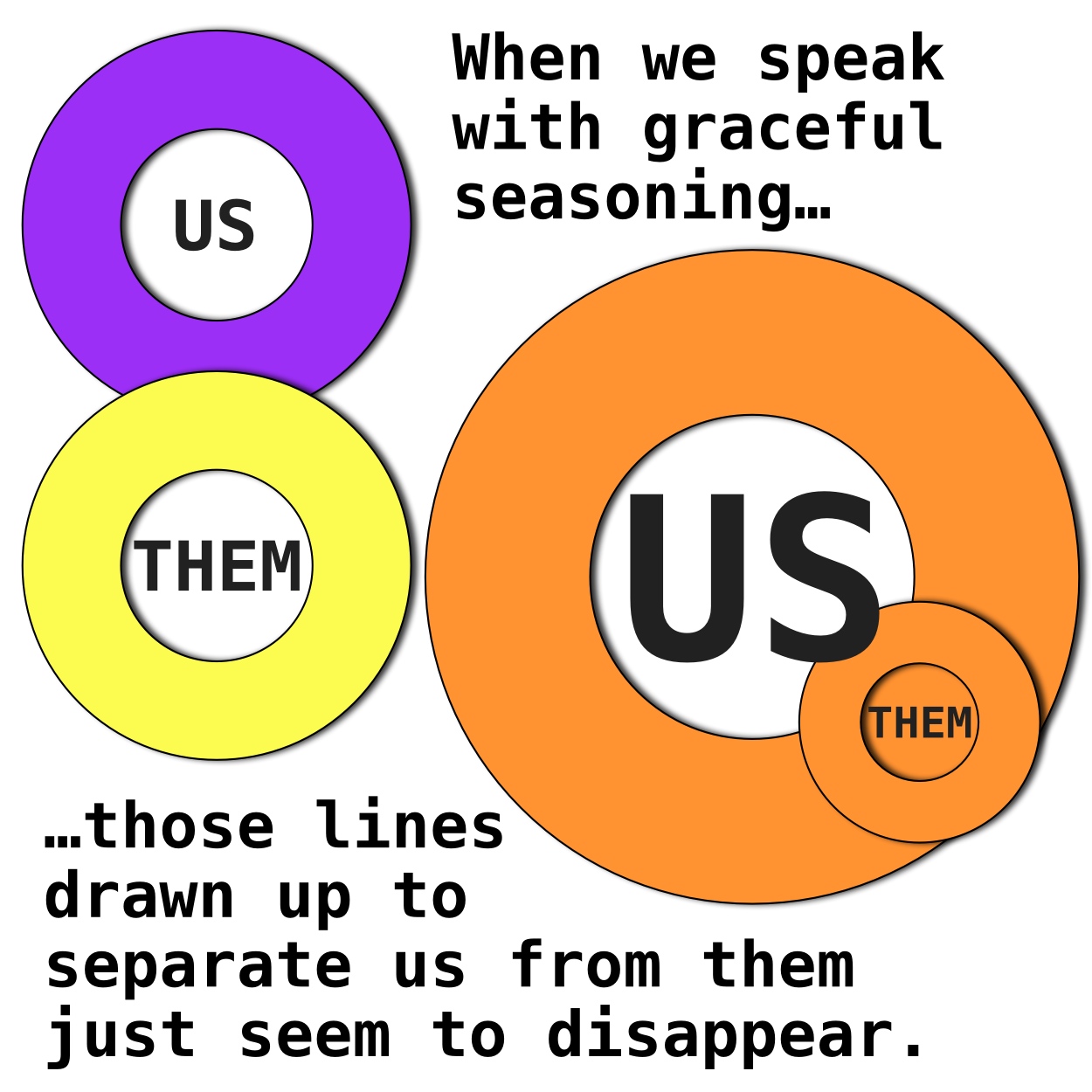 November 21: Civility transcends us and them.
Colossians 4:5 & 6, “Be wise in the way you act toward outsiders; make the most of every opportunity. Let your conversation be always full of grace, seasoned with salt, so that you may know how to answer everyone.”
It might be easy when reading the scriptures to fall into an us and them attitude when thinking of how we ought to behave, speak and act. The scriptural writers, especially when we’re reading Paul, Peter and James, are very concerned with helping a new community in it’s formative first generation. This leads to a lot of us language, but it doesn’t have to be to the exclusion of them. Us and them thinking can lead us to disparaging them and us defaming them, us devaluing them and us disenfranchising them. That is not our calling.
God’s grace, as it is lived and shared, and as it forgives and builds up, is not just for Christians to lavish on Christians. When we speak to someone who is not a person of our faith we do not do so with distaste, condescension or incivility. Their dignity remains intact and it is part of our responsibility to recognize and defend it. We should speak to anyone who may be “outside” as we speak to anyone who may be “inside.” We speak with grace, seasoning our speech for the well-being of the listener. When we speak with graceful seasoning those lines drawn up to separate us from them just seem to disappear.
Not to mention the simple fact that I can be a horrible judge of who may be inside or outside. We can all come to certain conclusions about what the classical or orthodox theological positions of Christianity should be, and we all know that there’s a broad field of doctrine being taught and lived across the earth. Some will self-identify as Christians, some will self-identify as another religious affiliation, or none. People with whom we interact may be very much like us, or not like us at all. The constant in all our conversations will be God’s grace, and that grace is the constant flavoring in our all conversations, all our “answers.”
My favorite example of this kind of grace is found in Acts 17:16-34 when Paul speaks to the people in Athens, Greece. At the time Paul sees a lot of idolatry, the idols lined up in the city are very real, very immediate. This disturbs Paul’s soul and he wants to share the message of Christ with the people, so he begins his address in the Areopagus (Town Hall) by complimenting them. Whoa, what? Yes, he starts by affirming their religious devotion and the thorough nature of their religious practice. He quotes their own poets to affirm all people’s place as God’s children. See how he speaks a blend of us and them? He recognizes an “us” aspect with his hearers. With this kind of foundation he unpacks his message. All the people won’t believe him, but they sure heard him. He delivered his message seasoned with grace. And it’s no wonder that our verse today is from his letter to the Colossians. How many times today do we see Christians rationalizing their way into beginning their gospel presentation with some form of, “How’s that road to hell going for ya, sinner?” or some other form of turn or burn harness that begins with stripping a perceived outsider of dignity and respect?
When feelings of condescension rise up in me I must renounce them and find a new footing. When my conversation becomes animated by distaste instead of grace I must stop and change my heart. When my speech is flavored by bitterness it’s not what my hearer needs. When I’m loving us and not loving them I’m playing the wrong game all together.
AMDG, Todd
Nov. 20, 2013 Civility in Xian Scripture
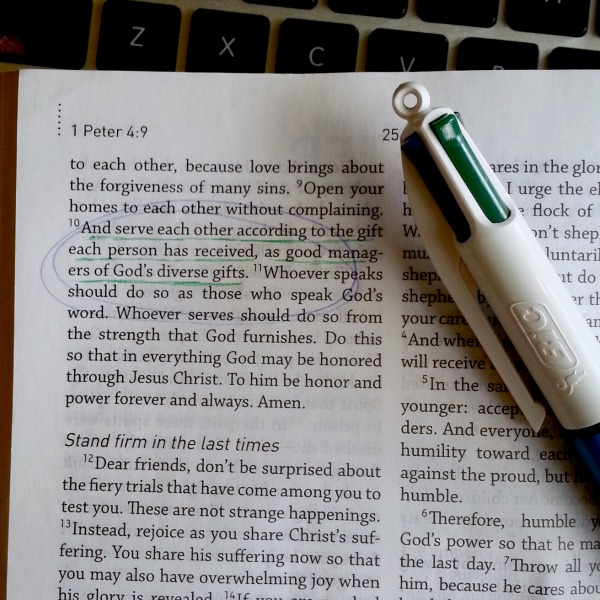 November 20: Civility is faithful service to God!
1 Peter 4:8-11, “Above all, love each other deeply, because love covers over a multitude of sins. Offer hospitality to one another without grumbling. Each of you should use whatever gift you have received to serve others, as faithful stewards of God’s grace in its various forms. If you speak, you should do so as one who speaks the very words of God. If you serve, you should do so with the strength God provides, so that in all things God may be praised through Jesus Christ. To him be the glory and the power for ever and ever. Amen.”
I am a steward. You are a steward. What a great word! It means that you and I are the operating agents of God who manage and dispense the “properties” and “affairs” of God in the world. Peter is helpful enough to name exactly what we are stewards of: God’s grace.
In speaking and serving others, using whatever gifts and abilities with which we have been blessed, we dispense God’s grace and cover sins with love. Amazing. The word really encompasses a lot about us. In the Greek an oikonomoi was a household servant, the servant who apportioned things, managing affairs and resources of the household on behalf of the master of the house. In this case, in 1 Peter 4, we are the faithful servants apportioning God’s grace in love to cover sins and to serve joyfully the people around us. The passage above is quoted from Today’s New International Version, and in the Common English Bible oikonomoi is translated to be “manager.” We are managing God’s grace and gifting in our lives to the benefit of the people around us.
Here’s the catch… we aren’t just apportioning grace to the deserving, but also to those who have sinned or in some way become less deserving. This where we find the biblical truth of the day to teach us something of our civility. We aren’t meant to be walking talking dispensers of God’s wrath for people, punishing sins, withholding grace and replying to incivility with incivility. We are meant to be the people who dispense grace when needed to cover sins, love and service to the least deserving, faithful to the God who employs us in the household of the earth.
The point of all this is to give glory to God in Jesus Christ. Our faithful stewardship, our service to others, our love and absence of “grumbling,” all of it accrues to the glory of God, showing God’s greatness in this world. Incivility probably breaks in through me most when I begin worrying about my own glory or begin to hold back the grace I am sent to share.
Saving God, let grace flow through me
unimpeded to the people most needing
whether or not they can seeit is your love and grace that drives
any gifts they might receive
filling and quickening our livesI’m your steward but I pray
for love to cover my own sins
to be kept in your kingdom this day
AMDG, Todd
Nov. 19, 2013 Civility in Xian Scripture
 November 19: Lose it or use it.
Ephesians 4:31 & 32, “Get rid of all bitterness, rage and anger, brawling and slander, along with every form of malice. Be kind and compassionate to one another, forgiving each other, just as in Christ God forgave you.”
I know, it’s almost too much to take a cheesy saying like “use it or lose it” and try to make a point by reversing it, but I’m game. A huge part of tackling the work of yesterday’s verse and making sure that wholesome, helpful and constructive things flow from our choice of words will be removing the negativity which wants to tear down, destroy and punish.
Bitterness, rage and anger. These must be avoided. Brawling, slander and malice. These must be un-chosen. This means that when we find ourselves enjoying the anger, relishing the malice or laboring under the heaviest of grudges, we must make a change.
When anger happens, we recognize it, name it and release it. When an injury threatens to become a grudge, we seek healing, seek help and seek peace. If we hold tight to these things or leave them the liberty to run unnamed and unchecked in our lives, we will find them returning in our words and actions. Just as civility is born from what we value and carry inside of us, so it goes with incivility.
We have a double movement, one of choosing and one of un-choosing. Civility is a “selective” way that we live our lives, holding to what is most good and releasing what is most negative. In this keeping and releasing we set ourselves up for civility or for incivility. We stack our own deck for the positive or for the negative results when we speak and act. I really do have to lose the anger and rage, or I’ll use them. Lose it or use it.
We don’t use the word a lot, but “renounce” is a good one for this idea. To renounce is to “formally declare one’s abandonment of” something. It’s a legal word, and it’s the idea behind today’ verses. Can I renounce the bitterness, rage and anger? Can I renounce the brawling, slander and malice?
Can I stand today and prayerfully, sincerely and honestly make a renunciation of these things that take root in my life and bear such bitter fruit?
I do renounce bitterness.
I do renounce rage.
I do renounce anger.
I do remounce brawling.
I do renounce slander.
I do renounce malice.
Just saying the words does not get the job done, but it sets me on the path. And some things simply need to be said out loud, ya know? If I choose this path, then I must prayerfully walk it and find the help I need to remain on it.
AMDG, Todd
Nov. 18, 2013 Civility in Xian Scripture
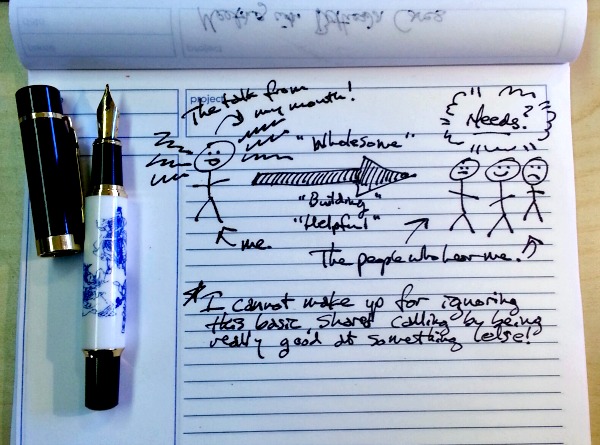 November 18: Building people up is a shared calling.
Ephesians 4:29, “Do not let any unwholesome talk come out of your mouths, but only what is helpful for building others up according to their needs, that it may benefit those who listen.”
I always get a little uneasy when I see lists that people have made of spiritual gifts and they include things like love, grace and mercy. Are those really specialized gifts and abilities for just a few people? Growing up in church it was exciting to hear for the first time about spiritual gifts and the idea that the Holy Spirit inhabits each of us in unique and empowering ways. I still believe that, but I’m not so enamored of being enamored anymore.
A downside to the spiritual gifts frenzy is a downplaying of the shared calling we each have in our lives as followers of Christ. Ephesians 4 is an example of Paul laying out in very specific terms one of our shared callings… we are called to encourage and “build up” others by our words. It’s not the job for a specialist or a select few.
That’s why it worries me when grace, mercy and even humility pop up on the gifts list, as if some will have them and others not. Being called to build others up by speaking to their needs is a shared responsibility in which we all participate. The idea that I might not have to worry about this because I’m talented or gifted in another area of life runs counter to scriptural witness.
Jesus didn’t say some of his disciples would be identifiable by their love (John 13:34-35) while others would be known by their shirts, stickers, bracelets or other “Christian” merchandise, or even their awesome doctrines, sermons or uncanny abilities. He said said that his disciples would be recognized by their love for one another. We need to not let our enthusiasm for our various individual gifts outpace our fundamental shared calling to be people builders.
Why keep such a firm hold on the basics? Because we tend as people to let specialization, authority and power isolate us from others. The accessible nature of Jesus confuses us and doesn’t always make sense. The passage in John 13 is a classic moment of Jesus presenting this to his disciples… in verses 13-17 he makes a point of connecting his lordship and authority with service. He says that “Yes, I am your teacher and Lord, I’m your authority in very way, and so I demand that you build others up as I’m building you up in love and service “ (Yeah, that’s my paraphrase.)
Who doesn’t love the recent stories of Pope Francis and his humble way of touching people and ministering among those who are social outcasts for various reasons? He excites us because he’s breaking the trend of letting power and authority isolate him from others. Just like the heart warming stories of the Pope touching his neighbors, you and I can warm hearts and have the same effect in our circles of influence. It’s something we all share in common, this calling to see the needs in the people around us and then speak and work to meet those needs.
We’re people builders, you and I. Popes, preachers and pew warmers, we’re all in the family business with a shared call to build people up. This basic, shared calling will by necessity preclude much of the incivility that might separate us and tear others down. It runs counter to the divisive, judgmental language we might choose when we’ve chosen a different marker for our discipleship, like personal piety, doctrinal correctness or hermeneutical purity. This is where our Savior leads… as always the question is whether I will follow.
AMDG, Todd
Nov. 17, 2013 Civility in Xian Scripture
 November 17: Value gentleness.
Philippians 4:5, “Let your gentleness be evident to all. The Lord is near.”
I have liked this verse for a while; it intrigues me. It was the verse on our church building marque sign for a long time. Gentleness. Is it a lost art? Is it even aspired to these days? Of all the things we’re tracking and trying to develop in our lives, is gentleness even on the list?
I was told as a young Christian that I should be many things, but gentleness isn’t one I can really remember being stressed. I was told to be courageous, convicted, radical, even obnoxious. I was taught that God liked it when I was “in your face” on fire for Jesus! I had to stand out, be set apart, be different, be totally crazy for God… gentleness for the babies. We liked triumphal verses like 4:13, tell me what I can do! I can accomplish anything! The kicker is that my gentleness is your gain! Maybe that’s Paul’s whole point?
I think that conviction exists in gentleness, maybe even more than in radical counter-culturalism. I bet that gentleness opens doors that brashness only closes. I bet that gentleness listens better than harshness, understands more than meanness, and gentleness creates more peace than antagonism. I just bet. I just bet I’ll meet more people tomorrow who need my gentleness than need my jerkiness.
AMDG, Todd
Nov. 16, 2013 Civility in Xian Scripture
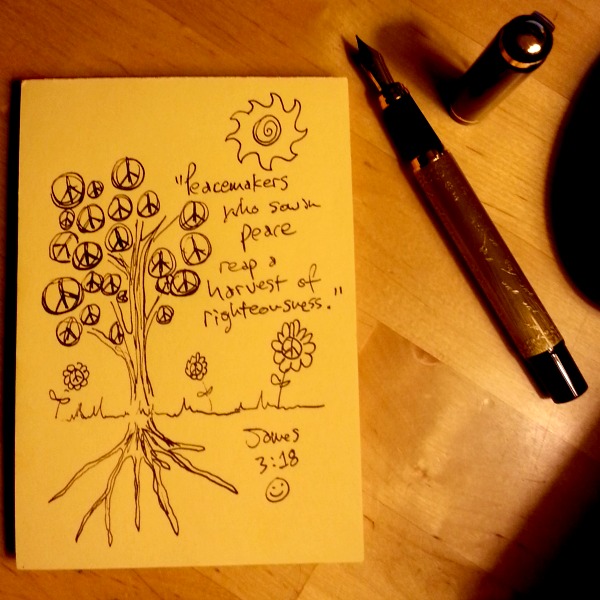 November 16: I really want to be a peacemaker.
James 3:18, “Peacemakers who sow in peace reap a harvest of righteousness.”
I really want to be a peacemaker. But if I learned anything from my tiny bit of farming experience growing up, it’s that “sowing” can be hard work. James makes it sound so easy, so poetic. I find the actuality of peacemaking a bit more taxing. Harvest, even a harvest of righteousness, is hard work.
I really want to be a peacemaker. But I have to get on board with the long-haul view of this thing. Quoting the verse, memorizing the verse, and really liking the verse, just doesn’t get it done. Peacemaking is as much identity as it is action, like a farmer… farming is who a person is as much as what a person does. Sowing and reaping is an expression of the way of life chosen by a person, not just a days activities. I must be the sower and also the soil.
Did you notice the verse says “sow in peace” and not “sow peace.” Peace is not what we are necessarily sowing in life… peace is the way we sow all the things of the day. This is about our greetings, our lunch meetings, our arguments, our partings, our friendly waves, our stress-laden mornings and collapsing in bed at night. This is helping a friend with a question, a child with homework, and a parent carrying groceries. The peacemaker is not a “one-trick-pony” who just walks all day around bemoaning, “Can’t we all just get along?” The peacemaker looks like everyone else, but moves through life leaving a trail of righteousness, like the tail of comet sparkling in the night sky.
I really want to be a peacemaker.
AMDG, Todd
 toddthomas.net