
Month: July 2017
The Joy and Deepness of Daily Prayer
This is my sermon transcript for July 30, 2017, and the promised resources to follow up on the idea of daily prayer, weekly spiritual practice and making your own daily prayer (mantra or litany). Be blessed, Beloved of God!

Sermon of July 30, The Practice of Daily Prayer
Good morning, I come to you today in the name of the God who infuses matter with divinity, who does not hold aloof, but enters into our world, our lives and our moments. I come to you as a fellow observer of the God whose Spirit is here and whose essence is love.
From Romans 8, one of our readings for today: “Can anything ever separate us from Christ’s love? Does it mean he no longer loves us if we have trouble or calamity, or are persecuted, or hungry, or destitute, or in danger, or threatened with death? No, despite all these things, overwhelming victory is ours through Christ, who loved us. And I am convinced that nothing can ever separate us from God’s love. Neither death nor life, neither angels nor demons, neither our fears for today nor our worries about tomorrow—not even the powers of hell can separate us from God’s love. No power in the sky above or in the earth below—indeed, nothing in all creation will ever be able to separate us from the love of God that is revealed in Christ Jesus our Lord.”
Do we have any fans of Dean Koontz, the author, here? He’s one of my favorites… he writes in a genre blending style, some horror, some mystery, always with some humor and something more than just a little supernatural. One of his most endearing characters is named Odd Thomas, a young man who can see (though not hear) the spirits of the dead. Anyone else an Odd Thomas fan? Among Odd’s colorful family is his very old, salty gambler of a grandmother, Granny Sugars, who taught him her daily prayer, waking each morning to ask God, “Spare me that I may serve.” It became Odd’s daily prayer.
I love to find these little, yet large, things in novels, songs and movies: glimpses of profound truths maybe embedded in fiction or simple daily life. These are reminders that more might be happening and might be present than just what I’m seeing, hearing or noticing.
Finding the profound in the ordinary is a way of describing what I wanted to chat about with you, today. Tomorrow is the feast day of St. Ignatius of Loyola, a saint, a sinner, one of the last Don Quixote’s in his own right, a Basque soldier, a preacher, an armchair theologian and a particularly astute observer of the human spirit. He founded the religious order The Society of Jesus, most known by the moniker The Jesuits.
St. Ignatius has in many ways been a spiritual friend and father to me, through my Spiritual Director Fr Leo Murray and other Jesuit writers, helping me construct a bit of the missing framework to exercising and daily exploring my faith in ways that help me grow, finding new vistas instead of simply struggling to maintain a place where I have arrived. My father Ignatius famously wrote his guide to hearing and recognizing God’s voice and direction in daily life, The Spiritual Exercises, before any theological education. Central to those Exercises, whether you complete them in the intended 30 day retreat or a one week to a nine month adaptation, is the idea of daily giving oneself to an intention and reflecting on the day that’s gone by. Each morning begins with a prayer of intention, a grace he called it; it’s something we hope to realize in the course of that day.
I’d like to chat about daily prayer, fresh on the heels of hearing Granny Sugar’s daily devotion, “Spare me that I may serve.” I know that Dean Koontz’s books are works of fiction, but he’s so good at developing characters that you can see the way this morning mantra, spare me that I may serve, shapes the life of Odd Thomas. He’s a character wholly devoted to helping others, often at a cost to himself. Granny Sugars’ simple prayer shapes his life and keeps him rooted on a chosen path regardless of the circumstances of any given day.
There’s a deep wisdom in this character and this little prayer. Our intentions do shape us, intentions like daily prayers that reflect the basic decisions we make for the day before the day happens. So, in Romans Paul can say that daily trials don’t reflect the love of God for us, or a lack of God’s love, for he’s predetermined that God’s love is consistent regardless of what any day brings us. Granny Sugars prayed a prayer that assumed she would serve if spared. And we make choices and can affirm intentions before our days happen, choices and intentions that when held closely and believed in will lead us, shape us and sustain us with God’s help.
This is something I think I knew before I realized it was really true. I had an experience four years ago when I went up to Princeton Theological Seminary for a week long summer session on preaching. As I usually do when I travel I became a militant introvert. I’m always an introvert, but I have to act like an extrovert whether I’m working in religious vocation or at Apple at the mall, so when I travel I tend to curl inward and soak up some me time. And I was doing this at Princeton. Here’s the picture: at one point between classes I was out on the campus lawn, sitting under a tree, writing a haiku. That’s the kind of stuff introverts do when surrounded by strangers.
I began to notice that everyone else seemed to be walking around between classes in groups, social arrangements in which they were getting to know each other, and I thought, “What am I doing?” I was like, “I need to go interact with these people and not just play introvert for the week. We’re only here together a few days, and I could easily waste this opportunity to make some new friends.” Its not wrong to be an introvert, and I still am an introvert, but there was something here not to be missed. I ended up composing a prayer instead of a haiku under the tree that day, eventually writing these simple words: Let me love. Let me learn. Let me serve.
As I sat and watched people, people with people, it dawned on me that I needed that connection, or a similar connection with the people around me. I needed connection so that I could better love, better learn what needed to be learned, and to be ready to serve and be served. I was there to learn, it was a preaching class and conference, but learning is not the only value of my life. I sat with that prayer, tweaked it a bit, and came to these three things: loving, learning, serving… my heart, my head and my hands.
I’ve carried that prayer with me now for four years and found it resilient to the different themes and movements of life. I’ve used it as a beginning place of reflection when my day is not going well or when I feel a dissonance within my life; often I find that I’ve neglected one or two of these movements, not loving enough, missing what needed to be learned, or having arrived in a place of detachment and self-service.
The first experience I had of this sort of practice was really years and years ago when studying Eastern Orthodox Theology and I learned about the Jesus Prayer: “Jesus Christ, son of God, have mercy on me a sinner.” This is an ancient adaptation of a prayer Jesus himself shared in a parable about a two men who went to pray at the Temple, a religious leader and a despised tax collector. The Jesus Prayer is a breath prayer, a mantra and a litany. Here’s an exercise for you to try sometime… I will sometimes want to pray, but not really know where to start or how to begin. I’ll start with the Jesus Prayer and then slowly, as I repeat it, change the words to be prayers for specific change in me that I want to see around me, or for the needs of people I love, or just different expressions of praise for Christ, God or the Holy Spirit.
in Ignatius’ Spiritual Exercises, praying for a specific grace throughout a week or month is foundational to keeping focus and attention on what God is doing in my life and how the Spirit is speaking to me, and how to recognize the other voices and spirits in my life to ignore.
One last example, from our time here at St. John’s, and an example of adapting scripture into a daily prayer, is something Teresa and I did with our Sunday School class this past year. We wanted a binding theme throughout the year and began by choosing a passage of scripture to be our anthem. We chose Micah 6:8: He has told you, O mortal, what is good; and what does the Lord require of you but to do justice, and to love kindness, and to walk humbly with your God? This passage presents three main ideas: justice, kindness and humility. Justice, kindness and humility.
We spent time with our kids explaining what it means to be just, which is to be true, trustworthy, fair & honorable. We talked about kindness, being compassionate and good to the people around us. We spoke about humbly seeking to walk with God, to draw close to God and to follow God. We eventually comprised our weekly prayer for class and daily prayer for any day of the year: Help me be kind, help me be true, God I give myself to you. After using it a few times, it sticks and has meaning. Who doesn’t face an opportunity in any given day to be more kind, true in our words and actions, and more in tune with following God?
Prayers like these have a way of changing us. They keep us focused and they help us hold up certain truths as a compass for our faith, our emotional well being and our daily walk. As a mantra or a litany I often use my prayer Let me love Let me learn Let me serve reciting in over and over on my drive to work as way of storing up the energy and reserve of intention for my day. This way no matter what comes why way, no matter how people find me or I find them, no matter the moment, my choice has been made to love, to learn and to serve. As I go through my day I draw on that reserve of God’s will and my intention.
This is similar to what Paul is doing in the passage from Romans 8. He knows that some days and some seasons of life can be tough. He knows that we struggle and we experience pain. He himself struggles and faces hurt of many kinds. He also has learned that these daily hurts do not mean that God loves us less, but God’s love is steadfast even in the hardest of days. So he speaks it: God’s love and our lives are inseparable. Bad days don’t mean that God loves us less. God’s love and our lives are inseparable. It’s good to hear this and sit with it before the worst days roll around, so that when they do we have a starting place to deal with those painful times. This is what daily prayers can do for us, helping shape us for the best and worst of life, strength when needed, extra joy when happy and wisdom when pressed.
What’s your prayer? I invite you this week to make an exercise of distilling down a favorite or a meaningful passage into an expression of prayer. Or maybe not a passage, but an expression of the great themes of your faith as you understand them. It doesn’t have to rhyme. You could take something from the end of Romans 8. You could use Micah 6:8. Maybe use the way that Jesus sums up the Law in Matthew 22: ‘You shall love the Lord your God with all your heart, and with all your soul, and with all your mind… and ‘You shall love your neighbor as yourself.’
To help you do this, if I can, I’ve put some resources on my personal blog, and I invite you check them out. First, I’ve prepared a short one-week guide for daily prayer and reflection modeled after the Spiritual Exercises of Ignatius. That includes a sheet for each day which gives a grace to pray for, a passage to read, and prompts for reflection and prayer. This is best done shared with a spiritual friend, so I invite you to try it out and share the experience with someone else. You’re invited and welcome to bounce reflections and things off me as you pray and reflect through the week. My contact information is in the document. Secondly, there’s a little one page guide on making a personal daily prayer that includes the ones we’ve mentioned today and some helpful tips on making your own. This is all at toddthomas.net, and I invite you to share some of the journey with me and with one another.
I’m no Saint as Ignatius was in his life. I’m not an author like Dean Koontz. I don’t see dead people like Odd Thomas. I’m not even a rough and tumble cool 90 year old gambler like Odd’s Granny Sugars. But I am on this same road with Micah and those Roman believers, as are you. We are each set on a path of life, which is a path of will. It’s a path of choices, intentions and experiences. Our prayers are strength for that walk. Our prayers prepare us for the choices, the forks and turns we will take.
May God bless your path in the coming week. May we all in new and fresh ways, love the world and it’s people around us, learn something which we didn’t know or understand last week, and may our loving and knowing the world lead us to serve it’s needs with greater joy. Amen.
AMDG, Todd
Choosing Wholeness – Sermon Transcript
It was a deep blessing to be invited back to Church in Bethesda this past Sunday morning to bring a message during worship. I’m dropping the transcript of the sermon, below. I share this realizing that choosing wholeness and achieving wholeness are often two very different things, but I do believe we begin with the choice. Cheers!
Choosing Wholeness
Our text is Matthew 6:26-34 from The Inclusive Bible:
26 “Look at the birds in the sky. They don’t sow or reap, they gather nothing into barns, yet our God in heaven feeds them. Aren’t you more important than they?27 Which of you by worrying can add a moment to your lifespan? 28 And why be anxious about clothing? Learn a lesson from the way the wildflowers grow. They don’t work; they don’t spin. 29 Yet I tell you, not even Solomon in full splendor was arrayed like one of these.
30 If God can clothe in such splendor the grasses of the field, which bloom today and are thrown on the fire tomorrow, won’t God do so much more for you—you who have so little faith? 31 “Stop worrying, then, over questions such as, ‘What are we to eat,’ or ‘what are we to drink,’ or ‘what are we to wear?’ 32 Those without faith are always running after these things. God knows everything you need. 33 Seek first God’s reign, and God’s justice, and all these things will be given to you besides.
34 Enough of worrying about tomorrow! Let tomorrow take care of itself. Today has troubles enough of its own.
Good morning, everyone. I come to you in the name of the God who dresses wildflowers in their bold colors and striking style, who sees each individual in the vast clouds of birds which crisscross our skies, and who sends us to seek and make justice in our world. Let us pray…
“Saving God, may we seek you and your justice, trust you deeply and move into this world as your agents of peace, and kindness, trendsetting only when showing the great glory of your mercy and grace. May the words of our mouths and the mediations of our hearts be acceptable to you, our Rock and our Redeemer. Amen.”
It was an interesting experience to put our passage from Matthew 6 out on Facebook this week as our text for today, and immediately hear from multiple people something like, “Oh that’s my favorite text!” The longer I live, the more I fall in love with our diversity as human beings and people of faith. I did not choose the text for today because it’s one of my favorites, in fact, I chose it because it holds a message with which I struggle. An opportunity to speak to you is a chance, perhaps selfishly, for me to dig into a passage and grow.
You see, I’m good at worrying, it’s always been one of my special gifts. I’m not only kinda good at worrying, I’m also good to planning what I’m going to wear and especially what I’d like to eat. Just to illuminate that: When we lived Africa we had a professor from our seminary come and visit us, and I was so excited for us take him out and show him some the places where we were planting churches. As we drove through the rural areas I would often point to places along the road and say, “That’s a nice place to stop on the way home for some beans and rice. Oh, sometimes I like to stop over there because they have really good chicken. Sometimes I’ll go down here to the edge lake because companies bring ice to pack the day’s catch of fish in, and they use the ice to have cold Cokes!” He finally laughs and asks me, “Todd, are all your landmarks in life places to eat?” Yeah. They kinda were. Anyone with me on that way of mapping life?
I’m also paradoxically really good at procrastinating, even though my whole life I’ve tried not to procrastinate as much. Anyone else good at putting things off and feeling bad while doing it? Anyone else with me in wishing they didn’t put things off as much as we do? I’m a conflicted guy sometimes, making all these great plans and worrying, just to put off following the plans.
And in one little passage Jesus comes in and threatens my whole house of cards, to topple both my comfortable worrying and my comfortable guilt over procrastination: he says, “Don’t worry about anything, just put it off until tomorrow.”
What? Am I to really do that? Doesn’t Jesus know we’ve invented some of our own proverbs over the years, proverbs about doing. “Cleanliness is next to Godliness.” Anyone ever try to find that one in scripture? It’s not there, but it does very aptly capture one of our societal and religious preoccupations, huh? And more to the point, we have often quoted and canonized a “verse” that’s not even in scripture: “God helps those who help themselves.” That is exactly opposite of what Jesus just said!
I remember hearing this passage as a young Christian and being mortified… Jesus just told me to goof off. Every other teacher I’ve ever had has told me the opposite. Because at a glance, in English, this looks to be a debate about goofing off, when it really it’s more a text about wholeness.
The Greek word for anxious here is merimnaó, “a piece instead of a whole.” Jesus says not to let ourselves get pulled to pieces by life, taken apart by cares and concerns over small stuff, but as whole people seek the greatest things, and remain whole people by focusing on the greatest things: God’s reign, God’s justice. Hear the passage again, but paraphrased a bit with this drive for wholeness woven into the text…
Look at the birds in the sky. They don’t work like we do to buy the stuff we buy, yet God’s birds have all they need. Aren’t you smarter than birds, who just go be the birds they were made to be without worrying if they’re bird enough? Which of you by falling apart over the small stuff can add a moment of meaning to your life? Why lose your bearings in life over clothing and fashion? Really? Learn a lesson from the way the wildest flowers of the field grow. They don’t work. They don’t shop. Yet not even King Solomon in his fullest splendor was as amazing a sight as one of these delicate marvels. In God’s world outward adornment is casually lavished on the unplanned growth of the fields, which measure so small against your value – you have been made even more wonderfully. You don’t need a bunch of other adornment to be the beautiful creation God intended you to be.
So, decide today that you’re not going to keep falling apart and losing yourself in addictions to food and fashion. You are so much more those things, made to be so much more. Anyone can dress, and anyone can eat, and everyone does. God knows you. God loves you. So, live to see God’s glorious peace in this world, first in your own life and then multiplied around you. Live to see God’s justice made real in this world, first in you, and then multiplying in the world around you. Enough falling apart over the junk that doesn’t really make us happy or fulfilled… that stuff steals from us our today and promises us a false tomorrow! There’s enough need for justice today to keep us busy. Tomorrow will present opportunities for action and justice all its own.
Folks, I’m still going to do my laundry. Jesus wasn’t saying I have permission to stop doing my chores. I’m still going to eat, and Asian foods like Phó and Bulgogi will still be some of my most favorites. I plan to eat them some more. But I’m also going to hold extra tight to the truth that no matter how well I dress, someone, honestly a bunch of someones, will be dressed better. No matter how well I wear my clothes, there’s always some who will wear them better. And no matter what I eat, my favorite foods or not, it is still fuel for the meaning, it is the energy for what matters: God’s will and God’s reign in me and God’s justice for those who most need it.
May we never lose sight, that after the food is done, the clothes have faded, and all that we thought was so important has vanished from memory like last year’s whithered flowers, God’s justice and the hope that God’s justice engenders in us and the world, that is our tomorrow.
It’s no wonder that this passage drops into it’s context as it does, caught between the discussions of heavenly treasures and not judging. This passage is a natural extension of putting our focus on heavenly values, the things worth treasuring, and it’s a perfect prelude to a warning about judging people around us or succumbing to that judgement.
Wholeness is the opposite of judgment. Wholeness is a refutation of life lived as critical competitors focused on the flaws of others. Wholeness is freeing for us and the world around us.
No, Jesus isn’t writing us a life-long hall pass to skip class and goof off from our responsibilities. Jesus is reminding us that God is involved here, and even if the clothes fade and the flowers whither, there is justice, there is peace, and there is life infused with meaning, the kind of meaning that lasts.
So, fly. The God of the Birds has also given you wings. And smile. Enrich this world, for the God of Flowers has also made you beautiful and amazing. This is our gospel, our Good News. Amen.
Thanks, everyone at CiB, for a blessed morning together!
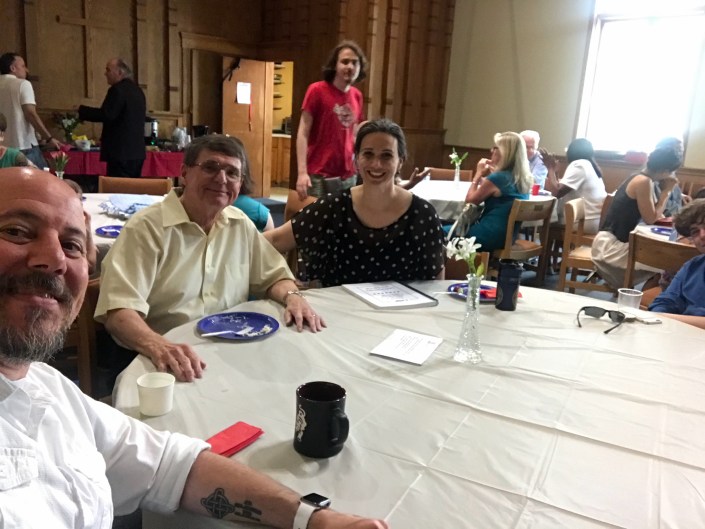


Here’s a link to CIB’s post about our visit with a few more pictures: https://www.churchinbethesda.com/single-post/2017/07/06/Thank-you-Todd-and-Teresa-Thomas
 toddthomas.net