
friendship
Faith & Depression: A Few Thoughts

This post began life as a reflection on mental health for the Lenten Season I was asked to make for a church project back in 2019. Now, five years down the road, I’ve returned to it to see if my thoughts have changed. It’s a good moment for me to do this, because I’ve had an acute episode with depression in recent months. Here are my reflections from five years ago with a few updates, things I believe about dealing with life-long depression and mental health struggles, particularly in the arena of faith.
Having Faith is No Free Pass
Some would believe and even say that being a person of faith can insulate you from mental health struggles like depression. I’ve found in my life that neither having faith nor being in ministry automatically keeps one from suffering the very human travails of depression. Depending on which studies you prefer to accept clergy will suffer depression at least as often or more often than the general public. Don’t get me wrong. When I’m experiencing depression I’m so glad for my faith and the positive and hopeful truths of my beliefs. My faith assures me of God’s love and my worth, and those are powerful countering messages to the inner voices of my depression and existential anxieties. But they aren’t an instant cure.
My spiritual director recently asked me how my prayer life changes when I’m depressed. That’s a great question. I don’t stop praying, but I definitely have seen a shift from a more relational expression of prayer, just talking with God, to a more intercessory style of prayer, talking about what others around me need. That’s not necessary a bad shift, but I do miss the quietly affirming conversations with my God. Those times will come back around, and it helps me to read back in my journals and reflect on that deeper experience of prayer in other times of my life.

Depression Doesn’t Make You Bad
Being depressed does not make me or you a person bad. I’m not weak, stupid, broken or any of the other things we sometimes call ourselves and others when suffering comes around. Depression can and does happen to anyone. Do you remember the scene of that night Jesus spent in the garden wrestling with fear and anxiety? It’s Lent, so if you go to church much you’ll probably hear the story read sometime soon. He spent a sleepless night in a garden feeling sad enough to die. He suffered anxiety and a deep fear and existential pain, but not because he had done anything wrong. Suffering through that dark night of sadness (and yes, dark night is a common metaphor for seasons of depression and suffering) did not mean he was bad, weak or deficient in his faith. It mostly meant his claims of being human were all too true.
It’s not easy to release the shame and guilt that accompany depression, but they are not weights which have to be borne, and certainly not borne alone.
There’s No Need to Ask Why
We don’t need to ask why someone is depressed. Certainly there are ways to live our lives which are healthy or not, and things which affect us like seasonal affective disorder, and we sometime abuse substances. I believe though that asking why someone is depressed, at least as a first question, can get in the way of acceptance, love, support and comfort. Too often a search for why is just an extension of a blame game, or just a bad, a fix-it game. Next time someone says to you ‘I’m depressed” and you feel the “Really? Why?” start to form in your mind, say instead, “I’m sorry, that’s no fun. I love you.” Let’s not assume guilt when someone suffers. All Jesus asked for from his closest companions while he was suffering that night in the garden was for them to sit with him awake a while. Let’s be friends willing to sit with someone through their dark night. You don’t need to analyze or fix them, but just be willing to be there and let your presence be a strength and help. If we can do that, then we may find the opportunity and relationship needed to ask, “How can I help?”
Beloved ones, times of depression come and go for everyone, more often for some. Instead of viewing these seasonal changes of life as a weakness or deficiency, may we ever see them as opportunities to affirm our love and support for one another.
AMDG, Todd+
October 24, 2012 Redux in 2016
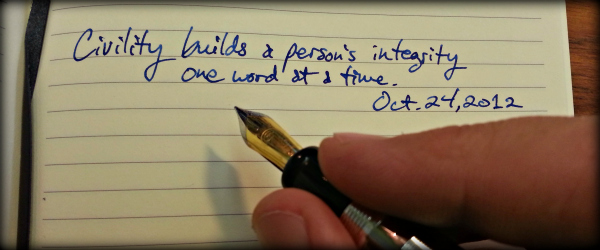
Oct. 24 ~ Civility builds a person’s integrity one word at a time. #civility
There are no shortcuts. There are no substitutes. We can choose to be a person known for our anger, our insults, our number of wins, our caustic attitude, or our superiority… but none of that replaces integrity.
Integrity is that essence of personhood that brings people to you when they have questions. It brings people to you when they need to say something. It brings people to you when they need to be heard.
Integrity is that honesty that enables people to listen to you with openness, and the fairness that allows you to hear dissenting positions. Civility creates integrity. Integrity creates trust. Trust creates friendships. Friendships create the most wholesome and transforming dialogue. Bank on it!
One Reason I Love Life Coaching: Healthy Dependence
“On Whom Do I Depend?”
 I think that creating healthy dependence is one of the things that makes life coaching a great experience. Life coaching helps us exercise a kind of healthy dependence that strengthens independence. Healthy dependence is the power behind that old axiom, “There is strength in numbers.”
Whenever I make a plan for action or set a goal in my life it’s good to know who is going to help me get to my destination. I ask: Who’s got my back? Who will help me? Who encourages me? Who can help me be accountable? Who cares about my success?
Who supports you? Who encourages you? Who will help you stay on track and meet the goals you set? Sometimes in life you might naturally gravitate to those people, but others times it can helpful to stop and think about with whom you will share your goals and plans. Surrounding yourself with a team of dependable people can make any goal in life, personal or professional, easier to meet and more enjoyable in the process.
Think about a few things:
1) With whom do I not need to confide and share my goals? Too often we have chosen poorly and shared our goals with the wrong people. Do you have a person in your life who has consistently discouraged you from your goals, even if they did so with the best intentions? You can’t change that person, but you can change yourself and your decisions. Evaluate the opportunities you have for creating a “team” of friends who will commit to helping you succeed. There is a difference between a friend who challenges and stretches me, and a friend who criticizes and discourages me. Often, the most well-intentioned friends hurt us the most simply by not communicating well. If they can’t tell the difference between challenging in a healthy way and hurtfully criticizing, I sure can, and I need to choose wisely when it comes to sharing.
2) How do I need to be supported? Most of us have been on the receiving end of unhealthy accountability. Unhealthy accountability is the friend or coworker who decides to hold us accountable when we haven’t asked them to do that for us. It’s also when we haven’t processed how we wish to be held accountable. We aren’t talking about being accountable to a boss or a supervisor at work, that’s a different thing. When I make healthy accountability with a peer or a friend to help me meet a goal, I need to do these simple things: 1) I need to chose a person who genuinely cares about me, 2) I need to share honestly and openly with my friend about my goal and the steps I am planning to achieve it, and 3) I need to decide how I want to be held accountable, as in what questions I want my friend to ask me and how often.
3) This is exactly what a life coach does! Sometimes we might already have these friends surrounding us and we know exactly how to fall into a rhythm of healthy sharing and dependence to meet goals in life. Often we don’t. A life coach is a dependable friend who listens, challenges, reflects and encourages, as you reflect, set goals and plan the steps to meet those goals.
Who’s on my team? On whom can I depend for help and support? I need a teammate or two or three to make the most of my time and energy applied to setting and meeting my goals in life. I may call on you sometime to “be on my team.” Please be gentle with me if I do. And if I can ever jump on your team to help out, you only have to ask!
The Barricade Shot
I am so decompressed today after a long and tiring, but wonderful Holy Week and Easter Sunday. I have tried to sit and blog some thoughts on a couple of things, but I can’t muster the concentration. But I had wanted to blog today, so I’ll share something else that’s been rattling around in my head for months, not really words, but an image, from the movie Les Misérables… at the barricade.

The first time I saw Les Misérables in the theater I was struck by this image that panned across the screen for just a moment, all the young revolutionaries scattered atop the barricade after their first big fight. The second time I saw the movie in the theater I waited for the image to arrive, and was again surprised that it came and went so fast.
I can’t decide if the director wanted to heightened the image’s power by not over-exposing it, or if he had no idea what he had. It is a perfect, romantic period painting, a pyramid in design and powerful in it’s individual elements and overall composition alike. It’s beautifully balanced and lit like a Rembrandt.
Here’s the romantic classic that the movie’s image has always brought to my mind, by Théodore Géricault… feel the similarities?

And though I said I’d share an image and not really words, a powerful part of this image in the movie is the lyricism happening in the song “Drink With Me” at that moment: “At the shrine of friendship never say die, let the wine of friendship never run dry. Here’s to you and here’s to me.”
Well, I said I wanted to blog today, and I managed to get one done.
Have a blessed week, my friends!
 toddthomas.net