
depression
Faith & Depression: A Few Thoughts

This post began life as a reflection on mental health for the Lenten Season I was asked to make for a church project back in 2019. Now, five years down the road, I’ve returned to it to see if my thoughts have changed. It’s a good moment for me to do this, because I’ve had an acute episode with depression in recent months. Here are my reflections from five years ago with a few updates, things I believe about dealing with life-long depression and mental health struggles, particularly in the arena of faith.
Having Faith is No Free Pass
Some would believe and even say that being a person of faith can insulate you from mental health struggles like depression. I’ve found in my life that neither having faith nor being in ministry automatically keeps one from suffering the very human travails of depression. Depending on which studies you prefer to accept clergy will suffer depression at least as often or more often than the general public. Don’t get me wrong. When I’m experiencing depression I’m so glad for my faith and the positive and hopeful truths of my beliefs. My faith assures me of God’s love and my worth, and those are powerful countering messages to the inner voices of my depression and existential anxieties. But they aren’t an instant cure.
My spiritual director recently asked me how my prayer life changes when I’m depressed. That’s a great question. I don’t stop praying, but I definitely have seen a shift from a more relational expression of prayer, just talking with God, to a more intercessory style of prayer, talking about what others around me need. That’s not necessary a bad shift, but I do miss the quietly affirming conversations with my God. Those times will come back around, and it helps me to read back in my journals and reflect on that deeper experience of prayer in other times of my life.

Depression Doesn’t Make You Bad
Being depressed does not make me or you a person bad. I’m not weak, stupid, broken or any of the other things we sometimes call ourselves and others when suffering comes around. Depression can and does happen to anyone. Do you remember the scene of that night Jesus spent in the garden wrestling with fear and anxiety? It’s Lent, so if you go to church much you’ll probably hear the story read sometime soon. He spent a sleepless night in a garden feeling sad enough to die. He suffered anxiety and a deep fear and existential pain, but not because he had done anything wrong. Suffering through that dark night of sadness (and yes, dark night is a common metaphor for seasons of depression and suffering) did not mean he was bad, weak or deficient in his faith. It mostly meant his claims of being human were all too true.
It’s not easy to release the shame and guilt that accompany depression, but they are not weights which have to be borne, and certainly not borne alone.
There’s No Need to Ask Why
We don’t need to ask why someone is depressed. Certainly there are ways to live our lives which are healthy or not, and things which affect us like seasonal affective disorder, and we sometime abuse substances. I believe though that asking why someone is depressed, at least as a first question, can get in the way of acceptance, love, support and comfort. Too often a search for why is just an extension of a blame game, or just a bad, a fix-it game. Next time someone says to you ‘I’m depressed” and you feel the “Really? Why?” start to form in your mind, say instead, “I’m sorry, that’s no fun. I love you.” Let’s not assume guilt when someone suffers. All Jesus asked for from his closest companions while he was suffering that night in the garden was for them to sit with him awake a while. Let’s be friends willing to sit with someone through their dark night. You don’t need to analyze or fix them, but just be willing to be there and let your presence be a strength and help. If we can do that, then we may find the opportunity and relationship needed to ask, “How can I help?”
Beloved ones, times of depression come and go for everyone, more often for some. Instead of viewing these seasonal changes of life as a weakness or deficiency, may we ever see them as opportunities to affirm our love and support for one another.
AMDG, Todd+
Suicide. Grace. God.
 It’s hard to say goodbye to someone who has been an integral part of the American experience for so many years, and yet someone the vast majority of us did not really know. Robin Williams was a comedic genius who gave us so many voices to enjoy. He could make us laugh with only a facial expression, but when he opened his mouth, and who knew what was going to come out, we would all be giddy and goofy with anticipation. What a soul! He will be missed in this life, and cherished and loved for his gifts.
He was also a human being, and had all the flawed brokenness that is so endemic to our daily struggle. Like many others, he was not immune to depression because of money, fame or success. Probably the money, fame and success were some of the things that could exacerbate his depression. I’m not doctor, so I don’t speak from medical training. I’m just someone who has grappled with depression my entire life, and I can relate to the reality of the best times bringing on the worst. If you have asked, “How could he be depressed with all the money and fame?” then you’re probably not someone who has struggled with chronic depression. For you this could an opportunity to realize how difficult it has been for that friend or family member to deal with their depression. It defies logic. It is very real. It is not chosen.
So while we mourn and look around and listen to one another, there were a few things I’m not always hearing and I wanted to make sure got clearly said…
1) Depression doesn’t separate you from God’s love. No one should assume that struggling with chronic depression is in any way necessarily an indicator that someone has rejected God, lost God’s love or is trying to live life without God. There is no scriptural basis for that kind of judgment or condemnation.
2) Depression is never bigger than God’s grace and love. That goes for anyone who attempts suicide, succeeds at suicide or is a survivor left by a loved one who commits suicide. To be reminded that God’s grace is bigger than suicide is not to say that suicide is ok. Suicide is painful, hurtful and devastating for the survivors. And yet, suicide also flows from some of the deepest pain and anguish that we carry as humans. As our hearts are moved and made raw by the anguish of suicide, can we believe that the heart of God is any less moved? There’s no scriptural basis for saying that suicide is an instant separation from God… that’s a traditional teaching that needs to be corrected.
3) Beware the isolation. I’m not speaking here specifically to Robin Williams’ experience, but in a broader sense… don’t go it alone. Chronic depression and the feelings of worthlessness, hopelessness and shame that it engenders will move you to separate yourself from others. Please don’t. Seek people. Start with a doctor who can help you determine if there’s a medical need that requires treatment, and get with a healing community… your friends, family, church, synagogue, temple, mosque, etc.
4) Don’t help isolate people who are depressed! Please, don’t turn away from someone who is struggling with a depression that you don’t understand. Help create a community of hope and healing where you live. Read, study and pray to be prepared to be a healing presence for someone in need. Be prepared to love and to help as much as someone will let you.
5) For my fellow followers of Christ, if a “Christian” blogger or group speaks of suicide in a judgmental, accusatory fashion, lacking the grace and love we expect from Jesus, then for the love of Jesus DO NOT SHARE THAT BLOGGER! Why is it that the worst opinions and perspectives I have seen on the death of Robin Williams have been from “Christian” groups? This is not as it should be, and the solution is ours to enact. I refuse to link to them and expand their influence by sharing their hate and/or ignorance, even to refute and disown their words. Please, please, please be discerning.
If you’re up against that wall, when depression and it’s crippling grip have a hold, I’m yours. Email me, ok? We’ll chat. I’ll give ya my email, in code so the spammers can’t get in the way… it’s reserve7 @ gmail. com. Squish that together without the spaces and you got me. We’ll walk some road together. If you don’t like me, find someone else! We’re in this together.
“But no matter what comes, we will always taste victory through Him who loved us. For I have every confidence that nothing—not death, life, heavenly messengers, dark spirits, the present, the future, spiritual powers, height, depth, nor any created thing—can come between us and the love of God revealed in the Anointed, Jesus our Lord.”
Romans 8:37-39
AMDG, Todd
For some, there are days that are hard earned, when holding on takes every bit of faith and hope… celebrate the victory! Luka Bloom celebrates that in his song, You Survive.
Here are a few other resources…
National Suicide Prevention Lifeline, call 24/7: (800) 273-8255
The Trevor Project for our LGBTQ youth,
and for our veterans… Veterans Crisis Line.
sacred unease (a poem for nov. 1 2012)
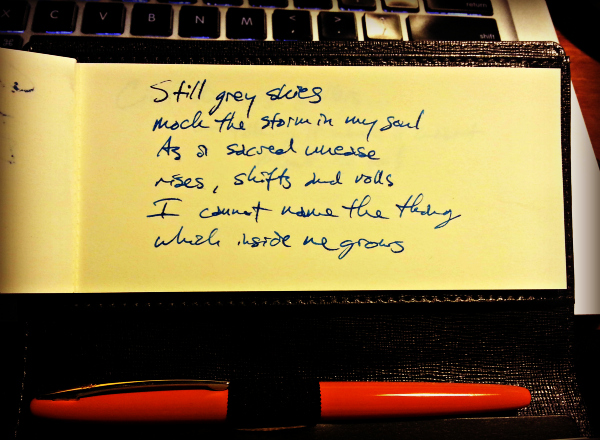
still grey skies
mock the storm in my soul
as a sacred unease
rises, shifts and rolls
i cannot name the thing
which inside me grows
This often happens when I sit to intentionally write some poetry. A still, quiet moment allows me to hear some of my more painful inner movements that are drowned out in the usual activity of the day. It’s not that I’m totally filled with melancholy, but it’s there.
In recent months I’ve been in several different situations discussing the impact of depression on our lives and those conversations have had me thinking. I have lived with the ebb and flow of depression as long as I can remember. I don’t think it’s ever outright owned me, but it’s been there. I’ve learned to watch the seasons and to be aware of their impact on my moods. I’ve learned to listen to the people who love me and live with me; Teresa will let me know when I seem to be letting it get an upper hand.
I’ve been thinking about some of the ways that being a person of faith has impacted the way I deal with my depression and darker moods. I think that growing up with a “seen and unseen” worldview has been helpful for me. I was raised to put my faith in something beyond my senses, beyond my ability to perceive, as I could perceive other things. So when the dark thoughts come and I perceive no hope, I have this reflex to look past it and try to see what may not be seen.
I have a cognitive trigger built into me that causes me to seek. When I seek I am in movement. When I am in movement I cannot be held in the grip of anxiety, fear or hopelessness for too long. So when I am in the grip of depression, it never holds all of me, there is a bit of me still free to roam.
I’m not saying that this idea is a panacea or a magic cure all of some kind. And there will always be times when our imbalanced physiology demands the help of trained professionals, both for counseling and for medication. When I stop seeking, then I think it will be time for me to see a professional.
But having that safety valve built into me allows me to be very open about the presence of darkness in my soul. I can deal with the fact that even as a creature of the light, I retain these shadows; I own the shadows. But the shadows don’t own me. I’m grateful to God for this. And so even as I write something that questions what “inside me grows” I am also very assured that it will not one day rule me and destroy me, or supplant in me what God would do. My unease is sacred.
 toddthomas.net