
Same-Sex Marriage, A Response
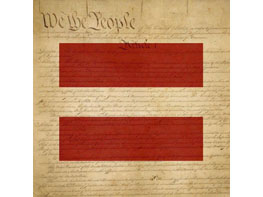 There is a comment thread in my first post on same-sex marriage that I will respond to here in this post. I’d like to make a couple of points that might get lost in just replying in that thread…
A reader named Deanna asked me to go look at a blog which leveled the charge of “idolatry” at people of faith who do not condemn their gay neighbors and same-sex marriage. My friend Greg went and read it and responded, and I checked out as well. Here are a couple of points I’d make…
First Point: Name calling is just too easy and evasive.
There are so many arenas on the web to talk about and debate what the scriptures actually say about same-sex attractions or practices, and I really encourage people to dig in and try to answer some of the tough questions surrounding the issue of same-sex activities recorded in the scriptures and how we interpret them, if living by the scriptures is one of your personal drives. I will say that I agree with Greg on his take on the referred article… too simplistic and unfair. It’s far too easy to simply accuse people you don’t agree with as idolaters. When you can’t hold a substantive argument, the recourse should be doing more scholarly homework, not resorting to name calling.
Maybe, one day soon I’ll unpack my reading of scripture and same-sex attractions and relationships here, at least as I have come to believe and read the scriptures. I am someone who holds scriptures at the core of my life and thought, dependent on and grateful for them.
However, in my previous blog post, though I did mention own belief that a same-sex orientation is not antithetical to my faith, all the ideas I expressed were about removing inequalities in our civil laws about marriages and it’s benefits. The article to which I was referred at least began at the marriage question, but only as a spring-board to move to other things, like name-calling in disagreement. Why change the subject? Scallia’s exchange was interesting, but hardly definitive.
The bottom line is that I am happy to respect anyone’s right to hold a view on same-sex marriage and to have their own thoughts on same-sex orientation, but I am not happy to have anyone’s views unnecessarily held above their neighbor’s views to their neighbor’s detriment. That is not “neighborly,” nor kind nor civil.
Second Point: Has no one ever taught us to disagree?
I’m afraid that people of faith who do believe that same-sex attractions and relationships are antithetical to their faith are missing a great opportunity to grow in their own beliefs and at the same time make a fair, just statement to their neighbors who believe differently. I wonder why we so often think that someone’s differing opinion undermines our own? Universal agreement is certainly not the best test for one’s own convictions.
Suppose that more traditional thinking people of faith who opposed same-sex mariage would say something liek this:
“Well, it is a ‘free country’ and you are responsible for your own life. So I will not try to get in your way on such a personal issue that involves consenting adults living their lives. By the way, if you ever want to consider my views on the issue, I’d be glad to buy you a cup of coffee and chat.”
Such an offer may not get many takers, but it’d be respected far more than shrill name calling and denial of people’s civil rights.
People of faith have been disagreeing poorly for a long time, so I don’t blame our current generations for the problem. I do however think we could make some real strides forward on disagreeing better. We can be part of the solution!
This is especially needed when we are thrown in the public spotlight. I grew up in churches that happily argued and condemned each other all the time, relishing the delight of publishing scathing articles about another congregation, a college or some preacher who disagreed with their view. The worst days were when one congregation would take out a full-page ad in the local paper to condemn another. What a horrible witness to the reconciling power of Christ.
People of faith who want to point to the faith of the writers of our national documents like the Declaration of Independence and Constitution should be humbled that faith had such a grand part of crafting these documents of freedom and liberty, not restriction and denial. Faith helped create the guarantees of freedom that we now debate in our national conversation and in the highest court of the land. In such a national arena we need to recognize that our views and opinions are best shared with respect, dignity and a large dose of humility.
Holy Week: A Repudiation of Violence
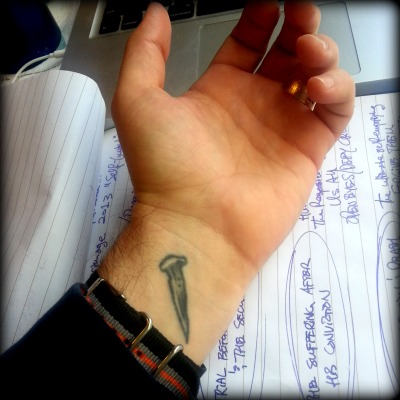 Seven or so years ago I stated my journey with tattoos. I had a nail tattooed on one wrist, and then my dear friend (and then boss as well as newly minted author) Suzanne Castle graciously gifted me with the other wrist nail. I wanted these tattoos to mark that Easter Season and the meaning that Christ has held in my pilgrimage through life.
This week as I work on Good Friday devotional ideas and prepare for Easter Sunday, I am stuck not by the violence of what was done to Jesus, but by what a repudiation of the violence the events represent for students of Jesus.
Beginning in the garden when Jesus heals the servant whose ear is struck off in his defense, our Lord lays the foundation for a different way to do life…
Luke 22:49-51 “When Jesus’ followers saw what was going to happen, they said, ‘Lord, should we strike with our swords?’ And one of them struck the servant of the high priest, cutting off his right ear. But Jesus answered, ‘No more of this!’ And he touched the man’s ear and healed him.”
Wow, can you see Jesus in your mind’s eye, hands raised and eyes wide, motioning his friends to a halt, “No more of this!” No more of this! Striking with the sword was not the answer. Striking back was not the way.
Later, on trial for his very life, Jesus will again repudiate violence as he speaks to Governor Pilate. His assures the Governor that his followers will not violently storm any chambers or raise weapons in his defense or to overthrow any authority, for that is not his kind of kingdom.
John 18:33-36 “Pilate then went back inside the palace, summoned Jesus and asked him, ‘Are you the king of the Jews?’ Is that your own idea,’ Jesus asked, ‘or did others talk to you about me?’ ‘Am I a Jew?’ Pilate replied. ‘Your own people and chief priests handed you over to me. What is it you have done?’ Jesus said, ‘My kingdom is not of this world. If it were, my servants would fight to prevent my arrest by the Jewish leaders. But now my kingdom is from another place.’”
These passages have caused me to stop and reflect on the exquisite repudiation of violence that exists in the violence to be done to Jesus. That God would enter into life to bear the burden of such violence to open our eyes, to soften our hearts, to change our way, gives me pause and humbles my “wisdom” I am tempted to think I have collected.
I look at the nails tattooed on my wrists and I think that I have tended to meditate selfishly on what they mean, that I am the recipient of such love. Today I am moved to meditate on the awesome burden of love that I am live, instead of the violence that so often inhabits my thoughts, my mind and my heart.
I’m not sure I will ever be worthy of such audacious marks as these inked nails; most days I know that I fall so painfully short. As I’ve been thinking of a new tattoo for this Easter Season, I feel the need to double down on what it’s all about… maybe I read too much news, but it seems that from battlefield torture to Middle America’s children raping children, to living in ignorance of the plight of my poorest neighbor, the world needs a change of pace, a new way.
Same-Sex Marriage
 Ok, here we go. Over twenty years ago I was so very blessed to marry my life’s love, my soul mate and best friend, Teresa. I cannot imagine having taken this journey with someone else. I am so thankful.
Because Teresa and I are Christians, our marriage took place in a church building, with a Christian minister officiating. But interestingly, the “paper trail” of our wedding began earlier, not in a church building, but in a county office in Abilene, Texas. The civil authorities issued our marriage license and demanded a copy back, signed, for their records.
I believe our faith has framed and guided our marriage, and it is integral to who we are. But it was the civil government which allowed us to marry and have all those rights and privileges afforded a married couple. Those privileges, by the way, have nothing intrinsically to do with gender, faith or sexual orientation… visitation rights, filing joint taxes, hospital visitation, insurance coverage, etc.
Why does the civil government do this? Well, because we have this amazing document we call The Constitution that was created to, among other things, “..secure the Blessings of Liberty…” Those nation builders were poetic rascals, and that phrase rings very similar to the idea put forth in our nation’s Declaration of Independence that all people have certain rights as human beings including the rights of “Life, Liberty and the pursuit of Happiness.”
Being married has made me so happy! Living with the liberty to seek marriage to the one I love, and then to obtain marriage to the one I love, has been one of the most worthwhile pursuits of my life. It has been a pursuit and realization of happiness.
Today, in the same country many simply do not have the same rights and protections as I do, because they love and wish to marry someone of the same gender. In some way, we have decided their endowed right to life, liberty and the pursuit of happiness shall have restrictions imposed that are not imposed on my own. All those rights and privileges I mentioned, that have nothing to do with gender or faith, can and are most often denied to them.
My friends, I do not believe that my own faith instructs me to oppose same-sex marriage. I do however understand that many of you believe that your faith does not allow you the option of same-sex marriage or orientation. And for the sake of your conscience, and because it is your right to live life based on your faith convictions, I respect and support your living by that faith. No one should ever force you to live in an orientation or marriage that you do not desire. But we are talking civil rights, folks. We are talking about the very base of civil rights which afford you and I and everyone the opportunity to worship and live according to personal faith, as one’s conscience dictates. These are shared rights to pursue happiness in freedom.
While proofing this blog for me, my previously mentioned wife, the beautiful Teresa, asked me to mention something about interracial marriage in our nation. She said, “This isn’t a new issue” meaning that the denial of people’s right to marry whom they choose is not a new problem. Many Americans fought the civil right of others to marry someone of different ethnicity, often again on religious grounds. Though it was legal in many States, marrying a person of another ethnicity was not a protected right for all people in our country until a 1967 ruling by the Supreme Court. 1967!
You may answer the question of same-sex marriage by any criteria you wish to use, for your own life. This is your right. Answering it for your neighbor, by any criteria of your own choosing, is not however your moral, ethical or constitutional right.
 Everyone can empathize with a person’s desire to pursue life-long love with their chosen partner. And we can also empathize with the desire simply to be free to do something, even if we ultimately choose not to do it. We know that the burden of not being free is an emotional, psychological and spiritual injury. We must not be a people who do such injury to others.
For straight people, the freedom to marry remains their right whether they marry or not. A freedom is strength. A freedom is joy. Not being free is painful. Right now, a majority of people in our country enjoy the strength and happiness of a basic civil right to pursue personal happiness in the agreement of marriage and all it’s attendant rights and privileges. And at the same time in the same country a minority is held bound in the pain and loss of being denied the same right.
For me, the burden of my own rights will necessitate that I support the rights of my neighbor. My freedom to marry cannot be a selfishly hoarded treasure. If I am given this gift by my civil authorities, pursuant to the execution of our nation’s founding documents, then this gift is also for my neighbor, regardless of ethnicity, gender, orientation or personal faith.
In short, I stand with my homosexual neighbors, now and always, in support of their intrinsic human dignity and their full, complete set of civil rights. My faith tells me that they are beloved of God, and so it is my joy to serve them and love them. Whether my gay neighbor is a citizen of my country or not, I will always support their freedom and human rights, but especially in the country of my birth, I will expect that they are treated as full citizens, endowed with every right I myself enjoy.
And maybe one day, one glorious day off sometime in the future… I won’t have to even clarify that I am standing with my gay neighbor, or my straight neighbor, or my Christian neighbor, or my Muslim neighbor, or Hindu neighbor, my atheist neighbor, my male neighbor, my female neighbor… maybe, just maybe, we’ll grow up into a mature respect of people that no longer needs such labels to engage their amazing worth, value and dignity as human beings. Amen.
A Not So Blind Faith

I don’t go to Catholic Mass all that much, not nearly as often as many of my Protestant friends think I do given my bromance with St. Ignatius of Loyola, so I was happy to have a surprise chance to drop in on a noon Mass one day this week with my good friend Greg and others down at St. Paul’s College in DC. We arrived five minutes fashionably late and I had to grab an empty chair that was of course up front near the altar and next to one of the presiding Fathers.
I’m not Catholic, though I love and appreciate my Catholic brothers and sisters. And I know a good bit about the Mass, though I don’t know the rhythms like a good Catholic. This means that when I go to Mass I have to bring my “A Game.” I have to work hard to listen and watch everything so that I’m not always the last one standing or sitting. I rarely make the sign of the cross in prayers or before the Gospel reading… my goal is not to pass myself off as a Catholic, but I do hope to worship and to at least not be a distraction for others.
In this particular noon Mass I was rocking along quite well when the wonderful old, probably retired, Father who was presiding over the Mass moved to deliver his homily. I had of course already noticed his quaking voice and shaking hands, a loss of muscle control I would usually associate with my own sweet grandmother’s Parkinsons Disease or other such aliments that afflict the mature among us. But he manfully strove with his body to grip the lectern and deliver the homily with a stronger voice and presence than he had previously shown us.
His text was from Daniel 3, the famous story of Shadrach, Meshach and Abednego and their fiery trial. As he worked to bring his body under greater control and speak quite eloquently on the passage my personal empathy went through the roof with this dear old man. I know the feeling… when I am especially tired or excited I will often have to work over-time to keep my stuttering under control.
His obvious effort served to focus me on the passage and his words. And so I was unprepared for the power of the words in verse 18, “But even if God doesn’t save us…” It’s a familiar passage, and one I have happily preached many times myself. But caught in the furnace of age, not himself delivered from the ravages of a failing body, this old priest drove those words to the center of my soul. From the lips of the three young men so long ago, to the lips of this venerable priest, to my own often too-hard heart, the words rang as they seldom have for me. Forget the fickleness of my faith, the faith that follows on good days and coasts on the bad days! Forget my faith that only responds to the gifts of God. Forget my faith that only survives on answered prayer! O God, give me a faith that stares into the trial and carries on regardless.
Some detractors might label this kind of faith that moves regardless of immediate evidences of God as “blind faith.” And certainly there are times when I could simply pantomime my religion instead of being a thinking, “seeing” person and an accountable soul. But that is not what I see happening in the story from Daniel. That is not what is happening in the life of a old priest who musters his strength to worship God and to serve his friends at the altar. It is not a blind faith, but a decisive faith. A faith that has chosen and does not have to continue choosing again and again. It is not a blind faith, but a very self-possessed faith that knows itself.
Even as I type the words I find my inner voice crying out in prayer, “Lord, help me know myself! Help me be so decisive! Help me be so self-possessed of faith and you!” And as we prayed together in Mass this week, “Lord, hear our prayer” I continue to pray, “Lord, hear my prayer!” For if I can bet on anything, it’s really two sure things: 1) another trial is eventually headed my way, and 2) I can either have decided my course, or be caught unprepared for the heat.
Praying, Todd
Nonjudgmental Christians, Part 2
We begin with the words of James 4:11-12…
11 Brothers and sisters, do not slander one another. Anyone who speaks against a brother or sister or judges them speaks against the law and judges it. When you judge the law, you are not keeping it, but sitting in judgment on it. 12 There is only one Lawgiver and Judge, the one who is able to save and destroy. But you—who are you to judge your neighbor?
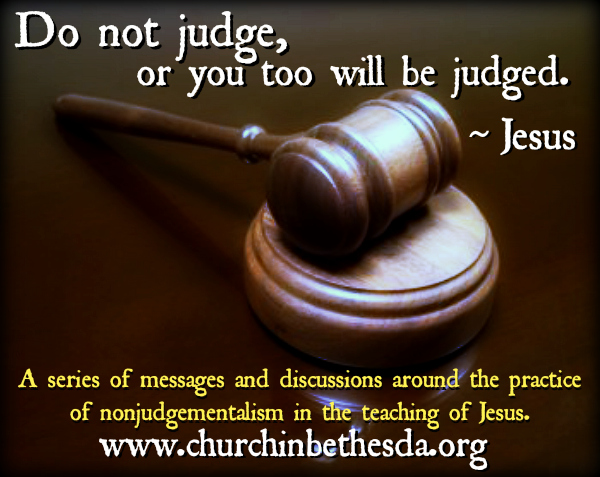 James makes a fundamental point about judging… when a person chooses to become a judge there is a usurping of the way things should be… a stepping out of place for the one who chooses to judge. Who am I to judge you? Who am I to act as if I am the judge and not simply a co-defendant, standing at the same level as you?
In the first week of this series we looked at the straightforward warning from Jesus that we should not judge others. It creates a reciprocal loop of judgment and easily becomes tangled our own blindness and hypocrisy. But at the same time we are told not to judge, we are also told by scripture to be involved in one another’s lives. And for that reason many Christians get really uncomfortable when we quote Jesus saying, “Do not judge.” They immediately begin qualifying the statement, basically creating loopholes for judgment.
I get the rub, I really do. When I speak of being nonjudgemental I often get a response somewhat like, “But if I see something sinful, I’m supposed to point it out!” or maybe “If I see someone in trouble, I can’t pretend that everyone is just ok and not help!” Some Christians like to speak of nonjudgementalism as being convictionless or “wishy washy.”
I see where the problem is and I do understand what is trying to be said: If I see someone hurting themselves or hurting others by their words and actions, I should not pretend that I don’t know anything is going on. I agree with that. It’s not being a very good friend or brother if someone I love is doing harm in their words and actions, but I simply stand by and watch.
Do I have to judge someone to correct them?
There are certain passages are often sited in support of actively judging the people around us: John 7:24, James 5:20, Ephesians 4:15, and 2 Thessalonians 3:11-15. These are passages I have seen and heard Christians quote as their “License to Judge.” If you want to look at those, you’re welcome to and encouraged to. But here’s deal on each… The John passage deals with people’s performance of the Law and how it is judged fulfilled or not, as Jesus is speaking to the religious pros, correcting their misjudgment. That hardly overrides his own warning not to judge. The James passage is about correcting someone “in sin,” but of course comes a chapter after James reminds us not to judge people. The Ephesians passage is the famous (and famously abused) “speaking the truth in love,” but is in a context of building people up, not tearing them down. And the 2 Thessalonians passage is crystal clear that the offending people are not to be viewed as enemies, but as fellow believers. So, let’s move on to the real issue…
We seem to have some problem premises, some destructive ideas that we need to root out and remove from our lives and habits. I identify and list them in the following way, but they are interrelated and can be see in almost any order. These are wrong ideas…
1. For me to have convictions about right & wrong, I must be judging you or correcting you.
2. Because for me to help you, I must first judge you.
3. Because help and correction only follow judgment.
4. Judging and correcting are one and the same.
When I think in ways based on these problem premises, I cannot distinguish judging from helping, judging from correcting, or even sometimes judging from encouraging. This idea is fairly self-evident when you quote Jesus, “Do not judge” and a nearby Christian immediately says, “Yeah but…”
The bottom line is that when I allow myself to distinguish between judging and correcting, I can correct without judging. Sounds simple, but I actually have to work on this to do it well. You may sin, but I do not have to judge you a sinner, fallen, evil or wrong, before I can show you a better way. And vice versa. When I am caught in a weakness, or a moment of poor choice or wisdom, you do not have to judge me a failure to lend a helping word or hand. Jesus modeled this so well!
Neither Do I Condemn You
Jesus models a way of helping, even correcting, without judging in John 8:1-11. He says, “Neither do I condemn you.” That’s right, even when a person is caught doing wrong and guilt is not in question in any way, Jesus still begins with “Neither do I condemn you.” But Jesus! It’s a slam-dunk! This person is totally guilty… but Jesus didn’t condemn. He didn’t say, “Well, you screwed that up! Here’s what you do to fix things…” He didn’t say, “You’re so guilty, and you suck at fidelity and all, but good thing I still love ya anyway. Shape up.” He says, “Neither do I condemn you.” And in saying that, he loses absolutely no authority to correct her behavior.
Think back on John 4, as Jesus speaks with another woman, whom he knows to be living with a man out of marriage, and he doesn’t condemn either one of them. Instead, he chats with her having one of the deepest theological discussions recorded in the gospel narratives.
Think again on every single time Jesus touches the “unclean” or eats, drinks and associates with the wrong kind of people. He’s amazing in the way he reaches into people’s lives and touches them, without judging. Why can’t I do this as easily? Is it simply my ego that demands they be judged first? Jesus makes it look easy, but I know I have to work hard to retrain my heart.
I will also say this, one more thing about the passage in John 8… by the time Jesus says “Leave your life of sin” he has that person’s attention. He has an audience with her, I believe in large part, because he did not feel the need to judge her first. How many times have I lost an audience because judgment rang through in my opening remarks, or it was painted across my face? The question makes my stomach hurt, just to be honest with you.
The real test of this thing, this amazing way that Jesus modeled for us to reject condemnation and judgment, was seen on the cross. He looked at a raving crowd that demanded his death, at the soldiers who nailed him to a piece of wood, and he said, “Father forgive them, they don’t know what they are doing.” What? Jesus? They do too know! They just did it! Guilt is once again crystal clear!
But for Jesus, the choice has been made to look on others without the need to judge and condemn. He doesn’t need to revel in their guilt before offering prayers for their benefit. The words from the cross need to haunt me, drive me, guide me. If I could only look at the people around me whose guilt is so certain, and begin with a love not rooted in what they’ve done or not done, then maybe I would receive the same.
I don’t judge the judgmental people. I’ve been there too many times myself. I feel the judgement sometimes rise up within me. My heart can sometimes judge, classify, label and dismiss a person faster than a super computer can process 2+2. But when I want to judge, I need to not judge. When you feel like judging, please stop it.
My heart has some growing to do. It so often feels like judgment has replaced love in my heart, by habit and experience. But didn’t someone once say, “Knowing is half the battle?”
Comparing a Sitting US President and Hitler: Uncivil
I am going to just to say it out loud: Comparing any U.S. President to Adolf Hitler is about the most overused, ridiculous and vapid attempt at humor or political astuteness that can be imagined. It simply serves to embarrass the person doing so, and it serves to move everyone exposed to it a bit further from any meaningful dialogue or engagement with current policy issues. Every President deserves better than this. You and I deserve better than this. It is simply demeaning for us all.
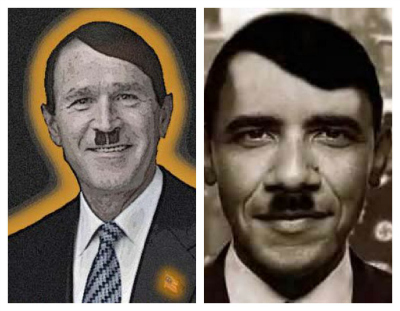 It isn’t funny. It isn’t clever. It isn’t civil. And however well intentioned or sincere a person might be, it doesn’t advance any valid political ideas or highlight any useful policy insight. In the most blunt terms it is a waste of time and extremely disrespectful to our nation’s highest office and any person who might be holding that office.
This is also not a problem of the political right alone, or solely of the political left. This has recently been done with both past President George W. Bush and current President Barack Obama. Both have been vilified by an attempt to connect their actions and intentions to a dictator with whom neither have any political, national or religious common ground. This is a problem of American discourse, not just of one political party or political persuasion. And when followers of Christ engage in it, it becomes a spiritual problem, a spiritual short-sightedness.
Of all of my friends and neighbors who believe that implicating connections and commonalities between their political adversaries and an historical evil such as Adolf Hitler, I ask only this: Find something constructive to do with your time. It might look like this…
- Find someone to encourage.
- Find someone to help.
- Pray for or find a way to better relate to a political figure you feel the urge to vilify or defame.
- Pray for and find a way to help the people around the world suffering under political and tyrannical regimes that are actually reminiscent of Adolph Hitler’s abuses and murderous evil.
Comparing Presidents and Hitler: Lame.
I am going to just to say it out loud: Comparing any U.S. President to Adolf Hitler is about the most overused, ridiculous and vapid attempt at humor or political astuteness that can be imagined. It simply serves to embarrass the person doing so, and it serves to move everyone exposed to it a bit further from any meaningful dialogue or engagement with current policy issues. Every President deserves better than this. You and I deserve better than this. It is simply demeaning for us all.
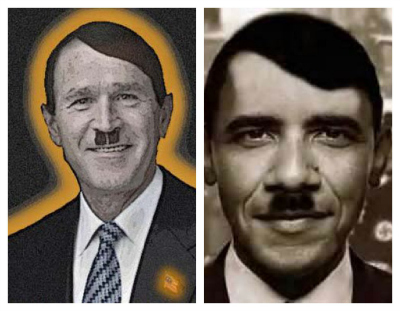 It isn’t funny. It isn’t clever. It isn’t civil. And however well intentioned or sincere a person might be, it doesn’t advance any valid political ideas or highlight any useful policy insight. In the most blunt terms it is a waste of time and extremely disrespectful to our nation’s highest office and any person who might be holding that office.
I would remind my fellow Christians that disrespect for others is not a spiritual gift nor is it something to which we are called to aspire. We are not called to be disrespectful, but to submit ourselves in genuine honor and concern for others, even to the point of loving one we would consider an “enemy.” (Matthew 5:43-48 “Love your enemy.” 1 Peter 2:11-17 “Honor everyone.” Ephesians 4:25-5:2 “Put away from you all bitterness and wrath.”)
This is also not a problem of the political right alone, or solely of the political left. This has recently been done with both past President George W. Bush and current President Barack Obama. Both have been vilified by an attempt to connect their actions and intentions to a dictator with whom neither have any political, national or religious common ground. This is a problem of American discourse, not just of one political party or political persuasion. And when followers of Christ engage in it, it becomes a spiritual problem, a spiritual short-sightedness.
Of all of my friends and neighbors who believe that implicating connections and commonalities between their political adversaries and an historical evil such as Adolf Hitler, I ask only this: Find something constructive to do with your time. It might look like this…
- Find someone to encourage.
- Find someone to help.
- Pray for the political leader you feel the urge to slander and defame.
- Pray for people around the world suffering under political and tyrannical regimes that are actually reminiscent of Adolph Hitler’s abuses and murderous evil.
Philippians 4:8-9
8 Finally, beloved, whatever is true, whatever is honorable, whatever is just, whatever is pure, whatever is pleasing, whatever is commendable, if there is any excellence and if there is anything worthy of praise, think about these things. 9 Keep on doing the things that you have learned and received and heard and seen in me, and the God of peace will be with you.
Reviewing Starbucks’ $1 Reusable Cup
 I spent a bit of time this week making sure that I interacted with the little $1 cup from Starbucks. I’m happy to say that for the most part, this is a great little cup, nothing to be ashamed of carrying to and from your favorite local coffee shop!
CONS: Let’s start with the cons, so we end with the good stuff. First, it’s not the prettiest cup you’ll ever buy. The cup and lid are two different plastics, the cup in a slightly off-white and the lid in bright white. The cup’s off-white to yellow body reminds me of the old PC computers that were all in the slowly yellowing plastic. Remember those? Yeah, not pretty. Secondly, the thin plastic of the cup will heat up and burn your hand. When you first pick it up you think you don’t need the paper sleeve, but ya do.
PROS: Now the good stuff! First, The cup is good for both tall and grande drinks, or small and medium at normal coffee shops. =) I think the first thing I read online the other day said the cup would hold a venti drink, but that would be a big cup, tumbler size. Secondly, the cup is dishwasher safe! I try to hand wash all my cups anyway, to minimize the bump and chip in a washer. But, you can just drop this one in the top rack! Thirdly, and though I haven’t field tested this aspect, the cup says it microwave safe! That’s a plus for reheating water in a pinch. And finally, the satin finish on the cup and printed layout familiar to a paper cup makes it fun to personalize! If you want to, ask them how to mark your favorite drink and save time on your next visit to refill.
I hope the cheap price point and novelty will catch some attention. This is a great alternative to a paper cup and a fun way to start reusing instead of disposing!
Nonjudgemental Christians, Part 1

This past Sunday I started a discussion with our church family on the teaching of Jesus that we not be people who judge others. I am blogging along at our church website on our series and wanted to also place the entries here.
Nonjudgemental Christians, Part 1
Here’s our base text from Matthew 7:1-6…
1 “Do not judge, or you too will be judged. 2 For in the same way you judge others, you will be judged, and with the measure you use, it will be measured to you.
3 “Why do you look at the speck of sawdust in someone else’s eye and pay no attention to the plank in your own eye?4 How can you say, ‘Let me take the speck out of your eye,’ when all the time there is a plank in your own eye?5 You hypocrite, first take the plank out of your own eye, and then you will see clearly to remove the speck from the other person’s eye.
6 “Do not give dogs what is sacred; do not throw your pearls to pigs. If you do, they may trample them under their feet, and then turn and tear you to pieces.
Do Not Judge
We started with the recognition that the word “judge” here means exactly that, “to judge” or to give a verdict. It’s not just criticism, but it is delivering a verdict; a person is judged inadequate, worthless, wrong, or without value. A person is judged as not worth God’s time, not in God’s favor. It is the decision on a person’s worth and value, a full and complete judgement. Certainly among the audience on the day that Jesus spoke these words there were many of the religious professionals present who were well versed in judging, and many who had been judged.
As we read through the ministry and life Jesus we often see these religious professionals in action. They are the ones in the background whispering, “If he only knew.” When Jesus was eating or interacting with people they judged unworthy or undeserving of his attention, they assumed he simply didn’t know who they were. If he knew, surely he would have judged the person as they did. And yet Jesus did not judge as they did, and his words warn us of judging. Some examples of people judging others when Jesus did not: Luke 7:36-50, Mark 2:13-17, John 8:1-11, and Matthew 21:28-32 (premature judgement).
The first warning in this passage that Jesus gives is very clear… if we choose to indulge in bringing judgment, then we open ourselves up to the same standards and imposition of judgment. He says clearly, “Do not.” Then he unpacks the danger of judgement as it opens us up to the same treatment.
Do Not Judge, But Maybe Help
Jesus goes on to essentially make a joke of my hypocritical use of judgment, that I easily overlook the reasons in my own life to face judgement and turn to quickly judge another. He says that when judging others I overlook the “plank” which debilitates my own life to focus on the “speck” that trips you up. Jesus asks “Why do you do this?” Why do I do this blatantly hypocritical thing? Because your speck, your sins or mistakes, they make me an expert. My own plank, my own sins and mistakes, they just make me a failure. Why wouldn’t I choose to spend the day on your problems instead of my own?
And yet, Jesus puts a line of hope out there for me. I can work on on my own life, and maybe, just maybe, one day I’ll be able to help another person. Maybe, if I can do something about this plank in my eye, if I can find my way from the debilitation of my own sins and weakness, then I will be strong enough to help someone with a speck. Because no matter how hard I work on my life and no matter how much I achieve in purifying my life, the contrast is still overwhelmingly against me: my plank vs. your speck. My primary responsibility is always my own sin, no matter how well I ever manage to hide or tame it, or notice yours.
Some see these words as a chance to judge, a license to judge! You see, if I can simply tame a sin in my own life, then it’s fair game to judge in your life. But I will have to humbly disagree with that. This is still within the discussion on judgment which Jesus began with the words, “Do not judge.” We are still talking about why we don’t judge. Removing a plank from my eye does not give me license to judge, but an opportunity to help. St. Paul would later echo the same sentiment in Ephesians 4:28, “Those who have been stealing must steal no longer, but must work, doing something useful with their own hands, that they may have something to share with those in need.” I am not to judge, but I may be able to help. There’s a big difference.
Pigs and Pearls
And finally there’s the closing verse of the passage we used on Sunday, the one about pearls, pigs and dogs. I was surprised to find so many commentators who treated this verse as unattached to the fuller discussion. They simply made a comment on the common sense of not wasting precious resources on ventures or opportunities that are not precious.
Yet it is a beautiful restatement of verses 1 & 2! Verse 6 restates the devastating reciprocity of judgment that Jesus warns us of, that when I judge I open myself up to the same treatment. Think of verse 6 now, and in that imagery, the pearls and sacred things are the people around me, and the pigs and dogs are my judgements. If I throw those precious people to my judging (usually to feed my own ego and righteousness), the same judgments will eventually turn and destroy me. I will reap what I sow.
So Why Do We So Often Judge?
In the coming weeks we’ll be talking about the job of sharing life as nonjudgemental people, and yet we are involved in one another’s lives and have a responsibility to help each other when needed. Can we recognize opportunities to help without the prerequisite of judgment? Can we make sense of other things that New Testament writers say in light of the words of Jesus? Maybe I’m too much an optimist, but I believe we can, if we will be both thoughtful speakers and thoughtful listeners, bound in love.
Peace, Todd
Oh Yeah… Cold Cups!
 I want to mention reusing cold cups instad of simply disposing of them, or better yet, carry a nice reusable cold cup! Most coffee shops that also sell cold or iced drinks will sell cold cups just as they sell hot drink cups.
But it’s not so easy as it seems! There’s obviously a different part of the brain associated with carrying a reusable cold drink cup. I say that completely scientifically. I have no trouble remembering to carry a coffee cup, and though I own a nice reusable cold cup, I can’t remember it to save my life.
But the payoffs are the same as reusable hot cups when it comes to preventing waste. I don’t kick myself too badly when I’m out & about and don’t have a reusable cold cup for that iced venti Passion Tea Lemonade from Starbucks, but I can make sure to keep that plastic cup, wash and reuse it a couple of times.
I am trying to break my addiction to Diet Coke right now, so I am using that Big Gulp image as a reminder to, well… “Just say no.” But that doesn’t mean I shouldn’t keep my reusable cold cups handy for the trips to the Starbucks!
 toddthomas.net