
Devotional Thoughts
Nov. 8, 2013 Civility in Xian Scripture
 November 8: The civility of shutting my mouth pays big returns.
Proverbs 10:19, “Sin is not ended by multiplying words, but the prudent hold their tongues.”
This past Sunday at Church in Bethesda we started the month’s series of exploring the big themes of scripture that support civility, and this past weekend we talked about the theme of “I need to shut my mouth!” How many times does something strike us the wrong way, and a harsh or even inaccurate retort is flying before we really think things through? Are you able to see something on Facebook you don’t like and just scroll on? Can I keep my mouth shut when it really doesn’t need to be open?
The first half of the verse is challenging for a pastor, or any blogger or pundit for that matter. What? Stop multiplying words? Words are our tools! Words are an amazing gift! Our species rocks the world of words! But, still the proverb warns us of thinking that more and more words are what we need. Sometimes we need silence. The prudent know this.
pru·dent 1. acting with or showing care and thought for the future.
So here’s how I break it down, the return on investing in some quiet…
Shutting my mouth buys me time…
~ to think and reflect. I may even think of a clarifying question that gets us a lot further in our dialogue than a pointed reply.
~ to listen. The old saying is that “God gave us one mouth and two ears, so be quiet and listen!”
~ to forgive. Too much is said too soon, too loudly and too wrongly, because I want to punish and retort more than I want to forgive and extend grace.
~ to choose what I will eventually say. If given a chance, on almost any day, how much of what we say would we say differently? If only we had a 10 second delay on our speech, hmmmm?
~ to stop a fight before it even gets started. That’s choice peacemaker stuff right there!
~ to stop a fight after it gets started by breaking the cycle. Because someone has to break that cycle of responses and one-uppers. Again, peacemaking instead of peacebreaking.
Developing the art of shutting my mouth is not saying that words aren’t important or valuable, but in truth, it’s living like my words actually are important and valuable. It comes down to being aware of my words. Have I given myself time to make sure that my words are going to support the future instead of killing it before it has a chance to happen? If I go quiet on you, don’t worry… I’m probably just trying to buy myself the time I need to really value you and the words I’ll eventually say.
AMDG, Todd
Nov. 7, 2013 Civility in Xian Scripture
 November 7: Civility is a debt I owe my neighbor.
Proverbs 3:29-31, “Do not plot harm against your neighbor, who lives trustfully near you. Do not accuse anyone for no reason– when they have done you no harm. Do not envy the violent or choose any of their ways.”
These few verses do a wonderful job of challenging an entrenched individualism and distorted sense of self-preservation that is an undercurrent to a lot of American dialogue… in my humble opinion. The scriptural witness often points us outward to a concern and care for others that at times will seem to defy common sense and definitely push us out of our comfort zones. The verses today are somewhat passive in their nature of “don’t do.” They are also somewhat aggressive in their nature of re-orienting me from one wisdom to another.
What do I not do as a civil person of faith? I don’t plot ill for someone else, especially the “trusting” neighbor. We’ve already mentioned the place of empathy in civility, and now we add a new level of trustworthiness and “neighbor-care.” My neighbor should be able to trust that I’m not plotting against her or him. I hold a responsibility to commit myself to my neighbor’s good.
In the same vein, I will not falsely accuse that neighbor. False accusation is not in their best interest, and therefore is it not an option for me. We sometimes speak of the public trust and what responsibilities the various levels of government owe us as citizens, but do we speak enough of the trust we hold to one another as neighbors? I must not plot and accuse the trusting, innocent neighbor. Civility means I am worthy of their trust.
What about the neighbor who is not so innocent? I mean, if my neighbor steps out of line, well… we have a saying for that, right? We say, “Fight fire with fire!” I would bet the first time I ever heard that saying was in a cartoon, right around the time Bugs Bunny was declaring, “Of course you know, this means war!” But wherever I first heard it, there’s no question it’s an entrenched axiom (a perceived self-evident truth) that we have embraced. Our proverb challenges that with a simple injunction: Don’t envy the violent or adopt their ways.
Wow. My faith is calling me to something greater than fighting fire with fire? I immediately think of St. Paul’s poetic words in Romans 12:21, “Do not be overcome by evil, but overcome evil with good.” That’s such an awesome chapter, right?
Civility in my life will grow from a faithful development of trustworthiness in myself and a refusal to perpetuate the cycles created by a self-centered need to retaliate in kind against offenses to me. I look to my neighbor’s best interests. My neighbor, innocent or not, trusting or not, violent or not, has reason to expect a consistent lack of malice from me. No matter the gain that seems attainable by the ways of the violent, my path is already chosen and set. I pray that my neighbor is always safe with me.
AMDG, Todd
Nov. 6, 2013 Civility in Xian Scripture
 November 6: I am civil with the created because I revere the Creator.
James 3:10 & 11, “Out of the same mouth come praise and cursing. My brothers and sisters, this should not be. Can both fresh water and salt water flow from the same spring?”
I once lived by a spring. I had grown up for some years running in the woods and playing in and around little spring-fed creeks, but then I moved and lived next to a bonafide right-there-in-front-of-me spring, a hole in the ground that simply gave and gave and gave. It fed several stock tanks and then a creek that meandered off somewhere past my fields of wandering. That spring held my imagination. It was both cool and scary… it was primal.
James has a lot to say about our tongues and our words, and I’ve always enjoyed his poetic bent. He won’t just say, “Hey! Stop thinking you can use your words to bless and curse. Hypocrisy and doubled-mindedness like that is no good. Do you kiss your mother with that mouth?” Instead he says, “Think about your identity and nature. What is your primal identity? Is yours a nature that blesses or a nature that curses? Is your primal well of being a source of pure, sweet thought and word? Or is that essential spring of your life a salty wasteland that doesn’t give life?”
James doesn’t think we can cultivate two streams of life, one of cursing and one of praising, one of sweetness and one of saltiness, but instead he expects us to choose. In the context of the passage he points to a problem with thinking we will praise God but curse God’s created people. He doesn’t believe we can be two people, reserving respect, dignity and praise for the Creator while living a life of cursing, reviling and destruction with the created. It’s my very love and respect for God that becomes the basis of my love and respect of God’s created people.
I don’t have the option of loving God and hating people. I don’t have the option of being a “fig tree” with God and a “grapevine” with people. James insists that I be a whole person whose primal well-spring is consistent, sincere and good. And that is going to take some intention and some effort.
James alludes to it being a matter of “maturity” and that’s a good word for it. This consistent wellspring of my life will be the product of growth and development. It has been chosen and pursued. It’s no accident. Neither a fig tree nor a grapevine will reach maturity on accident, but by the collusion of their nature, their cellular intent and the proper environmental conditions. As humans we have this amazing gift of conscience and consciousness. We are co-creators even as we are part of the created. So we are not just fig trees and grapevines; we are participants in making ourselves. Will we choose the best fruit, a consistent fruit and a “praiseful” fruit for our neighbors?
I’m thinking back on that spring when I was young and the way it made me a little fearful. Clear, sweet water came from it, but I couldn’t see the bottom. There was no end to it’s giving. Maybe that’s my fear with civility. If I open that well in my life and give myself to it, where will it end? Who will come to drink of that well? Will I be emptied and drained completely? Can my well keep me refreshed while having to give so much to others? If I live a life toward the created that I live toward the Creator, will they abuse the gift? Will they understand? Will they be wasteful of it? Will they be deserving?
Faith says I can give my well to God. Faith says that I can trust God with the bottom I can’t see. Jesus promised a Samaritan woman that he would provide a drink of water that would become an internal wellspring of life (John 4). He promised it to anyone who came to him for a drink. There is my seed-spring, my well-beginning. So the intent is the starting place, and then comes the long walk of effort. It feels cool and kinda scary. My faith says I can do this, but I still get a bit wibbly inside when I can’t see the bottom.
AMDG, Todd
Nov. 5, 2013 Civility in Xian Scripture
 November 5: My anger is not a “spiritual gift” or any kind of gift from God.
James 1:19 & 20, “My dear brothers and sisters, take note of this: Everyone should be quick to listen, slow to speak and slow to become angry, because our anger does not produce the righteousness that God desires.”
I won’t beat this one too long today. Let’s just accept the premise that James gives us that our anger is not productive, not in God’s kingdom. So much incivility flows from our anger. It comes from our hot, burning anger in the intensity of the moment, and from the slow burning rage that simmers and consumes. Neither bring about the right-ness that God desires.
I’ve known Christians who seemed to think that their anger was a spiritual gift and a necessary tool of the kingdom, and they gave their anger full rein to run and romp. Crap, I’ve been that Christian. Who doesn’t like to burn with a little righteous indignation? Sometimes it is a legit response to evil. Sometimes it’s more of an addiction to the the adrenaline coursing through our veins. Sometimes it’s a sweet balm for our bruised ego.
We too often embrace our anger. It feeds our ego. It fires our imagination. And though embracing the anger might do well for our favorite superheroes battling evil in their comic book and cartoon worlds, in our world, it kills and stunts us. Anger itself is not the problem, as we all feel it sometimes, but it’s letting the anger guide us that causes the trouble. Scriptural voices are really clear on this… Jesus says that our anger leaves us subject to judgment (Matthew 5:21-24), and Paul warns against letting anger lead us into sin and letting it grow over time (Ephesians 4:26).
We have to put our anger aside. It’s not a tool, a gift or a strength. James connects it with too much talking and too little listening. So let’s shut our mouths, open our ears, and let go of the anger. If we seek God’s righteousness, anger is not the ride that will get us there. Civility and so much more suffers in the face of our anger.
AMDG, Todd
Nov. 4, 2013 Civility in Xian Scripture
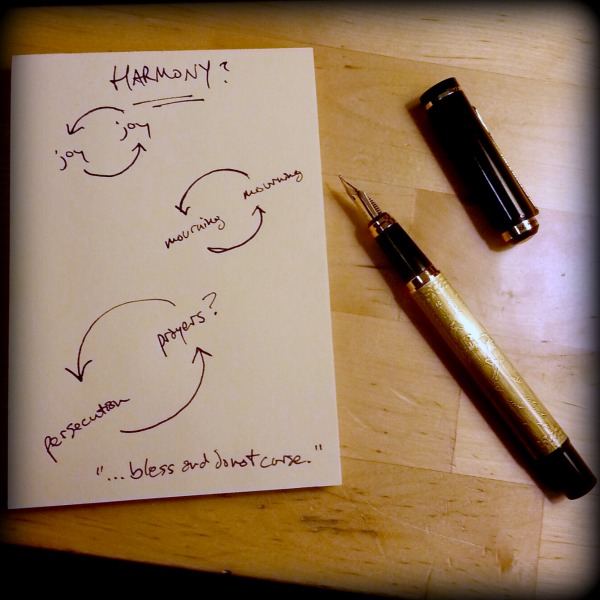 November 4: What is my way? Do I follow a way of cursing or a way of blessing?
Romans 12:14-16, “Bless those who persecute you; bless and do not curse. Rejoice with those who rejoice; mourn with those who mourn. Live in harmony with one another.”
St. Paul seems to believe that there is a harmony that exists outside of conformity or agreement, revenge or vengeance. In the face of those who disagree with us, even violently, Paul’s calling us to harmony. If Jesus hadn’t already presented us with the blessing of the peacemaker and the idea of not having enemies, I might just not worry about Paul on this one. But as it is, he’s following the lead of Jesus.
Harmony. What is a harmonizing life and behavior? In Paul’s view it seems to include an intense awareness of the other person and a response to them that meets their best interest and needs. So if the other is happy, be happy with them. If the other is hurting, hurt with them. If the other is attacking you, look into their situation and see their hurt, their pain and their need, and lift that in prayer. I’ve heard several wiser people than I mention the principle that “Those who cause pain do so out of their own pain.” Seeing the offender’s hurt is a needful step in responding in a way that might lead to their healing, and my truest healing as well.
Empathy seems to be a fundamental need of civility. We must learn to see the other and truly recognize where they are coming from and where they are going, otherwise we are just going to keep speaking out of step and missing each other. If we can’t emphasize with the other we’ll surely demonize them. Not only do we run the risk of falling into a cycle of vengeance, but we also miss the chance to share the other’s joy and share the other’s pain. This doesn’t mean we let ourselves be used and abused again and again. It means that we side-step the ego’s demand to retaliate and punish, which opens the door for a better response. Perhaps when we take a step to break that cycle of causing pain and pray for the one least deserving of our prayers, we might open a door to the needed healing.
It seems that harmony is another step away from the idea of dominating, defeating or winning. It sounds more like participating, sharing and supporting. It also sounds costly, because it demands an investment from me: energy, empathy and forgiveness. Honestly, the one persecuting and mistreating may never change. Their behavior might continue to be destructive. Our prayers have a layered effect of helping us maintain our responsibility to be as civil as we can, of helping us lay down the burden and move on with our healing, and of making sure that our voices are not found among the sources of discord and disharmony in the world.
Since we can only do what we can do, harmony is always our effort. Choosing a “way of blessing” for our lives is a daily walk, not necessarily a destination. I might often get a little off course, but hopefully not too often. That simple phrase in St. Paul’s verse “bless and not curse” is maybe the place we most engage harmony. It reminds me of the medical mantra, “first do no harm.” What’s my reflex? Do I move to curse or to bless? Am I a person of cursing or of blessing. What is my way? I guess I’m still working it out, but hoping to tip the scale toward blessing.
AMDG, Todd
Nov. 3, 2013 Civility in Xian Scripture
 November 3: Civility means I have no enemies, or at least don’t treat people as if they’re my enemies.
Matthew 5:43-45, “You have heard that it was said, ‘Love your neighbor and hate your enemy.’ But I tell you, love your enemies and pray for those who persecute you, that you may be children of your Father in heaven.”
A lot of incivility comes from our habit of dividing ourselves one from another. Our ego demands it of us. Often our ego demands we read scripture in such a way that we see ourselves separate from others, and therefore better, more correct, more deserving, more “right.” We just seem to enjoy our “us” having a “them.” We want a bad guy to revile, and then we learn to enjoy the reviling.
Who doesn’t enjoy cursing an enemy? Who doesn’t hesitate to defame an enemy? Who doesn’t leap at an opportunity to discredit or even distort the words of those who distort, defame and accuse them? Answer: People trying to follow the teaching of Christ, it seems.
Jesus calls us to love the haters. Jesus calls us to pray for those who would hurt us. It seems like Jesus might not understand what an enemy is… or maybe Jesus simply doesn’t expect us to have enemies. Because that’s the ultimate extension of this teaching, that I do not view anyone as an enemy. Instead I treat all people with peace, dignity and respect… even love. Wow.
This is cycle-breaking stuff here, if we live it. This teaching breaks the cycle of incivility as those who defame and attack us are not faced with a reciprocating hatred and attack. In our systems of winning and dominating, this sounds like acquiescence and defeat. When we focus on conflict and retaliation this feels like losing. When we focus on peace, on love and integrating others into our prayers, it becomes liberty and victory.
There’s very little chance I will wake tomorrow in a world filled with people who all think like me and who all like me. But I can wake without enemies. I can face a world tomorrow that is filled with opportunities and relationships instead of arguments and verbal skirmishes at our points of dissimilarity.
Let’s meditate on walking today and waking tomorrow with fewer enemies, because we have brought them to our hearts in prayer and made a place for even the most vile acting and speaking of those who are not like us, and who do not like us. Can we at least begin to have fewer enemies if not none? Are we ready to pray some truly difficult prayers, for the blessing of our enemies?
AMDG, Todd
Nov. 2, 2013 Civility in Xian Scripture
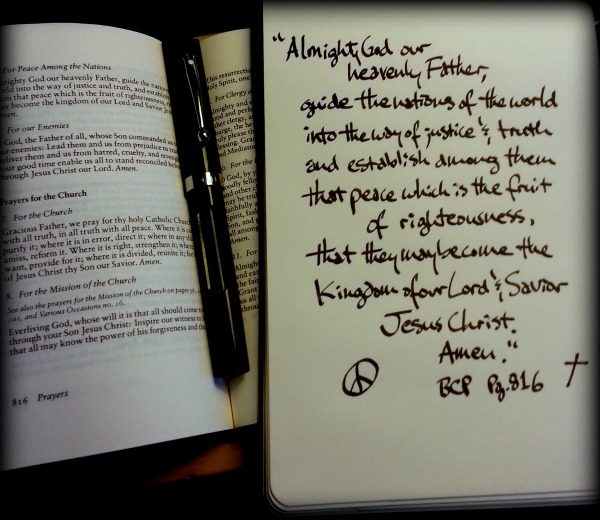 November 2: Civility flows from valuing peace. What do I bless?
 Nov. 1, 2013 Civility in Xian Scripture
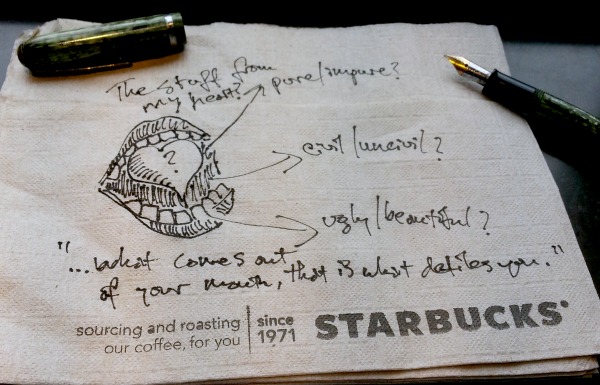 November 1: Civility begins in my heart, within me, and is my responsibility.
Matthew 15:10 & 11, “Jesus called the crowd to him and said, ‘Listen and understand. What goes into your mouth does not defile you, but what comes out of your mouth, that is what defiles you.'”
Quick definition: Civility “polite, reasonable, and respectful behavior”
Let’s begin by stating the obvious: Civility is a term that we don’t find in our scriptures, though it is a good old term. This month-long exercise is not about forcefully inserting civility into the scriptural narrative, and thereby “hijacking” scripture to teach something it doesn’t want or intend to teach. Instead we are going to dig into the teachings of scripture to illuminate the role and action of civility in our daily lives.
My belief is that civility (“polite, reasonable, and respectful behavior”) should flow very naturally from the mouth and life of someone acquainted with our scriptures. Christians, in their imitation of Christ and following the teachings of both the Old and New Testaments, should always be incredibly civil in daily discussions, when interacting with diverse neighbors and even when disagreeing. But we know that’s not always the case. Christians are often some of the most shrill and uncivil voices in our religious, political and social discussions and debates. (In October of 2009 I blogged about my embarrassment that Christians with bullhorns rudely disrupted many of our Muslim neighbors praying for our nation at the National Mall in DC.)
I’ve also heard and seen Christians act and speak with abrasive incivility and then rationalize and justify their words and actions upon religious arguments. They will judge, condemn and ridicule others, or one another, and then say something like, “I’m just following the Bible” or “It’s just what my faith demands of me.”
I believe that Christ and our scriptures show a better, immensely better, way. And so we begin with Jesus confronting those who devalued others (specifically their own parents) and rationalized it away with religious reasoning. In Matthew 15 some religious leaders questioned Jesus about his followers not being very correct in their observation of ritual purity, and he turns the question back on them in a deeper way, asking why they observe religion in a way that neglects the needs of their elderly parents. In the context of our verses in Matthew 15 Jesus is pointing out that people are more important than rules and regulations, even the best rules handed down by tradition and seeming so religious and right. The needs of the neglected parents matter more to God than legalistic excellence in the children. Jesus quotes Isaiah to say that their mouths and lips seem to be praising God and doing the right things, but it’s all wrong because their hearts are misplaced, moved far from God. I believe the teachings of our Christ and of our scriptures consistently show that religious practice and God’s heart are inextricably intertwined with the way we are called to treat others.
The passage is also a strong lesson that I am much more responsible and identified, not by what I might hear or see, but by what I might say and show. And this is where I must start with civility in my own life: within myself. My being civil is not dependent on someone else, but it’s a responsibility and an attribute of my own life, my own heart, my own words and actions. I hope that as we explore scripture in November we’ll be mutually encouraged and taught in deeper ways how the teachings of our Lord and our sacred texts lead us life-affirming, God-honoring and neighbor-serving civility.
Meditating with Saint Christopher
 I’ve been meditating on the story of Saint Christopher. It’s got my imagination fired up and my soul is energized by the images and icons of service that he represents. You can research the story here or here or here, as a few places to start. The story is readily available.
For some it will sound very odd to be meditating with or on a Saint. I didn’t grow up with the Saints, so I understand… it’s been a relatively new thing in my life, for about 6 years now, to read about and explore the lives of the Saints. My recent prayers, focusing on the short litany, “Let me love. Let me learn. Let me serve.” have brought me to the study of St. Christopher. Well, that and finding a sweet St. Christopher medallion at a flea market. =)
This Saint’s story is one of honest searching for a king worthy of serving. It’s a story about one’s strength and giftedness being used as a blessing to others. It’s a story that shows how we aren’t all the same in our coming to Christ or in our following of Christ. I like the story a lot. It’s a story of the divine in the mundane, and reminds me of a quote from Mother Teresa of Calcutta, “Be faithful in small things because it is in them that your strength lies.”
Don’t faint when you realize that we aren’t sure if he lived in the 3rd or 4th Century. Don’t give up on him because of the interesting divergence of details among the myriad traditions. The story of Christopher is not scripture, so we aren’t looking in it for that kind of divine revelation… but we can find in it divine vibrations… we can find in it a picture of humanity that points us to the divine.
Who can’t relate to the redemption of Christopher? Who can’t relate at some time in life to physically standing out, by our stature or appearance. Who can’t relate to seeking someone worthy of our service and fidelity? Who among us doesn’t live next to “raging rivers of life” that force us to journey together? I like the story. It inspires me.
I want to be a Christopher. I want to serve with fidelity and strength. I want to be a useful neighbor in the world. I want my service in this life to be service to the One who gives life. Perhaps one day we’ll each get across this river and wipe our tired brow, and sigh real big, and look around and say, “Dude, I just barely made it through.” And our Christ is going to high-five us and say, “No way. We rocked!”
November 2013: Civility in Christian Scriptures
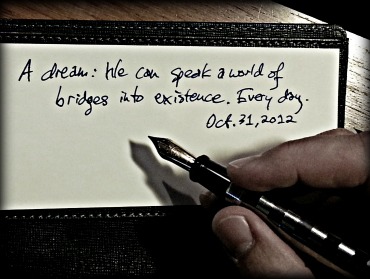 If you’ve been around me much, then you know that civility is an issue that interests me. I surely haven’t perfected the skill of civility, but I do try to use it and I appreciate so much when others do the same. Incivility makes me crazy. I’ve preached about civility and I’ve written about civility.
One of the funner things I’ve done was last year when I blogged and twittered statements about civility each day of October. All that is sitting in another blog of mine that’s been mostly inactive since, The Civil Pen. Those statements tended to be original ideas I wanted to convey, along with famous quotes and statements.
I really enjoyed that month of writing. I enjoyed it so much that I’m back for November of 2013. But this time I want to contribute something to the “theology of civility.” Each day of November, for each and every one of the 30 days, I’m going to blog, Twitter and Facebook a passage of Christian scripture, something from the Old or New Testament, that opens up the wonder and grace of civility. We’ll hear from Jesus, we’ll share ancient Proverbial wisdom, and we’ll dig in with other writers from the New Testament who are actively forming and being formed by the earliest Christian traditions.
I look forward to any and all participation from my circles of friends and family. I will try my best to be first and foremost faithful to God, then respectful of the scriptures and loving of my neighbor. I think it will be fun. I will also be preaching a series on Sunday mornings in November tied to some great scriptural themes on civility that we’ll see emerging from the scriptures, things like “control your anger” and “shut your mouth.” One of my favorite themes is that Jesus doesn’t send us out into the world to “win,” but instead to “make peace.”
Ultimately, I do this because I need it. I need to wrestle with these passages. I need civility planted deep in my heart and mind, and having taken root there, to grow into fruit in my life by which my God is both pleased and honored. If I end up boring you, then I apologize in advance. If this resonates and moves with you, if we make some connections that vibrate in your soul and cause us to dialogue and pray, then I will be satisfied. Either way, I commit the journey to God.
The stuff I’m writing and throwing out there will be available through my Twitter account (@Swirlyfoot) and my Facebook (also Swirlyfoot), and my own blog here (A Faithful Path) as well as our Church in Bethesda Blog. You’re invited to follow along as best suits your tastes.
AMDG, Todd
 toddthomas.net