
Devotional Thoughts
Nov. 17, 2013 Civility in Xian Scripture
 November 17: Value gentleness.
Philippians 4:5, “Let your gentleness be evident to all. The Lord is near.”
I have liked this verse for a while; it intrigues me. It was the verse on our church building marque sign for a long time. Gentleness. Is it a lost art? Is it even aspired to these days? Of all the things we’re tracking and trying to develop in our lives, is gentleness even on the list?
I was told as a young Christian that I should be many things, but gentleness isn’t one I can really remember being stressed. I was told to be courageous, convicted, radical, even obnoxious. I was taught that God liked it when I was “in your face” on fire for Jesus! I had to stand out, be set apart, be different, be totally crazy for God… gentleness for the babies. We liked triumphal verses like 4:13, tell me what I can do! I can accomplish anything! The kicker is that my gentleness is your gain! Maybe that’s Paul’s whole point?
I think that conviction exists in gentleness, maybe even more than in radical counter-culturalism. I bet that gentleness opens doors that brashness only closes. I bet that gentleness listens better than harshness, understands more than meanness, and gentleness creates more peace than antagonism. I just bet. I just bet I’ll meet more people tomorrow who need my gentleness than need my jerkiness.
AMDG, Todd
A Morning Prayer, adapted from Psalm 51
 “Have mercy on me, God.
As is the way of your great and enduring love
look away from my mistakes and forgive me.
Wash me in the stream of your compassion.
When you purify me I become clean,
clean and without any need to fear,
without any need to feel guilt ridden.
This day, take my heart and renew it,
and make my spirit strong and steadfast.
Always let me be the residing place
of your Holy Spirit.
And I will turn the joy of your presence
into service to my neighbors.”
An adaptation from Psalm 51, first as a communal prayer for our church family, and then for a single voice. The communal voice is found below…
“Have mercy on us, God.
As is the way of your great and enduring love
look away from our mistakes and forgive us.
Wash us in the stream of your compassion.
When you purify us we become clean,
clean and without any need to fear,
without any need to feel guilt ridden.
This day, take our hearts and renew them,
and make our spirits strong and steadfast.
Always let us be the residing place
of your Holy Spirit.
And we will turn the joy of your presence
into service to our neighbors.”
AMDG, Todd
Nov. 16, 2013 Civility in Xian Scripture
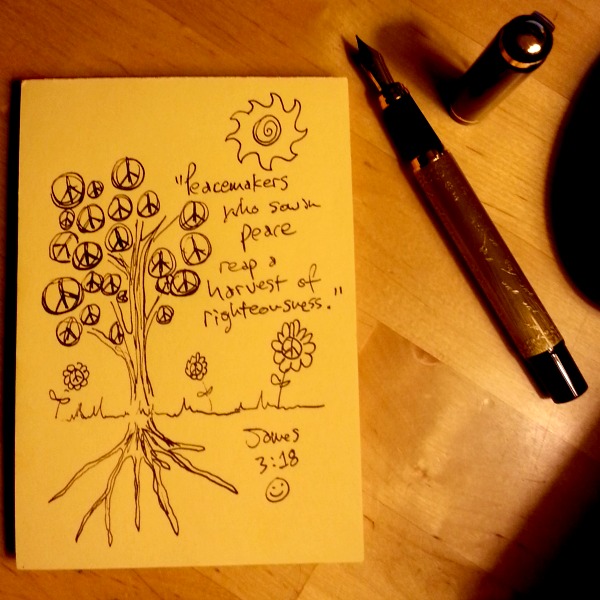 November 16: I really want to be a peacemaker.
James 3:18, “Peacemakers who sow in peace reap a harvest of righteousness.”
I really want to be a peacemaker. But if I learned anything from my tiny bit of farming experience growing up, it’s that “sowing” can be hard work. James makes it sound so easy, so poetic. I find the actuality of peacemaking a bit more taxing. Harvest, even a harvest of righteousness, is hard work.
I really want to be a peacemaker. But I have to get on board with the long-haul view of this thing. Quoting the verse, memorizing the verse, and really liking the verse, just doesn’t get it done. Peacemaking is as much identity as it is action, like a farmer… farming is who a person is as much as what a person does. Sowing and reaping is an expression of the way of life chosen by a person, not just a days activities. I must be the sower and also the soil.
Did you notice the verse says “sow in peace” and not “sow peace.” Peace is not what we are necessarily sowing in life… peace is the way we sow all the things of the day. This is about our greetings, our lunch meetings, our arguments, our partings, our friendly waves, our stress-laden mornings and collapsing in bed at night. This is helping a friend with a question, a child with homework, and a parent carrying groceries. The peacemaker is not a “one-trick-pony” who just walks all day around bemoaning, “Can’t we all just get along?” The peacemaker looks like everyone else, but moves through life leaving a trail of righteousness, like the tail of comet sparkling in the night sky.
I really want to be a peacemaker.
AMDG, Todd
Nov. 15, 2013 Civility in Xian Scripture
 November 15: I must own the response.
Proverbs 15:1, “A gentle answer turns away wrath, but a harsh word stirs up anger.”
One of the hardest principles of communication that we learned in college was that a communicator must own the response by the listener to the message. We studied cross-cultural communications and more general communications, learning to listen and understand an audience, to fashion our messages to meet the needs of a given context, and to receive back the response to the message. Receiving that response back and owning that response is crucial to dialogue.
When a communicator doesn’t own the response she says, “He just didn’t listen.” Or he says, “She’s not smart enough to understand what I’m saying.” This is a dead-end for communication. To be more personal, I’m guilty of having angrily snapped, “You’re just not listening!” We’ve all probably thrown up our hands at one time or another and exclaimed, “You’re just twisting what I said!”
It’s undeniable that there will be times my words are twisted. It’s going to happen that someone doesn’t listen. The principle we’re talking about doesn’t make me accountable for someone intentionally twisting my words, but it does remind me that I have to look at the response I receive when I communicate. The proverb above supports this principle by affirming that the message and it’s delivery can shape the response, for better or worse.
There are some assumptions about me at work in the Proverb of which I should take note: 1) I should be valuing the creation of peace between us, 2) I exercise a personal choice of how I will answer others, and 3) I know how to be gentle. If I have not valued peace, but instead focussed on defeating or dominating, then I’ve already made my choice and probably won’t even have the ability to respond in gentleness.
What do I want? Do I want to create peace, within the person with whom I speak and between us as human beings? Do I view someone as disposable and therefore not worth the effort to chose my words in a way that creates less friction between us? Have I exercised and practiced at being gentle? Have I bought into other ideas and principles that value my harshness over my gentleness? The answer is probably in the eyes of the person I last spoke with, if I’m willing to pay attention.
AMDG, Todd
Nov. 14, 2013 Civility in Xian Scripture
 November 14: We really do change things with our civility! Really, really!
Luke 6:27 & 28, “But to you who are listening I say: Love your enemies, do good to those who hate you, bless those who curse you, pray for those who mistreat you.”
What can our civility do? What can you do with a penny? My wife and I were at our middle son’s high school this week and an Assistant Principal stopped to chat with us, and he told us a little story about our son from a week or so before. If you know our family then you’re acquainted with our second son, an amazing young man named Josiah who happens to have a diagnosis of Autism. We are so proud of him, as we are proud of all three of our sons. This story is just a little confirmation of our pride and an affirmation of the teachings of Christ. Civility really does change things for the better.
The Assistant Principal was telling us of an incident of another student who decided that day to harass Josiah. Unfortunately, students struggling with Autism and other challenges are often targeted for bullying. They both ended up in the school office and the Principal instructed the offending student to apologize to our son. He did, and the Principal said Josiah crossed his heart and accepted the apology… then said, “What a sec!” Josiah reached in his pocket and pulled out a penny and, handing it to the other student who had harassed him, he said, “Here, just a little something for good luck!”
The principal dismissed Josiah back to class and said the other student broke into tears and had to sit down. He asked the student why he was crying and the boy said, “I was so rude to him, and then he did that for me!” Of course, I want to sit and cry, too. I want to cry for all the bullying happening in schools across our nation today, to cry for the love and pride I have for my son, and to cry for the times I have repaid evil with evil instead of showing the strength and beauty my son showed that day.
Oh, and I’m going to stop scolding Josiah for picking up every coin he sees on the ground. I had no idea the significance he placed on a penny, or the kind of gesture he might make with one. Many of us would have a hard time saying we have an “enemy” to whom we might apply to words of Jesus, but the reality is that our kids often do.
What Jesus set in motion among us to change the cycle of incivility needs to come to fruition in our lives. It’s just too easy to want to punish the bully. It’s too easy to hate the offender. It’s too easy to let our base emotions rule the day. But when we wander into this new kingdom, when we cross the boundary into a new place of grace and forgiveness, we change the world, even if only one soul on one day. I want to be worthy of that Christ, worthy of such a kingdom, worthy of my son.
AMDG, Todd
Nov. 13, 2013 Civility in Xian Scripture
 November 13: My civility is a prayer.
Psalm 19:12-14, “But who can discern their own errors? Forgive my hidden faults. Keep your servant also from willful sins; may they not rule over me. Then I will be blameless, innocent of great transgression. May these words of my mouth and this meditation of my heart be pleasing in your sight, LORD, my Rock and my Redeemer.”
I love those words, and it’s tough not to sing them in the melody in which I learned them long ago: “O let the words of my mouth and the meditations of my heart, be acceptable in thy sight, O God.” I truly first heard the melody and placed this verse in my heart many years ago when first hearing Keith Lancaster singing the words, as he and his companions have sung so many verses of scripture into the fabric of my heart and soul. Just as a bonus, here are some the Acappella guys singing many beautiful passages woven together, including this prayer from Psalm 19: More Precious Than Gold.
About a year ago I began adding these words to our opening prayers at Church in Bethesda. It was a spontaneous move one morning, and it stuck. It really gets at the root of what we often hope and pray: we want to please our God. We want our words and actions to make God happy and to honor all that God has said and done. These words are usually slipped in right after inviting God to be our “honored guest” in worship and right before we all together pray the words of the prayer Jesus left to us in Matthew 6.
I realize that the words in Psalm 19 are probably most reflective of the preceding prayers that David has articulated: forgive my hidden sins and bend my will to your own. It’s safe to say that such a desire is going to be pleasing to God. To take the prayer “May these words of my mouth and this meditation of my heart be pleasing in your sight…” out of Psalm 19 and apply them to my daily life is not to steal them from their truest meaning, but to give them a broader reach of hope. To bring them into my prayers for civility is not to misappropriate them, but it is to lift my daily words and actions into a new realm, into a new kingdom.
Have I brought my civility to God’s throne? Have I lifted my hopes and prayers to the level that David lifted his, to become an offering to God? If I see you on the street today, or if you drop by my office, or if we discuss politics or faith or fine dining, will I honor God with my meditations and words? Have I prayed it to the point that it’s woven into the liner of my heart and the tapestry of my soul? I won’t be up to the task every moment of every day, and I can easily imagine the times I will fail and fail memorably… but that is not a good enough reason not to journey on.
O God, forgive my hidden and secret sins, the ones I treasure too much and keep safely tucked away. I would be your servant, and that means I want to follow your lead in all my life, all my words and all my actions. I want to be more blameless, more worthy and more aware, of what you are doing in this world… and what you would do in me. May it be so.
AMDG, Todd
Nov. 12, 2013 Civility in Xian Scripture
 November 12: Speaking the truth in love needs to be understood and practiced. It can be a hallmark of a civility that holds and shares it’s own convictions while upholding the dignity of another person.
Ephesians 4:14 & 15, “Then we will no longer be infants, tossed back and forth by the waves, and blown here and there by every wind of teaching and by the cunning and craftiness of people in their deceitful scheming. Instead, speaking the truth in love, we will in all things grow up into him who is the head, that is, Christ.”
I have heard the phrase “speaking the truth in love” all my life around churches and Christians. Almost without exception, it’s been used to justify a concept of “tough love” that we have brought from our culture into our faith. It’s been my experience that we have used the phrase to justify harshness and judgmental attitudes, all in the name of how much we love someone. It’s not been a comforting phrase for me or many others.
That’s a real shame. In the context of the passage, it’s love that is setting us in contrast to deceit and “craftiness.” It’s also set in a contrast between being infantile and being grown up, mature. The love part of our speaking the truth is not a justification for harshness or incivility in speaking the truth, it’s the part of us that is caring for and protecting the one to whom we speak. I don’t think we need to order the two, placing truth over love, or love over truth… let them go hand in hand, side by side. Neither is more important, but they both are incredibly needed and sacred.
Just to put it out there, I’m not necessarily saying that there’s never a time for what we might call “tough love.” I am saying that we need to stop abusing this verse. This verse is a call to love and to truth, both. Maybe we need a reminder of what love is and what love looks like among us, with a piece of 1 Corinthians 13…
4 Love is patient, love is kind, it isn’t jealous, it doesn’t brag, it isn’t arrogant, 5 it isn’t rude, it doesn’t seek its own advantage, it isn’t irritable, it doesn’t keep a record of complaints, 6 it isn’t happy with injustice, but it is happy with the truth. 7 Love puts up with all things, trusts in all things, hopes for all things, endures all things. 8 Love never fails.
I know we like that passage for weddings, and it does fit very nicely in a wedding service. But the passage is a daily life passage, a me and you passage, a community passage. That is a picture of the love that is speaking truth in the Ephesians passage… it’s kind, patient, without jealousy, humble, encouraging (instead of bragging), in no way is it rude, selfish or self-centered. It’s hopeful, trusting, enduring and unfailing.
Can we be truthful and civil? Absolutely we can. If fact we can and should be both truthful and loving. Forget the craftiness and deceit of trying to be anything else, especially untruthful or unloving. Holding the two, truth and love, in tandem might be difficult, but it’s more than a worthy pursuit, it’s a necessity. I’m asking you to help me with it. Let’s grow up into Christ together.
AMDG, Todd
Nov. 11, 2013 Civility in Xian Scripture
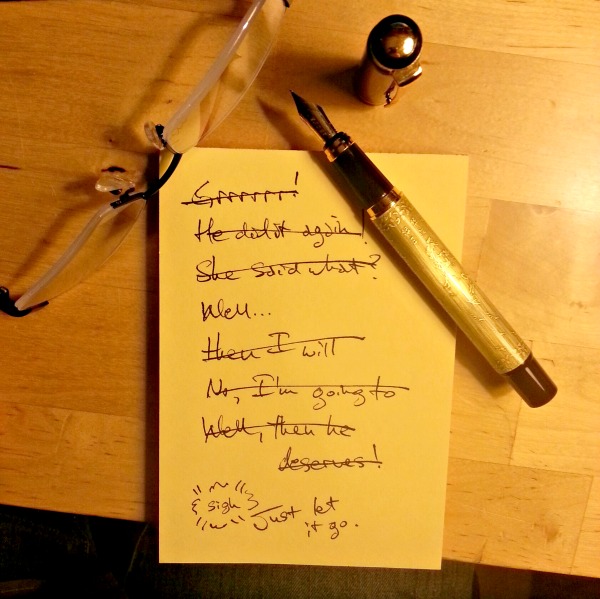 November 11: Just let it go.
Proverbs 12:16, “Fools show their annoyance at once, but the prudent overlook an insult.”
Truth is, not everything needs to be answered. Not every slight or offense needs to be acknowledged. Giving that satisfaction to every insult only validates the insult and often hands the reins of power to the other person. Incivility grows as the cycle of insult and response grows and continues.
Not every insult is even intentional. Take a deep breath. Buy yourself some time to chill out and reflect. And even if you figure that the insult, the other person’s incivility, was intentional… you can still just let it go. You know that thing Jesus said about “turning the other cheek” (Matthew 5:38-42) is maybe one of the most quoted and most misunderstood verses. Jesus didn’t say that we always let the accuser or the attacker have their way with us. Jesus said, “You have two cheeks, so use them both.” Go check it out… it’s in the context of Jesus pointing out how an “eye for an eye” and “tooth for a tooth” aren’t the only options we have for facing evil.
The eye and tooth thing was a restraining rule, it was meant to keep the aggrieved from unnecessarily escalating an offense. In other words, don’t take a whole head for an eye, or an arm for a tooth. But we’re so bad about managing our anger, we just keeping taking teeth and eyes until there’s nothing left for anyone. Slow things down… delay the fight… turn and present the other cheek.
We don’t need to be a people who leap to a fight. We don’t need to be a people who feed the trolls or the beast of incivility. We can leave that one to the foolish. It’s a hard teaching, found in both the proverb above and the words of Jesus. Being a victim of incivility does not license me to respond in kind.
AMDG, Todd
Nov. 10, 2013 Civility in Xian Scripture
 November 10: Civility can bring us the greatest win of all.
Proverbs 11:16, “A gracious woman gains honor; violent men gain only wealth.”
I absolutely love this comparison: the gracious woman and the violent man. Is there a stream in the ancient wisdom that recognized what we often make mention of today, that men too quickly turn to violence, either verbal or physical? It was just a few weeks ago that we saw many news stories about the women of the Congress stepping in and helping bring about an end to our Federal shutdown and impasse.
A grace filled person can achieve a much greater “win” than the violent person who takes out of turn, out of season and out of anger. This is one of those truths of what Jesus taught about forgiveness, loving enemies and keeping the heart pure. This truth wars against the apparent domination of the violent, that the violent can seem to seize riches and success at a dizzyingly rapid rate. There’s a better win out there to have.
I feel like making a new saint, a patroness of the gracious. She is Our Woman of Grace. She’s not a saint to pray to, or event to pray with… but a saint to become. She is the leaving of my violence. She is the hope of a better thing to come than my anger and greed can produce. She is me, when I’m at my best, and you at yours.
AMDG, Todd
Nov. 9, 2013 Civility in Xian Scripture
 November 9: Maybe it does matter what I watch?
Proverbs 4:23 & 24, “Above all else, guard your heart, for everything you do flows from it. Keep your mouth free of perversity; keep corrupt talk far from your lips.”
I can’t say this is totally true for everyone, but I have seen it in my own life… if I want to cut down on the less civil words and responses in my life, I need to watch what I watch. I’m a Netflix addict, a movie fiend, and sometimes I’m not the wisest of watchers.
Jesus will echo this Proverb’s sentiment in his own ministry when speaking of purity in Luke 6:43-45, “Out of the overflow of the heart the mouth speaks.” When I was a kid I heard it expressed as the axiom, “Garbage in, garbage out.” I was warned that if I filled up on the wrong stuff, the wrong stuff would come back up on me. Harsh words. Inappropriate words. Quick anger. Misplaced priorities. It’s all there and way too easy to pack too much in.
I need to choose the best source material. I need the best in to have the best out. I need to plan ahead for my civility by guarding the source.
AMDG, Todd
 toddthomas.net