
Month: November 2013
Nov. 20, 2013 Civility in Xian Scripture
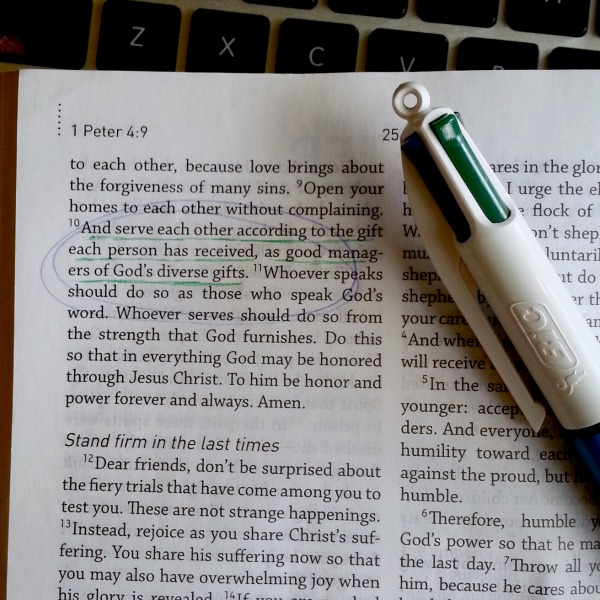 November 20: Civility is faithful service to God!
1 Peter 4:8-11, “Above all, love each other deeply, because love covers over a multitude of sins. Offer hospitality to one another without grumbling. Each of you should use whatever gift you have received to serve others, as faithful stewards of God’s grace in its various forms. If you speak, you should do so as one who speaks the very words of God. If you serve, you should do so with the strength God provides, so that in all things God may be praised through Jesus Christ. To him be the glory and the power for ever and ever. Amen.”
I am a steward. You are a steward. What a great word! It means that you and I are the operating agents of God who manage and dispense the “properties” and “affairs” of God in the world. Peter is helpful enough to name exactly what we are stewards of: God’s grace.
In speaking and serving others, using whatever gifts and abilities with which we have been blessed, we dispense God’s grace and cover sins with love. Amazing. The word really encompasses a lot about us. In the Greek an oikonomoi was a household servant, the servant who apportioned things, managing affairs and resources of the household on behalf of the master of the house. In this case, in 1 Peter 4, we are the faithful servants apportioning God’s grace in love to cover sins and to serve joyfully the people around us. The passage above is quoted from Today’s New International Version, and in the Common English Bible oikonomoi is translated to be “manager.” We are managing God’s grace and gifting in our lives to the benefit of the people around us.
Here’s the catch… we aren’t just apportioning grace to the deserving, but also to those who have sinned or in some way become less deserving. This where we find the biblical truth of the day to teach us something of our civility. We aren’t meant to be walking talking dispensers of God’s wrath for people, punishing sins, withholding grace and replying to incivility with incivility. We are meant to be the people who dispense grace when needed to cover sins, love and service to the least deserving, faithful to the God who employs us in the household of the earth.
The point of all this is to give glory to God in Jesus Christ. Our faithful stewardship, our service to others, our love and absence of “grumbling,” all of it accrues to the glory of God, showing God’s greatness in this world. Incivility probably breaks in through me most when I begin worrying about my own glory or begin to hold back the grace I am sent to share.
Saving God, let grace flow through me
unimpeded to the people most needing
whether or not they can seeit is your love and grace that drives
any gifts they might receive
filling and quickening our livesI’m your steward but I pray
for love to cover my own sins
to be kept in your kingdom this day
AMDG, Todd
Nov. 19, 2013 Civility in Xian Scripture
 November 19: Lose it or use it.
Ephesians 4:31 & 32, “Get rid of all bitterness, rage and anger, brawling and slander, along with every form of malice. Be kind and compassionate to one another, forgiving each other, just as in Christ God forgave you.”
I know, it’s almost too much to take a cheesy saying like “use it or lose it” and try to make a point by reversing it, but I’m game. A huge part of tackling the work of yesterday’s verse and making sure that wholesome, helpful and constructive things flow from our choice of words will be removing the negativity which wants to tear down, destroy and punish.
Bitterness, rage and anger. These must be avoided. Brawling, slander and malice. These must be un-chosen. This means that when we find ourselves enjoying the anger, relishing the malice or laboring under the heaviest of grudges, we must make a change.
When anger happens, we recognize it, name it and release it. When an injury threatens to become a grudge, we seek healing, seek help and seek peace. If we hold tight to these things or leave them the liberty to run unnamed and unchecked in our lives, we will find them returning in our words and actions. Just as civility is born from what we value and carry inside of us, so it goes with incivility.
We have a double movement, one of choosing and one of un-choosing. Civility is a “selective” way that we live our lives, holding to what is most good and releasing what is most negative. In this keeping and releasing we set ourselves up for civility or for incivility. We stack our own deck for the positive or for the negative results when we speak and act. I really do have to lose the anger and rage, or I’ll use them. Lose it or use it.
We don’t use the word a lot, but “renounce” is a good one for this idea. To renounce is to “formally declare one’s abandonment of” something. It’s a legal word, and it’s the idea behind today’ verses. Can I renounce the bitterness, rage and anger? Can I renounce the brawling, slander and malice?
Can I stand today and prayerfully, sincerely and honestly make a renunciation of these things that take root in my life and bear such bitter fruit?
I do renounce bitterness.
I do renounce rage.
I do renounce anger.
I do remounce brawling.
I do renounce slander.
I do renounce malice.
Just saying the words does not get the job done, but it sets me on the path. And some things simply need to be said out loud, ya know? If I choose this path, then I must prayerfully walk it and find the help I need to remain on it.
AMDG, Todd
Nov. 18, 2013 Civility in Xian Scripture
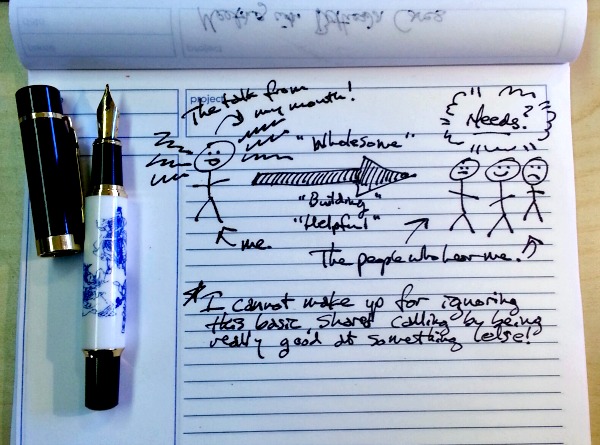 November 18: Building people up is a shared calling.
Ephesians 4:29, “Do not let any unwholesome talk come out of your mouths, but only what is helpful for building others up according to their needs, that it may benefit those who listen.”
I always get a little uneasy when I see lists that people have made of spiritual gifts and they include things like love, grace and mercy. Are those really specialized gifts and abilities for just a few people? Growing up in church it was exciting to hear for the first time about spiritual gifts and the idea that the Holy Spirit inhabits each of us in unique and empowering ways. I still believe that, but I’m not so enamored of being enamored anymore.
A downside to the spiritual gifts frenzy is a downplaying of the shared calling we each have in our lives as followers of Christ. Ephesians 4 is an example of Paul laying out in very specific terms one of our shared callings… we are called to encourage and “build up” others by our words. It’s not the job for a specialist or a select few.
That’s why it worries me when grace, mercy and even humility pop up on the gifts list, as if some will have them and others not. Being called to build others up by speaking to their needs is a shared responsibility in which we all participate. The idea that I might not have to worry about this because I’m talented or gifted in another area of life runs counter to scriptural witness.
Jesus didn’t say some of his disciples would be identifiable by their love (John 13:34-35) while others would be known by their shirts, stickers, bracelets or other “Christian” merchandise, or even their awesome doctrines, sermons or uncanny abilities. He said said that his disciples would be recognized by their love for one another. We need to not let our enthusiasm for our various individual gifts outpace our fundamental shared calling to be people builders.
Why keep such a firm hold on the basics? Because we tend as people to let specialization, authority and power isolate us from others. The accessible nature of Jesus confuses us and doesn’t always make sense. The passage in John 13 is a classic moment of Jesus presenting this to his disciples… in verses 13-17 he makes a point of connecting his lordship and authority with service. He says that “Yes, I am your teacher and Lord, I’m your authority in very way, and so I demand that you build others up as I’m building you up in love and service “ (Yeah, that’s my paraphrase.)
Who doesn’t love the recent stories of Pope Francis and his humble way of touching people and ministering among those who are social outcasts for various reasons? He excites us because he’s breaking the trend of letting power and authority isolate him from others. Just like the heart warming stories of the Pope touching his neighbors, you and I can warm hearts and have the same effect in our circles of influence. It’s something we all share in common, this calling to see the needs in the people around us and then speak and work to meet those needs.
We’re people builders, you and I. Popes, preachers and pew warmers, we’re all in the family business with a shared call to build people up. This basic, shared calling will by necessity preclude much of the incivility that might separate us and tear others down. It runs counter to the divisive, judgmental language we might choose when we’ve chosen a different marker for our discipleship, like personal piety, doctrinal correctness or hermeneutical purity. This is where our Savior leads… as always the question is whether I will follow.
AMDG, Todd
Nov. 17, 2013 Civility in Xian Scripture
 November 17: Value gentleness.
Philippians 4:5, “Let your gentleness be evident to all. The Lord is near.”
I have liked this verse for a while; it intrigues me. It was the verse on our church building marque sign for a long time. Gentleness. Is it a lost art? Is it even aspired to these days? Of all the things we’re tracking and trying to develop in our lives, is gentleness even on the list?
I was told as a young Christian that I should be many things, but gentleness isn’t one I can really remember being stressed. I was told to be courageous, convicted, radical, even obnoxious. I was taught that God liked it when I was “in your face” on fire for Jesus! I had to stand out, be set apart, be different, be totally crazy for God… gentleness for the babies. We liked triumphal verses like 4:13, tell me what I can do! I can accomplish anything! The kicker is that my gentleness is your gain! Maybe that’s Paul’s whole point?
I think that conviction exists in gentleness, maybe even more than in radical counter-culturalism. I bet that gentleness opens doors that brashness only closes. I bet that gentleness listens better than harshness, understands more than meanness, and gentleness creates more peace than antagonism. I just bet. I just bet I’ll meet more people tomorrow who need my gentleness than need my jerkiness.
AMDG, Todd
A Morning Prayer, adapted from Psalm 51
 “Have mercy on me, God.
As is the way of your great and enduring love
look away from my mistakes and forgive me.
Wash me in the stream of your compassion.
When you purify me I become clean,
clean and without any need to fear,
without any need to feel guilt ridden.
This day, take my heart and renew it,
and make my spirit strong and steadfast.
Always let me be the residing place
of your Holy Spirit.
And I will turn the joy of your presence
into service to my neighbors.”
An adaptation from Psalm 51, first as a communal prayer for our church family, and then for a single voice. The communal voice is found below…
“Have mercy on us, God.
As is the way of your great and enduring love
look away from our mistakes and forgive us.
Wash us in the stream of your compassion.
When you purify us we become clean,
clean and without any need to fear,
without any need to feel guilt ridden.
This day, take our hearts and renew them,
and make our spirits strong and steadfast.
Always let us be the residing place
of your Holy Spirit.
And we will turn the joy of your presence
into service to our neighbors.”
AMDG, Todd
Nov. 16, 2013 Civility in Xian Scripture
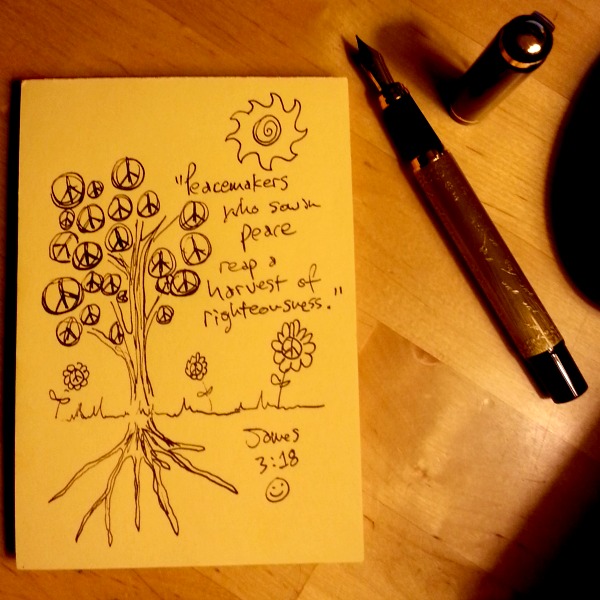 November 16: I really want to be a peacemaker.
James 3:18, “Peacemakers who sow in peace reap a harvest of righteousness.”
I really want to be a peacemaker. But if I learned anything from my tiny bit of farming experience growing up, it’s that “sowing” can be hard work. James makes it sound so easy, so poetic. I find the actuality of peacemaking a bit more taxing. Harvest, even a harvest of righteousness, is hard work.
I really want to be a peacemaker. But I have to get on board with the long-haul view of this thing. Quoting the verse, memorizing the verse, and really liking the verse, just doesn’t get it done. Peacemaking is as much identity as it is action, like a farmer… farming is who a person is as much as what a person does. Sowing and reaping is an expression of the way of life chosen by a person, not just a days activities. I must be the sower and also the soil.
Did you notice the verse says “sow in peace” and not “sow peace.” Peace is not what we are necessarily sowing in life… peace is the way we sow all the things of the day. This is about our greetings, our lunch meetings, our arguments, our partings, our friendly waves, our stress-laden mornings and collapsing in bed at night. This is helping a friend with a question, a child with homework, and a parent carrying groceries. The peacemaker is not a “one-trick-pony” who just walks all day around bemoaning, “Can’t we all just get along?” The peacemaker looks like everyone else, but moves through life leaving a trail of righteousness, like the tail of comet sparkling in the night sky.
I really want to be a peacemaker.
AMDG, Todd
Nov. 15, 2013 Civility in Xian Scripture
 November 15: I must own the response.
Proverbs 15:1, “A gentle answer turns away wrath, but a harsh word stirs up anger.”
One of the hardest principles of communication that we learned in college was that a communicator must own the response by the listener to the message. We studied cross-cultural communications and more general communications, learning to listen and understand an audience, to fashion our messages to meet the needs of a given context, and to receive back the response to the message. Receiving that response back and owning that response is crucial to dialogue.
When a communicator doesn’t own the response she says, “He just didn’t listen.” Or he says, “She’s not smart enough to understand what I’m saying.” This is a dead-end for communication. To be more personal, I’m guilty of having angrily snapped, “You’re just not listening!” We’ve all probably thrown up our hands at one time or another and exclaimed, “You’re just twisting what I said!”
It’s undeniable that there will be times my words are twisted. It’s going to happen that someone doesn’t listen. The principle we’re talking about doesn’t make me accountable for someone intentionally twisting my words, but it does remind me that I have to look at the response I receive when I communicate. The proverb above supports this principle by affirming that the message and it’s delivery can shape the response, for better or worse.
There are some assumptions about me at work in the Proverb of which I should take note: 1) I should be valuing the creation of peace between us, 2) I exercise a personal choice of how I will answer others, and 3) I know how to be gentle. If I have not valued peace, but instead focussed on defeating or dominating, then I’ve already made my choice and probably won’t even have the ability to respond in gentleness.
What do I want? Do I want to create peace, within the person with whom I speak and between us as human beings? Do I view someone as disposable and therefore not worth the effort to chose my words in a way that creates less friction between us? Have I exercised and practiced at being gentle? Have I bought into other ideas and principles that value my harshness over my gentleness? The answer is probably in the eyes of the person I last spoke with, if I’m willing to pay attention.
AMDG, Todd
Nov. 14, 2013 Civility in Xian Scripture
 November 14: We really do change things with our civility! Really, really!
Luke 6:27 & 28, “But to you who are listening I say: Love your enemies, do good to those who hate you, bless those who curse you, pray for those who mistreat you.”
What can our civility do? What can you do with a penny? My wife and I were at our middle son’s high school this week and an Assistant Principal stopped to chat with us, and he told us a little story about our son from a week or so before. If you know our family then you’re acquainted with our second son, an amazing young man named Josiah who happens to have a diagnosis of Autism. We are so proud of him, as we are proud of all three of our sons. This story is just a little confirmation of our pride and an affirmation of the teachings of Christ. Civility really does change things for the better.
The Assistant Principal was telling us of an incident of another student who decided that day to harass Josiah. Unfortunately, students struggling with Autism and other challenges are often targeted for bullying. They both ended up in the school office and the Principal instructed the offending student to apologize to our son. He did, and the Principal said Josiah crossed his heart and accepted the apology… then said, “What a sec!” Josiah reached in his pocket and pulled out a penny and, handing it to the other student who had harassed him, he said, “Here, just a little something for good luck!”
The principal dismissed Josiah back to class and said the other student broke into tears and had to sit down. He asked the student why he was crying and the boy said, “I was so rude to him, and then he did that for me!” Of course, I want to sit and cry, too. I want to cry for all the bullying happening in schools across our nation today, to cry for the love and pride I have for my son, and to cry for the times I have repaid evil with evil instead of showing the strength and beauty my son showed that day.
Oh, and I’m going to stop scolding Josiah for picking up every coin he sees on the ground. I had no idea the significance he placed on a penny, or the kind of gesture he might make with one. Many of us would have a hard time saying we have an “enemy” to whom we might apply to words of Jesus, but the reality is that our kids often do.
What Jesus set in motion among us to change the cycle of incivility needs to come to fruition in our lives. It’s just too easy to want to punish the bully. It’s too easy to hate the offender. It’s too easy to let our base emotions rule the day. But when we wander into this new kingdom, when we cross the boundary into a new place of grace and forgiveness, we change the world, even if only one soul on one day. I want to be worthy of that Christ, worthy of such a kingdom, worthy of my son.
AMDG, Todd
Nov. 13, 2013 Civility in Xian Scripture
 November 13: My civility is a prayer.
Psalm 19:12-14, “But who can discern their own errors? Forgive my hidden faults. Keep your servant also from willful sins; may they not rule over me. Then I will be blameless, innocent of great transgression. May these words of my mouth and this meditation of my heart be pleasing in your sight, LORD, my Rock and my Redeemer.”
I love those words, and it’s tough not to sing them in the melody in which I learned them long ago: “O let the words of my mouth and the meditations of my heart, be acceptable in thy sight, O God.” I truly first heard the melody and placed this verse in my heart many years ago when first hearing Keith Lancaster singing the words, as he and his companions have sung so many verses of scripture into the fabric of my heart and soul. Just as a bonus, here are some the Acappella guys singing many beautiful passages woven together, including this prayer from Psalm 19: More Precious Than Gold.
About a year ago I began adding these words to our opening prayers at Church in Bethesda. It was a spontaneous move one morning, and it stuck. It really gets at the root of what we often hope and pray: we want to please our God. We want our words and actions to make God happy and to honor all that God has said and done. These words are usually slipped in right after inviting God to be our “honored guest” in worship and right before we all together pray the words of the prayer Jesus left to us in Matthew 6.
I realize that the words in Psalm 19 are probably most reflective of the preceding prayers that David has articulated: forgive my hidden sins and bend my will to your own. It’s safe to say that such a desire is going to be pleasing to God. To take the prayer “May these words of my mouth and this meditation of my heart be pleasing in your sight…” out of Psalm 19 and apply them to my daily life is not to steal them from their truest meaning, but to give them a broader reach of hope. To bring them into my prayers for civility is not to misappropriate them, but it is to lift my daily words and actions into a new realm, into a new kingdom.
Have I brought my civility to God’s throne? Have I lifted my hopes and prayers to the level that David lifted his, to become an offering to God? If I see you on the street today, or if you drop by my office, or if we discuss politics or faith or fine dining, will I honor God with my meditations and words? Have I prayed it to the point that it’s woven into the liner of my heart and the tapestry of my soul? I won’t be up to the task every moment of every day, and I can easily imagine the times I will fail and fail memorably… but that is not a good enough reason not to journey on.
O God, forgive my hidden and secret sins, the ones I treasure too much and keep safely tucked away. I would be your servant, and that means I want to follow your lead in all my life, all my words and all my actions. I want to be more blameless, more worthy and more aware, of what you are doing in this world… and what you would do in me. May it be so.
AMDG, Todd
Nov. 12, 2013 Civility in Xian Scripture
 November 12: Speaking the truth in love needs to be understood and practiced. It can be a hallmark of a civility that holds and shares it’s own convictions while upholding the dignity of another person.
Ephesians 4:14 & 15, “Then we will no longer be infants, tossed back and forth by the waves, and blown here and there by every wind of teaching and by the cunning and craftiness of people in their deceitful scheming. Instead, speaking the truth in love, we will in all things grow up into him who is the head, that is, Christ.”
I have heard the phrase “speaking the truth in love” all my life around churches and Christians. Almost without exception, it’s been used to justify a concept of “tough love” that we have brought from our culture into our faith. It’s been my experience that we have used the phrase to justify harshness and judgmental attitudes, all in the name of how much we love someone. It’s not been a comforting phrase for me or many others.
That’s a real shame. In the context of the passage, it’s love that is setting us in contrast to deceit and “craftiness.” It’s also set in a contrast between being infantile and being grown up, mature. The love part of our speaking the truth is not a justification for harshness or incivility in speaking the truth, it’s the part of us that is caring for and protecting the one to whom we speak. I don’t think we need to order the two, placing truth over love, or love over truth… let them go hand in hand, side by side. Neither is more important, but they both are incredibly needed and sacred.
Just to put it out there, I’m not necessarily saying that there’s never a time for what we might call “tough love.” I am saying that we need to stop abusing this verse. This verse is a call to love and to truth, both. Maybe we need a reminder of what love is and what love looks like among us, with a piece of 1 Corinthians 13…
4 Love is patient, love is kind, it isn’t jealous, it doesn’t brag, it isn’t arrogant, 5 it isn’t rude, it doesn’t seek its own advantage, it isn’t irritable, it doesn’t keep a record of complaints, 6 it isn’t happy with injustice, but it is happy with the truth. 7 Love puts up with all things, trusts in all things, hopes for all things, endures all things. 8 Love never fails.
I know we like that passage for weddings, and it does fit very nicely in a wedding service. But the passage is a daily life passage, a me and you passage, a community passage. That is a picture of the love that is speaking truth in the Ephesians passage… it’s kind, patient, without jealousy, humble, encouraging (instead of bragging), in no way is it rude, selfish or self-centered. It’s hopeful, trusting, enduring and unfailing.
Can we be truthful and civil? Absolutely we can. If fact we can and should be both truthful and loving. Forget the craftiness and deceit of trying to be anything else, especially untruthful or unloving. Holding the two, truth and love, in tandem might be difficult, but it’s more than a worthy pursuit, it’s a necessity. I’m asking you to help me with it. Let’s grow up into Christ together.
AMDG, Todd
- ← Previous
- 1
- 2
- 3
- 4
- Next →
 toddthomas.net